
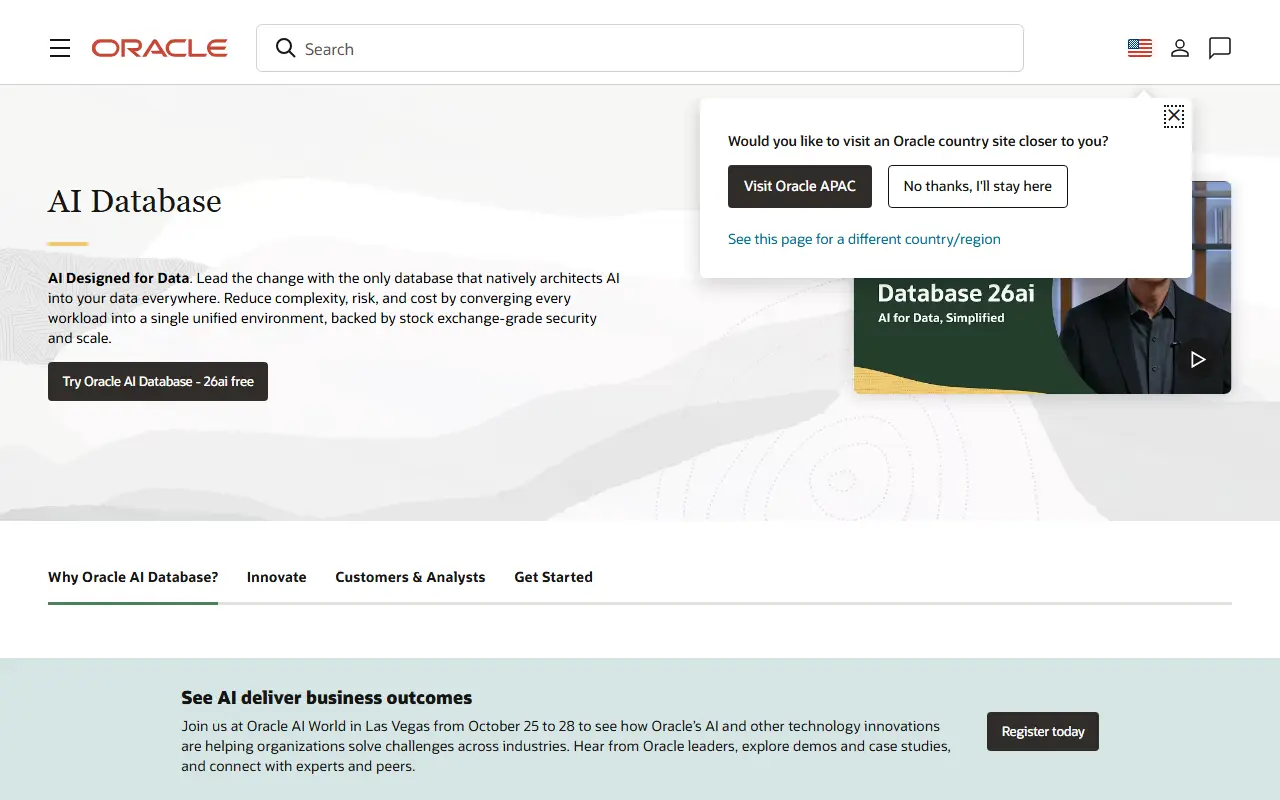
About Oracle Database
Oracle Database is a long-established relational database management system used by large organizations to run mission-critical applications. It supports SQL and Oracle's PL/SQL programming language, enforces ACID transactions, and is designed to hold both operational records and data used for reporting and analytics.
The product offers features aimed at enterprise operations, including partitioning, multitenant architecture, high-availability options such as clustering and standby databases, and extensive security controls. It can be installed on your own servers or consumed as a managed service through Oracle Cloud. It is a commercial product where licensing varies by edition and deployment, so it is mostly chosen by organizations that already depend on Oracle software or need its specific enterprise capabilities.
Key features
- Relational engine with SQL and PL/SQL
- ACID transactions for enterprise workloads
- Partitioning for very large tables
- High availability with clustering and standby options
- Multitenant architecture for consolidating databases
- On-premises or managed cloud deployment
Good fit for
- →Core systems at large enterprises
- →Consolidating many databases onto shared infrastructure
- →Mixed transactional and reporting workloads
- Tags
- relational-database
- sql
- enterprise
- plsql
- oracle
- high-availability
- rdbms
Oracle Database: questions and answers
- What is Oracle Database used for?
- Oracle Database is Oracle's commercial relational database for enterprise transactional and analytical workloads, available on premises and as a managed cloud service. It is a good fit for core systems at large enterprises, consolidating many databases onto shared infrastructure, and mixed transactional and reporting workloads.
- How much does Oracle Database cost?
- Oracle Database is a paid product with no free plan.
- Is Oracle Database open source?
- No. Oracle Database is proprietary (closed-source) software. Open-source alternatives to Oracle Database include PostgreSQL, MySQL and MariaDB.
- Can I self-host Oracle Database?
- Yes. Although Oracle Database is closed source, it can be self-hosted on your own servers, and the vendor also offers a hosted version.
- What are some alternatives to Oracle Database?
- Oracle Database competes with Microsoft SQL Server, Amazon Aurora and Amazon RDS. For open-source options, see Enlisted's ranked list of open-source Oracle Database alternatives.
Open-source alternatives to Oracle Database
See all
PostgreSQL
Databases
Mirror of the official PostgreSQL GIT repository. Note that this is just a *mirror* - we d
OSSvs Oracle Database★ 22k
MySQL
Databases
MySQL Server, the world's most popular open source database, and MySQL Cluster, a real-tim
OSSvs Oracle Database★ 12k
MariaDB
Databases
MariaDB server is a community developed fork of MySQL server. Started by core members of t
GPL-2.0vs Oracle Database★ 8.3k
OceanBase
Databases
OceanBase is the unified distributed database for the AI era — open-source, multi-model, o
Apache-2.0vs Oracle Database★ 10k
CockroachDB
Databases
CockroachDB — the cloud native, distributed SQL database designed for high availability, e
OSSvs Google Cloud Spanner★ 33k
rqlite
Databases
The lightweight, fault-tolerant database built on SQLite. Designed to keep your data highl
MITvs Cloudflare D1★ 18k
SaaS alternatives to Oracle Database
See all
Microsoft SQL Server
Databases
Microsoft relational database server with free Express and Developer editions
SaaS
Amazon Aurora
Databases
AWS cloud-built relational database compatible with MySQL and PostgreSQL
SaaS
Amazon RDS
Databases
Managed relational databases on AWS for MySQL, PostgreSQL, SQL Server and Oracle
SaaS
Google Cloud Spanner
Databases
Google horizontally scalable relational database with strong consistency
SaaS
SingleStore
Databases
Distributed SQL database for real-time analytics and transactional workloads
SaaS
Azure Cosmos DB
Databases
Microsoft globally distributed multi-model NoSQL database
SaaS