
 Oracle Database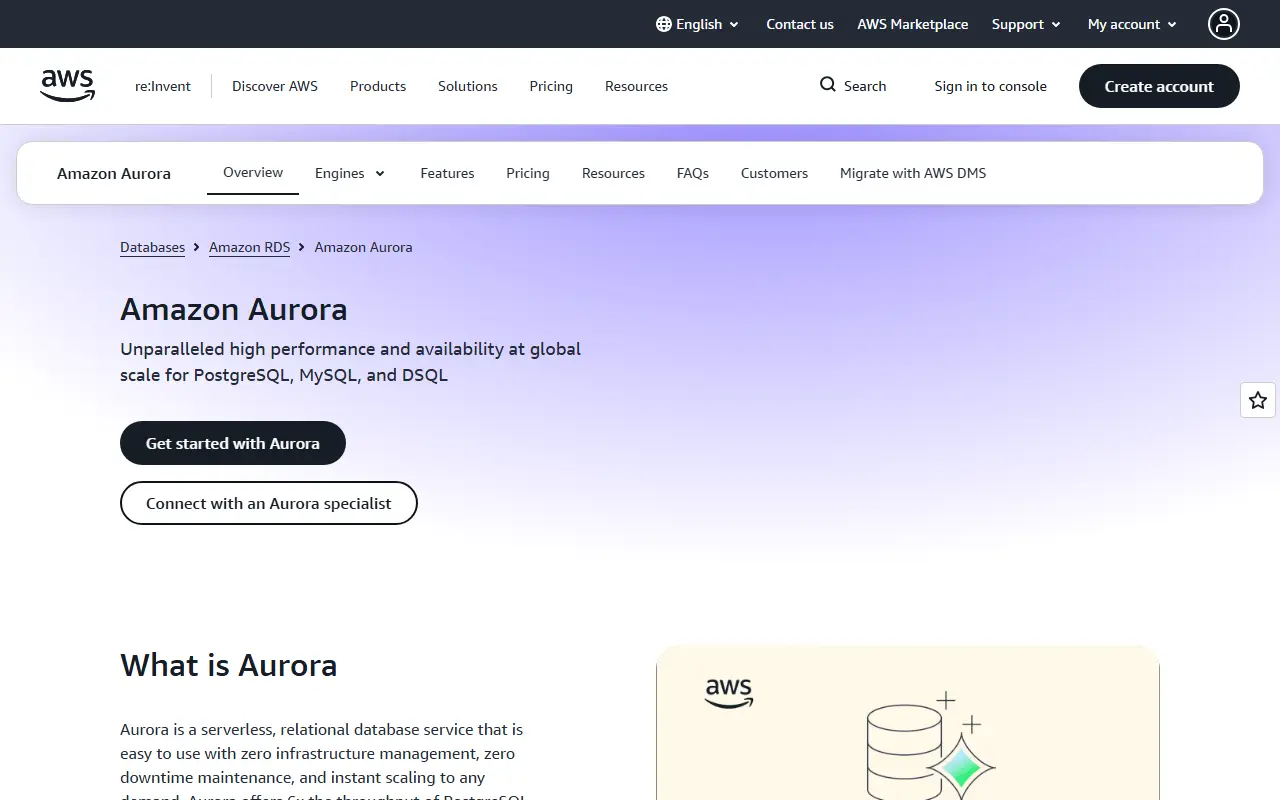
About Amazon Aurora
Amazon Aurora is a relational database engine from Amazon Web Services that is built for the cloud and is compatible with MySQL and PostgreSQL. Existing applications written for those databases can usually use Aurora with little change, while AWS handles storage, replication, backups and failover.
AWS describes it as a global-scale relational database service with full MySQL and PostgreSQL compatibility, with serverless options available. Aurora is a proprietary AWS service with no self-hosted edition, and it is billed on usage; AWS documents its architecture, global database features and pricing on its site.
Key features
- MySQL and PostgreSQL compatibility
- Managed storage, replication and failover
- Serverless deployment option
- Global database support
- Automated backups and recovery
Good fit for
- →Running high-traffic SQL applications on AWS
- →Migrating MySQL or PostgreSQL to a managed engine
- Tags
- aws
- relational-database
- mysql
- postgresql
- managed-database
- serverless
- dbaas
Amazon Aurora: questions and answers
- What is Amazon Aurora used for?
- Amazon Aurora is an AWS relational database built for the cloud, compatible with MySQL and PostgreSQL and offered as a managed service. It is a good fit for running high-traffic SQL applications on AWS and migrating MySQL or PostgreSQL to a managed engine.
- How much does Amazon Aurora cost?
- Amazon Aurora is a paid product with no free plan. Usage-based. Examples show storage at $0.10 per GB-month with $0.20 per million I/Os on Standard, or $0.225 per GB-month with no I/O charge on I/O-Optimized; instance hours are billed separately.
- Is Amazon Aurora open source?
- No. Amazon Aurora is proprietary (closed-source) software and can't be self-hosted. Open-source alternatives to Amazon Aurora include MySQL, Neon and TiDB.
- What are some alternatives to Amazon Aurora?
- Amazon Aurora competes with Amazon RDS, PlanetScale and Google Cloud Spanner. For open-source options, see Enlisted's ranked list of open-source Amazon Aurora alternatives.
Open-source alternatives to Amazon Aurora
See all
MySQL
Databases
MySQL Server, the world's most popular open source database, and MySQL Cluster, a real-tim
OSSvs Oracle Database★ 12k
Neon
Databases
Neon: Serverless Postgres. We separated storage and compute to offer autoscaling, code-lik
Apache-2.0vs Amazon Aurora★ 23k
TiDB
Databases
TiDB is built for agentic workloads that grow unpredictably, with ACID guarantees and nati
Apache-2.0vs Amazon Aurora★ 41k
CockroachDB
Databases
CockroachDB — the cloud native, distributed SQL database designed for high availability, e
OSSvs Google Cloud Spanner★ 33k
YugabyteDB
Databases
YugabyteDB - the cloud native distributed SQL database for mission-critical applications.
OSSvs Google Cloud Spanner★ 11k
OceanBase
Databases
OceanBase is the unified distributed database for the AI era — open-source, multi-model, o
Apache-2.0vs Oracle Database★ 10k
SaaS alternatives to Amazon Aurora
See all
Amazon RDS
Databases
Managed relational databases on AWS for MySQL, PostgreSQL, SQL Server and Oracle
SaaS
PlanetScale
Databases
Managed MySQL and Postgres with branching workflows and online schema changes
SaaS
Google Cloud Spanner
Databases
Google horizontally scalable relational database with strong consistency
SaaS
Azure Cosmos DB
Databases
Microsoft globally distributed multi-model NoSQL database
SaaS
Aiven
Databases
Managed service for running Postgres, MySQL, Kafka and other data systems in the cloud
SaaS
Microsoft SQL Server
Databases
Microsoft relational database server with free Express and Developer editions
SaaS