#1
An open-source column-oriented database management system built for real-time analytical reports, available to self-host or as the managed ClickHouse Cloud service.
- GitHub stars
- 51k
- Last commit
- today
- Latest release
- v26.10.2.103-stable
- Licence
- Apache-2.0
- Self-hosted
- Yes
- Hosted version
- Available
clickhouse.com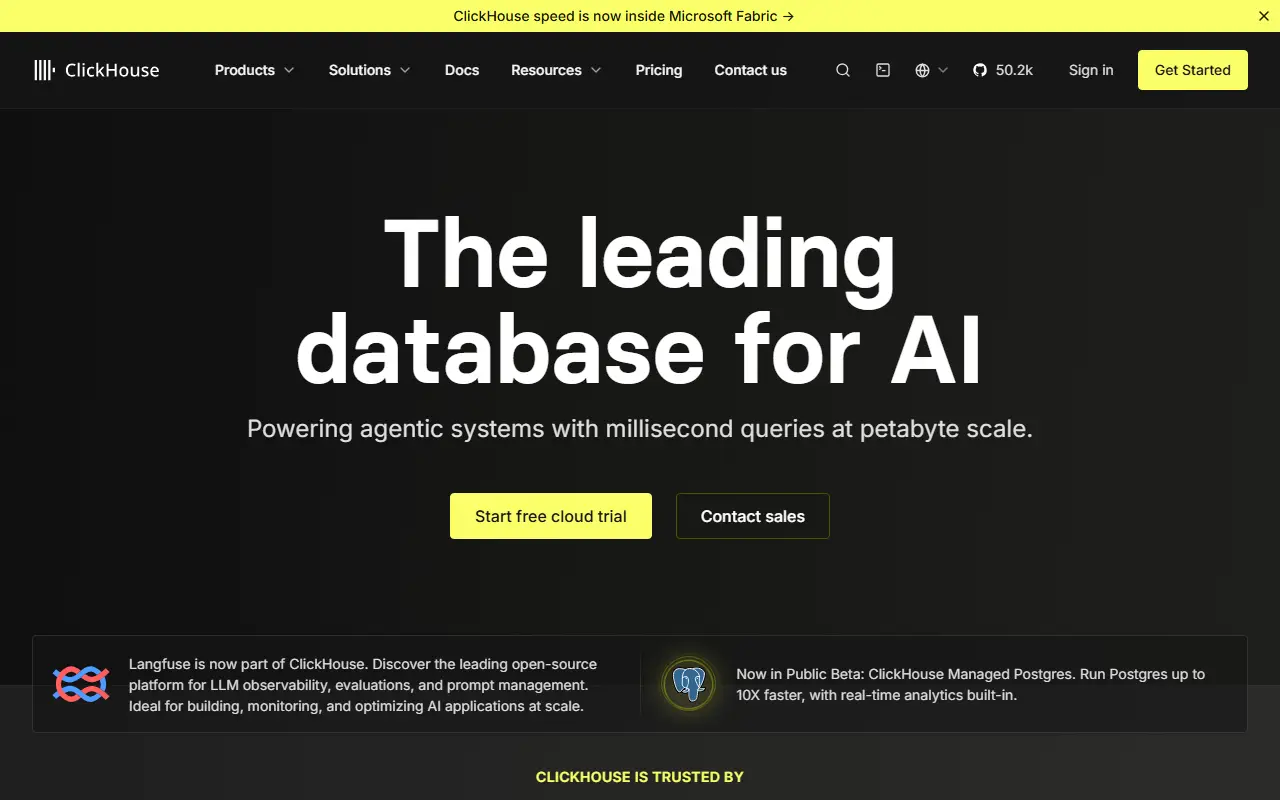
ClickHouse is an open-source database management system built to generate analytical reports in real time. Its column-oriented storage makes scans and aggregations over very large tables efficient, which is why it is widely used for event data, logs, metrics and product analytics. It is written in C++ and queried with SQL.
The project's topics describe it as an OLAP, massively parallel and distributed system, and it is used for big data workloads where query latency matters. You can install it on Linux, macOS or FreeBSD, follow a tutorial that sets up a small cluster, or skip installation by trying ClickHouse Cloud, a managed service built by its creators. Releases arrive monthly, with a community call for each one, and there are Slack and Telegram channels for help.
ClickHouse is Apache-2.0 licensed. It is a good fit for analytics engineers and platform teams who need fast aggregations over billions of rows and are comfortable operating a database, or who prefer to hand that operation to the vendor's cloud.
Key features
- Column-oriented storage for analytics
- SQL queries over large datasets
- Distributed, massively parallel processing
- Real-time analytical reporting
- Install on Linux, macOS or FreeBSD
- Managed ClickHouse Cloud option
Pricing: The open-source distribution is free. ClickHouse Cloud is usage-based, with plans from $53 (Basic), $437 (Scale) and $571 (Enterprise) per month and a 30-day trial with $300 in credits.
#2
PostgreSQL is an object-relational database management system supporting SQL features such as transactions, foreign keys and triggers.
- GitHub stars
- 23k
- Last commit
- yesterday
- Self-hosted
- Yes
postgresql.org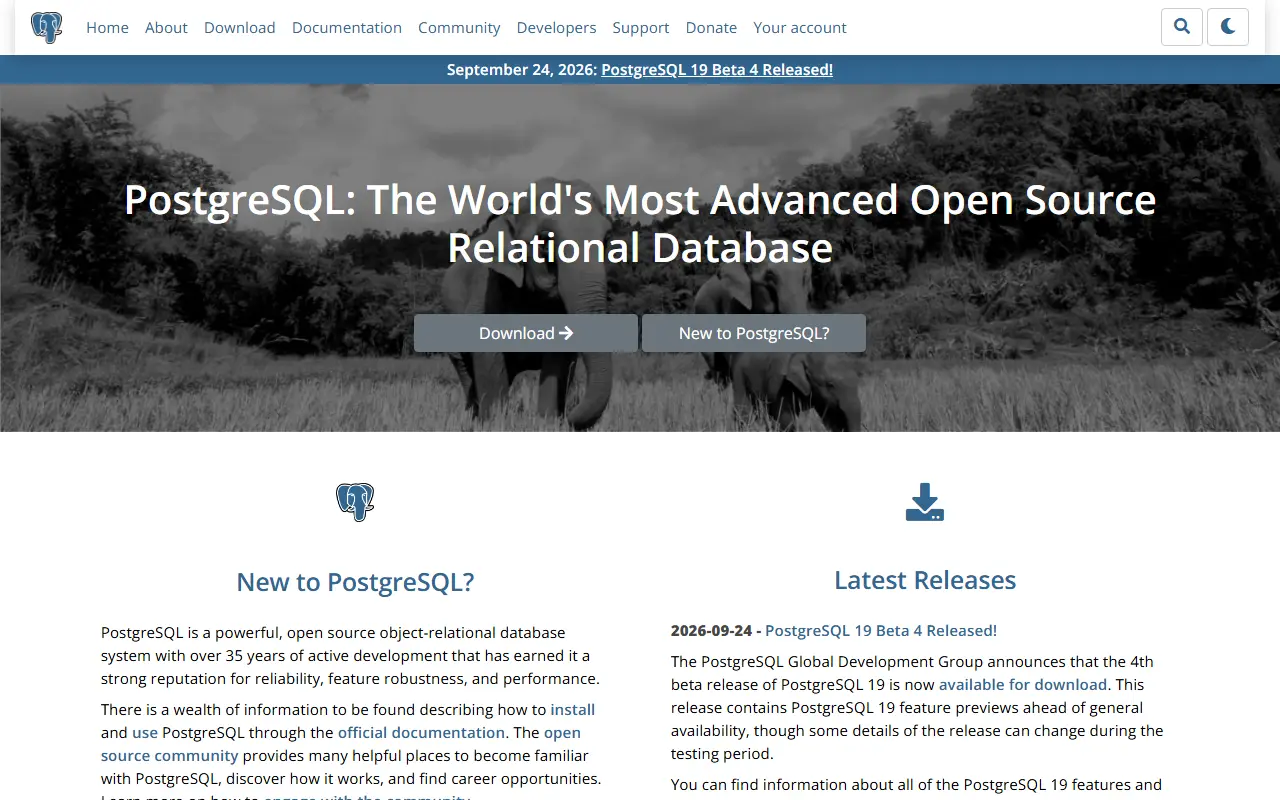
PostgreSQL is a feature-rich object-relational database management system covering a large part of the SQL standard. Its feature set includes transactions, foreign keys, subqueries, triggers, and user-defined types and functions, and the distribution also contains C language bindings. This GitHub repository is only a mirror of the official git repository, written in C, and the metadata lists the license as Other.
The project does not use GitHub pull requests; contributors submit patches through the process described on the PostgreSQL wiki. Copyright and license terms are in the COPYRIGHT file, general documentation for each version is published on the project site, and build instructions explain how to compile the server from source. The latest releases of the software and related software are available from the PostgreSQL website. Many hosting providers offer managed PostgreSQL, but the project itself is software you install and operate.
Key features
- Object-relational database with SQL support
- Transactions and foreign keys
- Subqueries and triggers
- User-defined types and functions
- C language bindings
- Documentation for building from source
Pricing: Free and open source; the repository lists the license as Other, so see the COPYRIGHT file for terms.
#3
A PostgreSQL extension that adds time-series storage, hypertables and a columnstore for fast, real-time analytics on event data.
- GitHub stars
- 24k
- Last commit
- today
- Latest release
- 2.32.0
- Self-hosted
- Yes
- Hosted version
- Available
tigerdata.com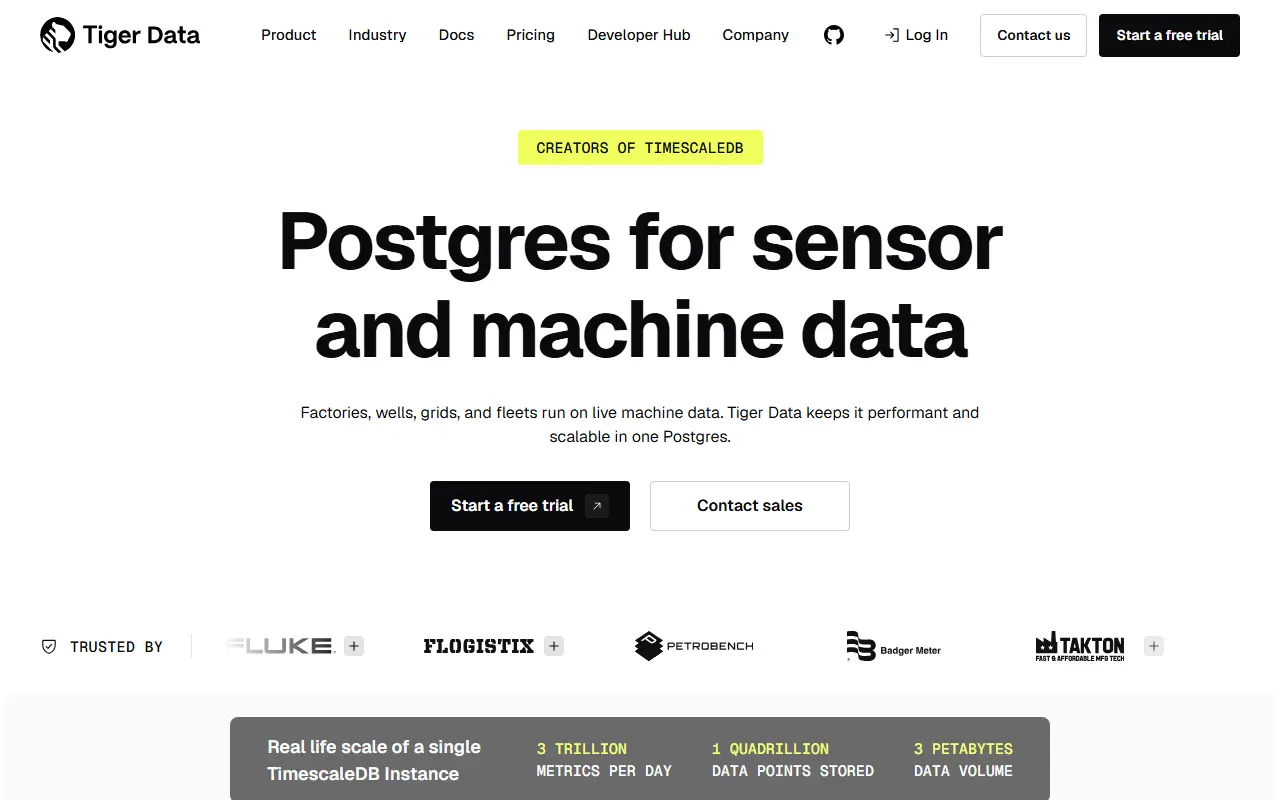
TimescaleDB is a PostgreSQL extension that turns Postgres into a database for time-series and event data, aimed at real-time analytics. Because it lives inside PostgreSQL, you keep SQL, existing tools and the broader Postgres ecosystem while gaining storage and query features designed for data that arrives continuously with timestamps.
The quick start walks through running it locally with a one-line install script or Docker, creating a hypertable with the columnstore enabled, inserting data directly into the columnstore and running analytical queries. It suggests Docker, around 8 GB of RAM and a psql or other PostgreSQL client, and warns that the install script is meant for local development and testing, not production. Topics list uses such as IoT, financial analysis and historian data.
The code is written in C, and its license is listed as 'Other' on GitHub because some features sit under Timescale's own license rather than a standard open-source one, so check which apply to you. The company, now branded TigerData, also runs a hosted cloud service. It suits teams who want time-series features without leaving PostgreSQL.
Key features
- PostgreSQL extension for time-series data
- Hypertables with columnstore
- Fast analytical queries on event data
- Full SQL and Postgres tooling compatibility
- Docker and one-line local install
- Managed cloud service from the vendor
Pricing: The open-source TimescaleDB is free to self-host. Tiger Cloud compute starts at $30 per month on Performance and $36 on Scale, plus storage, billed hourly with a 30-day free trial; Enterprise is by contact.
#4
MariaDB Server is an open-source relational database that began as a fork of MySQL, with vector search, pluggable storage engines and Galera clustering.
- GitHub stars
- 8.6k
- Last commit
- today
- Latest release
- mariadb-13.0.2
- Licence
- GPL-2.0
- Self-hosted
- Yes
mariadb.org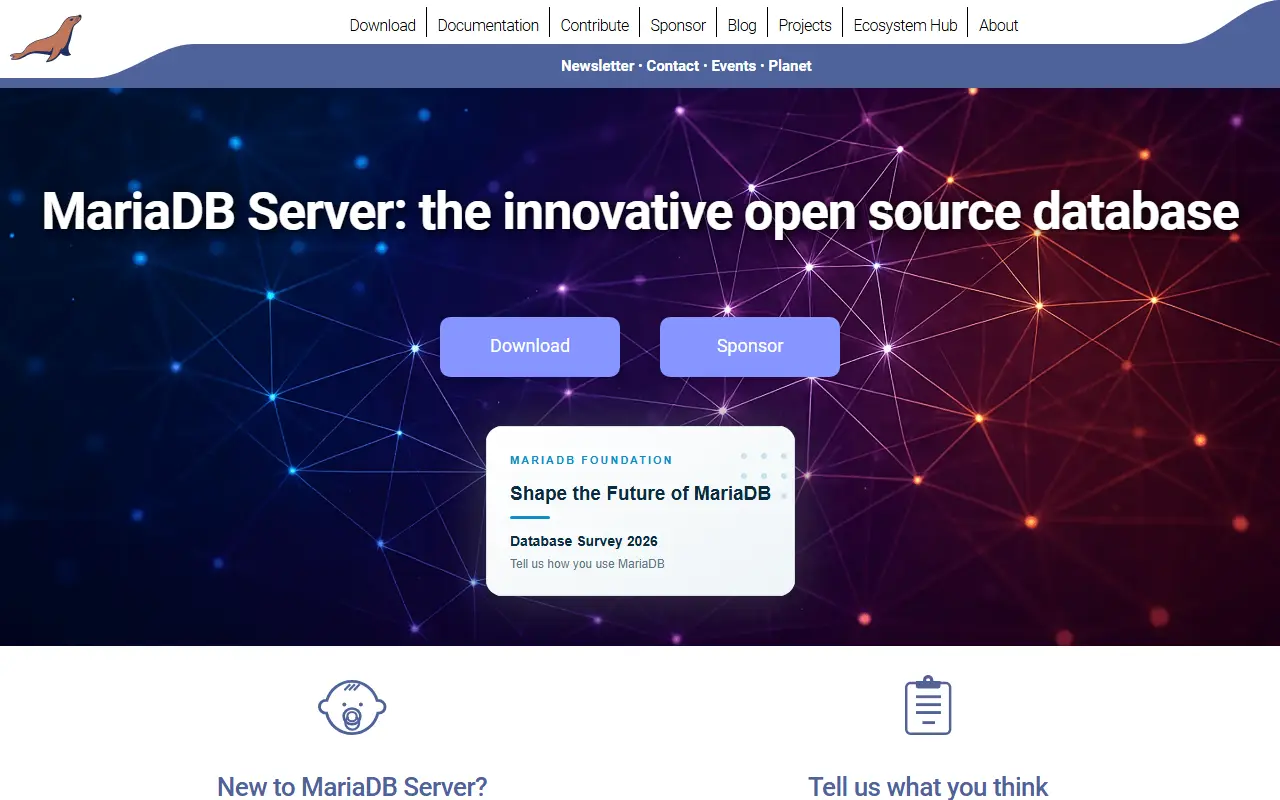
MariaDB Server is an open-source relational database built by a global community with the MariaDB Foundation and MariaDB plc. It started out as a MySQL fork driven by the people who created MySQL, keeps a high degree of MySQL compatibility, and is described as a straightforward migration target for existing MySQL deployments.
Since then it has gained its own capabilities. A native VECTOR data type with approximate nearest-neighbour HNSW indexing has been available since version 11.8. Pluggable storage engines include InnoDB, Aria and MyRocks, plus ColumnStore (analytics), Spider (sharding) and S3 (archiving). Replication options include async, semi-sync and parallel modes using global transaction IDs, and Galera provides synchronous multi-primary clustering. On the SQL side it offers common table expressions, window functions, temporal tables with system versioning, sequences and a range of JSON functions.
It also offers an Oracle SQL mode with PL/SQL-style routines, GIS data types and full-text indexing, and security features such as role-based access control, pluggable authentication, data-at-rest encryption and TLS. MariaDB is written in C++ and licensed under GPL-2.0, and you run it on your own servers or in the cloud.
Key features
- Native vector search with HNSW indexing
- Pluggable storage engines including InnoDB
- Galera synchronous multi-primary clustering
- Temporal tables and window functions
- MySQL and Oracle compatibility modes
- Spatial and full-text indexing
- Role-based access and data-at-rest encryption
Pricing: Free and open source under the GPL-2.0 licence.
#5
A graph database that stores data as connected nodes and relationships and is queried with the Cypher language, widely used for highly connected data.
- GitHub stars
- 17k
- Last commit
- 7 days ago
- Latest release
- 3.2.0-alpha08
- Licence
- GPL-3.0
- Self-hosted
- Yes
- Hosted version
- Available
neo4j.com
Neo4j is a graph database written in Java. Instead of tables, it stores data as nodes and relationships, which makes it a good fit for problems where the connections between records matter, such as social networks, fraud detection, recommendations and knowledge graphs. Data is queried with Cypher, the graph query language associated with the project.
The repository contains the open-source community edition of the database engine. Topics tag it as a NoSQL graph database and graphdb, and the project's tagline is simply that graphs are for everyone. The repository's homepage could not be fetched while preparing this entry, so details here are limited to the repository description and widely known facts about the product.
The community edition is licensed under GPL-3.0, while commercial editions with additional enterprise features and a managed cloud service are sold by Neo4j, Inc. You can run the database on your own servers or use the hosted service. It is aimed at developers and data teams modeling relationship-heavy data.
Key features
- Native graph storage with nodes and relationships
- Cypher query language
- NoSQL graph database engine
- Community edition source code
- Suited to connected-data problems
Pricing: A free AuraDB tier exists. Professional starts at $0.09 per GB per hour and Business Critical at $0.20 per GB per hour; Virtual Dedicated Cloud is quoted on request.
#6
Source repository of the MySQL relational database server, covering the open-source Community edition and the clustered MySQL Cluster variant.
- GitHub stars
- 13k
- Last commit
- 16 days ago
- Self-hosted
- Yes
- Hosted version
- Available
mysql.com
MySQL is a widely used open-source relational database. This repository contains the MySQL Server source code along with MySQL Cluster, which the description presents as a real-time, open-source transactional database. Applications talk to it using SQL, and it is a common choice for web applications and embedded products.
The MySQL website describes several offerings built around the server: the Community Edition, with a published governance model and early access builds; MySQL Enterprise Edition for advanced features, management tools and technical support; MySQL HeatWave, a cloud service that combines transactions with analytics and machine learning; and MySQL Cluster CGE. A program for OEM and ISV vendors covers embedding the database in other products.
The server is written in C++ and distributed under licenses detailed in the repository. Organizations can run the Community Edition on their own infrastructure, buy a commercial edition from Oracle, which owns the project, or use a managed cloud offering. Documentation, downloads and a developer zone are available on mysql.com.
Key features
- Open-source relational database server
- SQL query interface
- MySQL Cluster for transactional workloads
- Community and Enterprise editions
- HeatWave managed cloud option
- Documentation and developer resources
Pricing: Community Edition is open source; Enterprise Edition and the HeatWave cloud service are commercial offerings.
#7
A distributed relational database developed by Ant Group, MySQL-compatible and built on Paxos, supporting transactional, analytical and vector workloads.
- GitHub stars
- 10k
- Last commit
- yesterday
- Latest release
- v4.6.0_CE_BP1
- Licence
- Apache-2.0
- Self-hosted
- Yes
en.oceanbase.com
OceanBase is a distributed relational database developed by Ant Group. It runs on a cluster of commodity servers and uses the Paxos protocol and a distributed architecture to provide high availability and scalability, without depending on a specific hardware architecture.
It is compatible with MySQL, which eases migration from MySQL databases, and supports hybrid transactional and analytical processing, so one engine can serve both OLTP and OLAP workloads. The project now describes itself as a unified, multi-model database for the AI era, with topics that include vector search and full-text search. Cloud-native operation is supported through a Kubernetes operator.
You can try it by deploying a stand-alone instance with an all-in-one package on Linux, starting a Docker container from images on Docker Hub, quay.io or ghcr.io, or running it on Kubernetes with ob-operator. OceanBase is written in C++ and licensed under Apache-2.0, with a developer guide for compiling the observer yourself.
Key features
- Distributed architecture on Paxos
- Compatible with MySQL applications
- Hybrid transactional and analytical processing
- Vector and full-text search
- Docker and Kubernetes deployment
- All-in-one stand-alone installer
Pricing: Free and open source under the Apache-2.0 licence.
#8
A PostgreSQL-compatible, cloud-native distributed SQL database for transactional workloads that need scale, fault tolerance or multi-region deployment.
- GitHub stars
- 11k
- Last commit
- today
- Latest release
- v2026.1.3.0
- Self-hosted
- Yes
yugabyte.com
YugabyteDB is a distributed SQL database that is compatible with PostgreSQL. It combines the relational features of traditional databases with the scale-out design of NoSQL systems, and is intended for cloud-native OLTP applications that need correct data and at least one of scalability, tolerance to failures or global distribution.
Its SQL layer, YSQL, reuses the PostgreSQL query layer and so supports most PostgreSQL features, including data types, stored procedures, triggers and extensions. Its transaction model follows the design of Google Spanner, using Raft consensus for replication and hybrid logical clocks for distributed ACID transactions, with snapshot, serializable and read committed isolation. Reads are strongly consistent by default and can be tuned to read from followers and replicas.
The database can be configured to withstand failures at the level of a disk, rack, node, zone, region or whole cloud, recovering on its own, and the topics mention multi-region, multi-cloud and Kubernetes deployments. The project is written mainly in C and C++, the repository lists its license as Other, and documentation covers architecture, roadmap and how to build applications.
Key features
- PostgreSQL-compatible SQL layer
- Distributed ACID transactions
- Replication using Raft consensus
- Snapshot, serializable and read committed isolation
- Automatic failover and repair
- Multi-region and multi-cloud deployments
- Kubernetes deployment support
Pricing: The open-source database is free. The managed Aeon service starts at $125 (Standard) or $167 (Professional) per vCPU per month plus storage and transfer, with a free trial; Enterprise is quoted.
#9
H2 is a fast, embeddable SQL database written in pure Java, with JDBC access, in-memory or disk storage, encryption and a browser-based console.
- GitHub stars
- 4.6k
- Last commit
- yesterday
- Latest release
- version-2.5.252
- Self-hosted
- Yes
h2database.com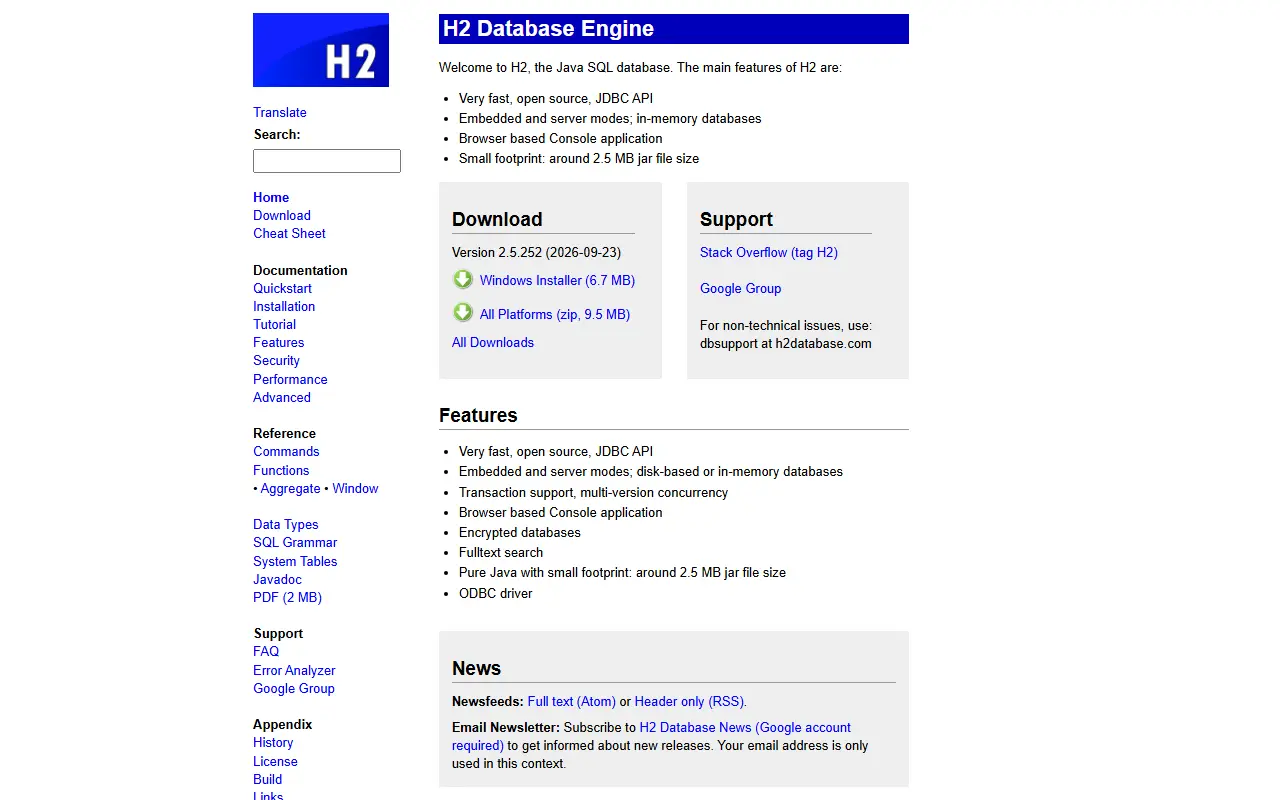
H2 is a relational database management system written in Java. It can run embedded inside an application or as a standalone server, and databases can live on disk or purely in memory, which makes it popular for development, testing and small production uses where a full database server would be overkill.
Listed features include a JDBC API, transaction support with multi-version concurrency, a browser-based console application, encrypted databases and full-text search. It is pure Java with a small footprint, about 2.5 MB for the jar, and it also provides an ODBC driver. The project documents SQL commands, functions, aggregate and window functions and data types, and offers a tutorial, issue tracker and forum.
H2 is open source, with its license shown as 'Other' on GitHub, and is added to Java projects as a dependency, so no hosting is needed. It suits Java developers who want a lightweight database for unit tests, prototypes and embedded applications.
Key features
- Embedded and server modes
- In-memory or disk-based databases
- JDBC API and ODBC driver
- Transactions with multi-version concurrency
- Browser-based console application
- Encrypted databases and full-text search
Pricing: Free and open source; see the repository for license terms.
#10
CrateDB is a distributed, PostgreSQL-compatible SQL database built on Lucene for real-time analytics over large volumes of time-series, JSON and vector data.
- GitHub stars
- 4.5k
- Last commit
- today
- Latest release
- 6.5.1
- Licence
- Apache-2.0
- Self-hosted
- Yes
- Hosted version
- Available
cratedb.com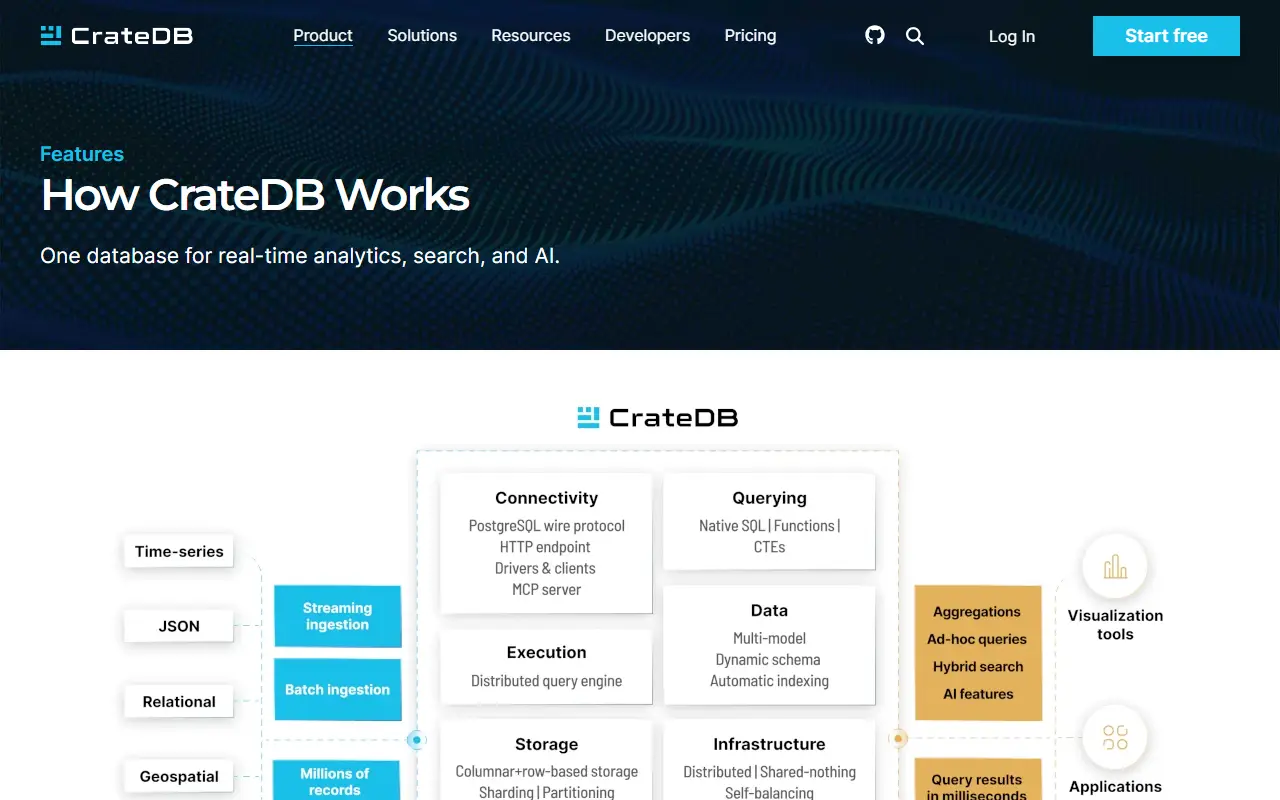
CrateDB is a scalable, distributed SQL database for storing and analyzing very large volumes of data in near real time, including complex queries. It is compatible with PostgreSQL and based on Lucene, and the vendor describes answers in under a second across datasets of millions to billions of rows and many data types, without pre-aggregation.
The product handles many data models in one engine, including time series, document and JSON, vector, full-text, spatial and relational data. Its repository topics mention IoT, industrial IoT, OLAP, analytics and vector databases. The code is written in Java, and the vendor lists solutions for real-time industrial analytics, AI operations and application analytics across industries such as manufacturing and energy.
CrateDB is licensed under Apache-2.0 in its open-source edition. It is available as the OSS build you run yourself, as an enterprise edition and as the managed CrateDB Cloud, with pricing published on the vendor's site. It suits teams building analytics on high-volume machine and event data.
Key features
- Distributed SQL engine
- PostgreSQL wire compatibility
- Time-series, JSON, vector and full-text data
- Spatial and relational data models
- Real-time analytics on large datasets
- OSS, enterprise and cloud editions
Pricing: CrateDB Cloud has a free plan with 2 vCPUs. Shared clusters start at $0.073 per hour and dedicated clusters at $0.246 per hour including basic support; custom plans are quoted.
Oracle Database alternatives: questions
- What is the best open-source alternative to Oracle Database?
- ClickHouse is the top-ranked open-source alternative to Oracle Database on Enlisted: An open-source column-oriented database management system built for real-time analytical reports, available to self-host or as the managed ClickHouse Cloud service. Other strong options are PostgreSQL, TimescaleDB, MariaDB and Neo4j.
- What are the best commercial alternatives to Oracle Database?
- Amazon RDS, Microsoft SQL Server, Google Cloud Spanner, Amazon Aurora and SAP HANA are among the hosted, closed-source alternatives to Oracle Database listed on Enlisted, which lists 17 in total. Compare their pricing and features on each tool page.
- Are these Oracle Database alternatives free?
- All 10 are open source, so the code is free to use under its licence, and all of them can be self-hosted on your own server or computer. 5 also offer a paid or managed cloud version if you'd rather not host it yourself.
- How is this list of Oracle Database alternatives ranked?
- By a score built from GitHub stars, star growth over the last 30 days and how recently the code changed. 10 of these projects shipped code in the last 30 days. Data is refreshed daily, and nobody can pay to move up.
 TrackMedia
 TrackRev