7,363 open-source and SaaS tools, with GitHub stats refreshed every day.

4 alternatives ranked by real activity

Open-source Instaclustr alternatives

A curated, ranked list of the 4 best open-source alternatives to Instaclustr.

The best open-source alternative to Instaclustr is Valkey. If that doesn't suit you, other good options are Apache Cassandra, CloudNativePG and Autobase.

Instaclustr alternatives are mainly databases. 4 of them shipped code in the last 30 days, 4 can be self-hosted, and 4 use a permissive licence.

Last updated October 3, 2026 · ranked by GitHub stars, growth and recent commits

Valkey

A high-performance, open-source key-value data store forked from Redis before its license change, built for caching and realtime workloads with a module system.

GitHub stars
27k
Last commit
yesterday
Latest release
9.1.2
Licence
BSD-3-Clause
Self-hosted
Yes
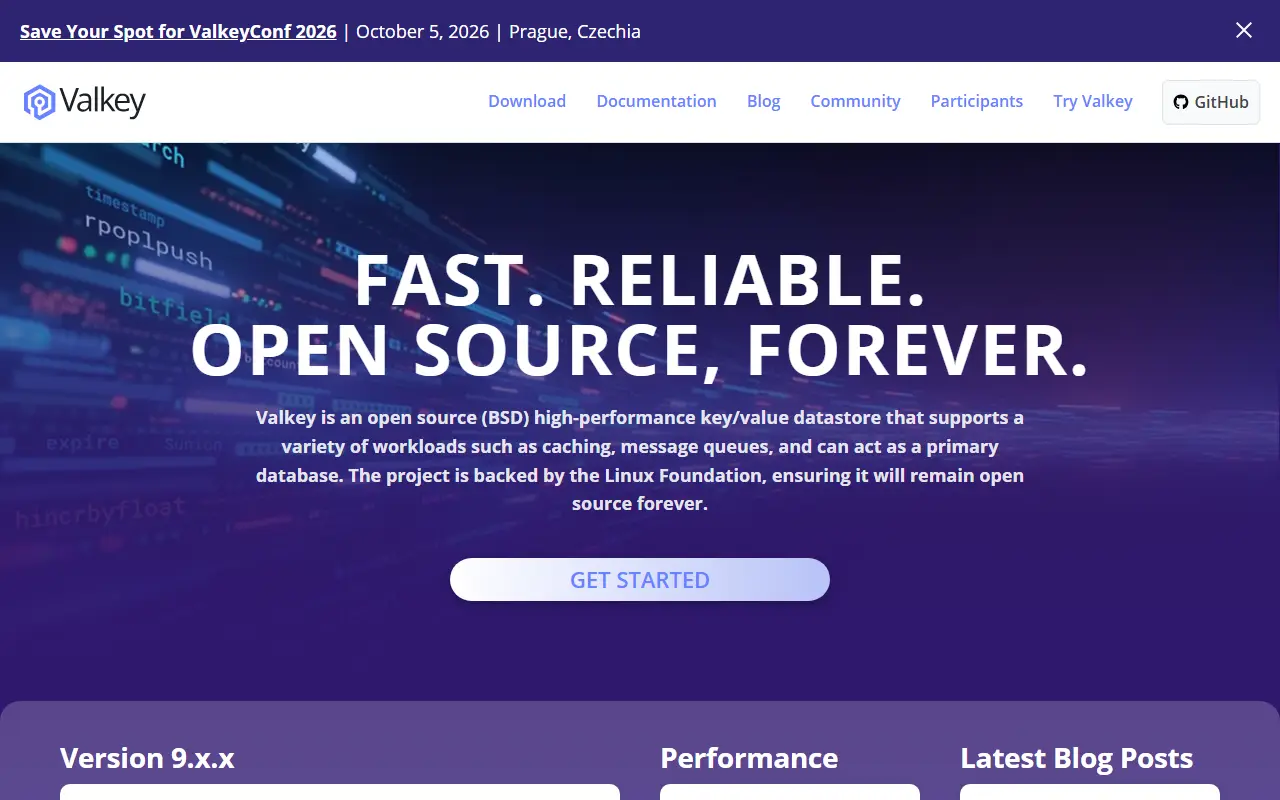
valkey.ioValkey homepage screenshot

Valkey is a distributed key-value database optimized for caching and other realtime workloads. It was forked from the open-source Redis project just before Redis moved to source-available licenses, and it continues as a community-driven alternative under the permissive BSD-3-Clause license.

It acts as a data structure server that mainly handles key-value workloads, supporting many native data structures along with an extensible module system for adding new structures and access patterns. The code is written in C and can be compiled with a simple make command on Linux, macOS, OpenBSD, NetBSD and FreeBSD, on both big and little endian and 32 and 64-bit systems. Support for Solaris-derived systems is limited and not guaranteed. TLS needs OpenSSL development libraries and can be built in or as a module.

The README is a quick-start only, with fuller documentation on valkey.io. Valkey is self-run software and is compatible with the Redis ecosystem of clients, so teams use it as a replacement for Redis in caching, session storage and queues when they prefer a fully open-source license.

Key features

  • Distributed key-value data store
  • Native data structures
  • Extensible module system
  • Builds on Linux, macOS and BSD systems
  • TLS support built in or as a module
  • Permissive BSD-3-Clause open-source license

Pricing: Free and open source under the BSD-3-Clause license.

Read more about ValkeyWebsite GitHub

Apache Cassandra

Apache Cassandra is an open-source distributed NoSQL database built for linear scalability and fault tolerance on commodity hardware or cloud infrastructure.

GitHub stars
10k
Last commit
today
Licence
Apache-2.0
Self-hosted
Yes
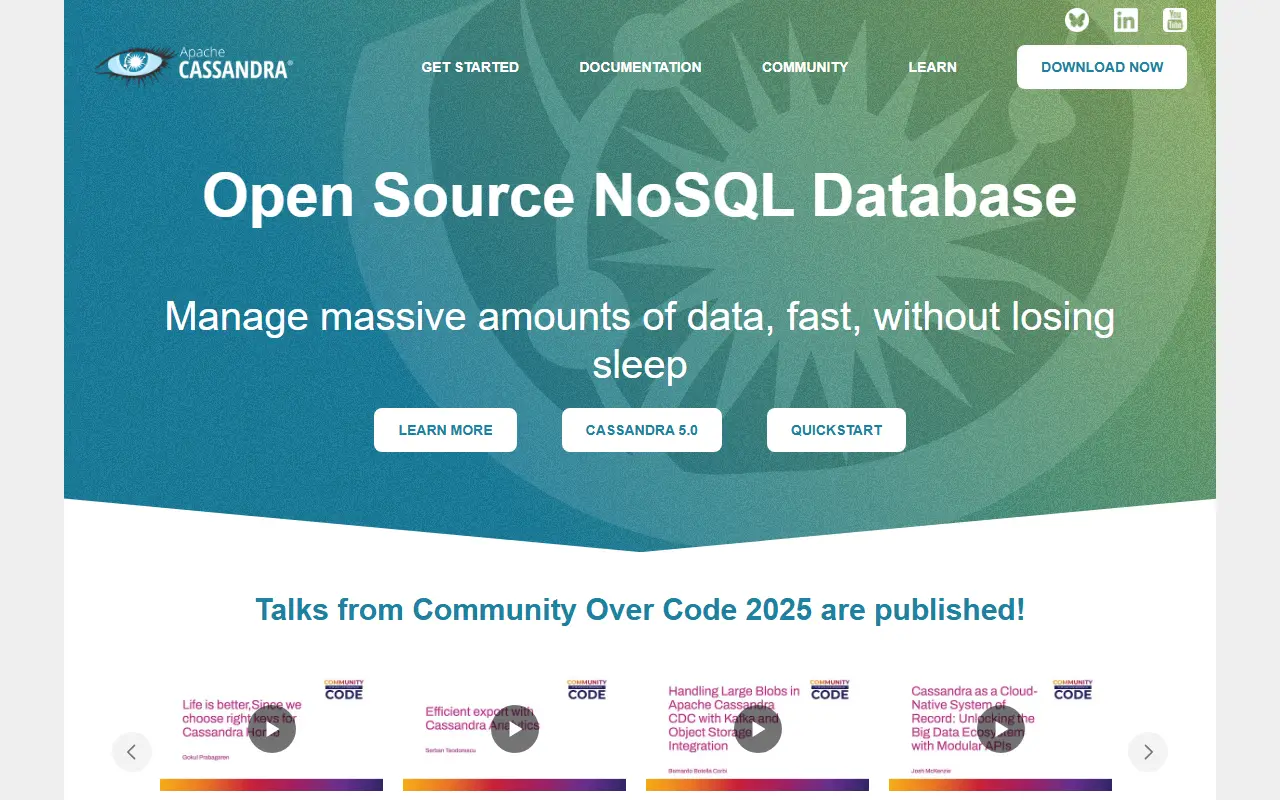
cassandra.apache.orgApache Cassandra homepage screenshot

Apache Cassandra is an open-source, transactional, distributed NoSQL database. It is built to manage very large amounts of data across many machines, aiming for linear scalability and proven fault tolerance whether it runs on commodity servers or in the cloud, with no loss of performance. It is written in Java and developed under the Apache Software Foundation.

The project site presents Cassandra 5.0 along with documentation, a quickstart and community resources, and recent talks from the community cover topics such as Storage Attached Indexes, the Accord transaction protocol, mutation tracking, backups with Medusa, a sidecar process and analytics integrations. Cassandra is queried through CQL and can be run in clusters spanning racks, data centers or cloud regions.

Cassandra is licensed under Apache-2.0 and you run it yourself, either on your own servers or on cloud virtual machines or Kubernetes. It is typically chosen for write-heavy, always-on applications such as time-series data, messaging, IoT and large user-facing systems that must stay available when individual nodes fail.

Key features

  • Distributed NoSQL storage
  • Linear scalability across nodes
  • Fault tolerance on commodity hardware
  • CQL query language
  • Storage Attached Indexes in 5.0
  • Multi data center deployments

Pricing: Free and open source under the Apache-2.0 licence.

CloudNativePG

A Kubernetes operator that manages the full lifecycle of PostgreSQL clusters, including high availability, failover, backups and updates, without external HA tools.

GitHub stars
9.4k
Last commit
yesterday
Latest release
v1.30.1
Licence
Apache-2.0
Self-hosted
Yes
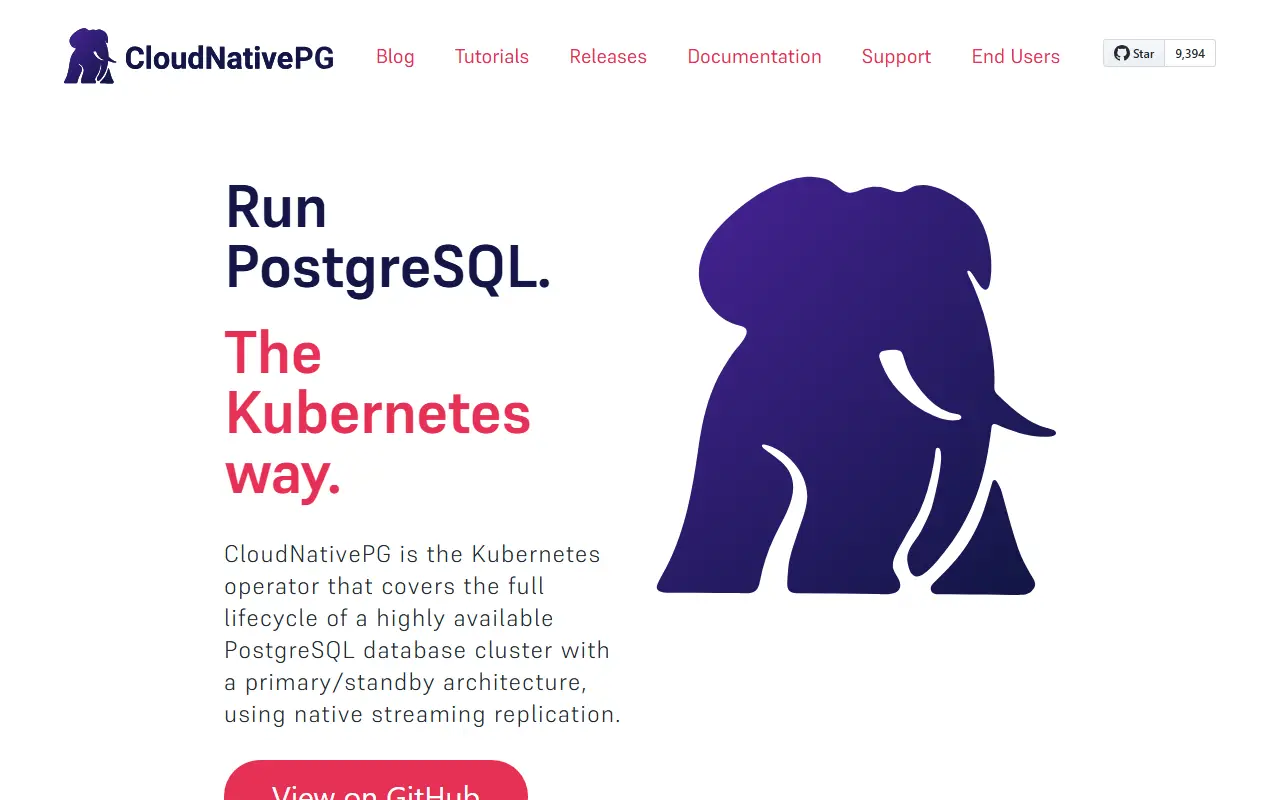
cloudnative-pg.ioCloudNativePG homepage screenshot

CloudNativePG, often shortened to CNPG, is an open-source platform for running PostgreSQL databases on Kubernetes. Its core component is an operator that handles the whole operational lifecycle, from deployment to ongoing maintenance, in a way that fits GitOps-driven CI/CD automation.

It takes a Kubernetes-native approach to primary and standby cluster management. Rather than relying on external high-availability tools such as Patroni, repmgr or Stolon, the operator integrates directly with the Kubernetes API, and the status of a PostgreSQL cluster is exposed on the Cluster resource. It follows the operator pattern to reconcile the desired state, and application containers are immutable. Topics also list failover, switchover, replication, disaster recovery, a kubectl plugin, a Prometheus exporter and JSON logging.

CloudNativePG is a CNCF project written in Go and licensed under Apache-2.0, with a quickstart guide, governance policies, a list of adopters and pointers to commercial support. It is intended for Kubernetes administrators who want PostgreSQL managed as a native workload.

Key features

  • Kubernetes operator for PostgreSQL clusters
  • Primary and standby cluster management
  • Automated failover and switchover
  • Direct Kubernetes API integration
  • Immutable application containers
  • Prometheus exporter and JSON logging
  • Companion kubectl plugin

Pricing: Free and open source under the Apache-2.0 licence; the project points to commercial support providers.

Autobase

Autobase is an open-source platform that provides a DBaaS-like experience for PostgreSQL on your own infrastructure, automating clusters, failover and backups.

GitHub stars
4.4k
Last commit
yesterday
Latest release
2.11.0
Licence
MIT
Self-hosted
Yes
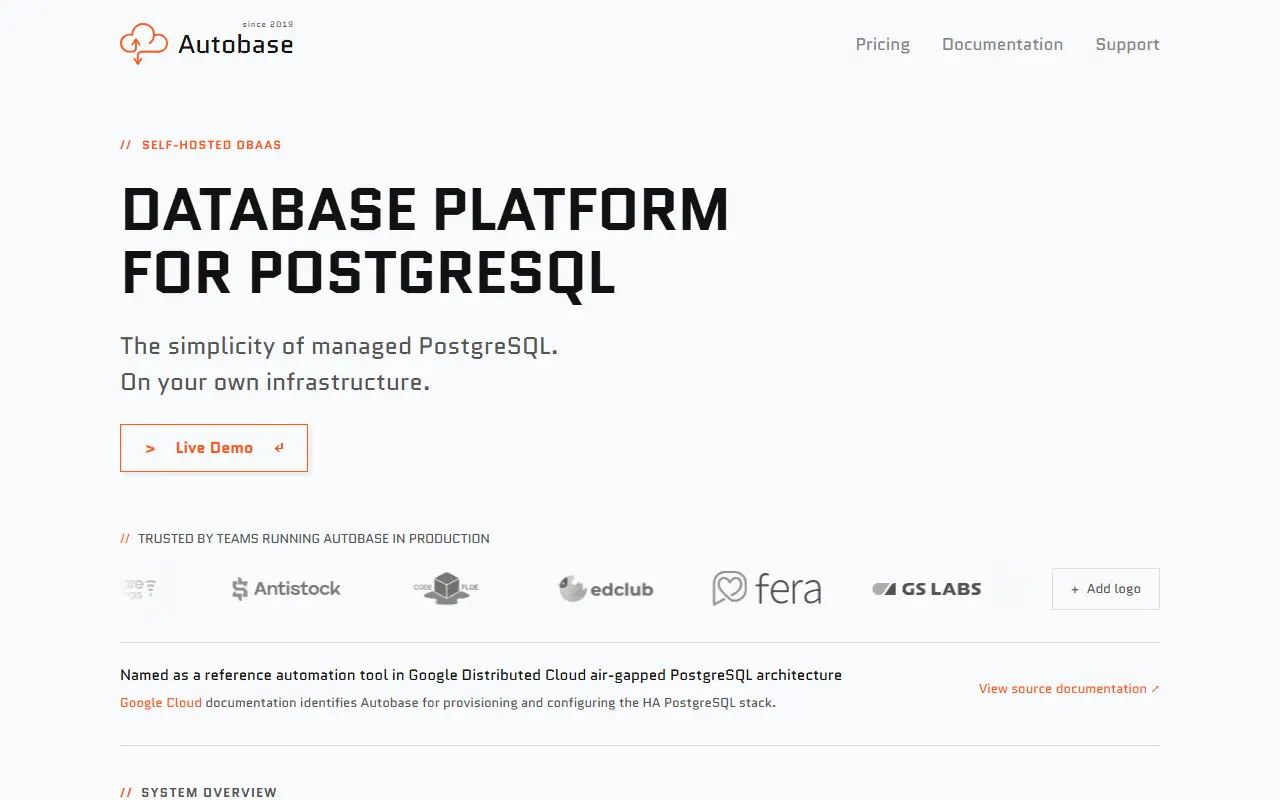
autobase.techAutobase homepage screenshot

Autobase is an internal database platform for PostgreSQL that brings the managed database experience of a cloud DBaaS onto infrastructure you control. You build and operate production-grade PostgreSQL clusters with high availability, and the tool aims to simplify deployment, reduce operating costs and make database management approachable even for teams without deep database expertise.

It automates deployment, failover, backups, restore, upgrades and scaling, with Patroni topics indicating a proven high-availability foundation, and offers a web interface written in TypeScript on top of automation scripts. The documentation includes an architecture overview. It is the successor to what was previously a PostgreSQL cluster automation project.

Autobase is MIT-licensed and self-hosted, running on your own servers, virtual machines or cloud accounts. It suits platform teams and companies that want managed-database convenience without paying for a hosted service, and that are ready to operate the underlying machines.

Key features

  • Highly available PostgreSQL cluster creation
  • Automatic failover between nodes
  • Backup and restore automation
  • Automated upgrades and scaling
  • Web interface for cluster management
  • Runs on your own infrastructure

Pricing: Free MIT-licensed edition with CLI management. Paid commercial plans are Standard at $256, Professional at $1024 and Premium at $4096 per month, with a month free on annual billing.

Read more about AutobaseWebsite GitHub

Instaclustr alternatives: questions

What is the best open-source alternative to Instaclustr?
Valkey is the top-ranked open-source alternative to Instaclustr on Enlisted: A high-performance, open-source key-value data store forked from Redis before its license change, built for caching and realtime workloads with a module system. Other strong options are Apache Cassandra, CloudNativePG and Autobase.
Are these Instaclustr alternatives free?
All 4 are open source, so the code is free to use under its licence, and all of them can be self-hosted on your own server or computer.
How is this list of Instaclustr alternatives ranked?
By a score built from GitHub stars, star growth over the last 30 days and how recently the code changed. 4 of these projects shipped code in the last 30 days. Data is refreshed daily, and nobody can pay to move up.

People also look for alternatives to…

View all