
 Aerospike
 Momento
 Instaclustr
 ScaleGrid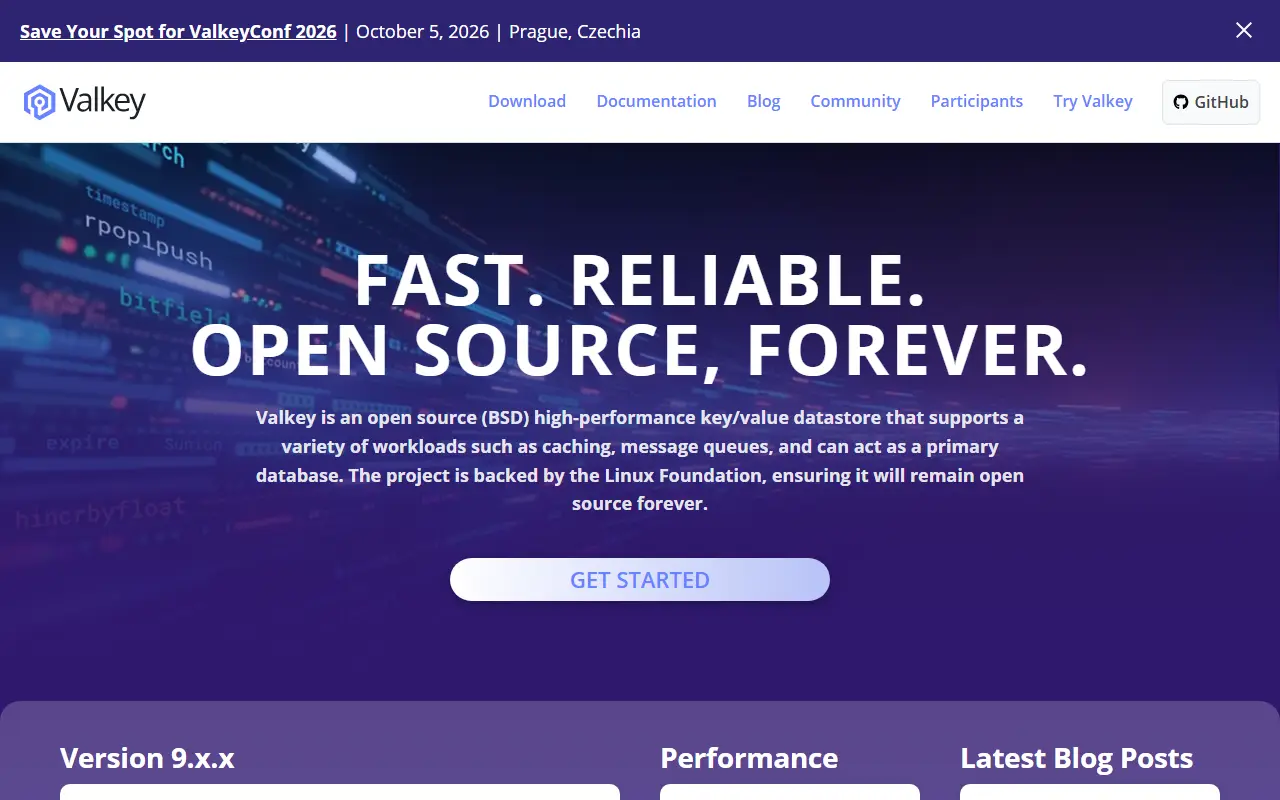
About Valkey
Valkey is a distributed key-value database optimized for caching and other realtime workloads. It was forked from the open-source Redis project just before Redis moved to source-available licenses, and it continues as a community-driven alternative under the permissive BSD-3-Clause license.
It acts as a data structure server that mainly handles key-value workloads, supporting many native data structures along with an extensible module system for adding new structures and access patterns. The code is written in C and can be compiled with a simple make command on Linux, macOS, OpenBSD, NetBSD and FreeBSD, on both big and little endian and 32 and 64-bit systems. Support for Solaris-derived systems is limited and not guaranteed. TLS needs OpenSSL development libraries and can be built in or as a module.
The README is a quick-start only, with fuller documentation on valkey.io. Valkey is self-run software and is compatible with the Redis ecosystem of clients, so teams use it as a replacement for Redis in caching, session storage and queues when they prefer a fully open-source license.
Key features
- Distributed key-value data store
- Native data structures
- Extensible module system
- Builds on Linux, macOS and BSD systems
- TLS support built in or as a module
- Permissive BSD-3-Clause open-source license
Good fit for
- →Caching in front of databases
- →Replacing Redis under an open license
- →Session and queue storage
- Tags
- key-value
- cache
- redis-alternative
- database
- nosql
- in-memory
- c-language
- valkey
- self-hosted
Valkey: questions and answers
- What is Valkey used for?
- Valkey is a high-performance, open-source key-value data store forked from Redis before its license change, built for caching and realtime workloads with a module system. It is a good fit for caching in front of databases, replacing Redis under an open license, and session and queue storage.
- Is Valkey open source?
- Yes. Valkey is open source under the BSD-3-Clause licence. Its source code is on GitHub at valkey-io/valkey and is written mainly in C.
- Is Valkey free?
- Yes. Valkey is open source, so the software itself is free to use.
- Can I self-host Valkey?
- Yes. Valkey can be self-hosted on your own server or infrastructure.
- What is Valkey an alternative to?
- Valkey is an open-source alternative to Upstash, Aiven, Amazon ElastiCache and Amazon MemoryDB. Other open-source alternatives to Upstash include Redis, Dragonfly and DiceDB.
- Is Valkey actively maintained?
- Yes. The most recent commit to Valkey was on 2 October 2026, and the latest release is 9.1.2, published on 1 September 2026. The project has 27k stars on GitHub.
Open-source alternatives to Valkey
See all
Redis
Databases
For developers, who are building real-time data-driven applications, Redis is the preferre
OSSvs Upstash★ 77k
Dragonfly
Databases
A modern replacement for Redis and Memcached
OSSvs Upstash★ 32k
DiceDB
Databases
Open-source, low-latency key/value engine built on Valkey with query subscriptions and hie
OSSvs Upstash★ 11k
Garnet
Databases
Garnet is a remote cache-store from Microsoft Research that offers strong performance (thr
MITvs Upstash★ 12k
CloudNativePG
Databases
The most popular Kubernetes Operator for PostgreSQL.
Apache-2.0vs Amazon RDS★ 9.4k
Autobase
Databases
Automated database platform for PostgreSQL® - Your own DBaaS.
MITvs Amazon RDS★ 4.4k
SaaS alternatives to Valkey
See all
Upstash
Databases
Serverless Redis, Kafka and vector database with per-request pricing
SaaS
Aiven
Databases
Managed service for running Postgres, MySQL, Kafka and other data systems in the cloud
SaaS
Amazon ElastiCache
Databases
Managed in-memory caching service on AWS for Redis OSS, Valkey and Memcached
SaaS
Amazon MemoryDB
Databases
Durable in-memory database service on AWS compatible with Valkey and Redis OSS
SaaS
Google Memorystore
Databases
Managed in-memory data store on Google Cloud for Redis, Valkey and Memcached
SaaS
DigitalOcean Managed Databases
Databases
Managed PostgreSQL, MySQL, Valkey, MongoDB and Kafka clusters on DigitalOcean
SaaS