7,363 open-source and SaaS tools, with GitHub stats refreshed every day.

6 alternatives ranked by real activity

Open-source Amazon ElastiCache alternatives

A curated, ranked list of the 6 best open-source alternatives to Amazon ElastiCache.

The best open-source alternative to Amazon ElastiCache is Redis. If that doesn't suit you, other good options are Dragonfly, Valkey, Memcached and Garnet.

Amazon ElastiCache alternatives are mainly databases. 5 of them shipped code in the last 30 days, 6 can be self-hosted, and 3 use a permissive licence.

Last updated October 3, 2026 · ranked by GitHub stars, growth and recent commits

Redis

An in-memory data store used as a cache, session store, data structure server, message broker and vector query engine for real-time applications.

GitHub stars
77k
Last commit
2 days ago
Latest release
8.10.2
Self-hosted
Yes
Hosted version
Available
redis.ioRedis homepage screenshot

Redis is an in-memory data store that developers use as a cache, a session store, a database and a message broker. Because data lives in memory it answers requests quickly, which makes it popular for real-time applications. The project describes itself as a cache, a data structure server, and a document and vector query engine.

Rather than just strings, it offers data structures such as lists, sets, hashes, sorted sets and JSON, with higher-level patterns built on them, such as counters, queues, leaderboards and rate limiters, plus transactions and scripting. For caching it offers multiple eviction policies along with expiry for keys and for individual hash fields. It also handles key-value, document and time series storage, vector search and messaging. Client libraries cover most languages, and redis-cli and Redis Insight provide command line and graphical access.

The source is on GitHub, written in C, and can be built from source with documented flags for allocators, TLS and more. The license is listed as 'Other' in repository metadata, so check the current terms. Redis can be run on your own servers or consumed as a cloud-hosted service from the vendor.

Key features

  • Rich data types including hashes and sorted sets
  • Caching with eviction and key expiration
  • JSON, time series and document storage
  • Vector search for AI applications
  • Message broker and queue support
  • Transactions and server-side scripting

Pricing: Redis Cloud has a free 30 MB tier. Essentials starts at about $5 per month ($0.007 per hour) and Pro at $0.014 per hour with a $200 monthly minimum, billed on demand.

Read more about RedisWebsite GitHub

Dragonfly

An in-memory data store written in C++ that speaks the Redis and Memcached protocols, using a multi-threaded design to use modern hardware more efficiently.

GitHub stars
32k
Last commit
today
Latest release
v2.0.0
Self-hosted
Yes
Hosted version
Available
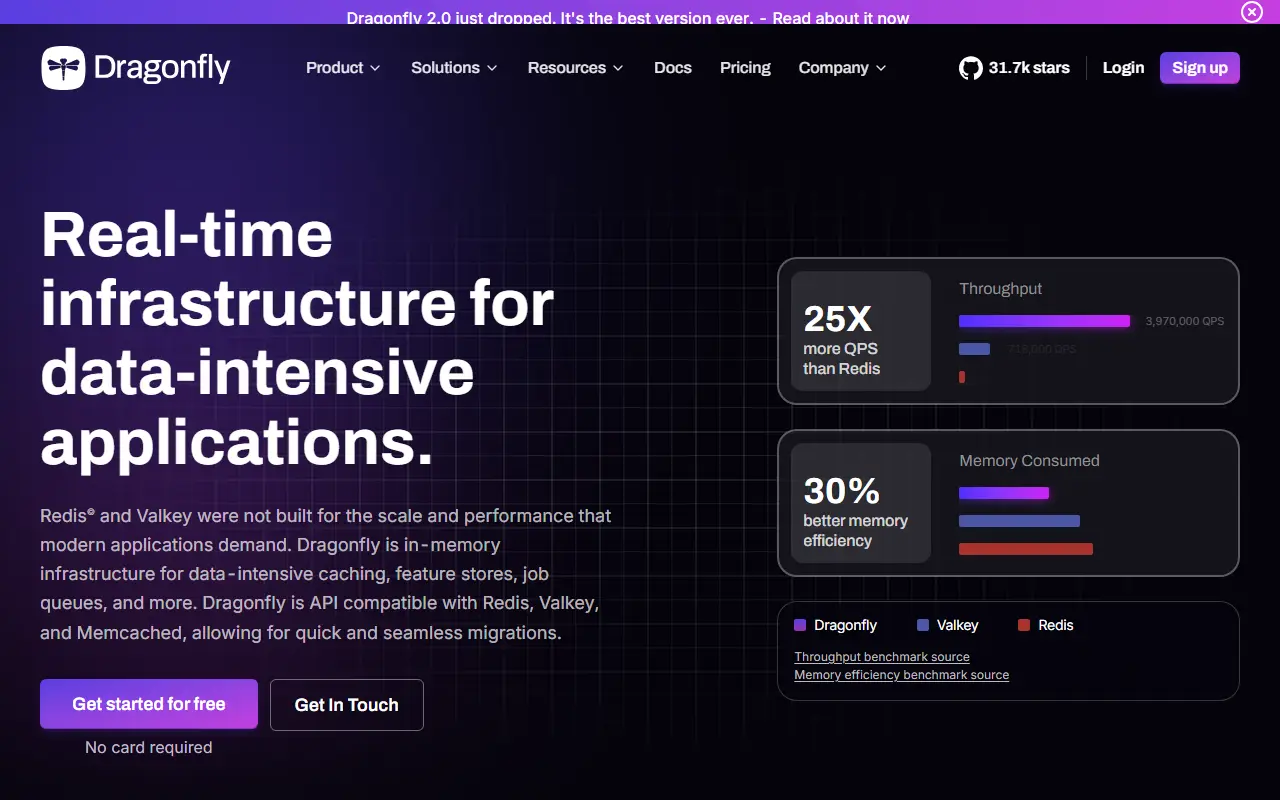
dragonflydb.ioDragonfly homepage screenshot

Dragonfly is an in-memory data store designed for modern application workloads and positioned as a replacement for Redis and Memcached. It implements the Redis and Memcached APIs, so existing applications and client libraries can point at it without code changes.

Unlike the single-threaded design of classic Redis, Dragonfly is multi-threaded and built around fibers, which lets one instance use many CPU cores. The project reports much higher throughput, better cache hit rates with lower tail latency and up to 80 percent fewer resources for a workload of the same size, with benchmarks against Redis on cloud instances in its documentation. Topics also link it to caching, key-value storage, message brokering and the Valkey and KeyDB ecosystems. Documentation covers a quick start, configuration, design decisions and building from source.

Dragonfly's license is listed as 'Other' on GitHub, so check the terms before using it in a commercial product. You can run it on your own servers or through Dragonfly Cloud, the company's hosted service, and a guide for AI agents is provided for tooling integration.

Key features

  • Compatible with Redis and Memcached APIs
  • Multi-threaded, fiber-based architecture
  • Drop-in adoption without code changes
  • Caching, key-value and message broker uses
  • Published benchmarks against Redis
  • Managed Dragonfly Cloud option

Pricing: Dragonfly Cloud Flex starts at $36 per month and Business at $2,000 per month. Self-Managed enterprise deployments are quoted on request; Flex has a free trial.

Read more about DragonflyWebsite GitHub

Valkey

A high-performance, open-source key-value data store forked from Redis before its license change, built for caching and realtime workloads with a module system.

GitHub stars
27k
Last commit
today
Latest release
9.1.2
Licence
BSD-3-Clause
Self-hosted
Yes
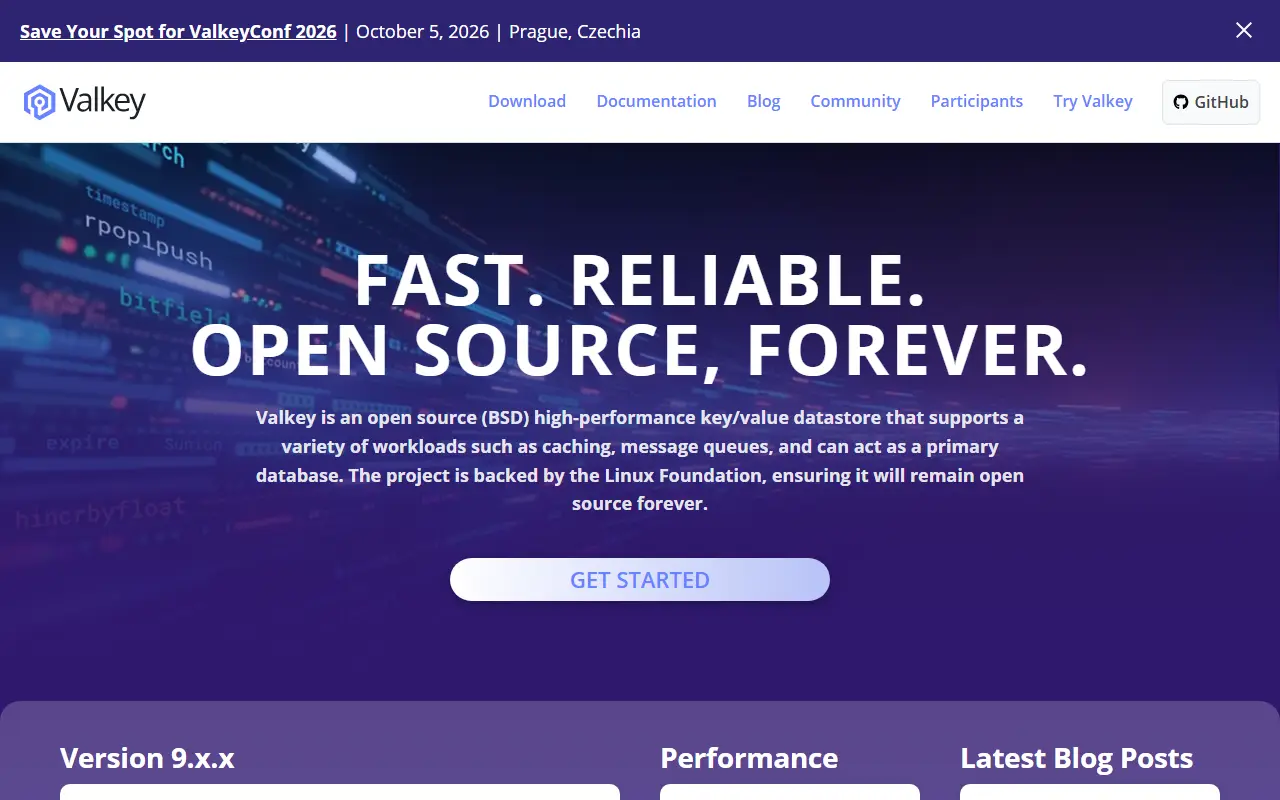
valkey.ioValkey homepage screenshot

Valkey is a distributed key-value database optimized for caching and other realtime workloads. It was forked from the open-source Redis project just before Redis moved to source-available licenses, and it continues as a community-driven alternative under the permissive BSD-3-Clause license.

It acts as a data structure server that mainly handles key-value workloads, supporting many native data structures along with an extensible module system for adding new structures and access patterns. The code is written in C and can be compiled with a simple make command on Linux, macOS, OpenBSD, NetBSD and FreeBSD, on both big and little endian and 32 and 64-bit systems. Support for Solaris-derived systems is limited and not guaranteed. TLS needs OpenSSL development libraries and can be built in or as a module.

The README is a quick-start only, with fuller documentation on valkey.io. Valkey is self-run software and is compatible with the Redis ecosystem of clients, so teams use it as a replacement for Redis in caching, session storage and queues when they prefer a fully open-source license.

Key features

  • Distributed key-value data store
  • Native data structures
  • Extensible module system
  • Builds on Linux, macOS and BSD systems
  • TLS support built in or as a module
  • Permissive BSD-3-Clause open-source license

Pricing: Free and open source under the BSD-3-Clause license.

Read more about ValkeyWebsite GitHub

Memcached

Multithreaded, event-driven in-memory key/value cache used to speed up distributed applications by keeping hot data in RAM.

GitHub stars
14k
Last commit
22 days ago
Licence
BSD-3-Clause
Self-hosted
Yes
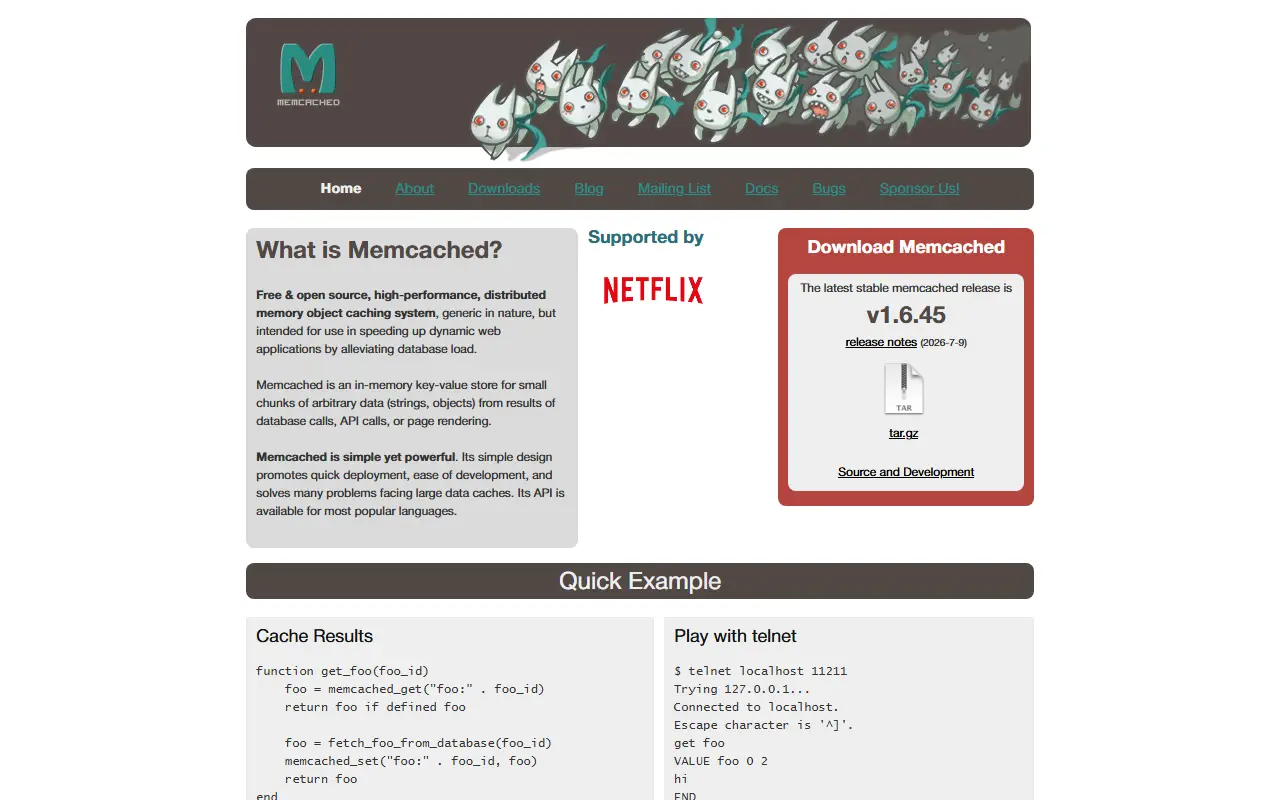
memcached.orgMemcached homepage screenshot

Memcached is an in-memory key/value cache store designed for distributed systems. Applications place frequently read data, such as query results or rendered fragments, in memory so they can skip slower backends. It is a long-established building block of web infrastructure and is released as open source under the BSD-3-Clause license.

The server is written in C, uses multiple threads and an event-based design built on libevent, and keeps its interface simple. Optional build features include TLS support through OpenSSL, process restrictions on Linux through libseccomp, and an experimental proxy mode. It can be compiled from a release tarball or from the git repository using the standard autotools workflow.

The project provides documentation on its website, including a tutorial, a wiki and a guide for diagnosing timeouts and odd behavior. Questions are handled through a mailing list rather than GitHub issues. Because it is a cache, operators typically run it on dedicated machines and avoid swapping when large memory is allocated.

Key features

  • In-memory key/value storage for caching
  • Multithreaded, event-based server in C
  • Optional TLS support via OpenSSL
  • Optional libseccomp process restrictions on Linux
  • Experimental proxy mode
  • Builds from tarball or git source

Pricing: Free and open source under the BSD-3-Clause license.

Read more about MemcachedWebsite GitHub

Garnet

Microsoft Research cache-store that speaks the Redis protocol, offering clustering, replication and persistence on a cross-platform .NET base.

GitHub stars
12k
Last commit
today
Latest release
v2.2.0
Licence
MIT
Self-hosted
Yes
Hosted version
Available
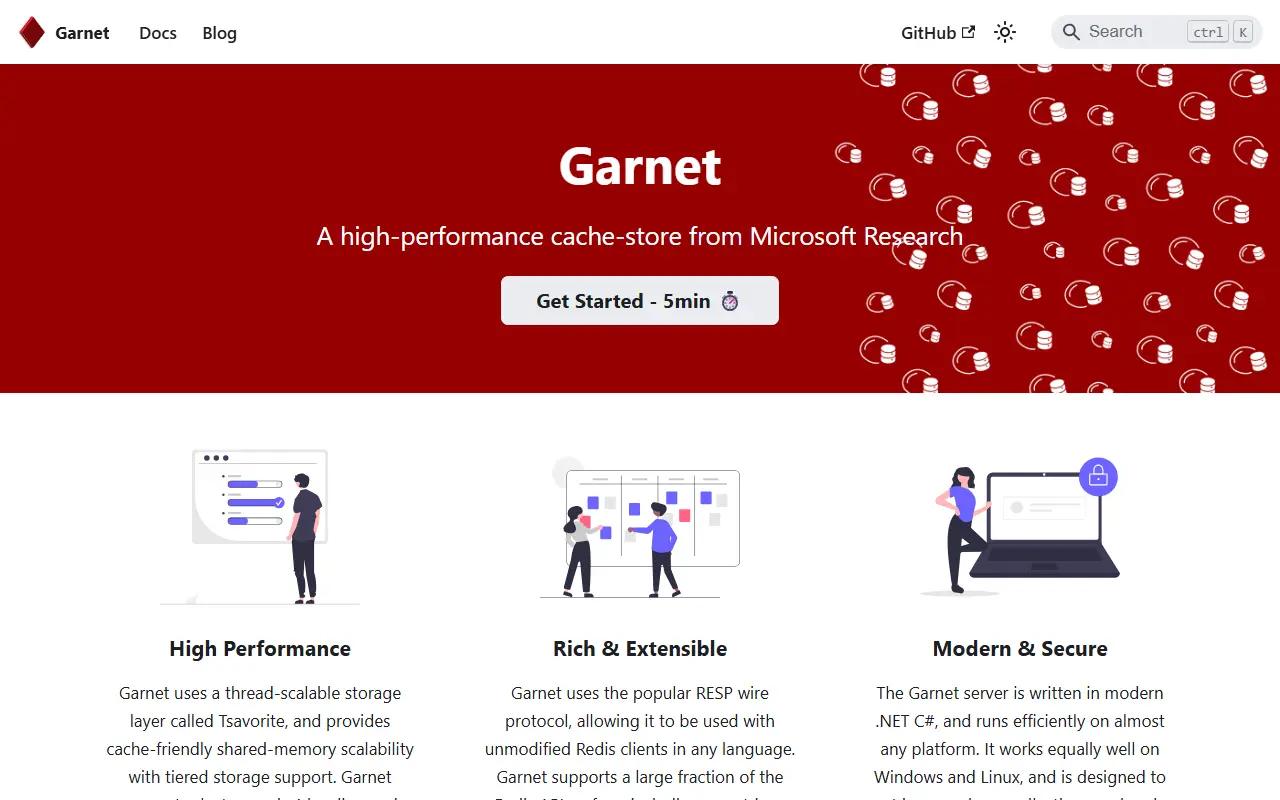
microsoft.github.ioGarnet homepage screenshot

Garnet is a remote cache-store from Microsoft Research. It adopts the RESP wire protocol, the one used by Redis, so existing Redis clients in most programming languages can talk to it without modification. That makes it a candidate for applications that already depend on Redis clients but want a different server implementation.

The project describes strong throughput and low latency, plus scalability, storage beyond memory, recovery, cluster sharding, key migration and replication. Newer previews add vector sets, offering approximate nearest-neighbor search backed by the DiskANN algorithm and the Tsavorite storage engine, and a range index for secondary lookups. Garnet is built on .NET and works on both Linux and Windows.

The code is written in C# and released under the MIT license, with documentation at microsoft.github.io/garnet. People who prefer not to operate it themselves can use Azure Cosmos DB Garnet Cache, which offers Garnet as a managed caching service. The repository contains everything needed to build and run the server.

Key features

  • Works with unmodified Redis clients via RESP
  • Cluster sharding with key migration
  • Replication and recovery support
  • Storage larger than memory
  • Vector sets preview using DiskANN
  • Cross-platform .NET implementation

Pricing: Free and open source under the MIT license; a managed option is offered as Azure Cosmos DB Garnet Cache.

Read more about GarnetWebsite GitHub

DiceDB

A key-value store forked from Valkey that stays compatible with Redis tooling and adds a spill module for persisting evicted keys to disk.

GitHub stars
11k
Last commit
5 mo ago
Latest release
1.0.0
Self-hosted
Yes
dicedb.ioDiceDB homepage screenshot

DiceDB is an open-source, low-latency key-value engine built as a fork of Valkey, which is itself a fork of Redis. It aims to stay fully compatible with Valkey and Redis tooling and client libraries, so existing applications and SDKs can talk to it, while extending the base server with extra capabilities.

The main addition described in the README is dicedb-spill, a module that transparently writes evicted keys to disk and restores them on cache misses. This lets a working set exceed the memory budget, and by default the module uses RocksDB with a configurable memory limit. The project notes that features from its earlier Go-based engine, which focused on reactivity and throughput, will gradually be ported over.

DiceDB is written in C and supports Linux, macOS and several BSD systems on 32-bit and 64-bit hardware. The quickest way to try it is the official Docker image, which comes preconfigured with the spill module enabled, and it can also be built from source. Because it is software you run yourself, it suits developers who want a Redis-compatible cache or store with disk-backed overflow.

Key features

  • Fork of Valkey with Redis compatibility
  • Spill module persisting evicted keys to disk
  • RocksDB-backed overflow storage
  • Configurable memory and spill limits
  • Official Docker image for quick start
  • Builds on Linux, macOS, and BSD systems
Read more about DiceDBWebsite GitHub

Amazon ElastiCache alternatives: questions

What is the best open-source alternative to Amazon ElastiCache?
Redis is the top-ranked open-source alternative to Amazon ElastiCache on Enlisted: An in-memory data store used as a cache, session store, data structure server, message broker and vector query engine for real-time applications. Other strong options are Dragonfly, Valkey, Memcached and Garnet.
Are these Amazon ElastiCache alternatives free?
All 6 are open source, so the code is free to use under its licence, and all of them can be self-hosted on your own server or computer. 3 also offer a paid or managed cloud version if you'd rather not host it yourself.
How is this list of Amazon ElastiCache alternatives ranked?
By a score built from GitHub stars, star growth over the last 30 days and how recently the code changed. 5 of these projects shipped code in the last 30 days. Data is refreshed daily, and nobody can pay to move up.

People also look for alternatives to…

View all