
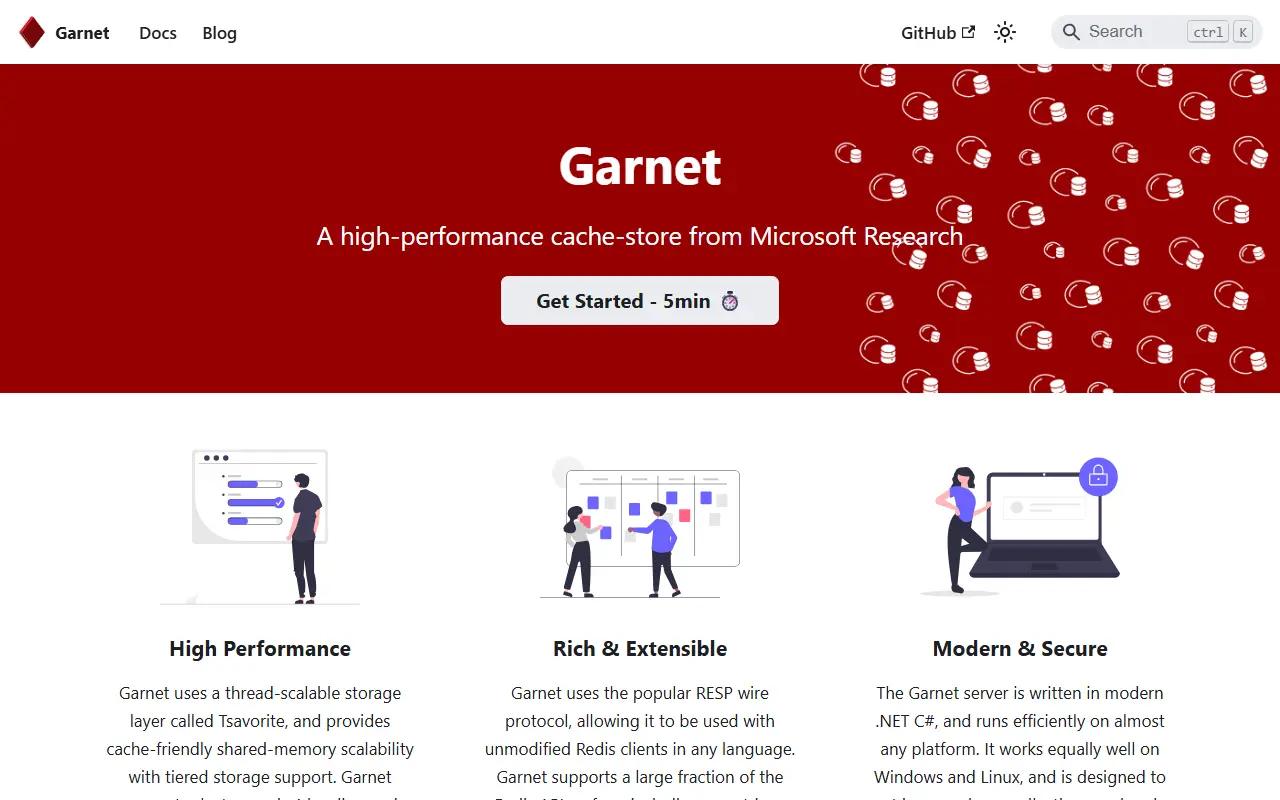
About Garnet
Garnet is a remote cache-store from Microsoft Research. It adopts the RESP wire protocol, the one used by Redis, so existing Redis clients in most programming languages can talk to it without modification. That makes it a candidate for applications that already depend on Redis clients but want a different server implementation.
The project describes strong throughput and low latency, plus scalability, storage beyond memory, recovery, cluster sharding, key migration and replication. Newer previews add vector sets, offering approximate nearest-neighbor search backed by the DiskANN algorithm and the Tsavorite storage engine, and a range index for secondary lookups. Garnet is built on .NET and works on both Linux and Windows.
The code is written in C# and released under the MIT license, with documentation at microsoft.github.io/garnet. People who prefer not to operate it themselves can use Azure Cosmos DB Garnet Cache, which offers Garnet as a managed caching service. The repository contains everything needed to build and run the server.
Key features
- Works with unmodified Redis clients via RESP
- Cluster sharding with key migration
- Replication and recovery support
- Storage larger than memory
- Vector sets preview using DiskANN
- Cross-platform .NET implementation
Good fit for
- →Replacing a Redis server behind existing clients
- →Low-latency caching for large services
- Built with
- C#
- Tags
- cache
- key-value
- redis-compatible
- dotnet
- low-latency
- cluster
- microsoft
Garnet: questions and answers
- What is Garnet used for?
- Garnet is a Microsoft Research cache-store that speaks the Redis protocol, offering clustering, replication and persistence on a cross-platform .NET base. It is a good fit for replacing a Redis server behind existing clients and low-latency caching for large services.
- Is Garnet open source?
- Yes. Garnet is open source under the MIT licence. Its source code is on GitHub at microsoft/garnet and is written mainly in C#.
- Is Garnet free?
- Yes. Garnet is open source, so the software itself is free to use. A managed cloud version is also available.
- Can I self-host Garnet?
- Yes. Garnet can be self-hosted on your own server or infrastructure.
- What is Garnet an alternative to?
- Garnet is an open-source alternative to Upstash, Amazon ElastiCache, Amazon MemoryDB and Google Memorystore. Other open-source alternatives to Upstash include Redis, Dragonfly and Valkey.
- Is Garnet actively maintained?
- Yes. The most recent commit to Garnet was on 2 October 2026, and the latest release is v2.2.0, published on 1 October 2026. The project has 12k stars on GitHub.
Open-source alternatives to Garnet
See all
Redis
Databases
For developers, who are building real-time data-driven applications, Redis is the preferre
OSSvs Upstash★ 77k
Dragonfly
Databases
A modern replacement for Redis and Memcached
OSSvs Upstash★ 32k
Valkey
Databases
A flexible distributed key-value database that is optimized for caching and other realtime
BSD-3-Clausevs Upstash★ 27k
DiceDB
Databases
Open-source, low-latency key/value engine built on Valkey with query subscriptions and hie
OSSvs Upstash★ 11k
Memcached
Databases
memcached development tree
BSD-3-Clausevs Amazon ElastiCache★ 14k
SSDB
Databases
SSDB - A fast NoSQL database, an alternative to Redis
BSD-3-Clause★ 8.3k
SaaS alternatives to Garnet
See all
Upstash
Databases
Serverless Redis, Kafka and vector database with per-request pricing
SaaS
Amazon ElastiCache
Databases
Managed in-memory caching service on AWS for Redis OSS, Valkey and Memcached
SaaS
Amazon MemoryDB
Databases
Durable in-memory database service on AWS compatible with Valkey and Redis OSS
SaaS
Google Memorystore
Databases
Managed in-memory data store on Google Cloud for Redis, Valkey and Memcached
SaaS
Momento
Databases
Serverless cache and pub/sub service with no infrastructure to manage
SaaS
Amazon DynamoDB
Databases
Serverless key-value and document database from AWS
SaaS