7,363 open-source and SaaS tools, with GitHub stats refreshed every day.

6 alternatives ranked by real activity

Open-source Gumloop alternatives

A curated, ranked list of the 6 best open-source alternatives to Gumloop.

The best open-source alternative to Gumloop is Dify. If that doesn't suit you, other good options are Langflow, Sim, Refly and Magic.

Gumloop alternatives are mainly AI infrastructure tools, but some are also workflow automation tools and AI tools. 4 of them shipped code in the last 30 days, 6 can be self-hosted, and 3 use a permissive licence.

Last updated October 2, 2026 · ranked by GitHub stars, growth and recent commits

Dify

An LLM application platform for building AI workflows, RAG pipelines and agents on one canvas, deployable in the cloud, a private VPC or self-hosted.

GitHub stars
158k
Last commit
today
Latest release
1.17.1
Self-hosted
Yes
Hosted version
Available
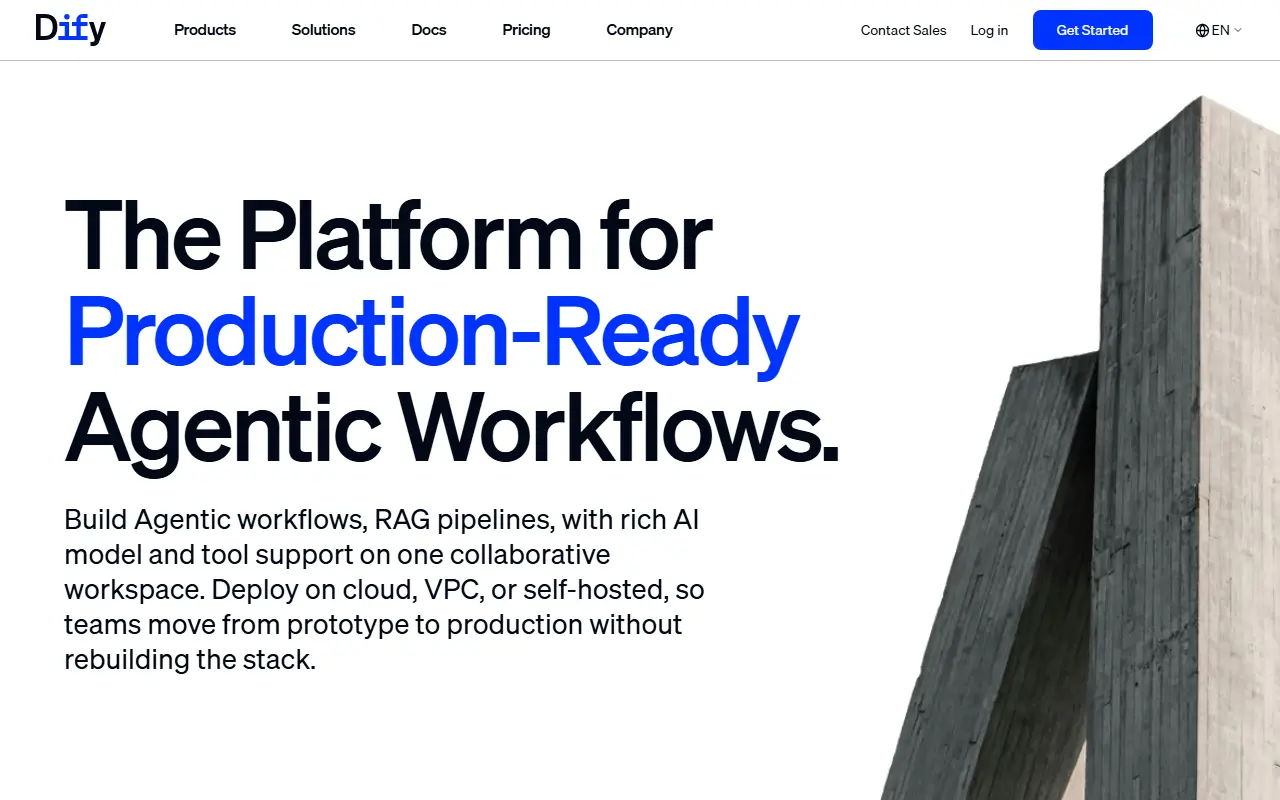
dify.aiDify homepage screenshot

Dify is a platform for building applications on top of large language models. Instead of wiring together prompts, retrieval code and model APIs by hand, teams assemble AI workflows, knowledge pipelines and agents in a shared visual workspace, then move them from prototype to production without changing stacks.

The product covers a workflow studio for agentic flows, a knowledge pipeline that prepares searchable knowledge bases for retrieval-augmented generation, model management across many providers, and a marketplace of tools, models and integrations. Observability integrations such as Opik, Langfuse and Arize Phoenix help trace and debug runs once an app is live.

Dify comes in a few editions: a community edition you deploy yourself with Docker, a hosted cloud service, and an enterprise edition for private deployments. The repository carries a custom license rather than a standard one, so check its terms before offering Dify as a service to others.

Key features

  • Visual workflow studio for agentic apps
  • Knowledge pipelines for retrieval-augmented generation
  • Model management across many LLM providers
  • Marketplace of tools, models and integrations
  • Observability integrations such as Langfuse
  • Deploy on cloud, VPC or Docker

Pricing: Free Sandbox on Dify Cloud and a free self-hosted Community edition. Cloud Professional costs $590 and Team $1590 per workspace per year; Enterprise is custom.

Langflow

A visual platform for building and deploying AI agents and workflows, with Python-customizable components and built-in API and MCP server support.

GitHub stars
155k
Last commit
today
Latest release
v1.12.4
Licence
MIT
Self-hosted
Yes
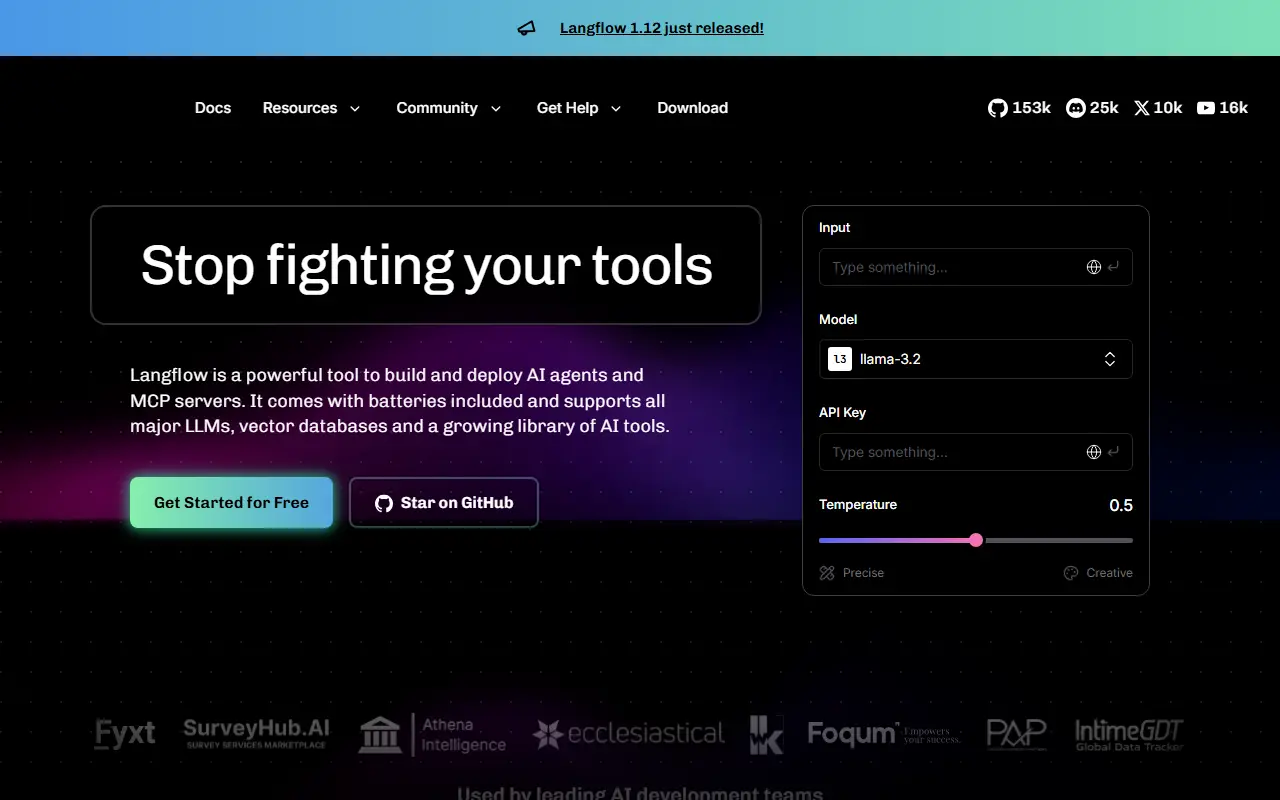
langflow.orgLangflow homepage screenshot

Langflow is an open-source platform for building AI-powered agents and workflows. Developers assemble flows in a visual authoring interface and can then deploy each flow as an API or export it as JSON for use in Python applications. It is written in Python and released under the MIT license.

The visual builder is paired with source-code access, so any component can be customized in Python, and an interactive playground lets you test and refine flows step by step. Langflow can orchestrate several agents with conversation handling and retrieval, works with the major LLMs and vector databases, and can expose flows as an MCP server so they become tools for MCP clients. Observability integrations include LangSmith and LangFuse.

You can install the Python package locally with uv, after which it serves the app at a local address, or use Langflow Desktop for Windows and macOS, which bundles its dependencies. It suits developers and AI teams prototyping retrieval and agent workflows who want both a drag-and-drop canvas and the freedom to write code.

Key features

  • Visual builder for agents and workflows
  • Python source access to customize components
  • Interactive playground for testing flows
  • Multi-agent orchestration with retrieval
  • Deploy flows as APIs or export as JSON
  • MCP server mode exposing flows as tools
  • Observability integrations such as LangFuse

Pricing: Free and open source under the MIT license.

Sim

A collaborative workspace for building, deploying and monitoring AI agents and workflows, with 1,000+ integrations, built-in tables and knowledge, in cloud or self-hosted form.

GitHub stars
30k
Last commit
today
Latest release
v0.9.10
Licence
Apache-2.0
Self-hosted
Yes
Hosted version
Available

Sim is a workspace for building, deploying and managing AI agents and workflows. You can build visually, conversationally or with code, connect more than a thousand integrations such as Slack, Notion, HubSpot, Salesforce and databases, and use any major LLM provider. The platform includes monitoring of runs, logs, schedules and workflow activity.

Beyond workflows, the same workspace also holds tables, files and knowledge. Tables act as a built-in database, files give the team and every agent one shared store, and knowledge bases serve as the agents' memory, ingesting files and structured data. The workspace is available in the browser and also as a desktop app for macOS 12 and later, for both Apple Silicon and Intel, which can be pointed at a self-hosted deployment.

Sim can be used as a cloud-hosted service at sim.ai or self-hosted, which requires Node.js 20 or newer and Docker. An interactive npx sim-setup wizard creates a deployment directory, provisions the database, generates secrets, writes the environment file and starts the services. The code is Apache-2.0 licensed and written in TypeScript with Next.js.

Key features

  • Visual, conversational and code-based agent building
  • 1,000+ integrations and major LLM support
  • Built-in tables, files and knowledge bases
  • Run, log and schedule monitoring
  • macOS desktop app
  • Interactive self-hosting setup wizard

Pricing: A free plan is available. Pro is $25 and Max $100 per user per month on monthly billing, with about 15% off annually; Enterprise is custom and sold through sales.

Refly

Open-source agent skills builder for creating versioned, reusable workflows that run in Refly, ship as APIs, or export to tools like Claude Code and Cursor.

GitHub stars
7.5k
Last commit
2 mo ago
Latest release
v1.1.0
Self-hosted
Yes
Hosted version
Available
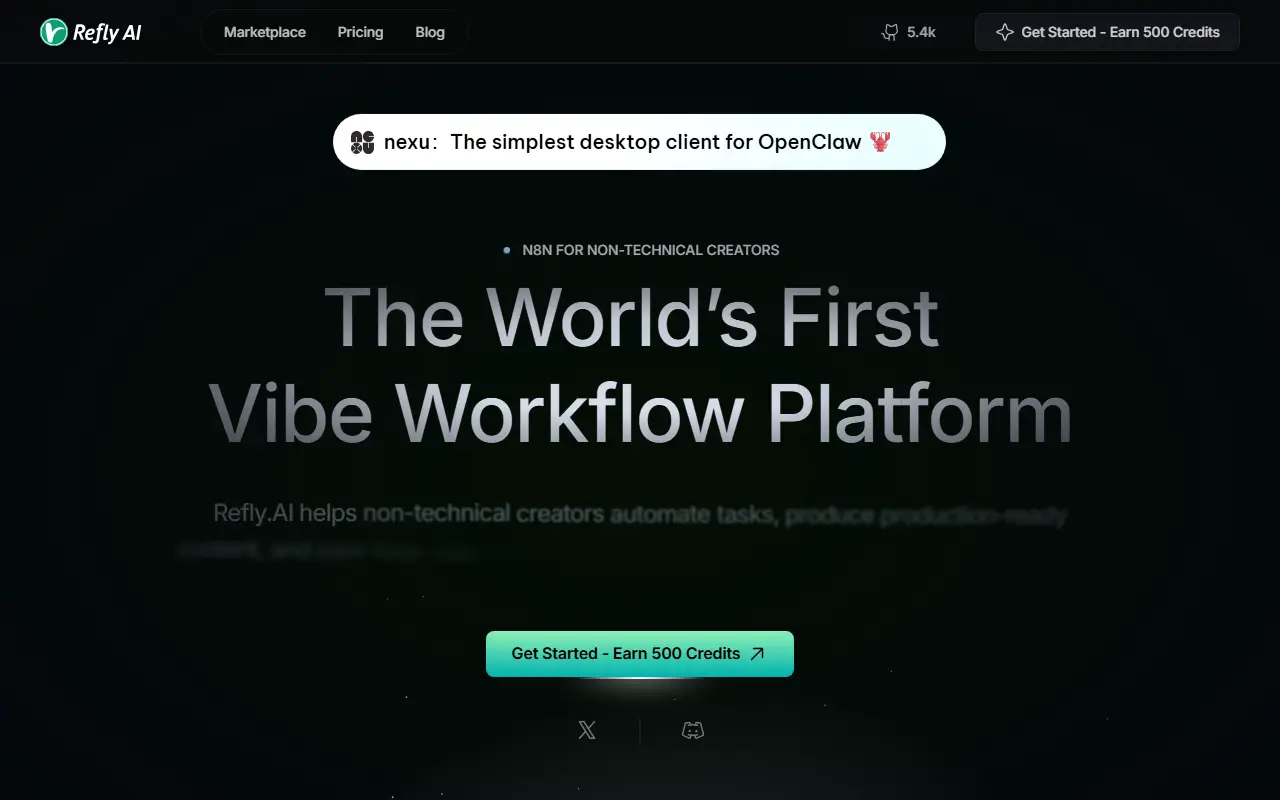
refly.aiRefly homepage screenshot

Refly is an open-source platform for building agent skills, which it treats as durable, versioned infrastructure rather than one-off prompts. You describe a workflow, Refly turns it into an executable skill, and that skill can be reused across teams and runtimes. The input lists its license only as other, so check the repository for terms.

Skills can be run in Refly with one click, exported to coding tools such as Claude Code, or deployed as APIs. Webhooks and bots can connect to Slack and Lark or Feishu, and a skills registry lets the community import, fork, and publish skills. Its topics mention n8n as a comparable workflow tool, and the project talks about compiling enterprise operating procedures into skills.

Refly can be deployed on your own server with Docker using the self-deployment guide, which the project recommends for developers, or accessed through a hosted workspace. It suits developers and operations teams automating repeatable work with AI agents and wanting those automations to be reviewable and shareable.

Key features

  • Builds versioned agent skills from workflows
  • Export skills to Claude Code and similar tools
  • Deploy workflows as APIs
  • Slack and Lark or Feishu bot integrations
  • Community skills registry with import and fork
  • Docker self-deployment guide

Pricing: A free plan gives 100 credits per day. Plus costs $19.9 per month, or $190 per year billed yearly, with 2,000 monthly credits.

Magic

Enterprise-oriented open-source AI agent platform that combines a general-purpose AI agent, a workflow engine, messaging, and collaborative office tools.

GitHub stars
5k
Last commit
1 mo ago
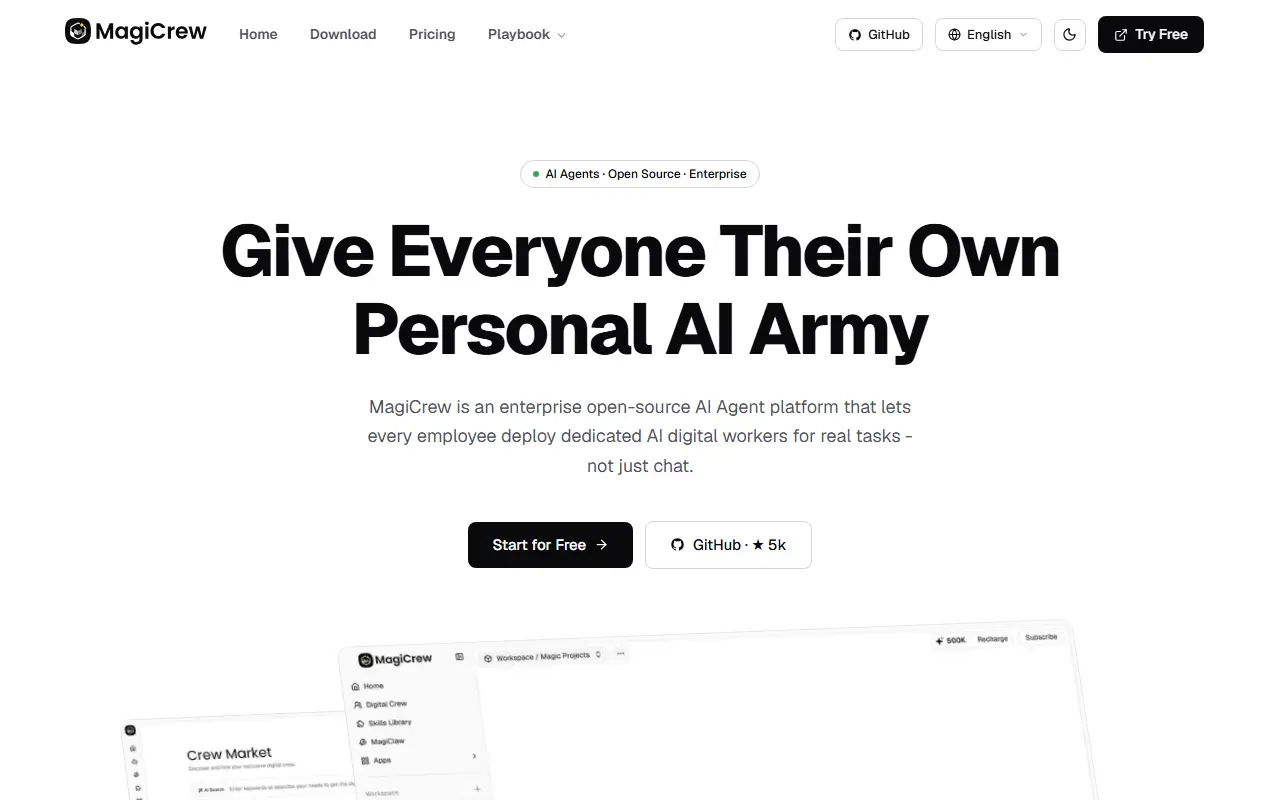
magicrew.aiMagic homepage screenshot

Magic, from the Magicrew project, is an open-source AI agent platform aimed at enterprises. It combines a generalist AI agent, a workflow engine, instant messaging, and an online collaborative office system in one product. The input lists its license only as other, so check the repository for terms.

The README frames it in contrast to personal AI assistants such as OpenClaw, which it credits as strong for individuals. In company settings, it argues, problems arise: data scattered across personal accounts, no budget guardrails, output that stops at plain text, and risky actions without approval gates. Magic is built to address security, control, direct business outcomes, and autonomous round-the-clock operation. Topics reference MCP, sandboxes, low-code and no-code workflows.

It is written in TypeScript and suits organizations that want to deploy AI agents with administrative control rather than adopt consumer tools. As the claims are the vendor's own, teams should evaluate its security and governance features themselves.

Key features

  • Generalist AI agent
  • Workflow engine with low-code building
  • Built-in instant messaging
  • Online collaborative office tools
  • MCP support and sandboxed execution
  • Approval gates for high-risk actions

Pricing: A free plan is given on sign-up. Paid plans are shown at $9.99 (Plus), $24.99 (Pro), $49.99 (Max) and $99.99 (Ultra) per month with points allowances, at a displayed discount.

LoomFlow

Lightweight AI-first workflow builder that turns a natural-language description into a runnable workflow and publishes it as an authenticated API.

GitHub stars
222
Last commit
17 days ago
Latest release
v0.1.11
Licence
MIT
Self-hosted
Yes
loom-flow-ashen.vercel.appLoomFlow homepage screenshot

LoomFlow is a workflow builder for individuals and small teams that starts from a plain-language idea. You describe what you want, it generates a runnable workflow on a visual canvas, you adjust it, and then you publish it as an authenticated HTTP API with shareable pages. It also includes built-in evaluation, evolution and quality gates for the AI steps. It is aimed at indie developers, content creators, small studios and automation hobbyists.

The README compares it with Dify and n8n. It describes Dify as a heavier platform for team LLM apps with knowledge bases and complex deployment, and n8n as general-purpose automation where AI is one node type among many. LoomFlow positions itself as the lightweight, AI-first option that is quick to start and easy to run.

Deployment is a single Docker command for self-hosting, and the README says the setup runs on modest hardware. The application is built with TypeScript and Next.js, uses Supabase according to its topics, and is licensed under MIT. The README warns users to change the default administrator credentials after installation.

Key features

  • Generates workflows from natural-language descriptions
  • Visual canvas for editing flows
  • One-click publishing as an authenticated API
  • Shareable runnable flow pages
  • Built-in evaluation and quality gates
  • Single-command Docker self-hosting

Pricing: Free and open source under the MIT license.

Gumloop alternatives: questions

What is the best open-source alternative to Gumloop?
Dify is the top-ranked open-source alternative to Gumloop on Enlisted: An LLM application platform for building AI workflows, RAG pipelines and agents on one canvas, deployable in the cloud, a private VPC or self-hosted. Other strong options are Langflow, Sim, Refly and Magic.
Are these Gumloop alternatives free?
All 6 are open source, so the code is free to use under its licence, and all of them can be self-hosted on your own server or computer. 3 also offer a paid or managed cloud version if you'd rather not host it yourself.
How is this list of Gumloop alternatives ranked?
By a score built from GitHub stars, star growth over the last 30 days and how recently the code changed. 4 of these projects shipped code in the last 30 days. Data is refreshed daily, and nobody can pay to move up.

People also look for alternatives to…

View all