
About Dragonfly
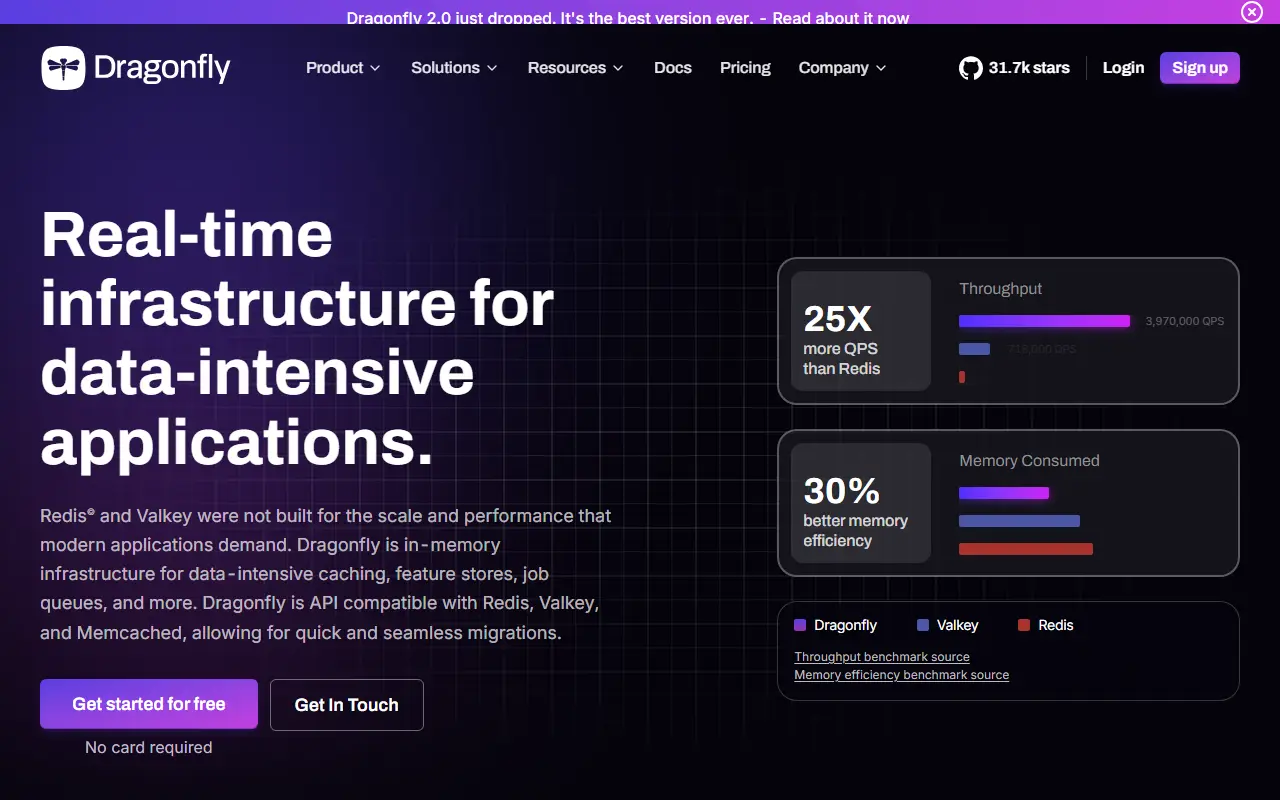
Dragonfly is an in-memory data store designed for modern application workloads and positioned as a replacement for Redis and Memcached. It implements the Redis and Memcached APIs, so existing applications and client libraries can point at it without code changes.
Unlike the single-threaded design of classic Redis, Dragonfly is multi-threaded and built around fibers, which lets one instance use many CPU cores. The project reports much higher throughput, better cache hit rates with lower tail latency and up to 80 percent fewer resources for a workload of the same size, with benchmarks against Redis on cloud instances in its documentation. Topics also link it to caching, key-value storage, message brokering and the Valkey and KeyDB ecosystems. Documentation covers a quick start, configuration, design decisions and building from source.
Dragonfly's license is listed as 'Other' on GitHub, so check the terms before using it in a commercial product. You can run it on your own servers or through Dragonfly Cloud, the company's hosted service, and a guide for AI agents is provided for tooling integration.
Key features
- Compatible with Redis and Memcached APIs
- Multi-threaded, fiber-based architecture
- Drop-in adoption without code changes
- Caching, key-value and message broker uses
- Published benchmarks against Redis
- Managed Dragonfly Cloud option
Good fit for
- →Replacing Redis to cut infrastructure cost
- →High-throughput caching layers
- →Session and leaderboard storage
- Tags
- in-memory
- redis-alternative
- memcached
- cache
- key-value
- database
- cpp
- multi-threaded
- nosql
Dragonfly: questions and answers
- What is Dragonfly used for?
- Dragonfly is an in-memory data store written in C++ that speaks the Redis and Memcached protocols, using a multi-threaded design to use modern hardware more efficiently. It is a good fit for replacing Redis to cut infrastructure cost, high-throughput caching layers, and session and leaderboard storage.
- Is Dragonfly open source?
- Yes. Dragonfly is open source under a custom licence. Its source code is on GitHub at dragonflydb/dragonfly and is written mainly in C++.
- Is Dragonfly free?
- Yes. Dragonfly is open source, so the software itself is free to use under the terms of its own licence. A managed cloud version is also available.
- Can I self-host Dragonfly?
- Yes. Dragonfly can be self-hosted on your own server or infrastructure.
- What is Dragonfly an alternative to?
- Dragonfly is an open-source alternative to Upstash, Amazon ElastiCache, Amazon MemoryDB and Google Memorystore. Other open-source alternatives to Upstash include Valkey, Redis and DiceDB.
- Is Dragonfly actively maintained?
- Yes. The most recent commit to Dragonfly was on 2 October 2026, and the latest release is v2.0.0, published on 16 September 2026. The project has 32k stars on GitHub.
Open-source alternatives to Dragonfly
See all
Valkey
Databases
A flexible distributed key-value database that is optimized for caching and other realtime
BSD-3-Clausevs Upstash★ 27k
Redis
Databases
For developers, who are building real-time data-driven applications, Redis is the preferre
OSSvs Upstash★ 77k
DiceDB
Databases
Open-source, low-latency key/value engine built on Valkey with query subscriptions and hie
OSSvs Upstash★ 11k
Garnet
Databases
Garnet is a remote cache-store from Microsoft Research that offers strong performance (thr
MITvs Upstash★ 12k
Memcached
Databases
memcached development tree
BSD-3-Clausevs Amazon ElastiCache★ 14k
ScyllaDB
Databases
NoSQL data store using the Seastar framework, compatible with Apache Cassandra and Amazon
OSSvs Amazon DynamoDB★ 16k
SaaS alternatives to Dragonfly
See all
Upstash
Databases
Serverless Redis, Kafka and vector database with per-request pricing
SaaS
Amazon ElastiCache
Databases
Managed in-memory caching service on AWS for Redis OSS, Valkey and Memcached
SaaS
Amazon MemoryDB
Databases
Durable in-memory database service on AWS compatible with Valkey and Redis OSS
SaaS
Google Memorystore
Databases
Managed in-memory data store on Google Cloud for Redis, Valkey and Memcached
SaaS
Aerospike
Databases
Real-time NoSQL database for low-latency, high-throughput applications
SaaS
Momento
Databases
Serverless cache and pub/sub service with no infrastructure to manage
SaaS