
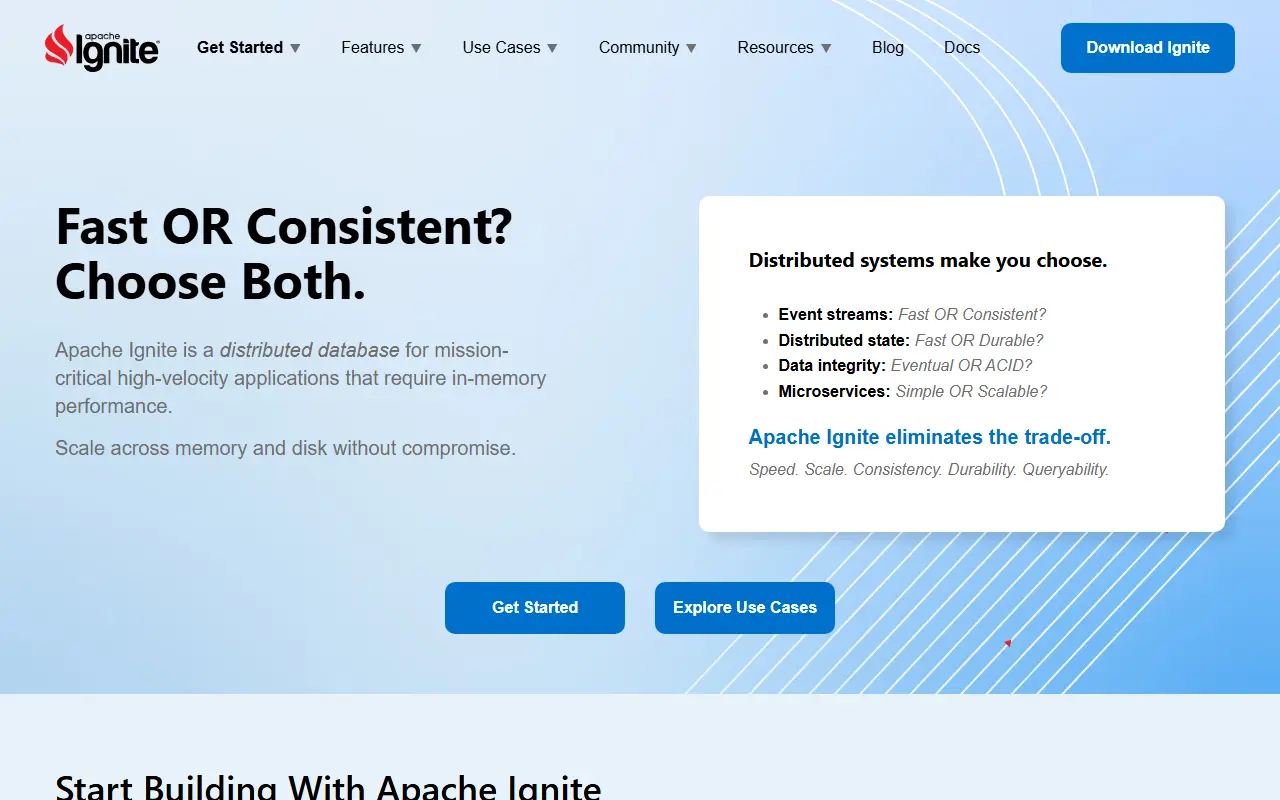
About Apache Ignite
Apache Ignite is a clustered database aimed at high-performance computing, running at the speed of memory. It can act as a data grid, cache and SQL database across a cluster, which suits workloads that need low-latency access to large datasets. This repository contains Ignite 2, while Ignite 3 lives in a separate repository, and both are actively developed.
Its multi-tier storage design treats RAM, disks and Intel Optane as separate layers that can all hold live data. The memory tier holds data in DRAM or Optane in memory mode, and the disk tier is optional, offering persistence either in an external database or in Ignite's own storage. Client APIs are available for Java, .NET and C++, and repository topics mention distributed SQL, in-memory computing, Hadoop and IoT.
Ignite is an Apache Software Foundation project under Apache-2.0 and written in Java. You deploy it on your own servers or Kubernetes clusters. It suits teams building data-intensive services that need fast reads and writes, transactions and SQL together.
Key features
- In-memory distributed database
- Multi-tier storage with memory and disk
- Distributed SQL queries
- Caching and data grid capabilities
- APIs for Java, .NET and C++
- Optional persistence of data
Good fit for
- →Low-latency caching layer for large datasets
- →In-memory computing for data-heavy apps
- Built with
- Java
- Tags
- distributed-database
- in-memory
- sql
- cache
- apache
- java
- data-grid
Apache Ignite: questions and answers
- What is Apache Ignite used for?
- Apache Ignite is a clustered in-memory database and data grid with optional disk persistence and SQL support, built for high-performance workloads. It is a good fit for low-latency caching layer for large datasets and in-memory computing for data-heavy apps.
- Is Apache Ignite open source?
- Yes. Apache Ignite is open source under the Apache-2.0 licence. Its source code is on GitHub at apache/ignite and is written mainly in Java.
- Is Apache Ignite free?
- Yes. Apache Ignite is open source, so the software itself is free to use.
- Can I self-host Apache Ignite?
- Yes. Apache Ignite can be self-hosted on your own server or infrastructure.
- What is Apache Ignite an alternative to?
- Apache Ignite is an open-source alternative to Aerospike. Other open-source alternatives to Aerospike include Apache Cassandra, Redis and Dragonfly.
- Is Apache Ignite actively maintained?
- Yes. The most recent commit to Apache Ignite was on 2 October 2026. The project has 5.1k stars on GitHub.
Open-source alternatives to Apache Ignite
See all
Apache Cassandra
Databases
Open source transactional distributed database. Linear scalability and proven fault-tolera
Apache-2.0vs Amazon DynamoDB★ 10k
Redis
Databases
For developers, who are building real-time data-driven applications, Redis is the preferre
OSSvs Upstash★ 77k
Dragonfly
Databases
A modern replacement for Redis and Memcached
OSSvs Upstash★ 32k
Valkey
Databases
A flexible distributed key-value database that is optimized for caching and other realtime
BSD-3-Clausevs Upstash★ 27k
ScyllaDB
Databases
NoSQL data store using the Seastar framework, compatible with Apache Cassandra and Amazon
OSSvs Amazon DynamoDB★ 16k
StarRocks
Databases
The world's fastest open query engine for sub-second analytics both on and off the data la
Apache-2.0vs Snowflake★ 12k
SaaS alternatives to Apache Ignite
See all
Aerospike
Databases
Real-time NoSQL database for low-latency, high-throughput applications
SaaS
Google Cloud Bigtable
Databases
Managed wide-column NoSQL database on Google Cloud for large analytical and operational workloads
SaaS
Exasol
Databases
In-memory analytics database for fast SQL queries on large datasets
SaaS
Google Cloud Spanner
Databases
Google horizontally scalable relational database with strong consistency
SaaS
Amazon Athena
Databases
Serverless interactive query service for analyzing data in Amazon S3 with SQL
SaaS
Amazon ElastiCache
Databases
Managed in-memory caching service on AWS for Redis OSS, Valkey and Memcached
SaaS