#1
An open-source Postgres development platform bundling a database, auth, auto-generated APIs, realtime, storage and vector tools, often chosen as a Firebase alternative.
- GitHub stars
- 115k
- Last commit
- today
- Latest release
- v1.26.08
- Licence
- Apache-2.0
- Self-hosted
- Yes
- Hosted version
- Available
supabase.com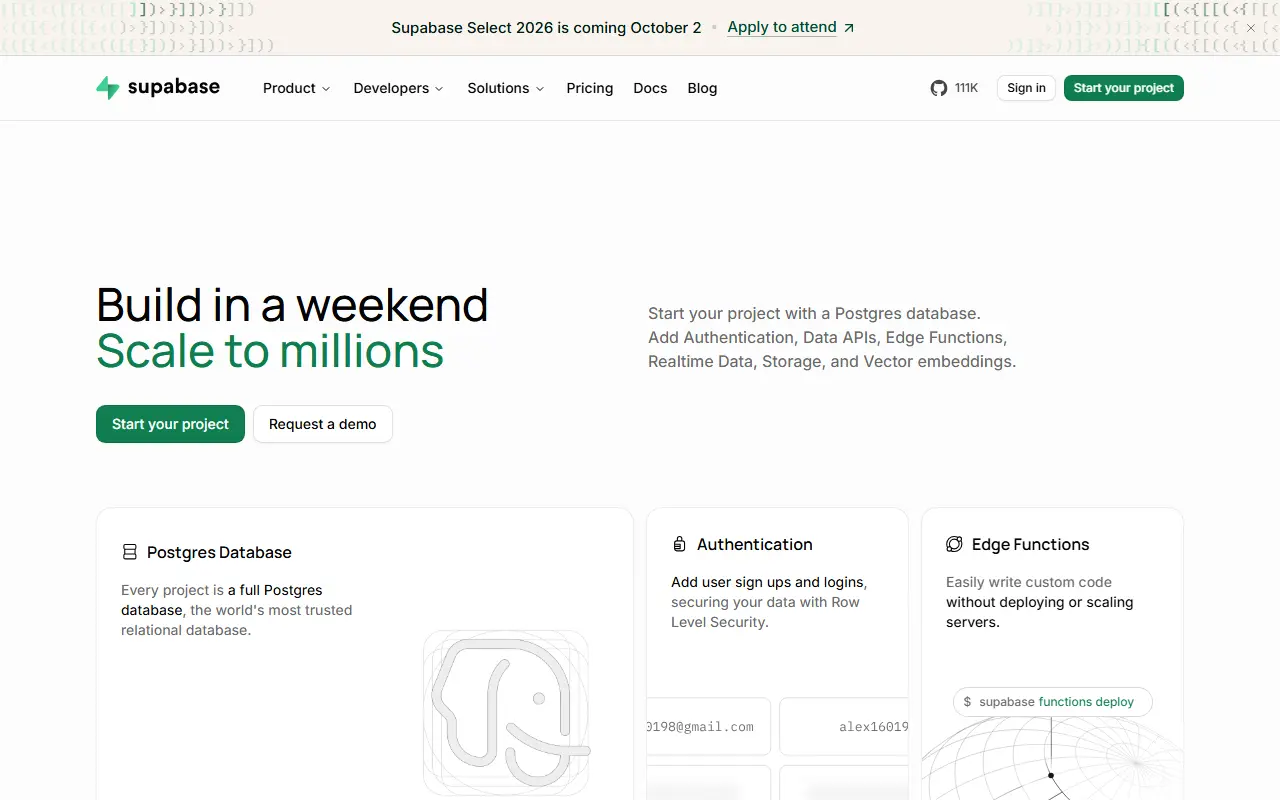
Supabase is a backend platform built around a dedicated Postgres database. It packages the pieces most web, mobile and AI apps need, including authentication and authorization, auto-generated APIs, file storage, serverless functions and a dashboard, so developers can start without assembling separate services. Its stated aim is a developer experience similar to Firebase, built from open-source components.
APIs are generated from your schema as REST and GraphQL, with realtime subscriptions over websockets. Logic can live in database functions or in Edge Functions that run on Deno. For AI work there is a toolkit for vectors and embeddings built on pgvector, and Postgres extensions such as PostGIS are available. Supabase combines existing open tools with ones it builds itself when nothing suitable exists.
The code is Apache-2.0 licensed. Supabase is offered as a hosted platform you can sign up for without installing anything, and the same stack can be self-hosted or run locally for development. It suits teams that want Postgres at the core of their app but prefer not to build the surrounding backend themselves.
Key features
- Hosted Postgres database with a dashboard
- Authentication and authorization
- Auto-generated REST and GraphQL APIs
- Realtime subscriptions over websockets
- Edge Functions and database functions
- File storage for user uploads
- Vector and embeddings toolkit with pgvector
Pricing: Free plan with 50,000 monthly active users. Pro starts at $25 and Team at $599 per month, with usage and extra compute billed on top; Enterprise is custom.
#2
An open-source system for deploying, scaling and managing containerized applications across clusters of hosts, hosted by the CNCF.
- GitHub stars
- 129k
- Last commit
- yesterday
- Latest release
- v1.37.2
- Licence
- Apache-2.0
- Self-hosted
- Yes
- Hosted version
- Available
kubernetes.io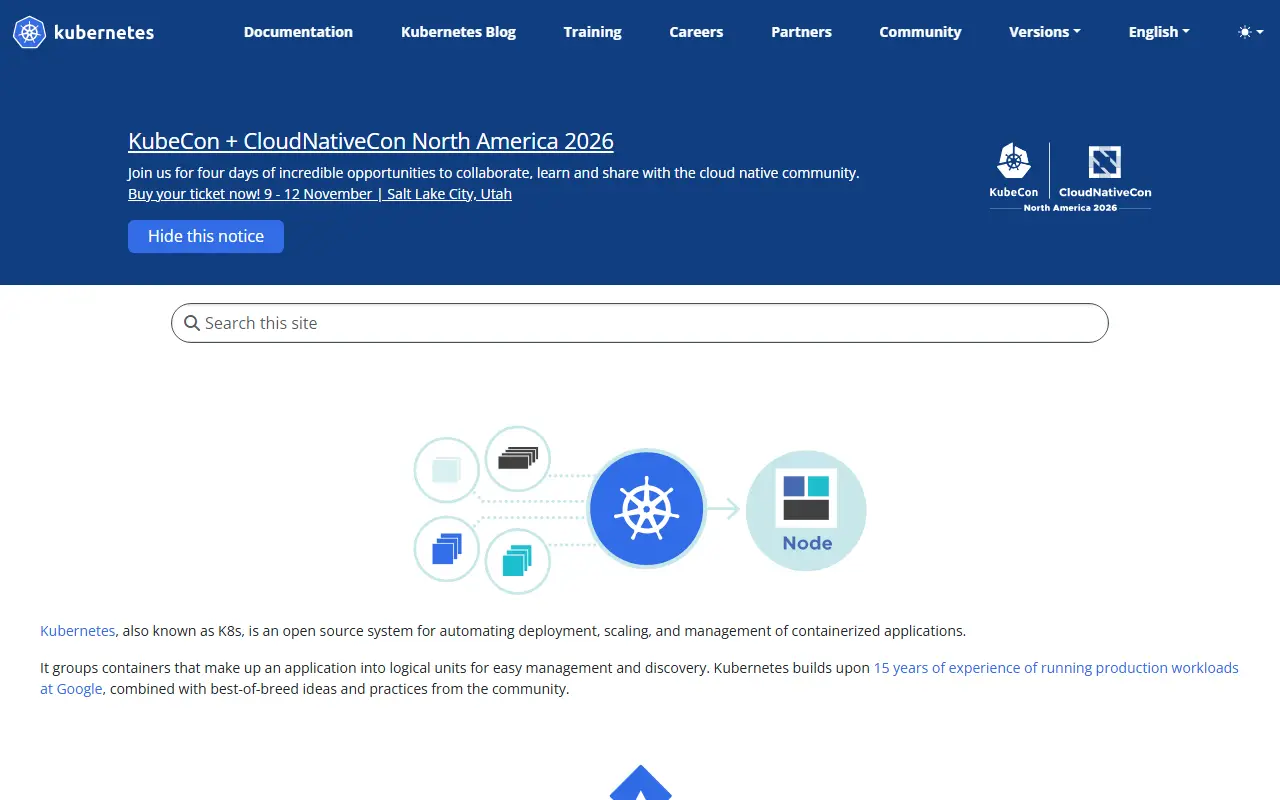
Kubernetes, also written K8s, is an open-source system that manages containerized applications across multiple hosts. It provides the basic mechanisms for deploying, maintaining and scaling applications, so teams can run containers reliably without scheduling each one by hand. It is written in Go and released under the Apache-2.0 license.
The project builds on years of experience running production workloads at Google with an internal system called Borg, combined with practices from the wider community. The Cloud Native Computing Foundation hosts the project. Users interact with it through declarative configuration and the documentation on kubernetes.io, which includes tutorials and a free course on scalable microservices.
Kubernetes can be run on your own infrastructure, and major cloud providers also offer managed Kubernetes services. The README adds that the k8s.io/kubernetes module is not supported for use as a library. It suits platform and DevOps teams running microservices that need scheduling, scaling and automatic recovery.
Key features
- Container scheduling across multiple hosts
- Automated application deployment and rollouts
- Scaling of containerized workloads
- Maintenance and self-healing of applications
- Declarative configuration of desired state
- CNCF-hosted with extensive documentation
Pricing: Free and open source under the Apache-2.0 license; cloud providers sell managed services built on it.
#3
An in-memory data store used as a cache, session store, data structure server, message broker and vector query engine for real-time applications.
- GitHub stars
- 77k
- Last commit
- yesterday
- Latest release
- 8.10.3
- Self-hosted
- Yes
- Hosted version
- Available
redis.io
Redis is an in-memory data store that developers use as a cache, a session store, a database and a message broker. Because data lives in memory it answers requests quickly, which makes it popular for real-time applications. The project describes itself as a cache, a data structure server, and a document and vector query engine.
Rather than just strings, it offers data structures such as lists, sets, hashes, sorted sets and JSON, with higher-level patterns built on them, such as counters, queues, leaderboards and rate limiters, plus transactions and scripting. For caching it offers multiple eviction policies along with expiry for keys and for individual hash fields. It also handles key-value, document and time series storage, vector search and messaging. Client libraries cover most languages, and redis-cli and Redis Insight provide command line and graphical access.
The source is on GitHub, written in C, and can be built from source with documented flags for allocators, TLS and more. The license is listed as 'Other' in repository metadata, so check the current terms. Redis can be run on your own servers or consumed as a cloud-hosted service from the vendor.
Key features
- Rich data types including hashes and sorted sets
- Caching with eviction and key expiration
- JSON, time series and document storage
- Vector search for AI applications
- Message broker and queue support
- Transactions and server-side scripting
Pricing: Redis Cloud has a free 30 MB tier. Essentials starts at about $5 per month ($0.007 per hour) and Pro at $0.014 per hour with a $200 monthly minimum, billed on demand.
#4
PostgreSQL is an object-relational database management system supporting SQL features such as transactions, foreign keys and triggers.
- GitHub stars
- 23k
- Last commit
- yesterday
- Self-hosted
- Yes
postgresql.org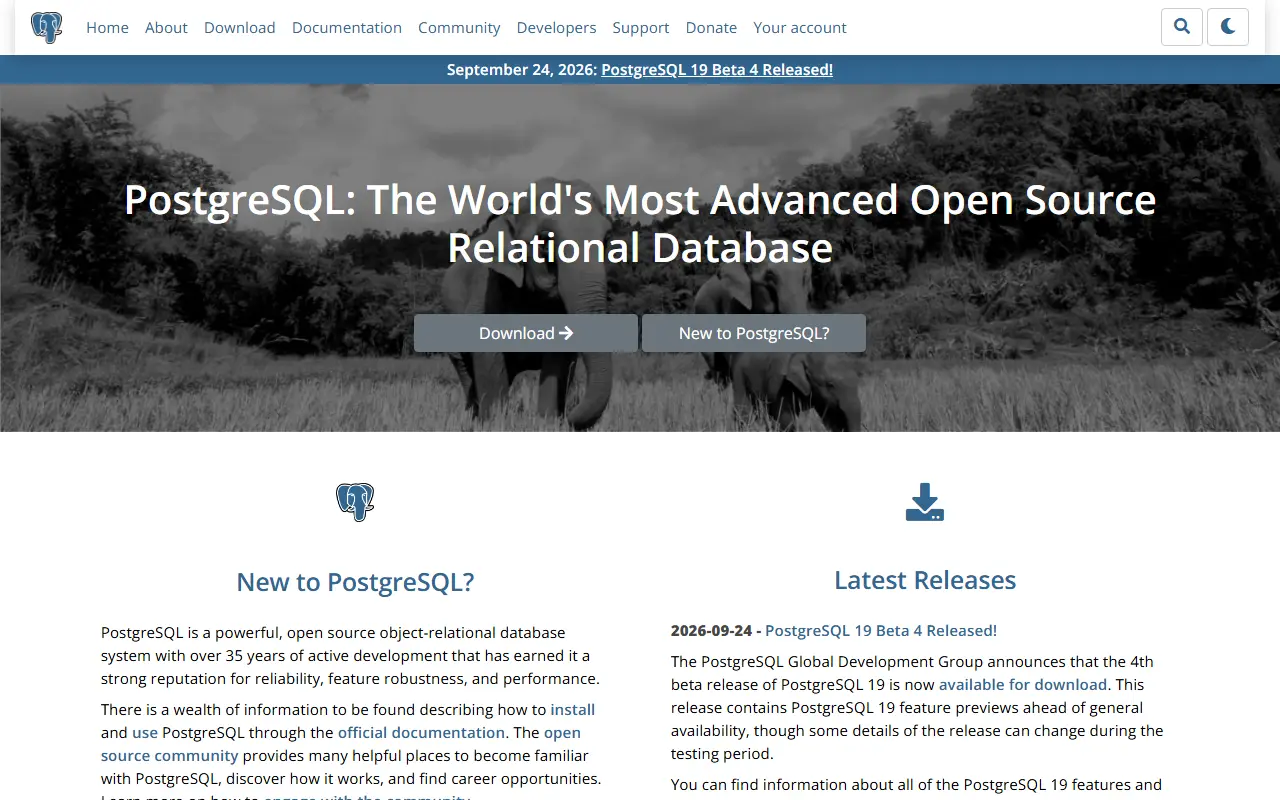
PostgreSQL is a feature-rich object-relational database management system covering a large part of the SQL standard. Its feature set includes transactions, foreign keys, subqueries, triggers, and user-defined types and functions, and the distribution also contains C language bindings. This GitHub repository is only a mirror of the official git repository, written in C, and the metadata lists the license as Other.
The project does not use GitHub pull requests; contributors submit patches through the process described on the PostgreSQL wiki. Copyright and license terms are in the COPYRIGHT file, general documentation for each version is published on the project site, and build instructions explain how to compile the server from source. The latest releases of the software and related software are available from the PostgreSQL website. Many hosting providers offer managed PostgreSQL, but the project itself is software you install and operate.
Key features
- Object-relational database with SQL support
- Transactions and foreign keys
- Subqueries and triggers
- User-defined types and functions
- C language bindings
- Documentation for building from source
Pricing: Free and open source; the repository lists the license as Other, so see the COPYRIGHT file for terms.
#5
A high-performance, open-source key-value data store forked from Redis before its license change, built for caching and realtime workloads with a module system.
- GitHub stars
- 28k
- Last commit
- yesterday
- Latest release
- 9.1.3
- Licence
- BSD-3-Clause
- Self-hosted
- Yes
valkey.io
Valkey is a distributed key-value database optimized for caching and other realtime workloads. It was forked from the open-source Redis project just before Redis moved to source-available licenses, and it continues as a community-driven alternative under the permissive BSD-3-Clause license.
It acts as a data structure server that mainly handles key-value workloads, supporting many native data structures along with an extensible module system for adding new structures and access patterns. The code is written in C and can be compiled with a simple make command on Linux, macOS, OpenBSD, NetBSD and FreeBSD, on both big and little endian and 32 and 64-bit systems. Support for Solaris-derived systems is limited and not guaranteed. TLS needs OpenSSL development libraries and can be built in or as a module.
The README is a quick-start only, with fuller documentation on valkey.io. Valkey is self-run software and is compatible with the Redis ecosystem of clients, so teams use it as a replacement for Redis in caching, session storage and queues when they prefer a fully open-source license.
Key features
- Distributed key-value data store
- Native data structures
- Extensible module system
- Builds on Linux, macOS and BSD systems
- TLS support built in or as a module
- Permissive BSD-3-Clause open-source license
Pricing: Free and open source under the BSD-3-Clause license.
#6
The source repository for MongoDB, a document-oriented NoSQL database server written in C++, with sharding support and official drivers for most languages.
- GitHub stars
- 29k
- Last commit
- today
- Self-hosted
- Yes
- Hosted version
- Available
mongodb.com
This repository holds the source of MongoDB, the document-oriented NoSQL database. It is written in C++ and contains the main server components: mongod, the database server, and mongos, the router used for sharded clusters. MongoDB stores flexible JSON-like documents rather than rows in fixed tables.
Most users install prebuilt packages rather than building from source. The README points to the community server download page, the mongodb-community-server Docker image and Homebrew taps, and also covers the MongoDB Shell, mongosh, and MongoDB Compass, a graphical client that can be installed with a packaged script. Client drivers exist for most programming languages, and RPM and Debian packages are produced by the build scripts. Documentation and a developer center help with learning.
The repository's license is listed as 'Other' on GitHub, so read the current license terms before building services on it. MongoDB can be run on your own infrastructure, and MongoDB Inc. also operates a managed cloud service. It is widely used as a general-purpose database for applications with evolving schemas.
Key features
- Document-oriented NoSQL database server
- mongos router for sharded clusters
- MongoDB Shell and Compass GUI
- Official drivers for most languages
- Docker image and Homebrew packages
- RPM and Debian packaging scripts

MariaDB Server is an open-source relational database that began as a fork of MySQL, with vector search, pluggable storage engines and Galera clustering.
- GitHub stars
- 8.6k
- Last commit
- today
- Latest release
- mariadb-13.0.2
- Licence
- GPL-2.0
- Self-hosted
- Yes
mariadb.org
MariaDB Server is an open-source relational database built by a global community with the MariaDB Foundation and MariaDB plc. It started out as a MySQL fork driven by the people who created MySQL, keeps a high degree of MySQL compatibility, and is described as a straightforward migration target for existing MySQL deployments.
Since then it has gained its own capabilities. A native VECTOR data type with approximate nearest-neighbour HNSW indexing has been available since version 11.8. Pluggable storage engines include InnoDB, Aria and MyRocks, plus ColumnStore (analytics), Spider (sharding) and S3 (archiving). Replication options include async, semi-sync and parallel modes using global transaction IDs, and Galera provides synchronous multi-primary clustering. On the SQL side it offers common table expressions, window functions, temporal tables with system versioning, sequences and a range of JSON functions.
It also offers an Oracle SQL mode with PL/SQL-style routines, GIS data types and full-text indexing, and security features such as role-based access control, pluggable authentication, data-at-rest encryption and TLS. MariaDB is written in C++ and licensed under GPL-2.0, and you run it on your own servers or in the cloud.
Key features
- Native vector search with HNSW indexing
- Pluggable storage engines including InnoDB
- Galera synchronous multi-primary clustering
- Temporal tables and window functions
- MySQL and Oracle compatibility modes
- Spatial and full-text indexing
- Role-based access and data-at-rest encryption
Pricing: Free and open source under the GPL-2.0 licence.
#8
A Kubernetes operator that manages the full lifecycle of PostgreSQL clusters, including high availability, failover, backups and updates, without external HA tools.
- GitHub stars
- 9.6k
- Last commit
- today
- Latest release
- v1.30.1
- Licence
- Apache-2.0
- Self-hosted
- Yes
cloudnative-pg.io
CloudNativePG, often shortened to CNPG, is an open-source platform for running PostgreSQL databases on Kubernetes. Its core component is an operator that handles the whole operational lifecycle, from deployment to ongoing maintenance, in a way that fits GitOps-driven CI/CD automation.
It takes a Kubernetes-native approach to primary and standby cluster management. Rather than relying on external high-availability tools such as Patroni, repmgr or Stolon, the operator integrates directly with the Kubernetes API, and the status of a PostgreSQL cluster is exposed on the Cluster resource. It follows the operator pattern to reconcile the desired state, and application containers are immutable. Topics also list failover, switchover, replication, disaster recovery, a kubectl plugin, a Prometheus exporter and JSON logging.
CloudNativePG is a CNCF project written in Go and licensed under Apache-2.0, with a quickstart guide, governance policies, a list of adopters and pointers to commercial support. It is intended for Kubernetes administrators who want PostgreSQL managed as a native workload.
Key features
- Kubernetes operator for PostgreSQL clusters
- Primary and standby cluster management
- Automated failover and switchover
- Direct Kubernetes API integration
- Immutable application containers
- Prometheus exporter and JSON logging
- Companion kubectl plugin
Pricing: Free and open source under the Apache-2.0 licence; the project points to commercial support providers.
#9
Source repository of the MySQL relational database server, covering the open-source Community edition and the clustered MySQL Cluster variant.
- GitHub stars
- 13k
- Last commit
- 16 days ago
- Self-hosted
- Yes
- Hosted version
- Available
mysql.com
MySQL is a widely used open-source relational database. This repository contains the MySQL Server source code along with MySQL Cluster, which the description presents as a real-time, open-source transactional database. Applications talk to it using SQL, and it is a common choice for web applications and embedded products.
The MySQL website describes several offerings built around the server: the Community Edition, with a published governance model and early access builds; MySQL Enterprise Edition for advanced features, management tools and technical support; MySQL HeatWave, a cloud service that combines transactions with analytics and machine learning; and MySQL Cluster CGE. A program for OEM and ISV vendors covers embedding the database in other products.
The server is written in C++ and distributed under licenses detailed in the repository. Organizations can run the Community Edition on their own infrastructure, buy a commercial edition from Oracle, which owns the project, or use a managed cloud offering. Documentation, downloads and a developer zone are available on mysql.com.
Key features
- Open-source relational database server
- SQL query interface
- MySQL Cluster for transactional workloads
- Community and Enterprise editions
- HeatWave managed cloud option
- Documentation and developer resources
Pricing: Community Edition is open source; Enterprise Edition and the HeatWave cloud service are commercial offerings.
#10
An open-source serverless Postgres platform that separates storage from compute to offer autoscaling, database branching and scale to zero.
- GitHub stars
- 23k
- Last commit
- 2 mo ago
- Latest release
- release-proxy-8853
- Licence
- Apache-2.0
- Self-hosted
- Yes
- Hosted version
- Available
neon.tech
Neon is a serverless Postgres database platform that is open source. It separates storage from compute and replaces the PostgreSQL storage layer with one that distributes data across a cluster of nodes, which enables autoscaling, branching of databases in the style of code, and scaling down to zero.
A running Neon system is made up of compute nodes plus a dedicated storage engine. The compute nodes are stateless PostgreSQL instances backed by that engine, whose two main components are the Pageserver, a scalable storage backend for the compute nodes, and the Safekeepers, a redundant write-ahead-log service that keeps WAL durably until the Pageserver has processed it and uploaded it to cloud storage. Developer documentation describes the architecture in more detail.
The easiest way to try Neon is the hosted Neon Free Tier, connecting with psql, DBeaver or the online SQL editor. The project is also written in Rust and licensed under Apache-2.0 so you can compile and run it locally for experiments, with build instructions for Linux and macOS. It suits teams that want Postgres with branching for development workflows and elastic scaling.
Key features
- Serverless Postgres with autoscaling
- Separated storage and compute
- Database branching for development
- Scale to zero when idle
- Pageserver and Safekeeper storage engine
- Hosted free tier available
Pricing: Free plan has no time limit. Launch is usage-based at $0.106 per CU-hour plus $0.35 per GB-month of storage; Scale is $0.222 per CU-hour.
1 more DigitalOcean Managed Databases alternative
DigitalOcean Managed Databases alternatives: questions
- What is the best open-source alternative to DigitalOcean Managed Databases?
- Supabase is the top-ranked open-source alternative to DigitalOcean Managed Databases on Enlisted: An open-source Postgres development platform bundling a database, auth, auto-generated APIs, realtime, storage and vector tools, often chosen as a Firebase alternative. Other strong options are Kubernetes, Redis, PostgreSQL and Valkey.
- What are the best commercial alternatives to DigitalOcean Managed Databases?
- Heroku Postgres, Instaclustr, Google Cloud SQL, ScaleGrid and Amazon Aurora are among the hosted, closed-source alternatives to DigitalOcean Managed Databases listed on Enlisted, which lists 42 in total. Compare their pricing and features on each tool page.
- Are these DigitalOcean Managed Databases alternatives free?
- All 11 are open source, so the code is free to use under its licence, and all of them can be self-hosted on your own server or computer. 6 also offer a paid or managed cloud version if you'd rather not host it yourself.
- How is this list of DigitalOcean Managed Databases alternatives ranked?
- By a score built from GitHub stars, star growth over the last 30 days and how recently the code changed. 10 of these projects shipped code in the last 30 days. Data is refreshed daily, and nobody can pay to move up.
 TrackMedia
 TrackRev