#1
A free, privacy-respecting metasearch engine that aggregates results from many search services without tracking or profiling users, designed for self-hosting.
- GitHub stars
- 39k
- Last commit
- yesterday
- Licence
- AGPL-3.0
- Self-hosted
- Yes
docs.searxng.org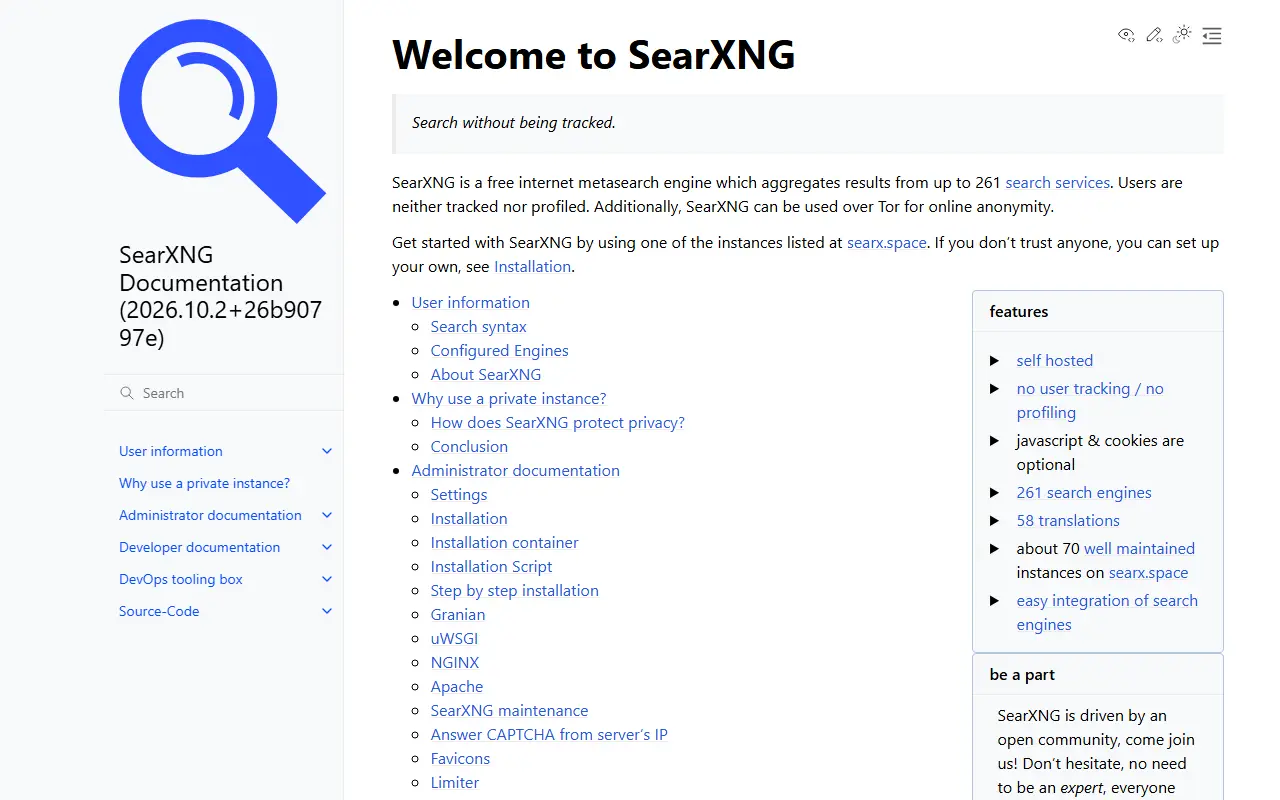
SearXNG is a free internet metasearch engine. It sends your query to many search services and databases, merges the results into one page, and does so without tracking or profiling the people who use it. Topics list engines such as Google, Bing, Brave, DuckDuckGo, Qwant and Startpage among the sources it can combine.
The documentation is organized for both users and administrators. Users get search syntax, a list of configured engines and an explanation of why a private instance matters. Administrators get settings in settings.yml, engine configuration, plugins, a bot-protection limiter, optional Redis or Valkey storage, and installation guides covering containers, an installation script and step-by-step setups with Granian or uWSGI behind NGINX or Apache. A long catalog of engines extends beyond web search to sources such as arXiv, Crossref, GitHub and Mastodon.
SearXNG is written in Python under the AGPL-3.0 license. Because it is meant to be self-hosted, you can run your own instance for yourself or a group; many volunteers also publicly host instances. It appeals to people who want to reduce reliance on any one search engine and keep their queries private.
Key features
- Aggregates results from many search engines
- No user tracking or profiling
- Configurable engines and plugins
- Container and script-based installation
- Optional Redis or Valkey integration
- Bot protection limiter
Pricing: Free and open source under the AGPL-3.0 license.
#2
A distributed, RESTful search and analytics engine written in Java, used for full-text search, log analysis and vector search across large datasets.
- GitHub stars
- 79k
- Last commit
- today
- Latest release
- v9.5.6
- Self-hosted
- Yes
- Hosted version
- Available
elastic.co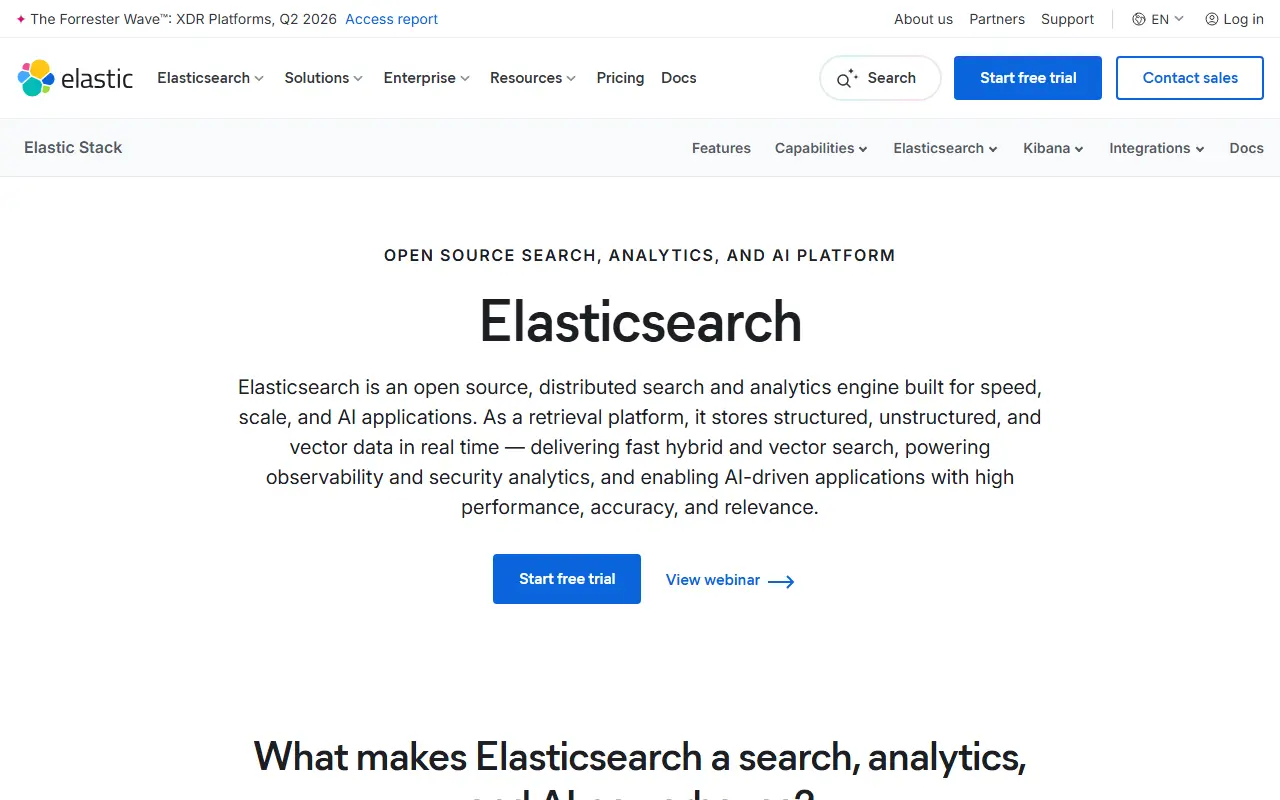
Elasticsearch is a distributed, RESTful search engine written in Java. It stores documents as JSON, indexes them so they can be searched quickly, and exposes everything through an HTTP API, which makes it a common backbone for site search, application search and log analytics. It is built on the Apache Lucene library.
Beyond full-text queries it supports filtering, aggregations for analytics and, in recent versions, vector search for semantic and AI-assisted retrieval. Data is spread across nodes in a cluster using shards and replicas, so capacity and resilience grow by adding machines. It is the core of the Elastic Stack, usually paired with Kibana for exploration and with ingestion tools for logs and metrics.
The repository describes the project as free and open source, while its license metadata is listed as 'Other', so review the current license terms before relying on it commercially. It can be self-managed on your own servers or used as a managed service through Elastic Cloud.
Key features
- Distributed full-text search over JSON documents
- RESTful HTTP API
- Aggregations for analytics
- Vector search for semantic retrieval
- Clustering with shards and replicas

A fast search engine API written in Rust that adds typo-tolerant, filterable and hybrid semantic search to websites and apps, available self-hosted or as a cloud service.
- GitHub stars
- 60k
- Last commit
- yesterday
- Latest release
- v1.56.2
- Self-hosted
- Yes
- Hosted version
- Available
meilisearch.com
Meilisearch is a search engine exposed through an API, written in Rust and designed to be dropped into applications and websites. It aims to give developers a good search experience quickly, with features that work out of the box rather than needing extensive tuning.
Its capabilities include hybrid search that combines semantic and full-text results, search-as-you-type with a target response time under 50 milliseconds, typo tolerance, filtering and faceted search, sorting and geosearch. The topics also describe it as a vector database for AI use cases. The project maintains example applications for movies, ecommerce with facets and filters, conversational home booking, personalization and a multi-tenant CRM, which show how the features fit together.
The license is listed as 'Other', so confirm the terms for your use case. Meilisearch can be run on your own infrastructure, and Meilisearch Cloud offers it as a managed service. It is a common pick for site search, product catalogs and in-app search where a lighter alternative to a large cluster is attractive.
Key features
- Hybrid semantic and full-text search
- Instant search-as-you-type results
- Typo tolerance and fuzzy matching
- Filtering and faceted search
- Sorting and geosearch
- Vector storage for AI search
- REST API with example demo apps
Pricing: Self-hosting is free under the MIT license. Meilisearch Cloud starts at $20 per month with a 14-day free trial, billed by usage or instance resources; Enterprise is quoted on request.
#4
A vector database and similarity search engine written in Rust, offering filtering over stored vectors and payloads, available self-hosted or as Qdrant Cloud.
- GitHub stars
- 36k
- Last commit
- today
- Latest release
- v1.20.0
- Licence
- Apache-2.0
- Self-hosted
- Yes
- Hosted version
- Available
qdrant.tech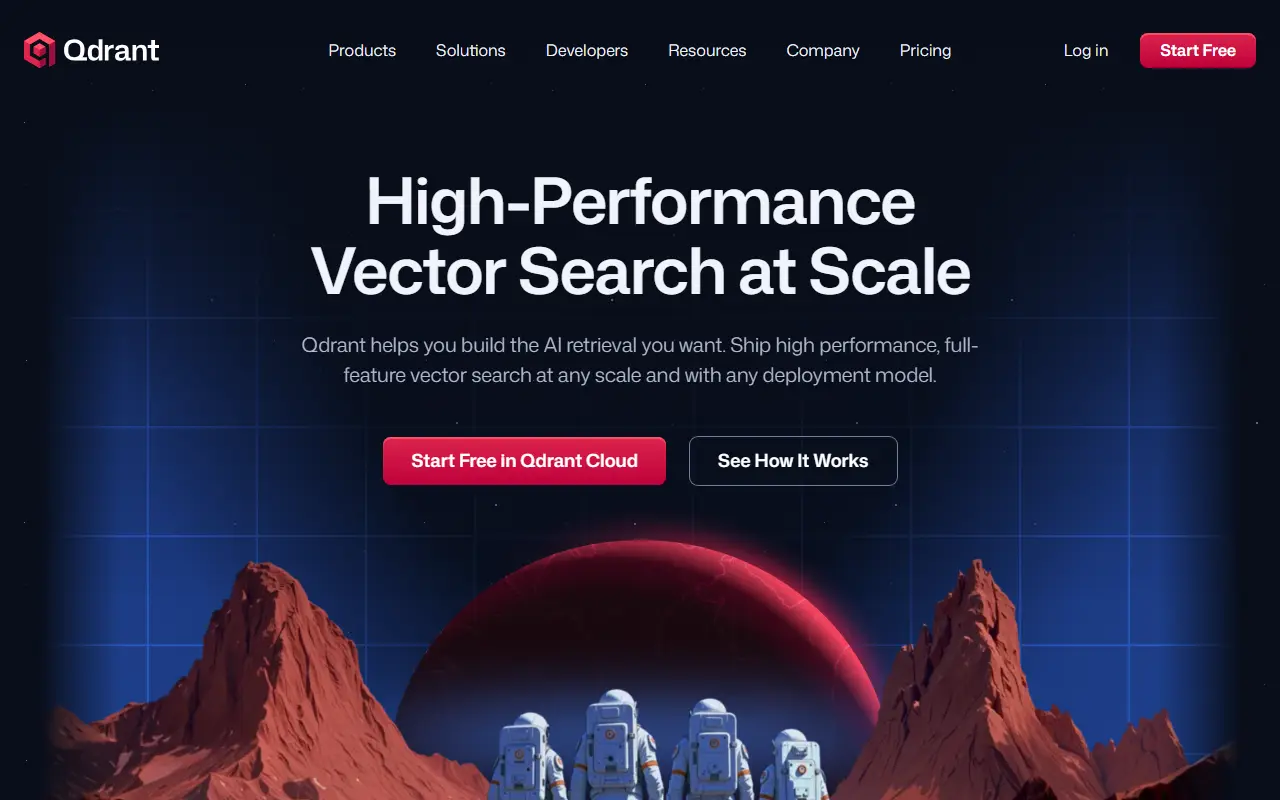
Qdrant is a vector database and similarity search engine. It stores points, which are vectors plus an attached payload, and exposes an API to store, search and manage them. That makes it a building block for semantic search, recommendations, image search and other applications that rely on embeddings from neural networks.
A key selling point is extended filtering support, so a vector query can be combined with conditions on the payload, which is useful for faceted search and matching. The engine is written in Rust and the maintainers point to benchmarks for its speed and reliability under load. Topics mention HNSW indexing and nearest-neighbor search, and there are client libraries, demo projects, integrations and a collection of agent skills that bring vector search into AI coding assistants.
Qdrant is Apache-2.0 licensed and can run on your own infrastructure. It is also available as the fully managed Qdrant Cloud, which includes a free tier. Teams building retrieval-augmented generation, recommendation and similarity features use it as the storage and retrieval layer for their embeddings.
Key features
- Vector storage with attached payloads
- Filtering combined with vector search
- HNSW-based nearest-neighbor search
- REST-style API with client libraries
- Agent skills for AI coding assistants
- Self-hosted or managed Qdrant Cloud
Pricing: A free-forever cloud tier is available. The Standard tier is usage-based, from $25; Premium requires a minimum spend and Hybrid and Private Cloud are quoted by the team.
#5
An open-source, cloud-native vector database for scalable similarity search over embeddings, with distributed, standalone and lightweight Python modes.
- GitHub stars
- 47k
- Last commit
- yesterday
- Latest release
- v3.0.6
- Licence
- Apache-2.0
- Self-hosted
- Yes
- Hosted version
- Available
milvus.io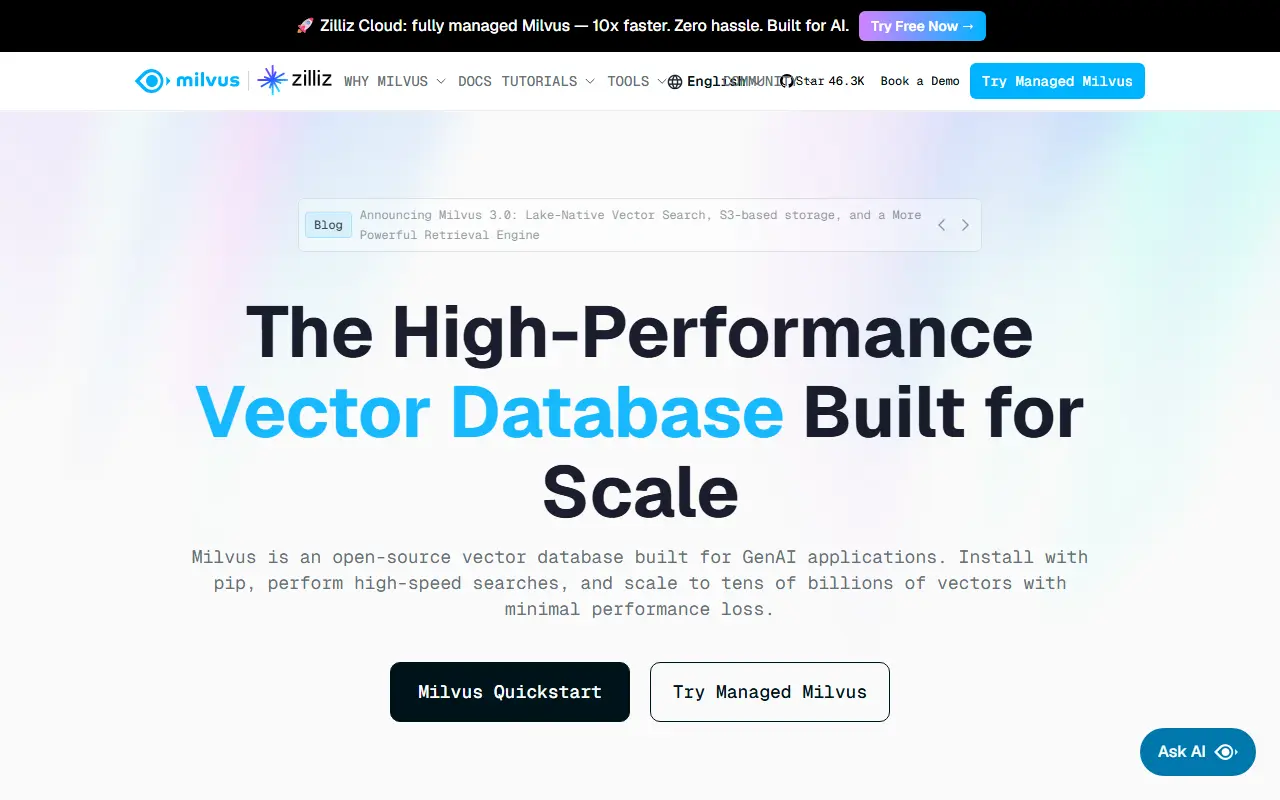
Milvus is an open-source vector database designed to scale. It supports AI applications by handling large volumes of unstructured data, including text, images and mixed-media content. It is written in Go and C++ with hardware acceleration for CPUs and GPUs, and it is released under the Apache-2.0 license.
The architecture is fully distributed and Kubernetes-native, so it can scale out horizontally while staying current through streaming updates in real time. Smaller deployments are covered too: a Standalone mode runs on a single machine, and Milvus Lite is a lightweight version installed with pip for quick starts in Python. The pymilvus SDK and its MilvusClient are used to create collections, ingest data and run vector searches.
Milvus can be self-hosted, or consumed as a managed service through Zilliz Cloud, which offers Serverless, Dedicated and bring-your-own-cloud options. The project is hosted by the LF AI & Data Foundation, with Zilliz as its major contributor. It suits teams building retrieval-augmented generation, semantic search and recommendation systems.
Key features
- Vector similarity search over embeddings
- Distributed, Kubernetes-native architecture
- Standalone mode for single machines
- Milvus Lite for quick Python starts
- Real-time streaming updates
- CPU and GPU hardware acceleration
Pricing: Open source under Apache 2.0; Zilliz Cloud offers a managed service with Serverless, Dedicated and BYOC options.
#6
A fast, typo-tolerant, in-memory search engine for site and app search, pitched as an open-source Algolia alternative and an easier-to-run Elasticsearch alternative.
- GitHub stars
- 27k
- Last commit
- 2 days ago
- Latest release
- v30.2
- Licence
- GPL-3.0
- Self-hosted
- Yes
- Hosted version
- Available
typesense.org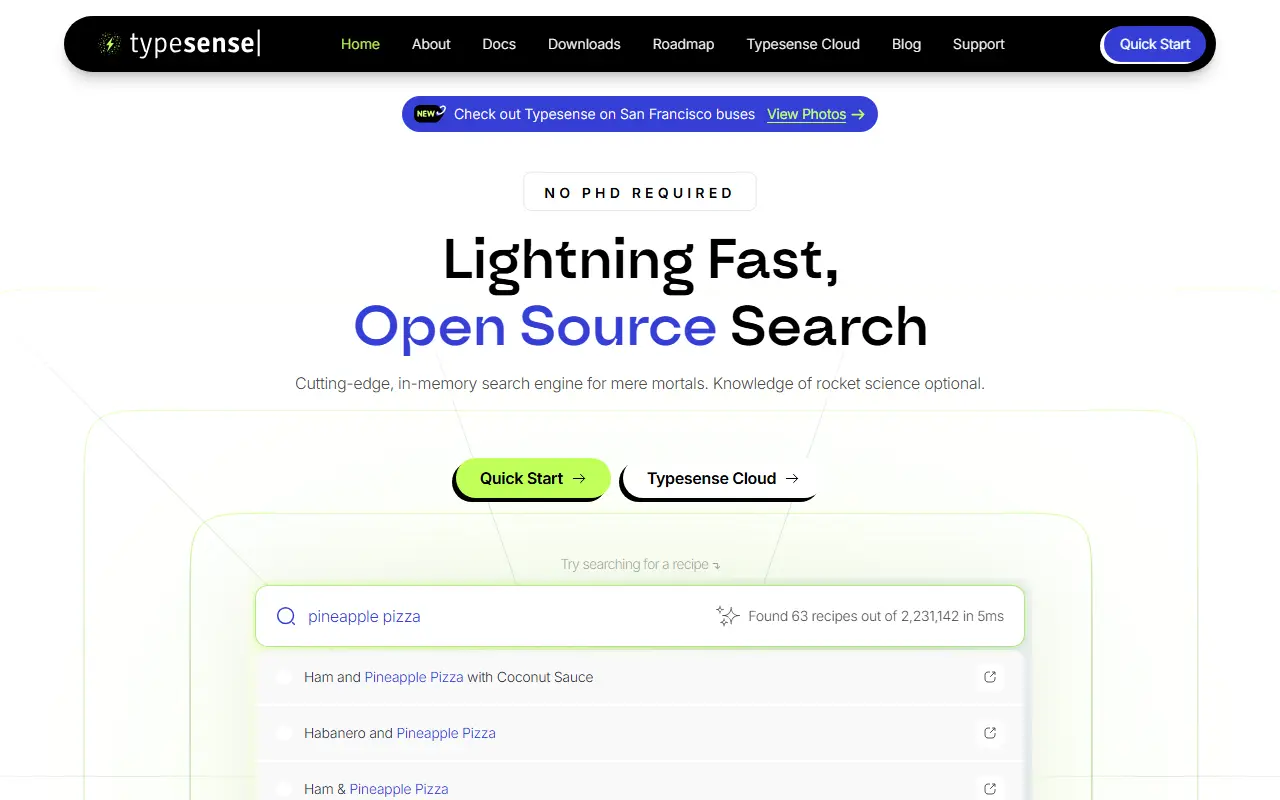
Typesense is an open-source search engine for building fast, typo-tolerant search experiences in websites and applications. It is pitched as an open-source substitute for Algolia and Pinecone, and as a simpler option than Elasticsearch. It keeps its index in memory and is written in C++.
The project's feature topics include typo tolerance and fuzzy matching, full-text search, faceting, geosearch, synonyms, merchandising rules and instant search, and it supports semantic and hybrid search. Public demos let you try it on large datasets, such as 32 million songs from MusicBrainz, 28 million books from OpenLibrary, a recipe set, Linux kernel commit messages, an ecommerce store experience, a geosearch listing browser and semantic search over Hacker News comments.
Typesense is licensed under GPL-3.0 and can be run on your own servers, and a managed Typesense Cloud service is also available. Documentation, a roadmap, a Slack community and video introductions are provided. It suits developers who want Algolia-style search with the option to self-host and keep costs predictable.
Key features
- Typo-tolerant, in-memory search
- Faceting, filtering and synonyms
- Geosearch for location-based results
- Semantic and hybrid search
- Merchandising controls for ranking
- Self-hosted or Typesense Cloud

A self-hosted SERP API and CLI that returns structured search results from Google, Bing, Yandex, Baidu, DuckDuckGo and Ecosia for AI agents and SEO tasks.
- GitHub stars
- 1.6k
- Last commit
- yesterday
- Latest release
- v0.8.19
- Licence
- MIT
- Self-hosted
- Yes
- Hosted version
- Available
openserp.org
OpenSERP is a free, open-source search results API and command-line tool. With one command it provides live, structured results from Google, Yandex, Baidu, Bing, DuckDuckGo and Ecosia on localhost, without API keys or per-search billing, which makes it useful as a search tool for LLMs and agents or as a backend for SEO rank tracking.
Each of the six engines has its own endpoint using the same JSON schema, and a megasearch endpoint runs one query across several engines, merging and deduplicating results. A URL extraction call returns search results together with clean Markdown of the target pages. It captures SERP features such as AI summaries, answer boxes and related searches, supports image search and filters, and offers JSON, Markdown, text and NDJSON output, plus proxies, caching and a resilient mode.
OpenSERP is written in Go and released under the MIT licence, with prebuilt Docker images and go install options. Official SDKs for JavaScript and others work against either a self-hosted server or the hosted API, which the README offers for people who would rather not run infrastructure. It suits developers building agents, research tools and rank trackers.
Key features
- Endpoints for six search engines
- Megasearch across several engines
- Page extraction to Markdown
- SERP features like answer boxes
- Image search and filters
- Proxy support and caching
Pricing: Usage-based credits with no subscription or minimum: about $7.83 per 1,000 searches, with errors free and credits that never expire. New accounts get 60 free credits.
#8
A cloud-native vector database that stores objects and embeddings and combines semantic search with keyword filtering, RAG and reranking in one query interface.
- GitHub stars
- 17k
- Last commit
- yesterday
- Latest release
- v1.40.5
- Self-hosted
- Yes
- Hosted version
- Available
weaviate.io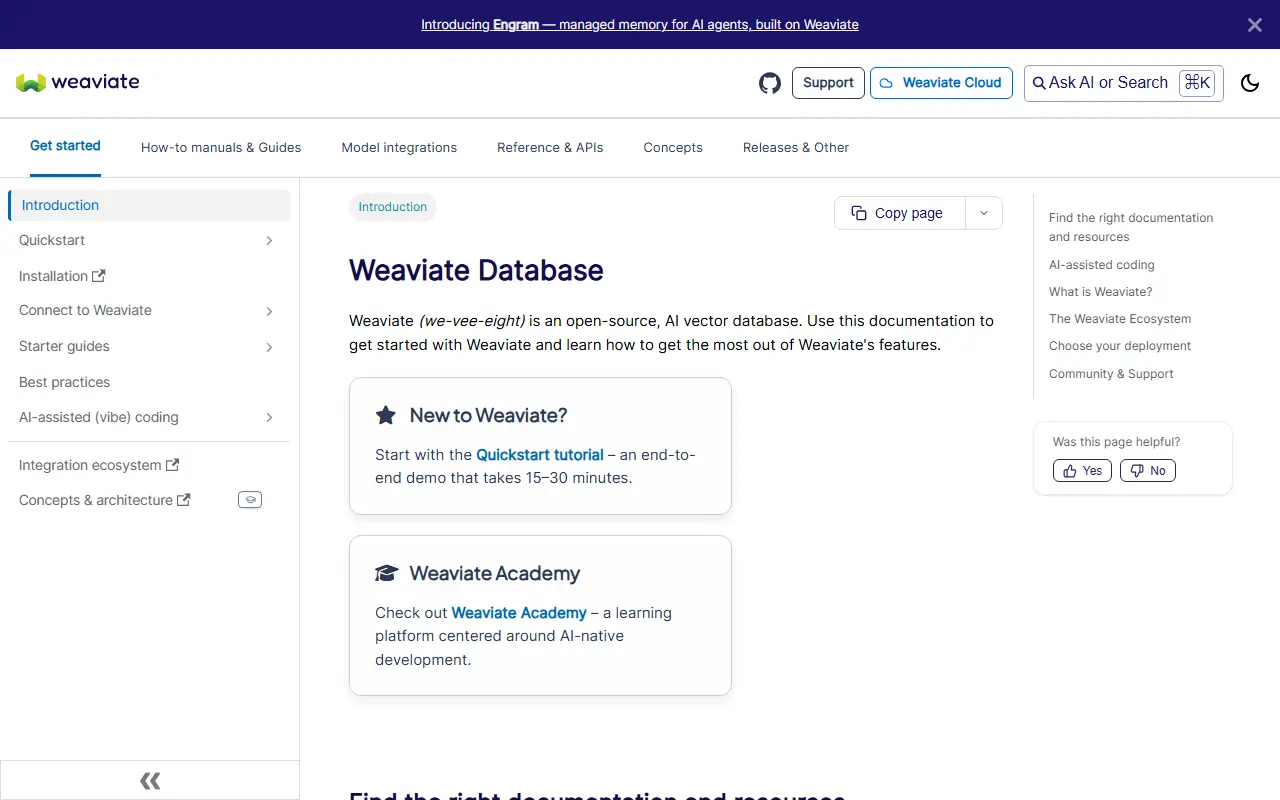
Weaviate is a vector database that stores both data objects and their vector embeddings, enabling semantic search at scale. One query interface can blend vector similarity search, keyword filtering, retrieval-augmented generation and reranking, and it is written in Go as a cloud-native system.
Common applications are RAG pipelines, semantic and image search, recommenders, chatbots and content classification. Vectors can be created automatically on import by integrated models from providers such as OpenAI, Cohere and Hugging Face, or you can import pre-computed embeddings. For production, it offers built-in multi-tenancy, replication and role-based access control. Topics reference approximate nearest neighbor search and HNSW indexing.
Weaviate can be deployed with Docker, on Kubernetes, or through the managed Weaviate Cloud, with guides for AWS and GCP, and the documentation includes quickstarts for both cloud and a local Docker instance. Its license is listed as 'Other' on GitHub, so check the repository terms. It suits teams building AI applications that need a scalable store for embeddings alongside structured filters.
Key features
- Stores objects and vectors together
- Hybrid vector and keyword search
- Integrated vectorizer models or bring your own
- Multi-tenancy and replication
- Role-based access control
- Docker, Kubernetes and Weaviate Cloud options

Wigolo gives AI coding agents local-first web search, fetch, crawl and research tools over MCP, with no API keys or cloud accounts required.
- GitHub stars
- 5.5k
- Last commit
- yesterday
- Latest release
- v0.3.1
- Self-hosted
- Yes
wigolo.app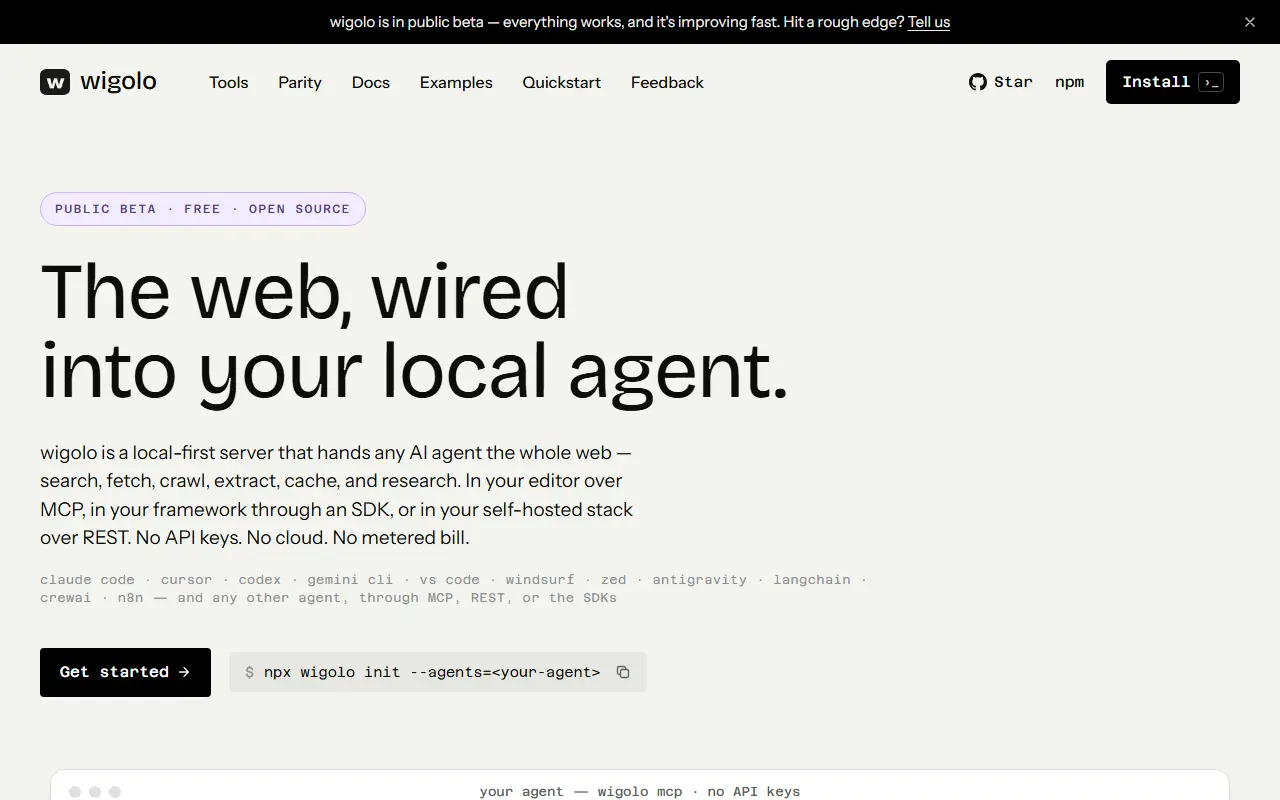
Wigolo is a local-first web access layer for AI agents. It exposes search, page fetching, crawling and research capabilities over the Model Context Protocol, so a coding agent can look things up on the web without you buying a search API key or sending queries through a metered cloud service.
The README says it works with a long list of clients, including Claude Code, Cursor, Codex and Gemini CLI as well as OpenCode, Windsurf, Zed and VS Code, and with frameworks such as LangChain, CrewAI, LlamaIndex, the Vercel AI SDK and n8n, plus any MCP client or plain REST. Repository topics describe it as a metasearch and web crawler and name Exa, Firecrawl and Tavily as the services it stands in for. The project is in public beta.
Wigolo is written in TypeScript and its license is listed as 'Other' on GitHub, so read the licensing section before commercial use. It runs on your own machine. It suits developers who want agent-ready web search that is private and free of per-query costs.
Key features
- Local web search over MCP
- Page fetching and crawling for agents
- Research workflows with no API keys
- Works with Claude Code, Cursor and Codex
- REST access for non-MCP clients
- Metasearch across multiple engines
Pricing: Runs locally with no per-query fees; check the repository for license terms.
#10
Trieve is an MIT-licensed platform that provides search, recommendations, RAG and analytics through an API, with self-hosting guides.
- GitHub stars
- 2.7k
- Last commit
- 9 mo ago
- Latest release
- trieve-helm-0.2.2
- Licence
- MIT
- Self-hosted
- Yes
- Hosted version
- Available
Trieve bundles search, recommendations, retrieval-augmented generation and analytics behind an API. It is written in Rust and licensed under MIT, with TypeScript and Python SDKs and an OpenAPI specification listed in the README.
Search options include semantic dense-vector search using OpenAI or Jina embeddings with Qdrant, typo-tolerant neural sparse-vector search, hybrid search with cross-encoder re-ranking, sub-sentence highlighting, recency biasing, filtering by date range, tag and numeric values, and grouping of chunks by file.
The README describes self-hosting in your own VPC or on-prem, with guides for AWS, GCP, Kubernetes and Docker Compose. RAG routes connect to OpenRouter for model access, and you can bring your own embedding, SPLADE, re-ranking or language models. A hosted sign-up with 1k chunks free is also linked.
Key features
- Semantic dense vector search with Qdrant
- Typo-tolerant neural search
- Hybrid search with cross-encoder re-ranking
- Recommendations API for similar chunks
- RAG routes via OpenRouter
- Bring your own models
- Grouping chunks to search at file level
Exa alternatives: questions
- What is the best open-source alternative to Exa?
- SearXNG is the top-ranked open-source alternative to Exa on Enlisted: A free, privacy-respecting metasearch engine that aggregates results from many search services without tracking or profiling users, designed for self-hosting. Other strong options are Elasticsearch, Meilisearch, Qdrant and Milvus.
- What are the best commercial alternatives to Exa?
- Brave Search API, SerpApi, Tavily, You.com and Jina AI are among the hosted, closed-source alternatives to Exa listed on Enlisted, which lists 14 in total. Compare their pricing and features on each tool page.
- Are these Exa alternatives free?
- All 10 are open source, so the code is free to use under its licence, and all of them can be self-hosted on your own server or computer. 8 also offer a paid or managed cloud version if you'd rather not host it yourself.
- How is this list of Exa alternatives ranked?
- By a score built from GitHub stars, star growth over the last 30 days and how recently the code changed. 9 of these projects shipped code in the last 30 days. Data is refreshed daily, and nobody can pay to move up.
 TrackMedia
 TrackRev