 TrackMedia
 TrackRev

About Parallel
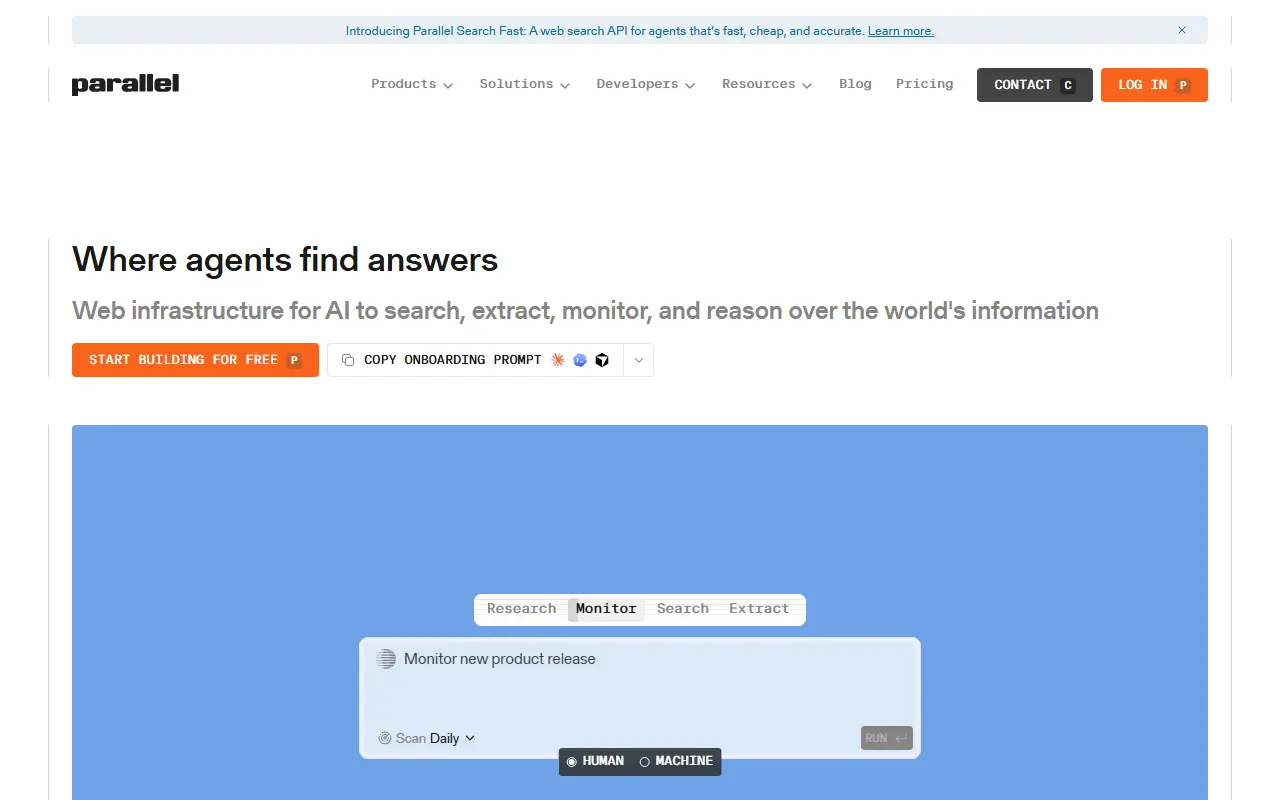
Parallel is a company that provides web access infrastructure for AI systems. Its APIs let agents and applications search the web, extract content from pages, monitor sources for changes and run deeper research, so products can answer with fresh, cited facts instead of relying only on model training data.
The product names on the homepage are Search, Extract, Monitor and Research, with a newer Parallel Search Fast API described as a quick, low-cost web search for agents. Use cases include watching portfolios, target accounts, competitor pricing and regulations with structured alerts, and giving assistants and coding agents current answers quickly enough for a chat thread.
Developers can start building for free through the platform, copy an onboarding prompt into tools such as Claude Code, Codex or Cursor, and read an agents.md file for integration guidance. Parallel is hosted and has a published pricing page, with no self-hosted version described.
Key features
- Web search API built for agents
- Extraction of clean content from pages
- Monitoring with structured change alerts
- Research API for multi-step questions
- Cited, structured results
- Onboarding prompts for coding assistants
Good fit for
- Giving a chat assistant current, cited answers
- Monitoring competitor pricing and regulations
- Enriching records with web research
Parallel: questions and answers
- What is Parallel used for?
- Parallel is web infrastructure for AI agents with APIs to search, extract, monitor and research the open web, returning structured, cited results. It is a good fit for giving a chat assistant current, cited answers; monitoring competitor pricing and regulations; and enriching records with web research.
- How much does Parallel cost?
- Parallel is a paid product with no free plan. A free trial is available. Pay per request rather than per token: Search and Extract start at $1 per 1K requests, Task API at $5 per 1K, and Enterprise is quoted. Free credits are offered each month.
- Is Parallel open source?
- No. Parallel is proprietary (closed-source) software and can't be self-hosted. Open-source alternatives to Parallel include Wigolo, SearXNG and OpenSERP.
- What are some alternatives to Parallel?
- Parallel competes with Exa, Tavily and Serper. For open-source options, see Enlisted's ranked list of open-source Parallel alternatives.
Open-source alternatives to Parallel
See all
Wigolo
Search
The go-to web for your AI coding agent — local-first search, fetch, crawl & research over
OSSvs Tavily★ 5.5k
SearXNG
Search
SearXNG is a free internet metasearch engine which aggregates results from various search
AGPL-3.0vs DuckDuckGo★ 39k
OpenSERP
Search
Self-hosted SERP API for AI, SEO & automation. Browser-rendered Google, Bing, Yandex, Baid
MITvs SerpApi★ 1.6k
XERJ
Search
XERJ is the new way for AI to search data. Its autoindex capability activates agents to kn
Apache-2.0vs Elastic★ 19k
Elasticsearch
Search
Free and Open Source, Distributed, RESTful Search Engine
OSSvs Algolia★ 79k
Meilisearch
Search
A lightning-fast search engine API bringing AI-powered hybrid search to your sites and app
OSSvs Algolia★ 60k
SaaS alternatives to Parallel
See all
Exa
Search
Search API that returns web pages by meaning, built for AI applications
SaaS
Tavily
Search
Web search and content extraction API for AI agents
SaaS
Serper
Search
Google Search results API for developers and AI agents
SaaS
Brave Search API
Search
Independent web index exposed through a paid search API
SaaS
Perplexity
AI Tools
Perplexity is an AI answer engine that responds to questions with summarized answers and cited web sources.
SaaS
Jina AI
Search
Search foundation APIs for embeddings, reranking and web content reading
SaaS