#1
An open-source retrieval-augmented generation engine that combines document understanding with agent capabilities to give LLMs grounded context.
- GitHub stars
- 94k
- Last commit
- yesterday
- Latest release
- v1.0.0
- Licence
- Apache-2.0
- Self-hosted
- Yes
- Hosted version
- Available
ragflow.io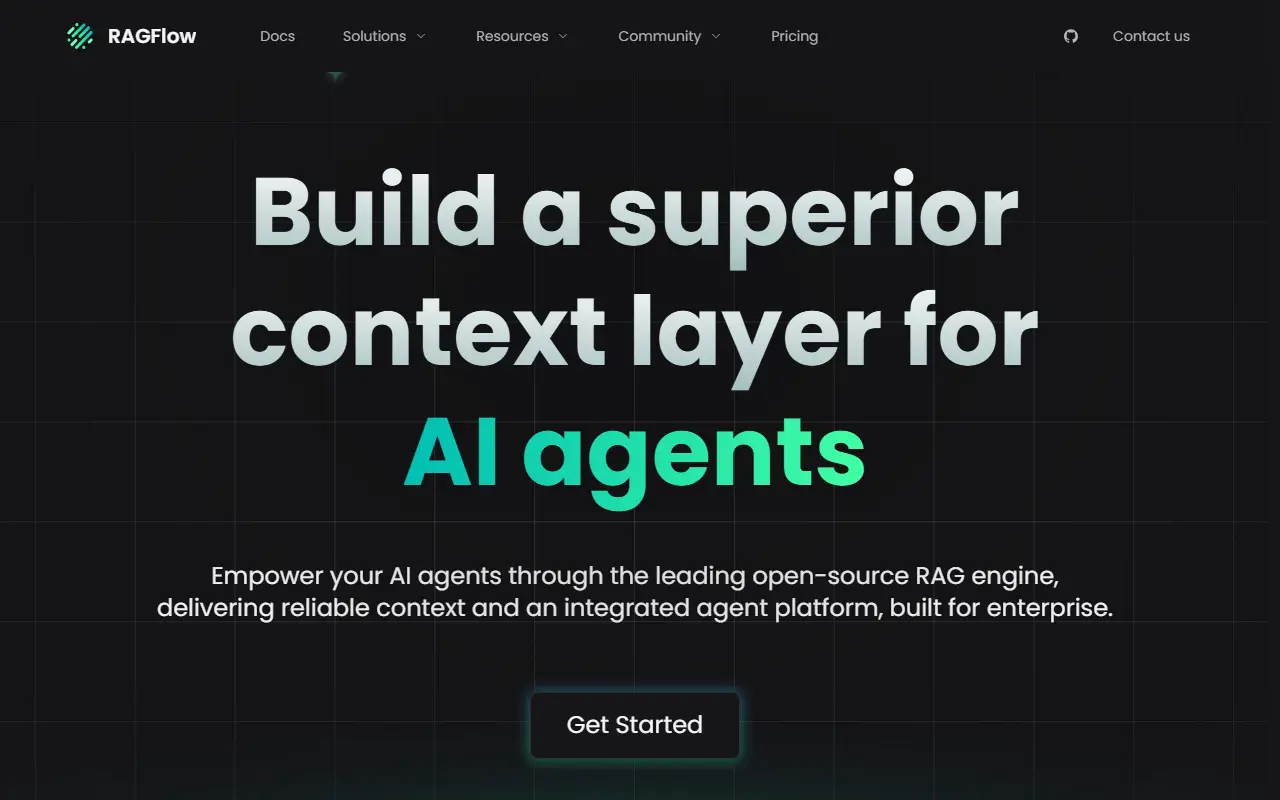
RAGFlow is an open-source engine for retrieval-augmented generation (RAG). It combines RAG with agent capabilities to give large language models a context layer built from your own documents, so applications can answer from real data. It is released under the Apache-2.0 license and, per the repository, is currently at a 1.0.0 release candidate.
It extracts knowledge from unstructured documents with complicated formats using deep document understanding, and offers pre-built agent templates. Recent updates mentioned in the README include website ingestion through sitemaps, Google BigQuery data sources with incremental sync, knowledge compilation that generates wikis, graphs, trees and mind maps, and agentic RAG with multiple thinking modes.
You can try the managed cloud service or deploy it locally by following the local deployment guide. The project provides documentation, a roadmap and a Discord community. It suits developers and enterprises building document question answering and knowledge-based assistants who want control over their data pipeline.
Key features
- Deep document understanding for unstructured files
- Retrieval-augmented generation workflows
- Pre-built agent templates
- Agentic RAG with adjustable thinking modes
- Website ingestion through sitemaps
- Knowledge compilation into wikis and graphs
- Google BigQuery data source sync
Pricing: Free plan with 500 credits per month. Starter shows $59 and Pro $259 per month (a lower unlabeled price of $29 and $129 likely applies with annual billing); Enterprise is quoted and can be deployed on-premises.
#2
A free, privacy-respecting metasearch engine that aggregates results from many search services without tracking or profiling users, designed for self-hosting.
- GitHub stars
- 39k
- Last commit
- yesterday
- Licence
- AGPL-3.0
- Self-hosted
- Yes
docs.searxng.org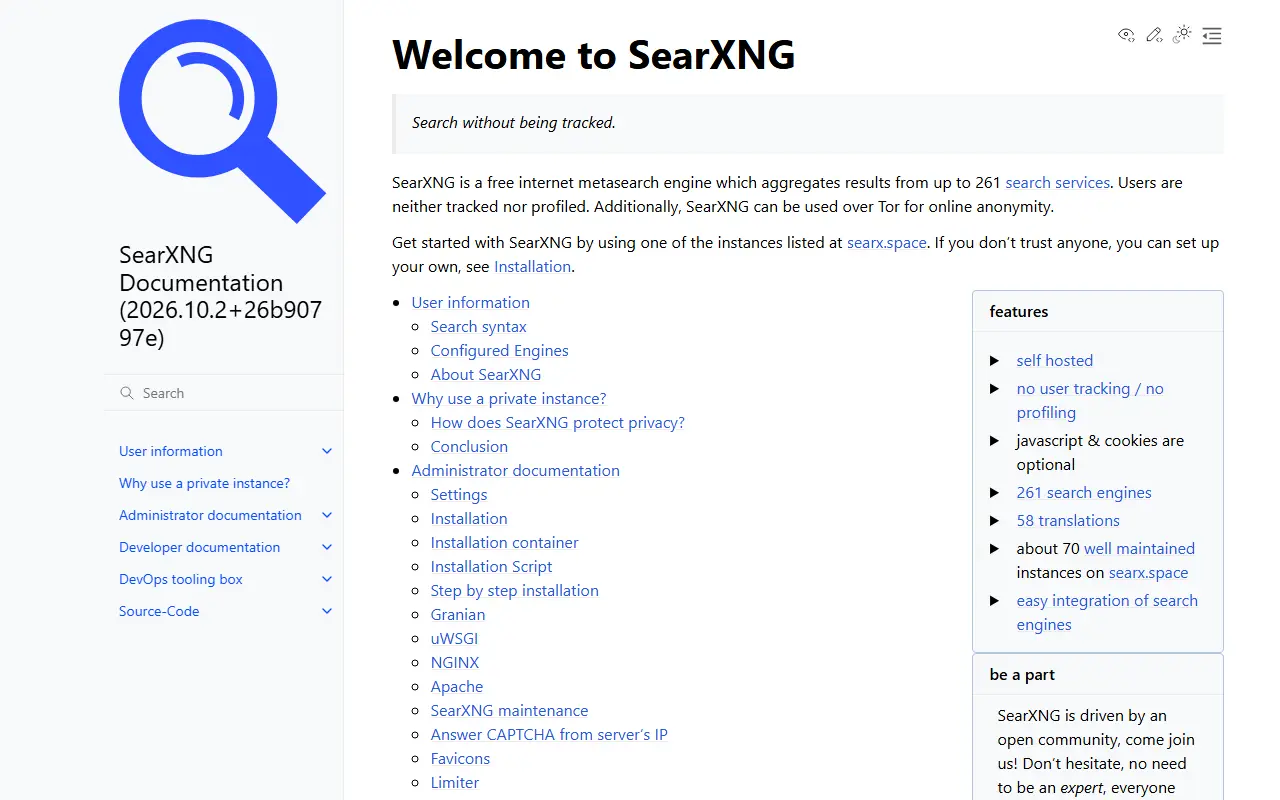
SearXNG is a free internet metasearch engine. It sends your query to many search services and databases, merges the results into one page, and does so without tracking or profiling the people who use it. Topics list engines such as Google, Bing, Brave, DuckDuckGo, Qwant and Startpage among the sources it can combine.
The documentation is organized for both users and administrators. Users get search syntax, a list of configured engines and an explanation of why a private instance matters. Administrators get settings in settings.yml, engine configuration, plugins, a bot-protection limiter, optional Redis or Valkey storage, and installation guides covering containers, an installation script and step-by-step setups with Granian or uWSGI behind NGINX or Apache. A long catalog of engines extends beyond web search to sources such as arXiv, Crossref, GitHub and Mastodon.
SearXNG is written in Python under the AGPL-3.0 license. Because it is meant to be self-hosted, you can run your own instance for yourself or a group; many volunteers also publicly host instances. It appeals to people who want to reduce reliance on any one search engine and keep their queries private.
Key features
- Aggregates results from many search engines
- No user tracking or profiling
- Configurable engines and plugins
- Container and script-based installation
- Optional Redis or Valkey integration
- Bot protection limiter
Pricing: Free and open source under the AGPL-3.0 license.
#3
An open-source AI platform for enterprise search and chat that indexes knowledge from 50+ apps and works with any LLM, deployable on your own infrastructure.
- GitHub stars
- 33k
- Last commit
- today
- Latest release
- v5.1.2
- Self-hosted
- Yes
onyx.app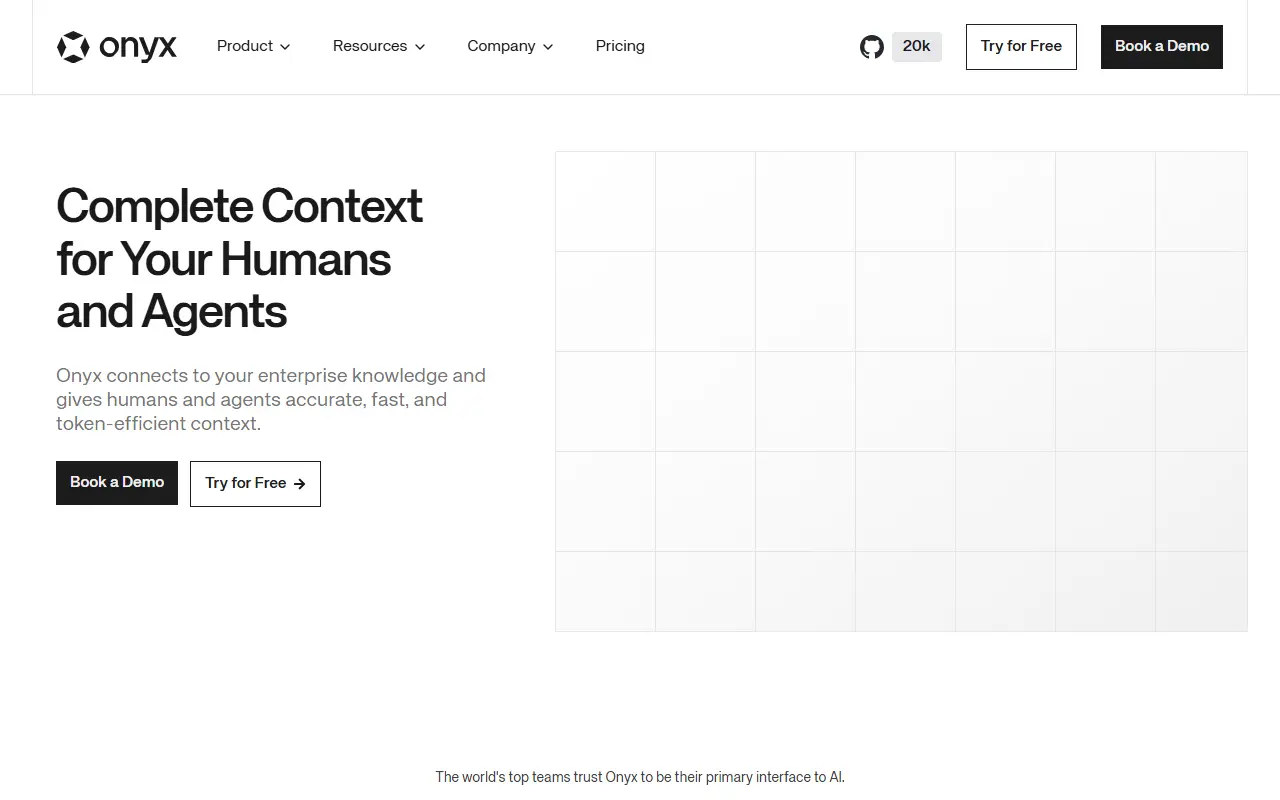
Onyx is an open-source AI platform that acts as a knowledge and context layer for teams and their AI agents. It connects to more than 50 applications, pulls in documents along with their metadata and permissions, and builds an internal representation so that LLMs can answer questions grounded in what your company actually knows.
The project argues that this indexed approach gives more reliable, lower-latency and cheaper context than approaches that have an agent search many tools iteratively through MCP. Features include agentic RAG on a hybrid index, a Deep Research mode for multi-step reports, custom agents with their own knowledge, instructions and actions, and live web search through providers such as Serper, Google PSE, Brave and SearXNG. Sandboxes and skills extend what models can do, and the chat interface works with every major LLM.
Onyx emphasizes data sovereignty through flexible self-hosted deployments, with a single-command deploy option. The code is written in Python and Next.js, and the license is listed as 'Other' on GitHub, so check the terms for the enterprise features. It suits organizations that want a private, ChatGPT-style assistant connected to internal documents.
Key features
- Connectors to 50+ workplace applications
- Hybrid index with agentic RAG
- Deep Research multi-step reports
- Custom agents with their own knowledge
- Web search via Serper, Brave and others
- Works with any LLM
- Indexing that respects source permissions
Pricing: Business costs $25 per user per month on monthly billing, or $20 per user per month billed annually, with a free trial. Enterprise pricing and deployment options are by contact.
#4
A vector database and similarity search engine written in Rust, offering filtering over stored vectors and payloads, available self-hosted or as Qdrant Cloud.
- GitHub stars
- 36k
- Last commit
- today
- Latest release
- v1.20.0
- Licence
- Apache-2.0
- Self-hosted
- Yes
- Hosted version
- Available
qdrant.tech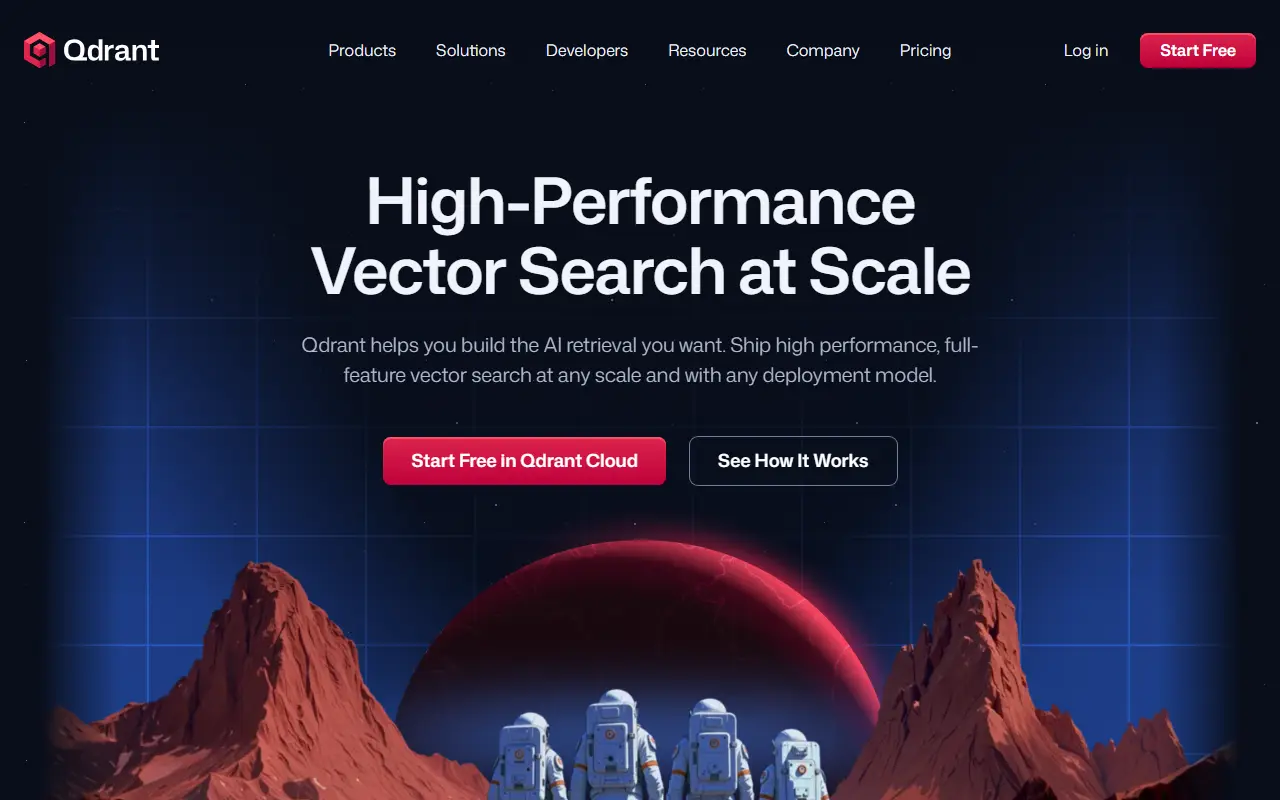
Qdrant is a vector database and similarity search engine. It stores points, which are vectors plus an attached payload, and exposes an API to store, search and manage them. That makes it a building block for semantic search, recommendations, image search and other applications that rely on embeddings from neural networks.
A key selling point is extended filtering support, so a vector query can be combined with conditions on the payload, which is useful for faceted search and matching. The engine is written in Rust and the maintainers point to benchmarks for its speed and reliability under load. Topics mention HNSW indexing and nearest-neighbor search, and there are client libraries, demo projects, integrations and a collection of agent skills that bring vector search into AI coding assistants.
Qdrant is Apache-2.0 licensed and can run on your own infrastructure. It is also available as the fully managed Qdrant Cloud, which includes a free tier. Teams building retrieval-augmented generation, recommendation and similarity features use it as the storage and retrieval layer for their embeddings.
Key features
- Vector storage with attached payloads
- Filtering combined with vector search
- HNSW-based nearest-neighbor search
- REST-style API with client libraries
- Agent skills for AI coding assistants
- Self-hosted or managed Qdrant Cloud
Pricing: A free-forever cloud tier is available. The Standard tier is usage-based, from $25; Premium requires a minimum spend and Hybrid and Private Cloud are quoted by the team.
#5
An open-source, cloud-native vector database for scalable similarity search over embeddings, with distributed, standalone and lightweight Python modes.
- GitHub stars
- 47k
- Last commit
- yesterday
- Latest release
- v3.0.6
- Licence
- Apache-2.0
- Self-hosted
- Yes
- Hosted version
- Available
milvus.io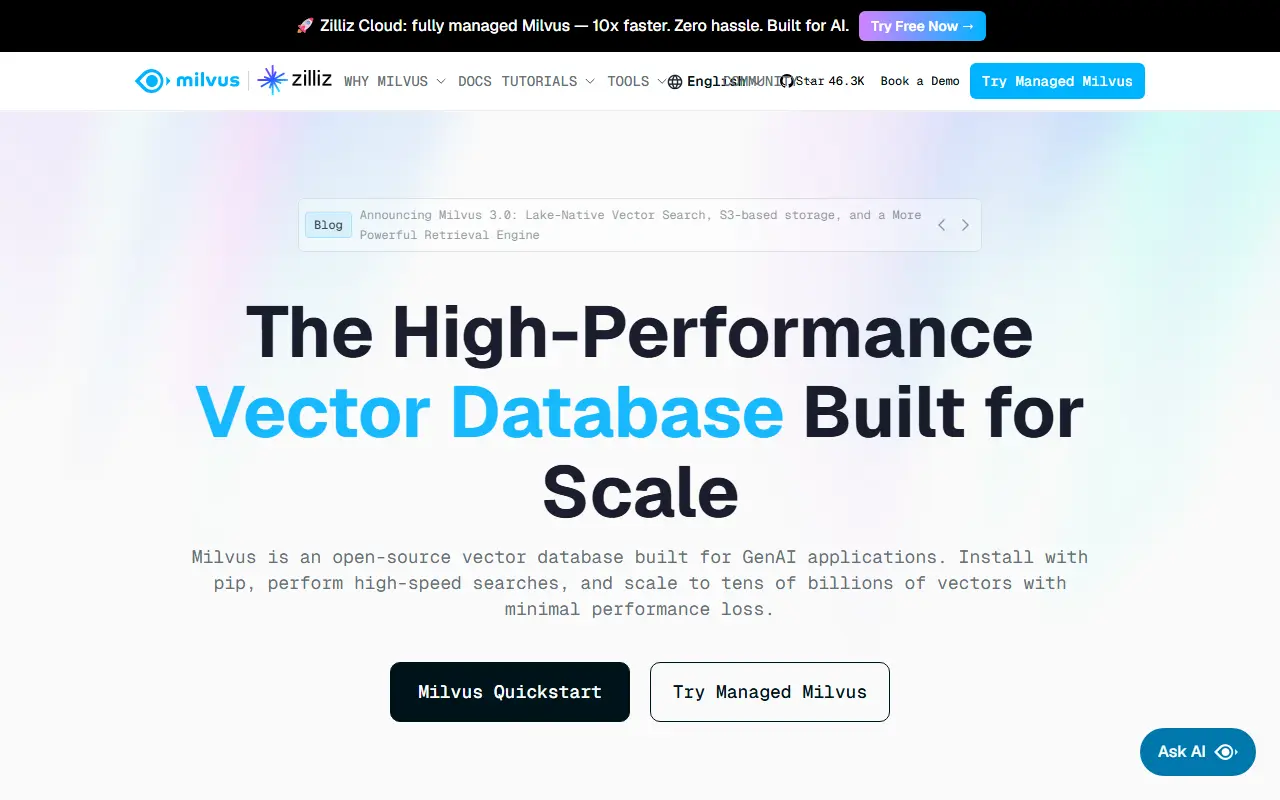
Milvus is an open-source vector database designed to scale. It supports AI applications by handling large volumes of unstructured data, including text, images and mixed-media content. It is written in Go and C++ with hardware acceleration for CPUs and GPUs, and it is released under the Apache-2.0 license.
The architecture is fully distributed and Kubernetes-native, so it can scale out horizontally while staying current through streaming updates in real time. Smaller deployments are covered too: a Standalone mode runs on a single machine, and Milvus Lite is a lightweight version installed with pip for quick starts in Python. The pymilvus SDK and its MilvusClient are used to create collections, ingest data and run vector searches.
Milvus can be self-hosted, or consumed as a managed service through Zilliz Cloud, which offers Serverless, Dedicated and bring-your-own-cloud options. The project is hosted by the LF AI & Data Foundation, with Zilliz as its major contributor. It suits teams building retrieval-augmented generation, semantic search and recommendation systems.
Key features
- Vector similarity search over embeddings
- Distributed, Kubernetes-native architecture
- Standalone mode for single machines
- Milvus Lite for quick Python starts
- Real-time streaming updates
- CPU and GPU hardware acceleration
Pricing: Open source under Apache 2.0; Zilliz Cloud offers a managed service with Serverless, Dedicated and BYOC options.
#6
Documenso is an open-source document signing platform positioned as a DocuSign alternative, available to self-host or use in the cloud.
- GitHub stars
- 16k
- Last commit
- today
- Latest release
- v2.21.1
- Licence
- AGPL-3.0
- Self-hosted
- Yes
- Hosted version
- Available
documenso.com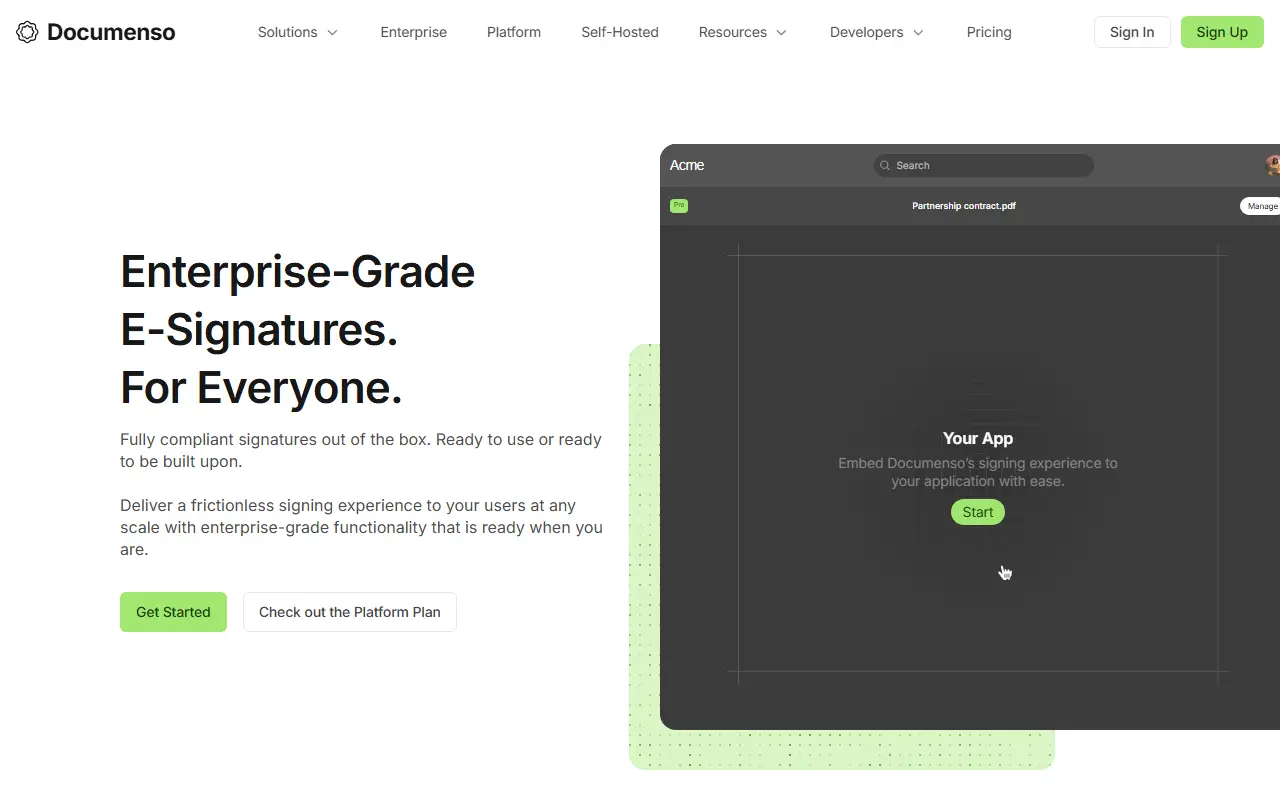
Documenso is an open-source alternative to DocuSign for signing documents digitally. Its stated aim is to build trust by letting people self-host the software and review how it works, rather than relying on a closed signing provider. It is released under the AGPL-3.0 license.
The product lets teams create templates, build signing workflows and integrate signing into other systems. Repository topics mention PDF signatures, digital signatures following the PAdES standard, e-signatures, PostgreSQL and Prisma. The README lists a stack of TypeScript, React Router v7, Hono, Prisma and Tailwind CSS with shadcn/ui and Radix UI components.
You can try it by self-hosting or by signing up on documenso.com, and an Enterprise plan is offered to large organizations that need extra flexibility and control. The maintainers have paused external pull requests apart from a small group of trusted contributors and ask for detailed issues instead, while keeping the code open to read, audit, run and fork.
Key features
- Digital document signing
- Reusable document templates
- Signing workflows and integrations
- PDF e-signatures with PAdES topic support
- Self-hosting with PostgreSQL
- Enterprise plan for large organizations
Pricing: Free plan with 5 documents a month. Individual is $25, Teams $40 and Platform $250 per month on yearly billing; Enterprise and self-hosted licences are quoted.
#7
Edison Scientific is a commercial platform with AI agents for scientific R&D, including literature synthesis, data analysis, molecular design, and novelty assessment.
- GitHub stars
- 9.6k
- Last commit
- 3 days ago
- Latest release
- v2026.08.12
- Licence
- Apache-2.0
- Hosted version
- Available
futurehouse.gitbook.io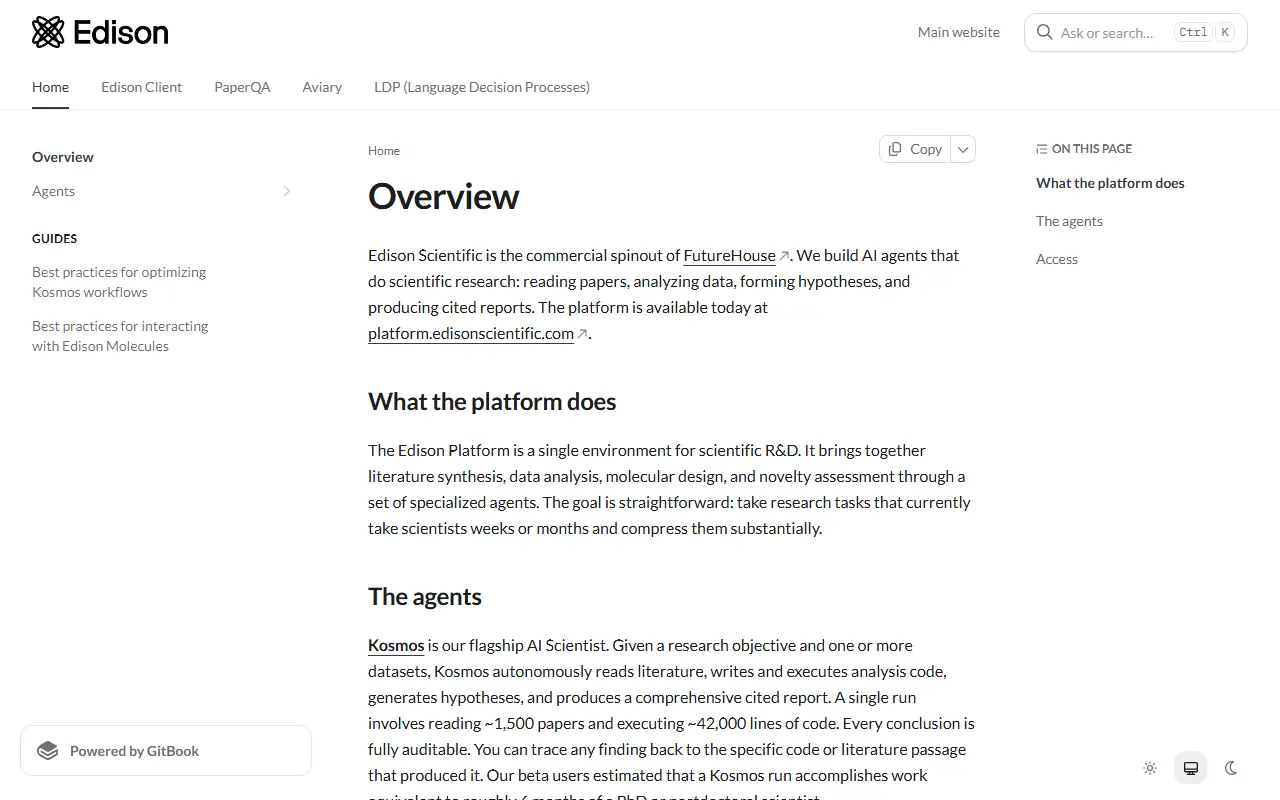
Edison Scientific is the commercial spinout of FutureHouse. It provides a single environment for scientific R&D, bringing together literature synthesis, data analysis, molecular design, and novelty assessment through specialized agents.
The platform includes agents such as Kosmos, Literature, Analysis, Precedent, and Molecules. Kosmos autonomously reads literature, writes and executes analysis code, generates hypotheses, and produces cited reports. Literature accesses 175M+ papers, trials, and patents. Analysis processes complex experimental data like flow cytometry and RNA-seq. Precedent assesses novelty, and Molecules is chemistry-focused.
Key features
- Kosmos agent: reads literature, writes and executes analysis code, generates hypotheses, and produces cited reports
- Literature agent: accesses 175M+ papers, trials, and patents with citation graph understanding
- Analysis agent: processes flow cytometry, RNA-seq, and other biological datasets
- Precedent agent: assesses novelty and identifies gaps across fields
- Molecules agent: chemistry-focused agent

Kibana is the web interface for querying, visualizing and managing data stored in Elasticsearch, used for dashboards, observability and analytics.
- GitHub stars
- 21k
- Last commit
- yesterday
- Latest release
- v9.5.6
- Self-hosted
- Yes
- Hosted version
- Available
elastic.co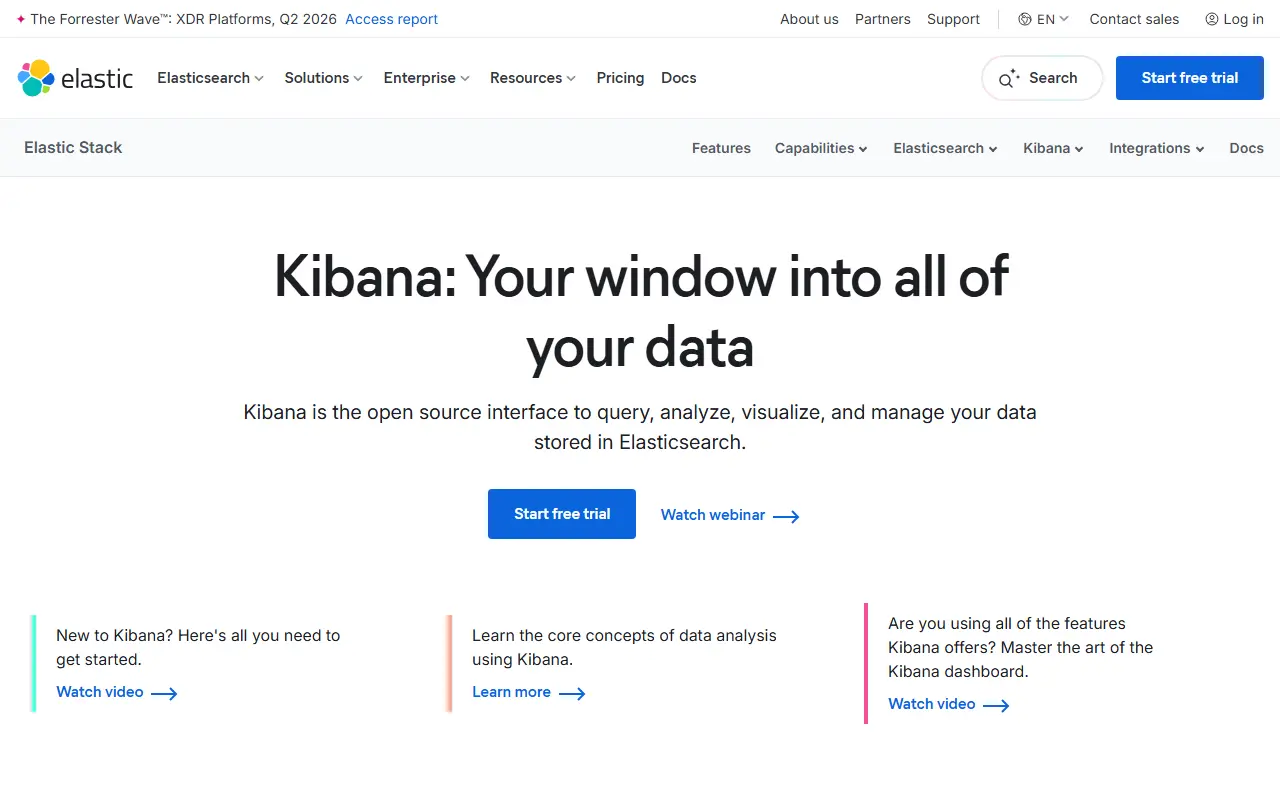
Kibana is the user interface that sits on top of Elasticsearch. It lets people query, analyze, visualize and manage the data stored there, turning indexes into charts, metrics views and dashboards. It is part of the Elastic Stack and is commonly used for log analysis, observability and general analytics work.
Teams build visualizations and assemble them into shared dashboards, explore documents with search, and use the interface to manage parts of an Elasticsearch deployment. The project advises running Kibana and Elasticsearch at the same version, with major versions required to match, because mismatches can cause problems and support may ask for an upgrade first.
The code is written in TypeScript. The repository lists its license as 'Other' rather than a standard SPDX identifier, so the license files should be read for the exact terms. Kibana can be downloaded and run on your own infrastructure, and Elastic also offers a hosted version through its Cloud service.
Key features
- Query and explore Elasticsearch data
- Visualizations and metrics charts
- Shared dashboards for monitoring
- Observability views for logs and metrics
- Management tools for Elasticsearch data
- Hosted option through Elastic Cloud

A cloud-native vector database that stores objects and embeddings and combines semantic search with keyword filtering, RAG and reranking in one query interface.
- GitHub stars
- 17k
- Last commit
- yesterday
- Latest release
- v1.40.5
- Self-hosted
- Yes
- Hosted version
- Available
weaviate.io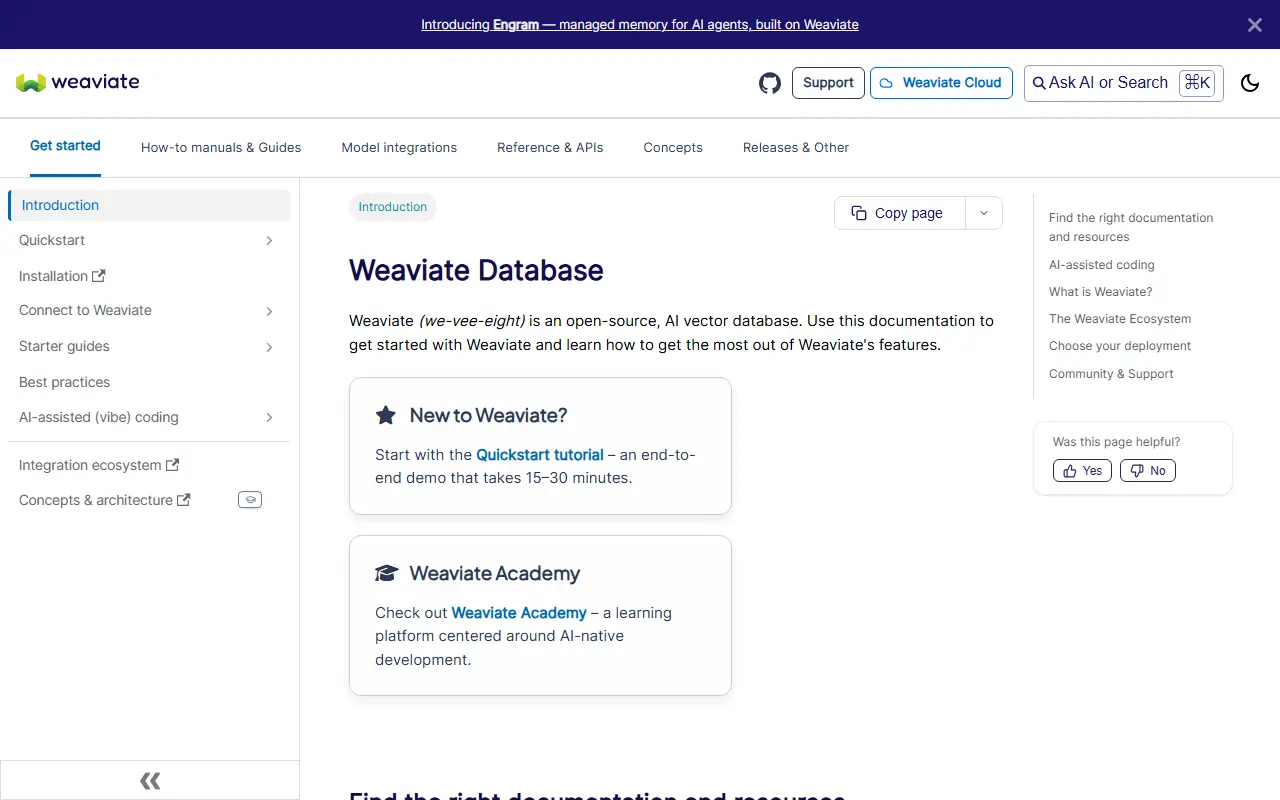
Weaviate is a vector database that stores both data objects and their vector embeddings, enabling semantic search at scale. One query interface can blend vector similarity search, keyword filtering, retrieval-augmented generation and reranking, and it is written in Go as a cloud-native system.
Common applications are RAG pipelines, semantic and image search, recommenders, chatbots and content classification. Vectors can be created automatically on import by integrated models from providers such as OpenAI, Cohere and Hugging Face, or you can import pre-computed embeddings. For production, it offers built-in multi-tenancy, replication and role-based access control. Topics reference approximate nearest neighbor search and HNSW indexing.
Weaviate can be deployed with Docker, on Kubernetes, or through the managed Weaviate Cloud, with guides for AWS and GCP, and the documentation includes quickstarts for both cloud and a local Docker instance. Its license is listed as 'Other' on GitHub, so check the repository terms. It suits teams building AI applications that need a scalable store for embeddings alongside structured filters.
Key features
- Stores objects and vectors together
- Hybrid vector and keyword search
- Integrated vectorizer models or bring your own
- Multi-tenancy and replication
- Role-based access control
- Docker, Kubernetes and Weaviate Cloud options

Federated AI search and RAG that queries your existing apps live, ranks results, and returns cited answers without copying data into a vector database.
- GitHub stars
- 3k
- Last commit
- 17 days ago
- Latest release
- v4.5.0.7
- Licence
- Apache-2.0
- Self-hosted
- Yes
swirlaiconnect.com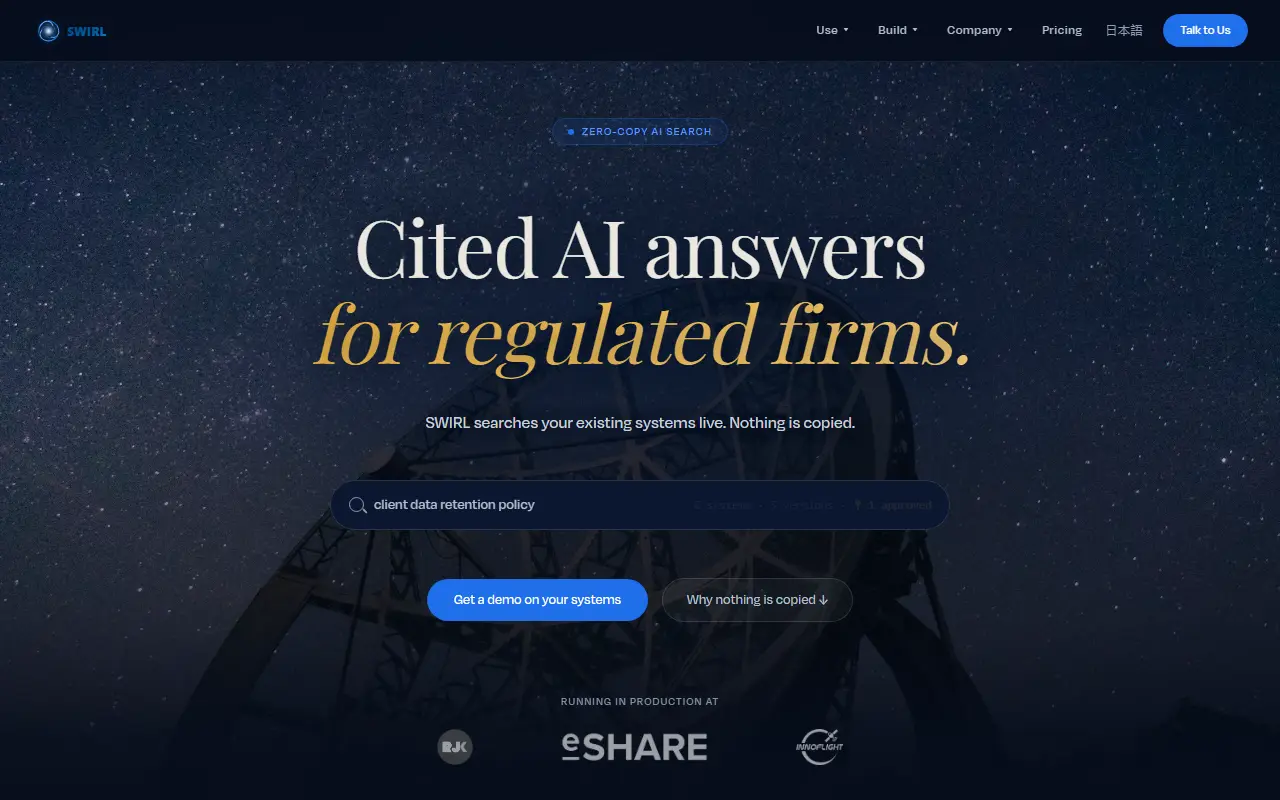
SWIRL is an AI search and retrieval-augmented generation tool that works without moving your data. Instead of copying content into a vector database, it queries your sources live with each user's own permissions, re-ranks the results, and can generate an answer with citations using the language model of your choice. The Community edition in this repository is released under the Apache-2.0 license.
Connectors reach many business applications, and the project's tagline refers to more than 100 apps. The approach avoids building ETL pipelines, standing up a vector store, or maintaining a second copy of data that needs security and audit controls, since permissions are enforced at the source. The stack is Python and Django, and a Docker quick start gets an instance running in about two minutes.
A separate SWIRL Enterprise edition adds a three-pass reranker, canonical answers, an MCP server for agents, and managed support. The Community edition is free to self-host. It suits IT and data teams wanting enterprise search across many systems while keeping data in place.
Key features
- Federated search across connected apps
- Live queries with source-level permissions
- No vector database or ETL needed
- Cited answers from your choice of language model
- Django-based with Docker quick start
- Enterprise tier adds reranking and MCP server
Pricing: Annual platform licences: Departmental $24K, Business $72K and Enterprise from $150K per year. No free plan is listed; a paid $12,000 pilot is credited to the first annual contract.
2 more Glean alternatives
Glean alternatives: questions
- What is the best open-source alternative to Glean?
- RAGFlow is the top-ranked open-source alternative to Glean on Enlisted: An open-source retrieval-augmented generation engine that combines document understanding with agent capabilities to give LLMs grounded context. Other strong options are SearXNG, Onyx, Qdrant and Milvus.
- What are the best commercial alternatives to Glean?
- Mindbreeze, Sinequa, Amazon Kendra, Google Gemini Enterprise and SearchBlox are among the hosted, closed-source alternatives to Glean listed on Enlisted, which lists 27 in total. Compare their pricing and features on each tool page.
- Are these Glean alternatives free?
- All 12 are open source, so the code is free to use under its licence, and all of them can be self-hosted on your own server or computer. 7 also offer a paid or managed cloud version if you'd rather not host it yourself.
- How is this list of Glean alternatives ranked?
- By a score built from GitHub stars, star growth over the last 30 days and how recently the code changed. 11 of these projects shipped code in the last 30 days. Data is refreshed daily, and nobody can pay to move up.
 TrackMedia
 TrackRev