7,363 open-source and SaaS tools, with GitHub stats refreshed every day.

10 alternatives ranked by real activity

Open-source Pinecone alternatives

A curated, ranked list of the 10 best open-source alternatives to Pinecone.

The best open-source alternative to Pinecone is Milvus. If that doesn't suit you, other good options are Qdrant, Chroma, Weaviate and LanceDB.

Pinecone alternatives are mainly databases, but some are also search tools. 8 of them shipped code in the last 30 days, 10 can be self-hosted, and 7 use a permissive licence.

Last updated October 2, 2026 · ranked by GitHub stars, growth and recent commits

Milvus

An open-source, cloud-native vector database for scalable similarity search over embeddings, with distributed, standalone and lightweight Python modes.

GitHub stars
46k
Last commit
yesterday
Latest release
v3.0.2
Licence
Apache-2.0
Self-hosted
Yes
Hosted version
Available
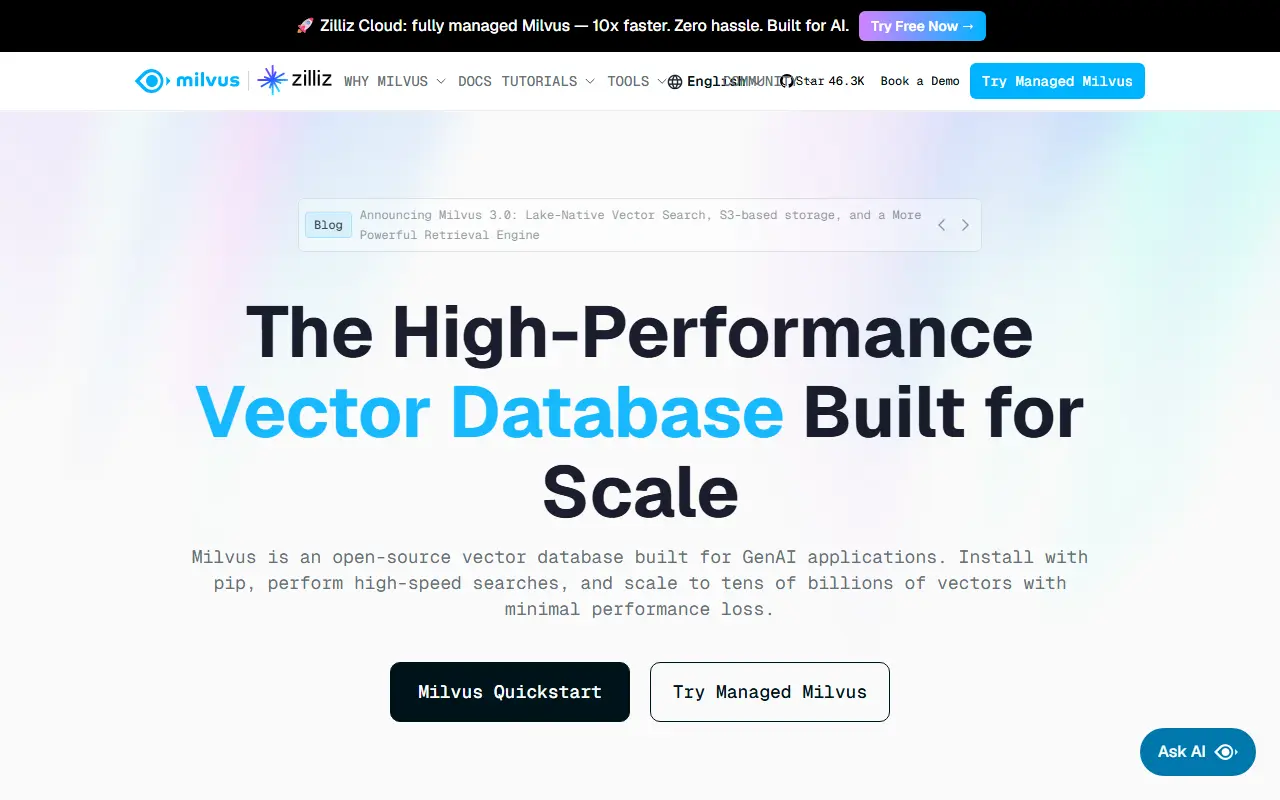
milvus.ioMilvus homepage screenshot

Milvus is an open-source vector database designed to scale. It supports AI applications by handling large volumes of unstructured data, including text, images and mixed-media content. It is written in Go and C++ with hardware acceleration for CPUs and GPUs, and it is released under the Apache-2.0 license.

The architecture is fully distributed and Kubernetes-native, so it can scale out horizontally while staying current through streaming updates in real time. Smaller deployments are covered too: a Standalone mode runs on a single machine, and Milvus Lite is a lightweight version installed with pip for quick starts in Python. The pymilvus SDK and its MilvusClient are used to create collections, ingest data and run vector searches.

Milvus can be self-hosted, or consumed as a managed service through Zilliz Cloud, which offers Serverless, Dedicated and bring-your-own-cloud options. The project is hosted by the LF AI & Data Foundation, with Zilliz as its major contributor. It suits teams building retrieval-augmented generation, semantic search and recommendation systems.

Key features

  • Vector similarity search over embeddings
  • Distributed, Kubernetes-native architecture
  • Standalone mode for single machines
  • Milvus Lite for quick Python starts
  • Real-time streaming updates
  • CPU and GPU hardware acceleration

Pricing: Open source under Apache 2.0; Zilliz Cloud offers a managed service with Serverless, Dedicated and BYOC options.

Qdrant

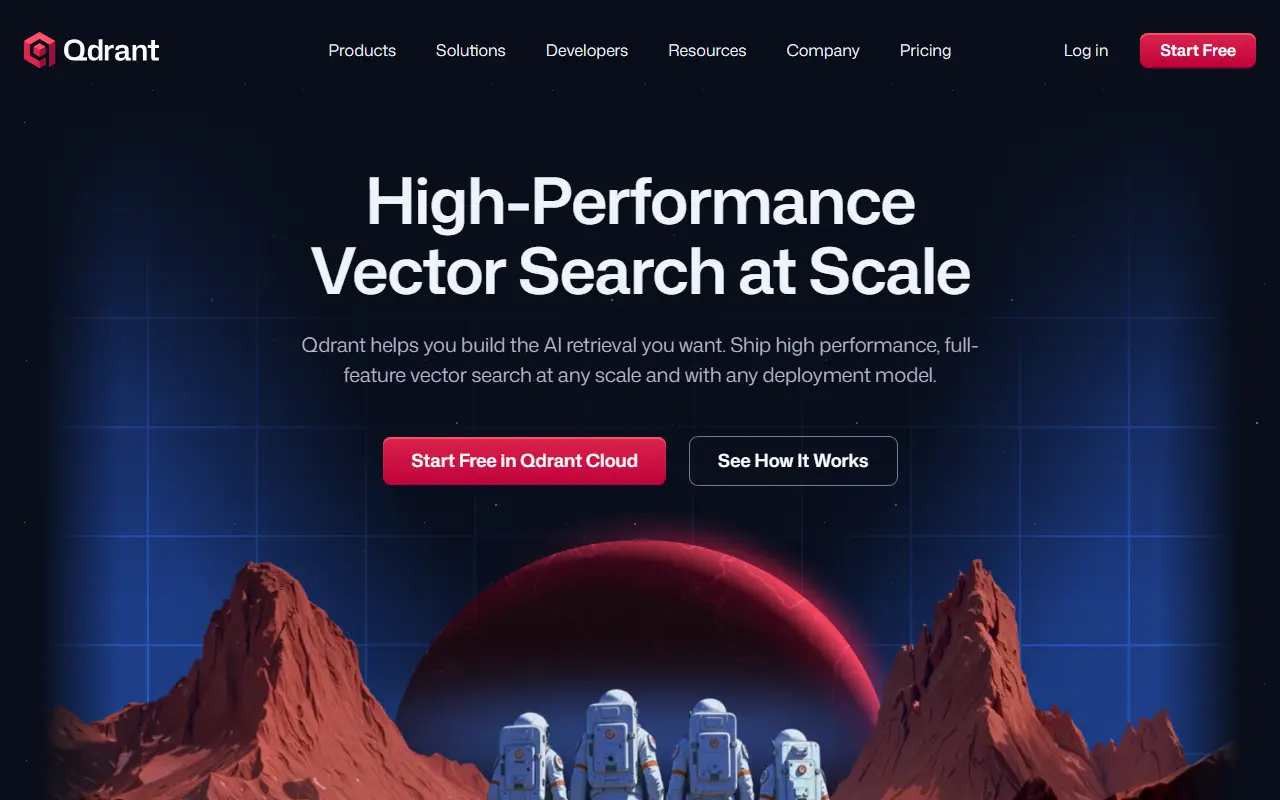
A vector database and similarity search engine written in Rust, offering filtering over stored vectors and payloads, available self-hosted or as Qdrant Cloud.

GitHub stars
35k
Last commit
yesterday
Latest release
v1.19.1
Licence
Apache-2.0
Self-hosted
Yes
Hosted version
Available
qdrant.techQdrant homepage screenshot

Qdrant is a vector database and similarity search engine. It stores points, which are vectors plus an attached payload, and exposes an API to store, search and manage them. That makes it a building block for semantic search, recommendations, image search and other applications that rely on embeddings from neural networks.

A key selling point is extended filtering support, so a vector query can be combined with conditions on the payload, which is useful for faceted search and matching. The engine is written in Rust and the maintainers point to benchmarks for its speed and reliability under load. Topics mention HNSW indexing and nearest-neighbor search, and there are client libraries, demo projects, integrations and a collection of agent skills that bring vector search into AI coding assistants.

Qdrant is Apache-2.0 licensed and can run on your own infrastructure. It is also available as the fully managed Qdrant Cloud, which includes a free tier. Teams building retrieval-augmented generation, recommendation and similarity features use it as the storage and retrieval layer for their embeddings.

Key features

  • Vector storage with attached payloads
  • Filtering combined with vector search
  • HNSW-based nearest-neighbor search
  • REST-style API with client libraries
  • Agent skills for AI coding assistants
  • Self-hosted or managed Qdrant Cloud

Pricing: A free-forever cloud tier is available. The Standard tier is usage-based, from $25; Premium requires a minimum spend and Hybrid and Private Cloud are quoted by the team.

Chroma

Open-source search infrastructure for AI that stores embeddings and supports vector, hybrid and full-text search, with a small API and a hosted Chroma Cloud.

GitHub stars
29k
Last commit
yesterday
Latest release
1.5.9
Licence
Apache-2.0
Self-hosted
Yes
Hosted version
Available
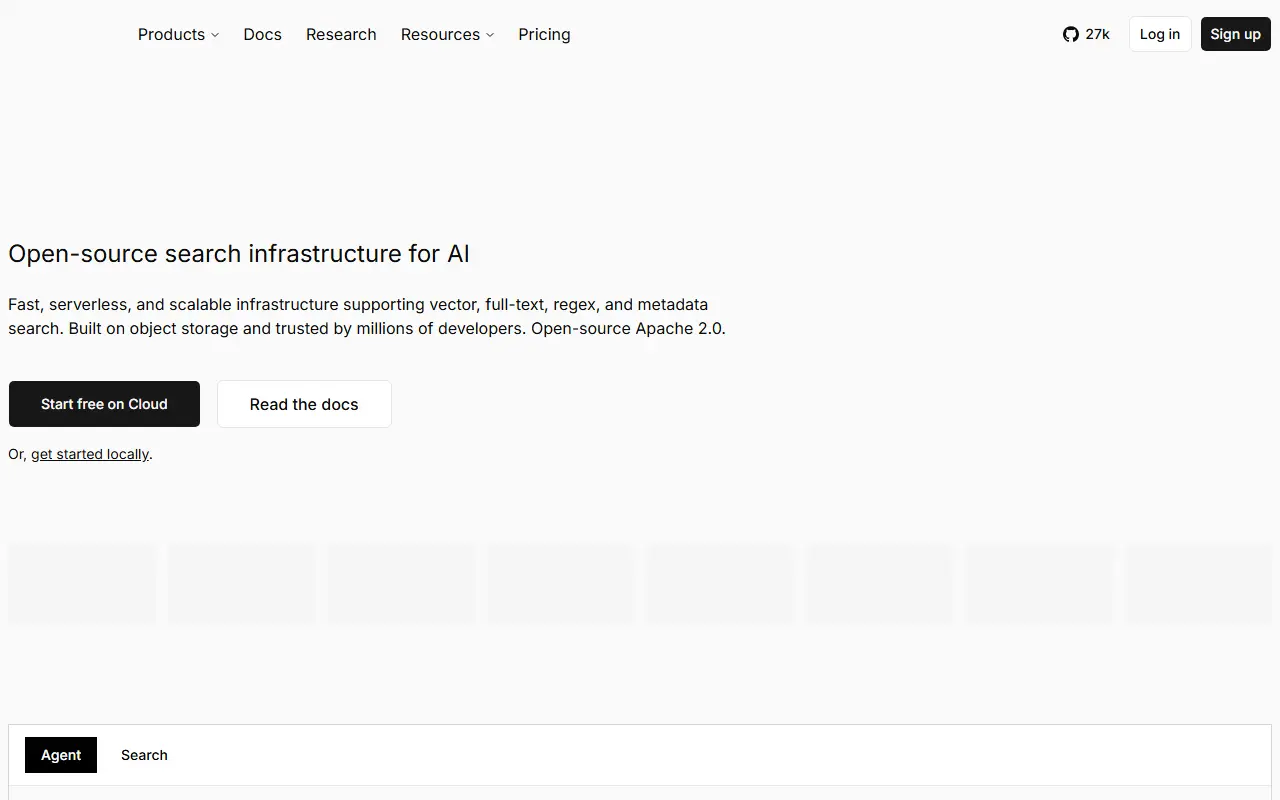
trychroma.comChroma homepage screenshot

Chroma is open-source data infrastructure for AI applications, centered on storing embeddings and searching them. It supports vector search, hybrid search and full-text search, and its core API is deliberately small, only four functions, so developers can add retrieval to an app quickly. The engine is written in Rust and clients are available through PyPI and npm packages.

For hosting, Chroma Cloud is the company's serverless managed service, which it describes as fast, cost-effective and scalable, and new users can create a database and try it with free starting credits. You can also run Chroma yourself. The project is developing rapidly, and the maintainers release new tagged versions of the Python and npm packages on Mondays, with hotfixes shipped whenever needed.

Chroma is Apache-2.0 licensed. Contributors can join the Discord contributing channel, review the roadmap and pick up good-first issues. Developers use it in retrieval-augmented generation setups, agent memory and semantic search features where they want an easy, embedded-friendly vector store.

Key features

  • Vector, hybrid and full-text search
  • Small four-function core API
  • Python and JavaScript clients
  • Serverless Chroma Cloud service
  • Rust core engine
  • Weekly tagged releases

Pricing: Chroma Cloud's Starter plan is $0 per month plus usage, with $5 in free credits. Team is $250 per month plus usage with $100 in credits; Enterprise is custom.

Weaviate

A cloud-native vector database that stores objects and embeddings and combines semantic search with keyword filtering, RAG and reranking in one query interface.

GitHub stars
17k
Last commit
yesterday
Latest release
v1.39.8
Self-hosted
Yes
Hosted version
Available
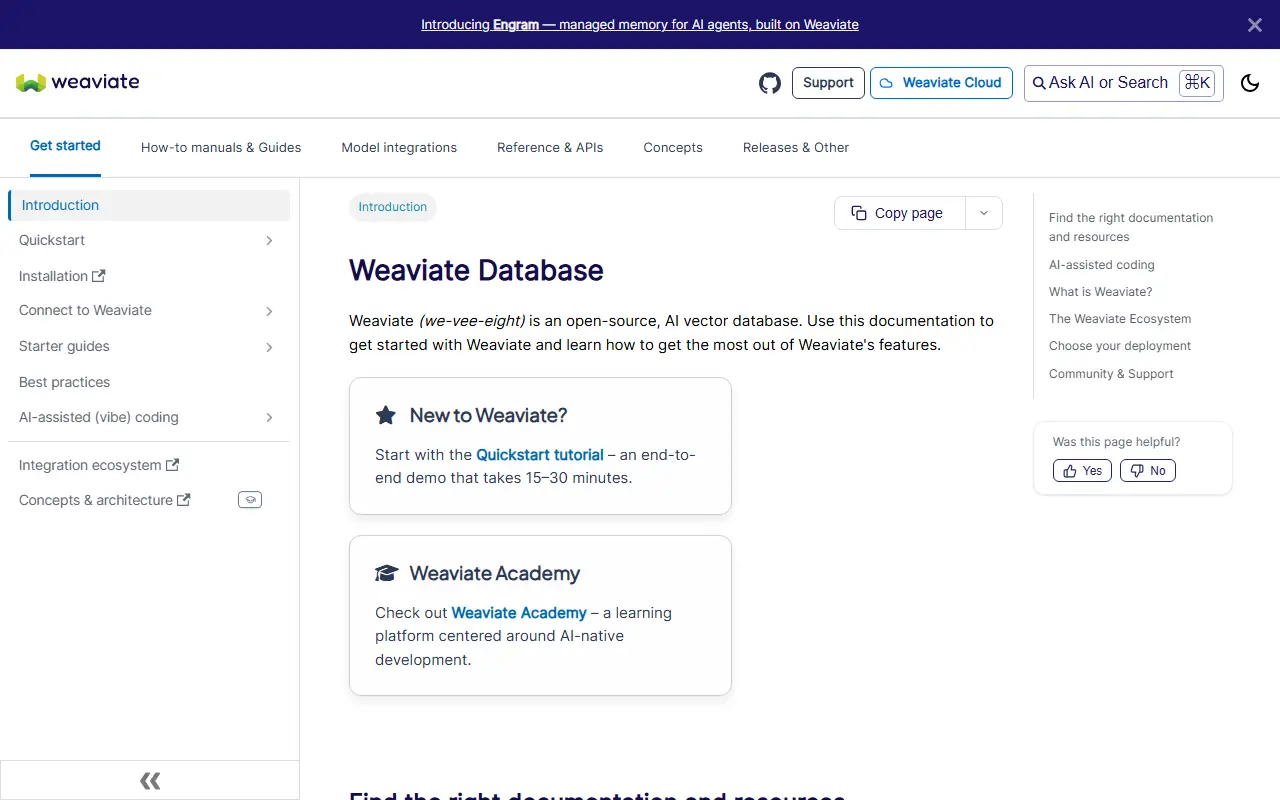
weaviate.ioWeaviate homepage screenshot

Weaviate is a vector database that stores both data objects and their vector embeddings, enabling semantic search at scale. One query interface can blend vector similarity search, keyword filtering, retrieval-augmented generation and reranking, and it is written in Go as a cloud-native system.

Common applications are RAG pipelines, semantic and image search, recommenders, chatbots and content classification. Vectors can be created automatically on import by integrated models from providers such as OpenAI, Cohere and Hugging Face, or you can import pre-computed embeddings. For production, it offers built-in multi-tenancy, replication and role-based access control. Topics reference approximate nearest neighbor search and HNSW indexing.

Weaviate can be deployed with Docker, on Kubernetes, or through the managed Weaviate Cloud, with guides for AWS and GCP, and the documentation includes quickstarts for both cloud and a local Docker instance. Its license is listed as 'Other' on GitHub, so check the repository terms. It suits teams building AI applications that need a scalable store for embeddings alongside structured filters.

Key features

  • Stores objects and vectors together
  • Hybrid vector and keyword search
  • Integrated vectorizer models or bring your own
  • Multi-tenancy and replication
  • Role-based access control
  • Docker, Kubernetes and Weaviate Cloud options

LanceDB

An embedded retrieval library and vector database for multimodal AI, built on the Lance columnar format with vector, full-text and SQL search.

GitHub stars
12k
Last commit
yesterday
Latest release
v0.39.0
Licence
Apache-2.0
Self-hosted
Yes
Hosted version
Available
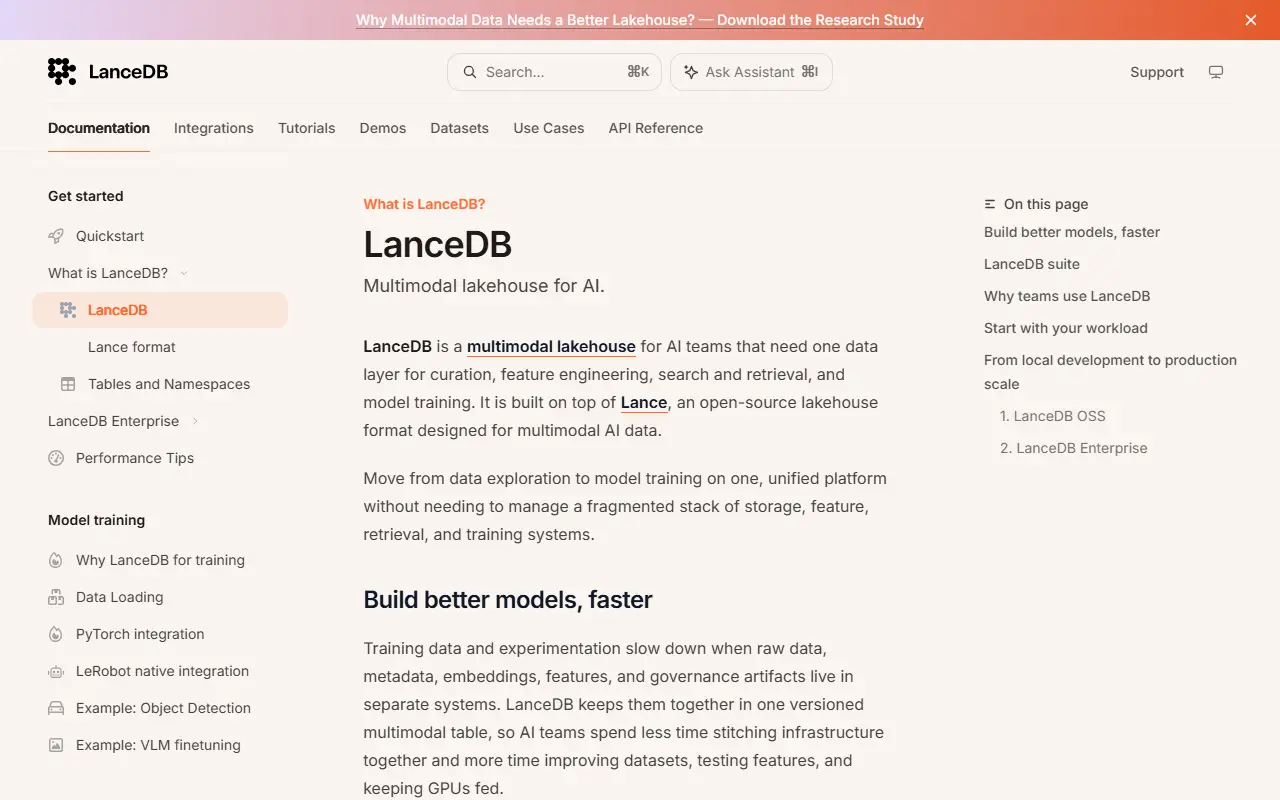
lancedb.comLanceDB homepage screenshot

LanceDB is an open-source retrieval library and vector database for AI and machine learning applications. It is built on the Lance columnar format and lets developers store, index and search vectors alongside metadata and multimodal data such as text, images, video and point clouds.

Search options include vector similarity, full-text search and SQL, with features such as zero-copy access, automatic versioning of data without extra infrastructure, and GPU support when building vector indexes. It offers Python, Node.js, Rust and REST APIs, with native Python and JavaScript or TypeScript support, and integrates with LangChain, LlamaIndex, Apache Arrow, Pandas, Polars and DuckDB.

The open-source library is Apache-2.0 licensed, runs locally or in your own cloud and is written in Rust, with an embedded design that needs no separate server for simple setups. A separate cloud and enterprise offering runs vector search at production scale without any servers for you to manage. LanceDB suits developers building semantic search, recommendation and retrieval pipelines for AI applications.

Key features

  • Vector similarity search
  • Full-text search and SQL queries
  • Multimodal data storage
  • Automatic data versioning
  • GPU-assisted vector index building
  • Python, Node.js, Rust and REST APIs
  • Integrations with LangChain and LlamaIndex

Pricing: Open source under Apache-2.0; a separate cloud and enterprise offering is available.

Vespa

An open-source platform for search, recommendation and personalization that serves vectors, tensors, text and structured data with machine-learned ranking at any scale.

GitHub stars
7.1k
Last commit
yesterday
Latest release
v8.753.16
Licence
Apache-2.0
Self-hosted
Yes
Hosted version
Available

Vespa is a platform for applications that must pick a subset of data from a large, changing corpus, evaluate machine-learned models over it, organize and aggregate the results and return them quickly. Typical examples are search, recommendation and personalization, and the platform adds vector search and retrieval-augmented generation as well, as shown in its topics.

Doing this over large data sets distributed across many nodes and evaluated in parallel is hard, and Vespa handles it with high availability and performance. It handles searching, running inference over and organizing vectors, tensors, text and structured data while serving. According to the README, Vespa has been developed over many years and runs behind several large internet services.

The repository contains all the code needed to build and run Vespa yourself under the Apache 2.0 licence, and new releases are made from the master branch on weekday mornings. You can deploy applications to the Vespa Cloud service, which offers a free trial, or run your own instance following the getting started guide. It is written in Java and C++ and suits teams building large-scale search and recommendation systems.

Key features

  • Search over text, vectors and tensors
  • Machine-learned model inference at serving time
  • Structured data filtering and aggregation
  • Distributed, highly available serving
  • Real-time updates while serving queries
  • Cloud service with a free trial

Pricing: Free and open source under Apache 2.0; Vespa Cloud is a managed service with a free trial.

Infinity

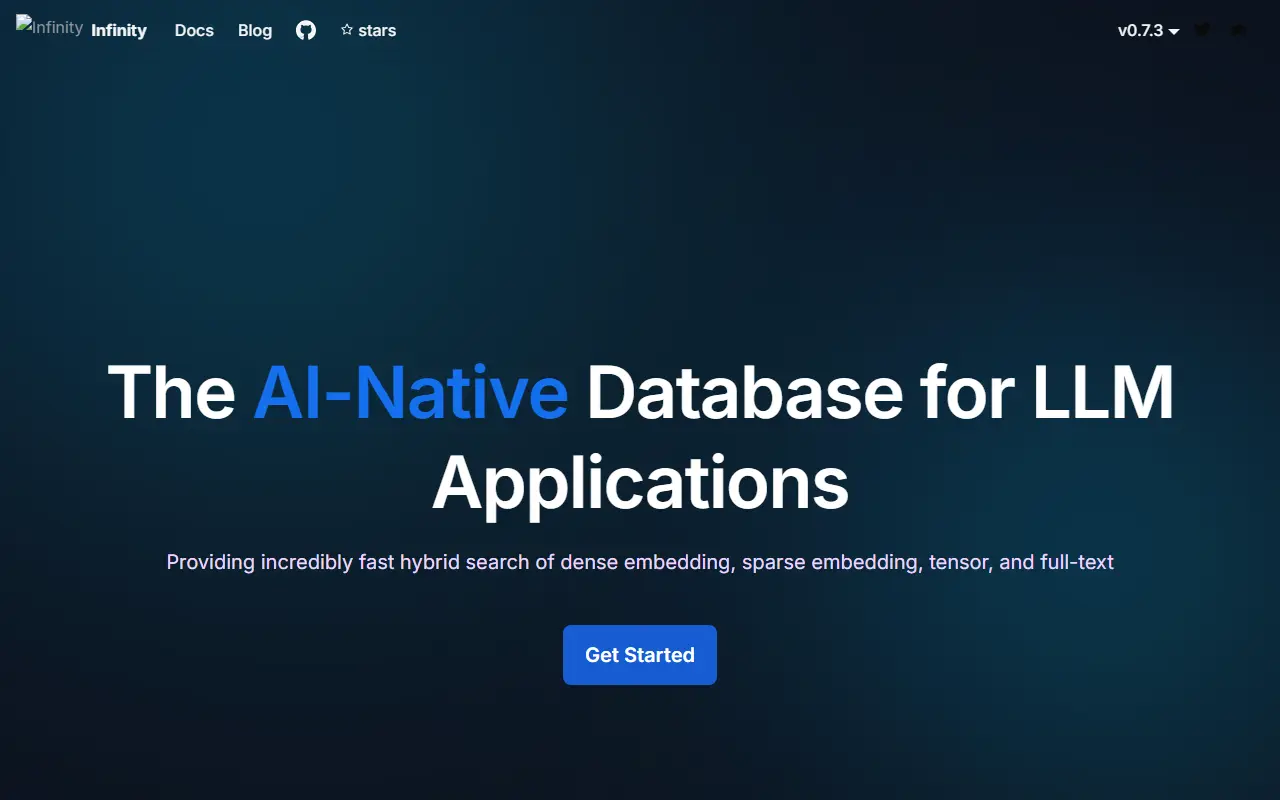
Infinity is an AI-native database from Infiniflow offering fast hybrid search over dense vectors, sparse vectors, tensors and full-text for LLM applications.

GitHub stars
4.7k
Last commit
9 days ago
Latest release
v0.7.3
Licence
Apache-2.0
Self-hosted
Yes
infiniflow.orgInfinity homepage screenshot

Infinity is a database built for LLM applications that combines several kinds of retrieval in one engine. It handles searches over dense vectors, sparse vectors, multi-vector tensors and full text, in addition to structured data, so retrieval-augmented generation pipelines do not need to join results from separate systems.

The README lists search, recommenders, question answering, conversational AI, copilots and content generation among its targets. Repository topics mention approximate nearest neighbor search, HNSW, BM25 and hybrid search, and the engine is written in C++ using C++20 modules. The project provides benchmarks, documentation and a roadmap, with community links on Discord and Twitter.

Infinity is licensed under Apache-2.0 and is run on your own servers. It suits developers building RAG and semantic search systems who want a single database for vector, keyword and multi-vector retrieval.

Key features

  • Dense and sparse vector search
  • Tensor multi-vector retrieval
  • BM25 full-text search
  • Hybrid search across data types
  • Support for RAG pipelines
  • C++20 high-performance engine

Pricing: Free and open source under the Apache-2.0 license.

NucliaDB

NucliaDB is a Rust and Python database for storing and searching unstructured data with hybrid vector, full-text and graph indexes, aimed at RAG.

GitHub stars
722
Last commit
yesterday
Latest release
v7.1.0
Self-hosted
Yes
Hosted version
Available
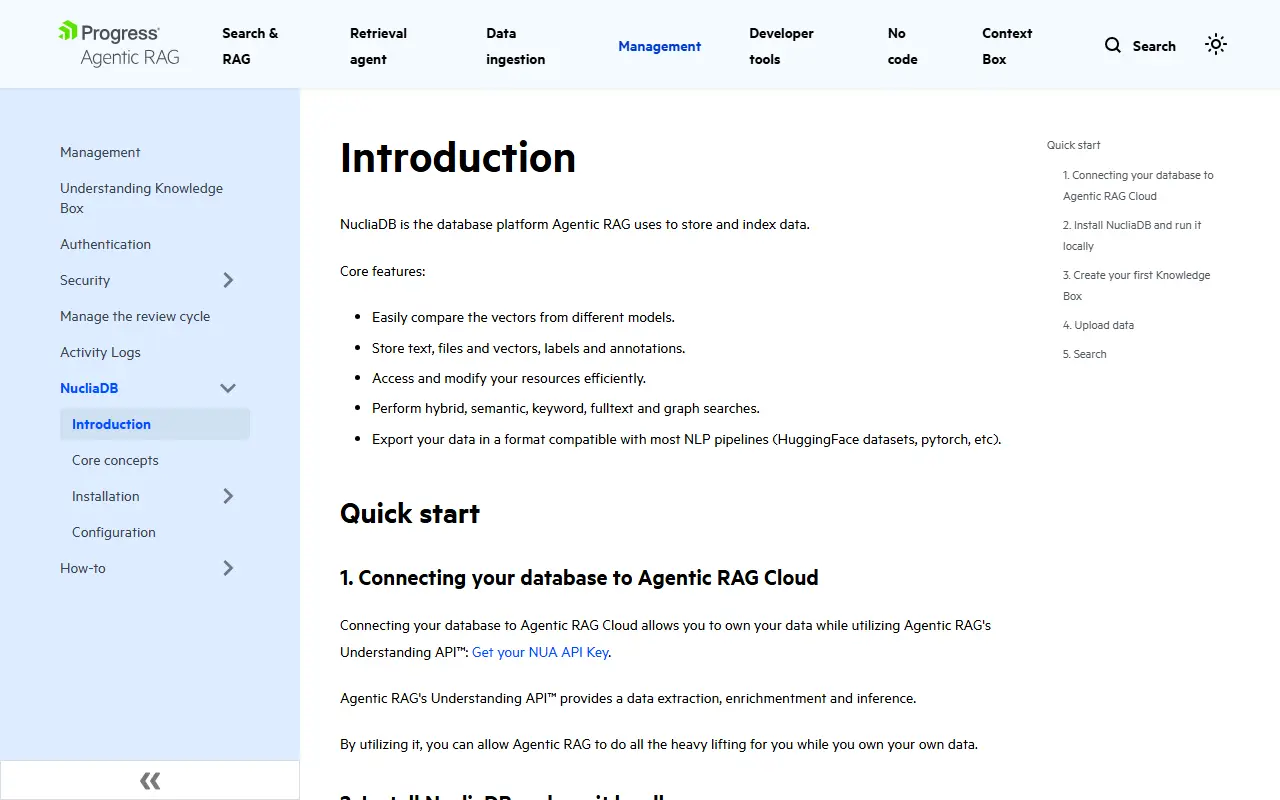
docs.nuclia.devNucliaDB homepage screenshot

NucliaDB, from Nuclia, is a database for storing and searching unstructured data, described as an AI search database for retrieval-augmented generation. It works as an out-of-the-box hybrid search engine that combines vector, full-text and graph indexes, and it was designed to index large datasets with multi-tenant support.

It stores text, files, vectors, labels and annotations in resources with multiple fields and metadata, with field types for text, files, links and conversations. Users can run keyword searches and semantic searches over vectors, export data in formats suited to NLP pipelines such as Hugging Face datasets, and apply role-based security with upstream proxy authentication. The storage layer uses PostgreSQL, with blob support through S3-compatible storage, Google Cloud Storage or Azure Blob Storage, plus index replication and distributed search.

NucliaDB can also connect to Nuclia's cloud APIs, the Understanding API for data and insight extraction and the Learning API for training models. The core is written in Rust and Python, and its license is listed as Other, so check the repository for the exact terms.

Key features

  • Hybrid vector, full-text and graph search
  • Multi-tenant resource storage
  • Text, file, link and conversation fields
  • S3, GCS and Azure blob storage support
  • Role-based security
  • Export for NLP pipelines

Epsilla VectorDB

Open-source vector database written in C++ for scalable embedding search with hybrid dense and sparse queries, metadata filtering and LangChain integrations.

GitHub stars
875
Last commit
10 mo ago
Latest release
v0.3.16
Licence
GPL-3.0
Self-hosted
Yes
Hosted version
Available
epsilla.comEpsilla VectorDB homepage screenshot

Epsilla is an open-source vector database focused on scalability, high performance and cost-effective vector search. It is designed to connect information retrieval with memory for large language models, so developers building retrieval-augmented generation systems can store embeddings and query them quickly. The core is written in C++ and uses parallel graph traversal techniques for indexing, which the project says is faster than HNSW at comparable precision.

It behaves like a complete database management system, with familiar database, table and field concepts where a vector is just another field type. Features include production-scale similarity search, metadata filtering, hybrid search combining dense and sparse vectors, built-in embedding support for natural-language search, and a cloud-native design with compute and storage separation, serverless operation and multi-tenancy. Integrations cover LangChain and LlamaIndex, and clients are available for Python, JavaScript and Ruby along with a REST API.

You can run the backend in Docker and talk to it from the Python client, or use Epsilla as a Python library without Docker by building the bindings. A managed Epsilla Cloud vector database service is offered and marked experimental. The code is licensed under GPL-3.0.

Key features

  • Vector similarity search for embeddings
  • Hybrid dense and sparse search
  • Metadata filtering
  • Database, table and field data model
  • Built-in embedding support
  • LangChain and LlamaIndex integrations
  • Python, JavaScript and Ruby clients

Pricing: Free tier available (no credit card required). Starter is $29/month, Professional $249/month, AI Concierge $2,499/month. Enterprise pricing is custom.

MyScaleDB

MyScaleDB is an open-source SQL vector database built on ClickHouse, combining vector search, full-text search and analytics for AI applications.

GitHub stars
1k
Last commit
1 yr ago
Latest release
myscaledb-v1.8.0
Licence
Apache-2.0
Self-hosted
Yes
Hosted version
Available
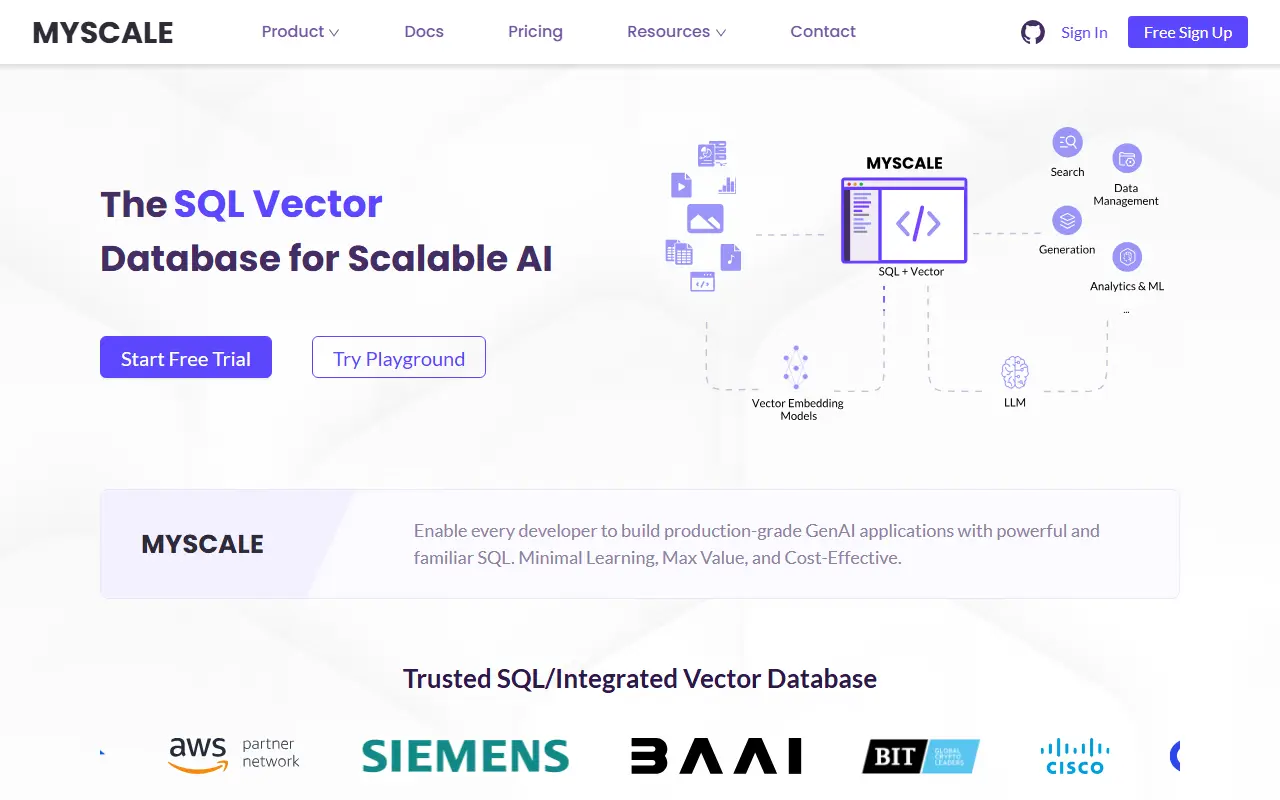
myscale.comMyScaleDB homepage screenshot

MyScaleDB is a database that adds high-performance vector search and full-text search to ClickHouse, so developers can build retrieval-augmented generation and other AI applications using ordinary SQL. It is a fork of ClickHouse rather than a separate service layered on top, and it keeps the OLAP architecture that makes ClickHouse suited to large datasets.

Because it speaks SQL, queries can combine vector similarity, metadata filters and joins across tables, which the project says improves RAG accuracy compared with filtering after retrieval. It manages structured data, text, vectors, JSON, geospatial and time-series data in one system, and the README stresses scalability as data grows.

The source code is released under Apache-2.0 and can be self-hosted. A managed offering, MyScale Cloud, runs MyScaleDB with extra premium features at billion-scale and is positioned against specialized vector databases that use custom APIs. It suits teams already comfortable with SQL who want one system for vectors and analytics.

Key features

  • SQL interface with vector-related functions
  • Vector search with metadata filtering
  • Full-text search alongside vectors
  • SQL-vector join queries
  • Built on the ClickHouse OLAP architecture
  • Supports JSON, geospatial and time-series data

Pricing: The core database is free under Apache-2.0; a managed MyScale Cloud service with extra premium features is also offered.

Pinecone alternatives: questions

What is the best open-source alternative to Pinecone?
Milvus is the top-ranked open-source alternative to Pinecone on Enlisted: An open-source, cloud-native vector database for scalable similarity search over embeddings, with distributed, standalone and lightweight Python modes. Other strong options are Qdrant, Chroma, Weaviate and LanceDB.
Are these Pinecone alternatives free?
All 10 are open source, so the code is free to use under its licence, and all of them can be self-hosted on your own server or computer. 9 also offer a paid or managed cloud version if you'd rather not host it yourself.
How is this list of Pinecone alternatives ranked?
By a score built from GitHub stars, star growth over the last 30 days and how recently the code changed. 8 of these projects shipped code in the last 30 days. Data is refreshed daily, and nobody can pay to move up.

People also look for alternatives to…

View all