
About Infinity
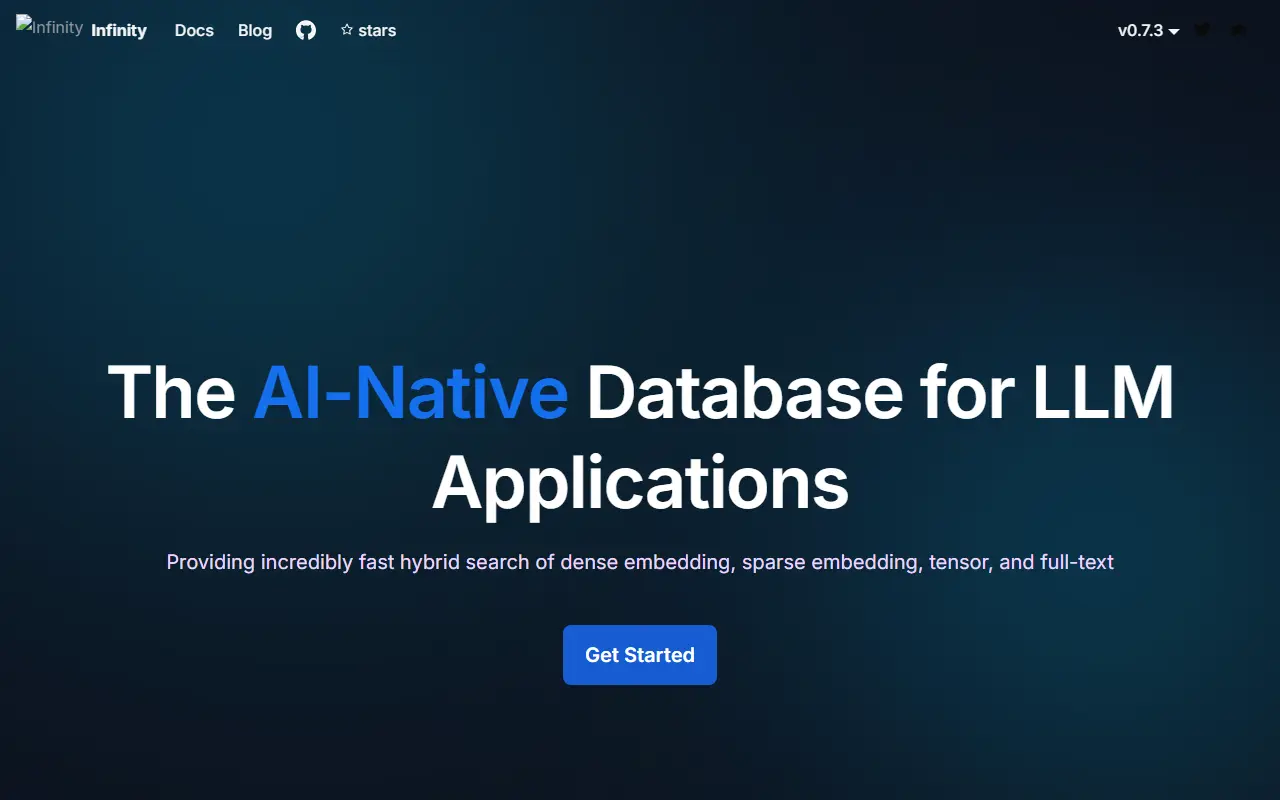
Infinity is a database built for LLM applications that combines several kinds of retrieval in one engine. It handles searches over dense vectors, sparse vectors, multi-vector tensors and full text, in addition to structured data, so retrieval-augmented generation pipelines do not need to join results from separate systems.
The README lists search, recommenders, question answering, conversational AI, copilots and content generation among its targets. Repository topics mention approximate nearest neighbor search, HNSW, BM25 and hybrid search, and the engine is written in C++ using C++20 modules. The project provides benchmarks, documentation and a roadmap, with community links on Discord and Twitter.
Infinity is licensed under Apache-2.0 and is run on your own servers. It suits developers building RAG and semantic search systems who want a single database for vector, keyword and multi-vector retrieval.
Key features
- Dense and sparse vector search
- Tensor multi-vector retrieval
- BM25 full-text search
- Hybrid search across data types
- Support for RAG pipelines
- C++20 high-performance engine
Good fit for
- →RAG and semantic search backends
- →Recommendation systems
- →Question-answering over documents
- Built with
- C++
- Tags
- vector-database
- hybrid-search
- rag
- full-text-search
- llm
- bm25
- cpp
- ai-native
Infinity: questions and answers
- What is Infinity used for?
- Infinity is an AI-native database from Infiniflow offering fast hybrid search over dense vectors, sparse vectors, tensors and full-text for LLM applications. It is a good fit for RAG and semantic search backends, recommendation systems, and question-answering over documents.
- Is Infinity open source?
- Yes. Infinity is open source under the Apache-2.0 licence. Its source code is on GitHub at infiniflow/infinity and is written mainly in C++.
- Is Infinity free?
- Yes. Infinity is open source, so the software itself is free to use.
- Can I self-host Infinity?
- Yes. Infinity can be self-hosted on your own server or infrastructure.
- What is Infinity an alternative to?
- Infinity is an open-source alternative to Pinecone and Elastic. Other open-source alternatives to Pinecone include Vespa, Epsilla VectorDB and MyScaleDB.
- Is Infinity actively maintained?
- Yes. The most recent commit to Infinity was on 23 September 2026, and the latest release is v0.7.3, published on 6 August 2026. The project has 4.7k stars on GitHub.
Open-source alternatives to Infinity
See all
Vespa
Search
The AI search platform
Apache-2.0vs Elastic★ 7.1k
Epsilla VectorDB
Databases
A high performance Vector Database leveraging parallel graph computing
GPL-3.0vs Pinecone★ 875
ParadeDB
Databases
One Postgres for your application data, full-text search, vector retrieval, and aggregatio
AGPL-3.0vs Elastic★ 9.3k
MyScaleDB
Databases
A @ClickHouse fork that supports high-performance vector search and full-text search.
Apache-2.0vs Pinecone★ 1k
Milvus
Databases
Milvus is a high-performance, cloud-native vector database built for scalable vector ANN s
Apache-2.0vs Pinecone★ 46k
Qdrant
Databases
Qdrant - High-performance, massive-scale Vector Database and Vector Search Engine for the
Apache-2.0vs Pinecone★ 35k
SaaS alternatives to Infinity
See all
Pinecone
Databases
Managed vector database for semantic search and retrieval apps
SaaS
Elastic
Search
Elastic builds Elasticsearch, a distributed search and analytics engine used for application search, logs, vector search and security analytics.
SaaS
Upstash
Databases
Serverless Redis, Kafka and vector database with per-request pricing
SaaS
DataStax Astra DB
Databases
Cassandra-based serverless database with vector search for AI applications
SaaS
Azure Cosmos DB
Databases
Microsoft globally distributed multi-model NoSQL database
SaaS
KX kdb+
Databases
Time-series database used for high-frequency market and sensor data analytics
SaaS