7,363 open-source and SaaS tools, with GitHub stats refreshed every day.

23 alternatives ranked by real activity

Open-source Elastic alternatives

A curated, ranked list of the 23 best open-source alternatives to Elastic.

The best open-source alternative to Elastic is Typesense. If that doesn't suit you, other good options are OpenObserve, Sonic, ZincSearch and OpenSearch.

Elastic alternatives are mainly search tools, but some are also databases and monitoring & observability tools. 19 of them shipped code in the last 30 days, 23 can be self-hosted, and 16 use a permissive licence.

Last updated October 2, 2026 · ranked by GitHub stars, growth and recent commits

Typesense

A fast, typo-tolerant, in-memory search engine for site and app search, pitched as an open-source Algolia alternative and an easier-to-run Elasticsearch alternative.

GitHub stars
27k
Last commit
yesterday
Latest release
v30.2
Licence
GPL-3.0
Self-hosted
Yes
Hosted version
Available
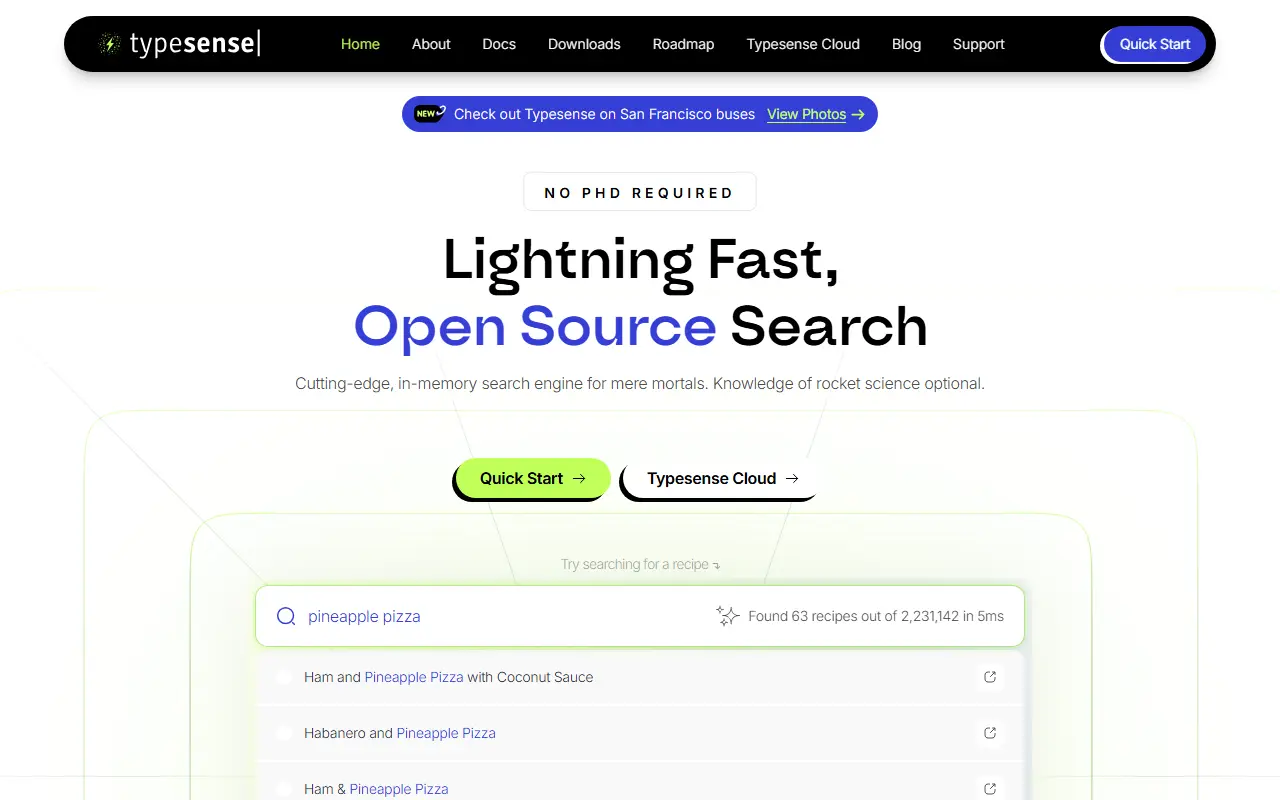
typesense.orgTypesense homepage screenshot

Typesense is an open-source search engine for building fast, typo-tolerant search experiences in websites and applications. It is pitched as an open-source substitute for Algolia and Pinecone, and as a simpler option than Elasticsearch. It keeps its index in memory and is written in C++.

The project's feature topics include typo tolerance and fuzzy matching, full-text search, faceting, geosearch, synonyms, merchandising rules and instant search, and it supports semantic and hybrid search. Public demos let you try it on large datasets, such as 32 million songs from MusicBrainz, 28 million books from OpenLibrary, a recipe set, Linux kernel commit messages, an ecommerce store experience, a geosearch listing browser and semantic search over Hacker News comments.

Typesense is licensed under GPL-3.0 and can be run on your own servers, and a managed Typesense Cloud service is also available. Documentation, a roadmap, a Slack community and video introductions are provided. It suits developers who want Algolia-style search with the option to self-host and keep costs predictable.

Key features

  • Typo-tolerant, in-memory search
  • Faceting, filtering and synonyms
  • Geosearch for location-based results
  • Semantic and hybrid search
  • Merchandising controls for ranking
  • Self-hosted or Typesense Cloud
OpenObserve

A cloud-native observability platform covering logs, metrics, traces, RUM and LLM monitoring, with Parquet columnar storage on S3 and a pitch against Datadog and Splunk.

GitHub stars
22k
Last commit
yesterday
Latest release
v1.1.0-rc1
Licence
AGPL-3.0
Self-hosted
Yes
Hosted version
Available
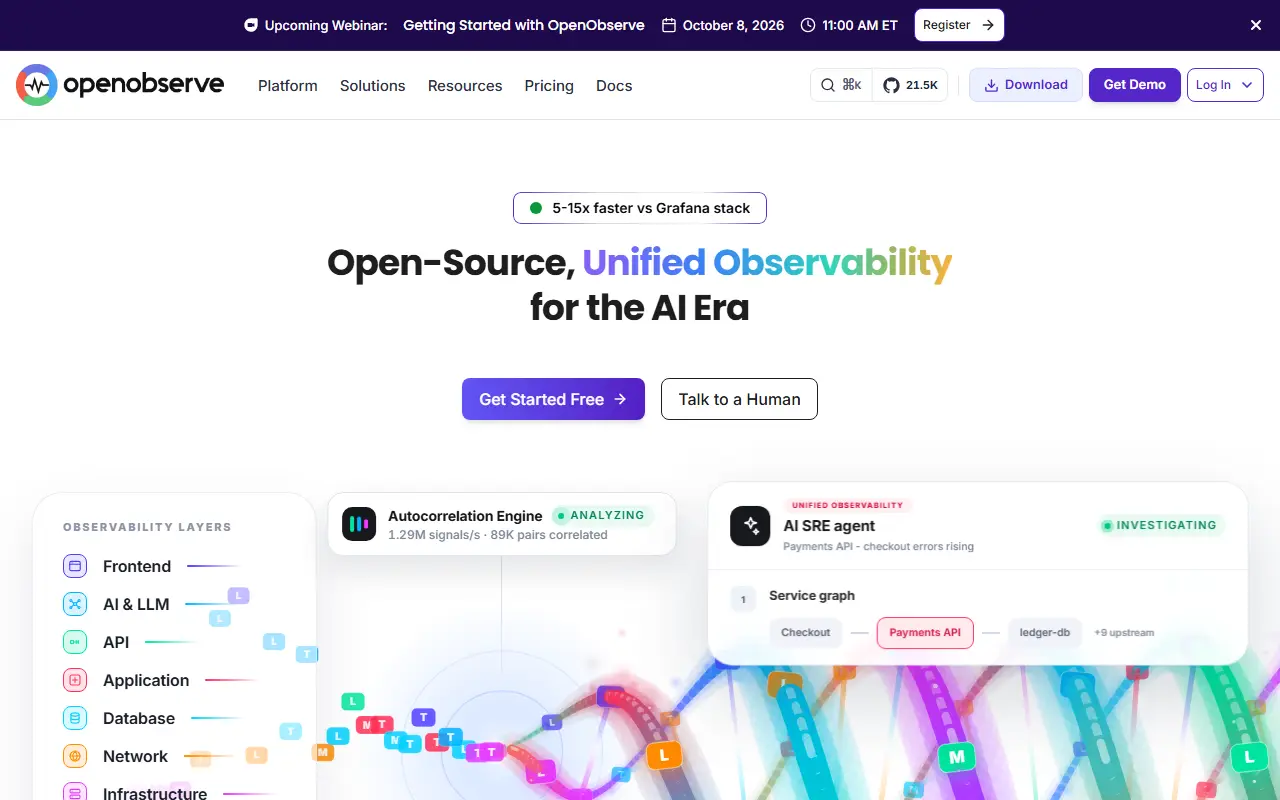
openobserve.aiOpenObserve homepage screenshot

OpenObserve, often shortened to O2, is open-source observability software spanning logs, metrics, traces and analytics, real user monitoring on web, Android and iOS, session replay, pipelines, SLOs and AI and LLM observability. It is pitched as a lower-cost option next to Datadog, Splunk and Elasticsearch for teams that want complete observability without the complexity or price.

Its architecture uses Parquet columnar storage and an S3-native design, which the project says can cut storage costs by up to 140 times compared with Elasticsearch, with petabyte-scale capacity. Topics reference OpenTelemetry, Prometheus, Jaeger and Kibana, showing the standards and tools it interoperates with. The README has sections on architecture, comparisons, production readiness, security and compliance, and an enterprise edition.

OpenObserve is AGPL-3.0 licensed, with a hosted cloud option and a self-hosted deployment, and documentation and a Slack community are provided. It suits engineering teams looking to consolidate logging, metrics and tracing in one tool while keeping storage costs under control.

Key features

  • Logs, metrics and traces in one platform
  • Real user monitoring and session replay
  • LLM and AI observability
  • Parquet columnar storage on S3
  • OpenTelemetry and Prometheus compatibility
  • Pipelines and SLO tracking

Pricing: Self-hosting is free. Cloud is pay-as-you-go at $0.50 per GB ingested plus $0.01 per GB queried, with unlimited users and a 14-day trial; Enterprise is custom.

Sonic

A lightweight, schema-less search index server written in Rust that returns document IDs in microseconds while using only tens of megabytes of memory.

GitHub stars
21k
Last commit
yesterday
Latest release
v1.10.1
Licence
MPL-2.0
Self-hosted
Yes
crates.ioSonic homepage screenshot

Sonic is a fast, lightweight search backend written in Rust. It ingests pairs of search text and identifiers and answers queries against them very quickly. Rather than storing your documents, it is an identifier index: a search returns the IDs of matching items, which you then look up in your own database.

It can normalize natural-language queries, offer auto-completion and return the most relevant results, and the author presents it as a simple alternative to heavyweight engines such as Elasticsearch for suitable use cases. The project places strong emphasis on performance and clean code, aiming to be crash-free and gentle on server resources, and its measurements report responses in the microsecond range with roughly 30 MB of RAM under load. Benchmarks are published, and the project was crafted in Nantes, France.

Sonic is licensed under MPL-2.0 and you run it yourself, typically as a small companion service next to your main database. It suits developers who need search-as-you-type or suggestion features in an app without operating a large cluster, and who are comfortable keeping the source documents elsewhere.

Key features

  • Identifier index returning document IDs
  • Schema-less ingestion of search text
  • Query normalization and auto-complete
  • Very low memory and CPU footprint
  • Microsecond-range query responses
  • Written in Rust

Pricing: Free and open source under the MPL-2.0 license.

ZincSearch

A lightweight full-text search engine written in Go that runs on a fraction of Elasticsearch's resources, with its own web UI and easy setup.

GitHub stars
18k
Last commit
17 days ago
Latest release
v1.0.0-beta3
Self-hosted
Yes
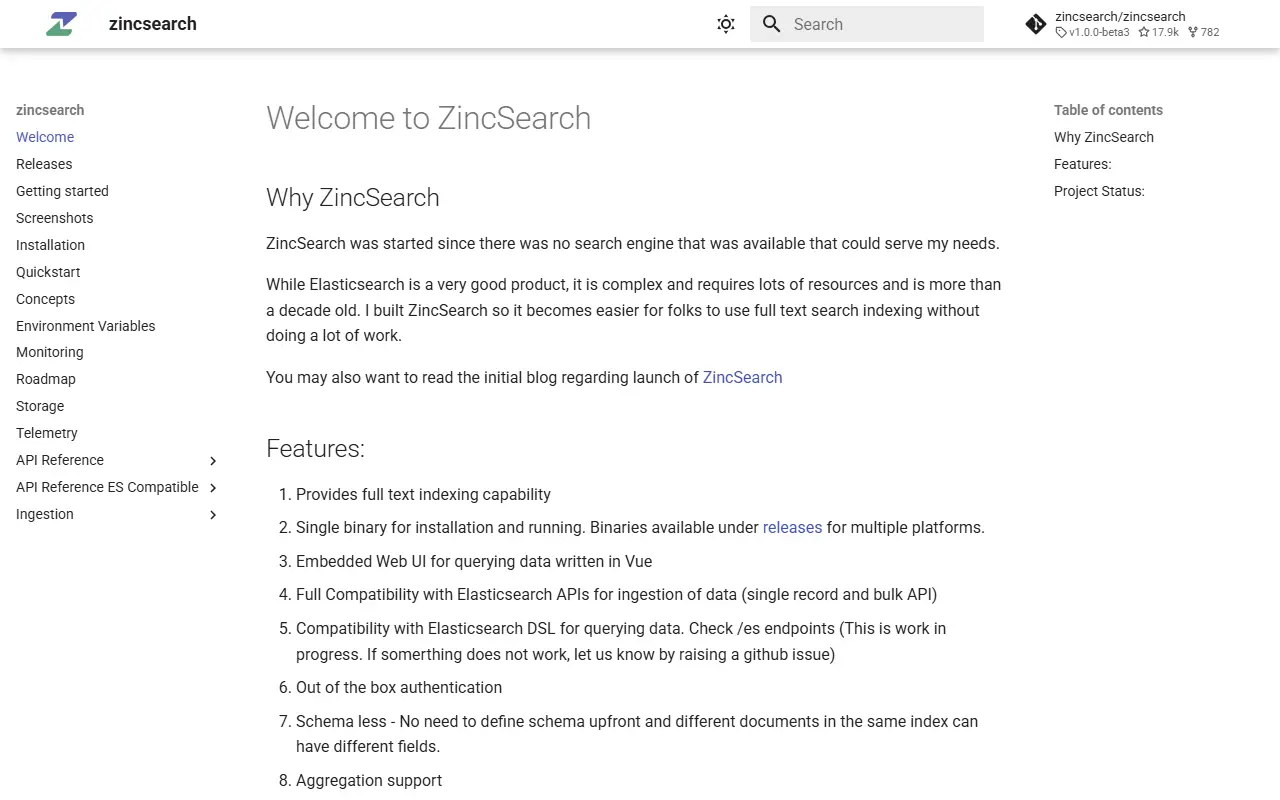
zincsearch-docs.zinc.devZincSearch homepage screenshot

ZincSearch is a search engine that performs full-text indexing, written in Go with a Vue-based web interface. It is positioned as a lightweight alternative to Elasticsearch that needs far fewer resources and avoids the large number of settings that Elasticsearch tends to require tuning. The author says you can have it running within a couple of minutes.

It uses the bluge indexing library, through a fork, under the hood. For applications that simply ingest documents through an API and search them, it can serve as a drop-in replacement for Elasticsearch, though Kibana is not supported and ZincSearch ships its own UI instead. The README includes an important note: if your goal is log and security search rather than adding search to an app or website, the same author points people to the OpenObserve project, which was built for that case.

ZincSearch is at a 1.0 beta release, and its license is listed as 'Other' on GitHub, so check the repository for terms. It suits developers who want application search with a small footprint, such as site search or in-app lookup, and who are comfortable running a service themselves.

Key features

  • Full-text indexing and search
  • Small resource footprint
  • Elasticsearch-compatible ingestion APIs
  • Built-in web UI
  • Quick setup in minutes
  • Go server with Vue front end

OpenSearch

An Apache-licensed, distributed and RESTful search engine and observability suite for searching, analyzing and monitoring large volumes of unstructured data.

GitHub stars
14k
Last commit
yesterday
Latest release
3.9.0
Licence
Apache-2.0
Self-hosted
Yes
Hosted version
Available
opensearch.orgOpenSearch homepage screenshot

OpenSearch is an open-source search and observability suite that makes large amounts of unstructured data searchable and analyzable. It is a distributed engine with a RESTful API, written in Java, and developed in the open by the OpenSearch community under the Apache 2.0 licence.

Teams use it for full-text search, log and event analytics, and monitoring of applications and infrastructure. The project provides downloads, documentation, forums and Slack channels, and it follows a formal release and maintainer process. Because it is distributed, clusters can be scaled across multiple nodes as data volumes grow.

OpenSearch includes certain Apache-licensed code derived from Elasticsearch, as its trademark notice explains. You can run it on your own servers, or use managed services offered by cloud providers. Security issues are reported privately by email rather than through public issues, and the project maintains a code of conduct for contributors.

Key features

  • Distributed search with a RESTful API
  • Full-text search over unstructured data
  • Log and event analytics
  • Observability and monitoring use cases
  • Scales across nodes in a cluster
  • Apache 2.0 licensed Java codebase

Pricing: Free and open source under Apache 2.0; managed hosting is available from cloud providers.

Ubicloud

An open-source cloud platform that turns bare-metal Linux servers into an AWS-style cloud with compute, storage, networking, managed Postgres, Kubernetes and AI inference.

GitHub stars
12k
Last commit
yesterday
Licence
AGPL-3.0
Self-hosted
Yes
Hosted version
Available
ubicloud.comUbicloud homepage screenshot

Ubicloud is an open-source cloud platform designed to run on any infrastructure, described by its authors as an open alternative to cloud providers in the way Linux is to proprietary operating systems. It delivers infrastructure-as-a-service capabilities on top of bare-metal hosts, for example Hetzner, Leaseweb and AWS Bare Metal.

Its services include elastic compute, non-replicated block storage, firewalls and load balancers, managed Postgres, Kubernetes, AI inference and IAM. A control plane takes leased bare-metal Linux machines, prepares them for cloud use, and then lets you provision and manage resources through a cloud console. The project is written in Ruby and topics also mention GitHub Actions runners.

You can use the managed platform at console.ubicloud.com without installing anything, where the underlying provider's price and location benefits are passed on to you, or build your own cloud by leasing servers and running the control plane yourself. Ubicloud is licensed under AGPL-3.0. The quick-start flow is currently described for Hetzner machines running Ubuntu 24.04.

Key features

  • Elastic compute on bare-metal servers
  • Block storage, firewalls and load balancers
  • Managed PostgreSQL databases
  • Managed Kubernetes clusters
  • AI inference services
  • IAM and cloud console

Pricing: Pay-as-you-go, billed per minute: runners from $0.00125 a minute, burstable VMs from $10.47 a month, managed PostgreSQL from $19.54 and Kubernetes from $71.82 a month. You can also self-host.

Quickwit

A cloud-native open-source search engine for observability data, built in Rust to index logs and traces on object storage with an Elasticsearch-compatible API.

GitHub stars
12k
Last commit
yesterday
Latest release
v0.9.1
Licence
Apache-2.0
Self-hosted
Yes
quickwit.ioQuickwit homepage screenshot

Quickwit is an open-source, cloud-native search engine designed for observability, covering log management and distributed tracing, with metrics support listed on the roadmap. It is written in Rust, builds on the Tantivy search library, and is meant to search large volumes of data kept in cheap object storage.

It provides full-text search and aggregation queries, schemaless or strict-schema indexing, and a RESTful API that is compatible with a large subset of the Elasticsearch and OpenSearch APIs, so existing clients can often be reused. It is native to Jaeger and OpenTelemetry, works as a Grafana data source and can ingest from Kafka, Kinesis and Pulsar. Compute and storage are decoupled, with stateless indexers and searchers, and data can sit on Amazon S3, Azure Blob Storage or Google Cloud Storage.

Operational features include multi-tenancy with many indexes, partitioning, retention policies and delete tasks for GDPR use cases, and a Helm chart for Kubernetes. Quickwit is licensed under Apache-2.0 and you run it yourself. It suits teams looking for lower-cost log and trace storage with a familiar search API.

Key features

  • Full-text search and aggregation queries
  • API compatible with Elasticsearch clients
  • Native Jaeger and OpenTelemetry support
  • Search directly on cloud object storage
  • Decoupled compute and storage
  • Ingestion from Kafka, Kinesis and Pulsar
  • Retention policies and GDPR delete tasks
  • Helm chart for Kubernetes

Pricing: Free and open source under the Apache-2.0 licence.

ParadeDB

A Postgres extension and distribution that adds fast full-text search, BM25 ranking, vector and hybrid search and analytics to PostgreSQL.

GitHub stars
9.3k
Last commit
yesterday
Latest release
v0.25.11
Licence
AGPL-3.0
Self-hosted
Yes
Hosted version
Available
paradedb.comParadeDB homepage screenshot

ParadeDB upgrades Postgres so that application records, keyword search, vector lookups and aggregate queries can share one database. It is built as a Postgres extension, home of pg_search, and uses standard SQL and ACID transactions, so there is no separate search engine to keep in sync.

A custom index delivers full-text and vector search with BM25 scoring, top-K queries, highlighting, tokenizers and filters, along with facets, aggregations, bucket and metrics queries, joins and columnar storage. Under the hood it builds on Rust libraries: pgrx bridges Postgres and Rust, Tantivy powers search and Apache DataFusion handles OLAP processing. Integrations cover Drizzle, Django, SQLAlchemy, Rails and EF Core, AI agent tooling such as MCP, and PaaS providers like Railway, Render, Fly.io and DigitalOcean.

You can try ParadeDB locally with Docker and psql, run it self-hosted, or use ParadeDB Cloud for a fully managed experience. It is written in Rust and licensed under AGPL-3.0. Teams use it to add search to an existing Postgres setup instead of adding Elasticsearch.

Key features

  • Full-text search with BM25 scoring
  • Vector and hybrid search
  • Facets, aggregations and joins
  • Columnar storage for analytics
  • Built as a Postgres extension
  • Standard SQL with ACID transactions
  • Integrations with ORMs and PaaS hosts

Pricing: Open source under AGPL-3.0; ParadeDB Cloud is a fully managed option.

Vespa

An open-source platform for search, recommendation and personalization that serves vectors, tensors, text and structured data with machine-learned ranking at any scale.

GitHub stars
7.1k
Last commit
yesterday
Latest release
v8.753.16
Licence
Apache-2.0
Self-hosted
Yes
Hosted version
Available

Vespa is a platform for applications that must pick a subset of data from a large, changing corpus, evaluate machine-learned models over it, organize and aggregate the results and return them quickly. Typical examples are search, recommendation and personalization, and the platform adds vector search and retrieval-augmented generation as well, as shown in its topics.

Doing this over large data sets distributed across many nodes and evaluated in parallel is hard, and Vespa handles it with high availability and performance. It handles searching, running inference over and organizing vectors, tensors, text and structured data while serving. According to the README, Vespa has been developed over many years and runs behind several large internet services.

The repository contains all the code needed to build and run Vespa yourself under the Apache 2.0 licence, and new releases are made from the master branch on weekday mornings. You can deploy applications to the Vespa Cloud service, which offers a free trial, or run your own instance following the getting started guide. It is written in Java and C++ and suits teams building large-scale search and recommendation systems.

Key features

  • Search over text, vectors and tensors
  • Machine-learned model inference at serving time
  • Structured data filtering and aggregation
  • Distributed, highly available serving
  • Real-time updates while serving queries
  • Cloud service with a free trial

Pricing: Free and open source under Apache 2.0; Vespa Cloud is a managed service with a free trial.

13 more Elastic alternatives

Elastic alternatives: questions

What is the best open-source alternative to Elastic?
Typesense is the top-ranked open-source alternative to Elastic on Enlisted: A fast, typo-tolerant, in-memory search engine for site and app search, pitched as an open-source Algolia alternative and an easier-to-run Elasticsearch alternative. Other strong options are OpenObserve, Sonic, ZincSearch and OpenSearch.
Are these Elastic alternatives free?
All 23 are open source, so the code is free to use under its licence, and all of them can be self-hosted on your own server or computer. 7 also offer a paid or managed cloud version if you'd rather not host it yourself.
How is this list of Elastic alternatives ranked?
By a score built from GitHub stars, star growth over the last 30 days and how recently the code changed. 19 of these projects shipped code in the last 30 days. Data is refreshed daily, and nobody can pay to move up.

People also look for alternatives to…

View all