 TrackMedia
 TrackRev

About SereneDB
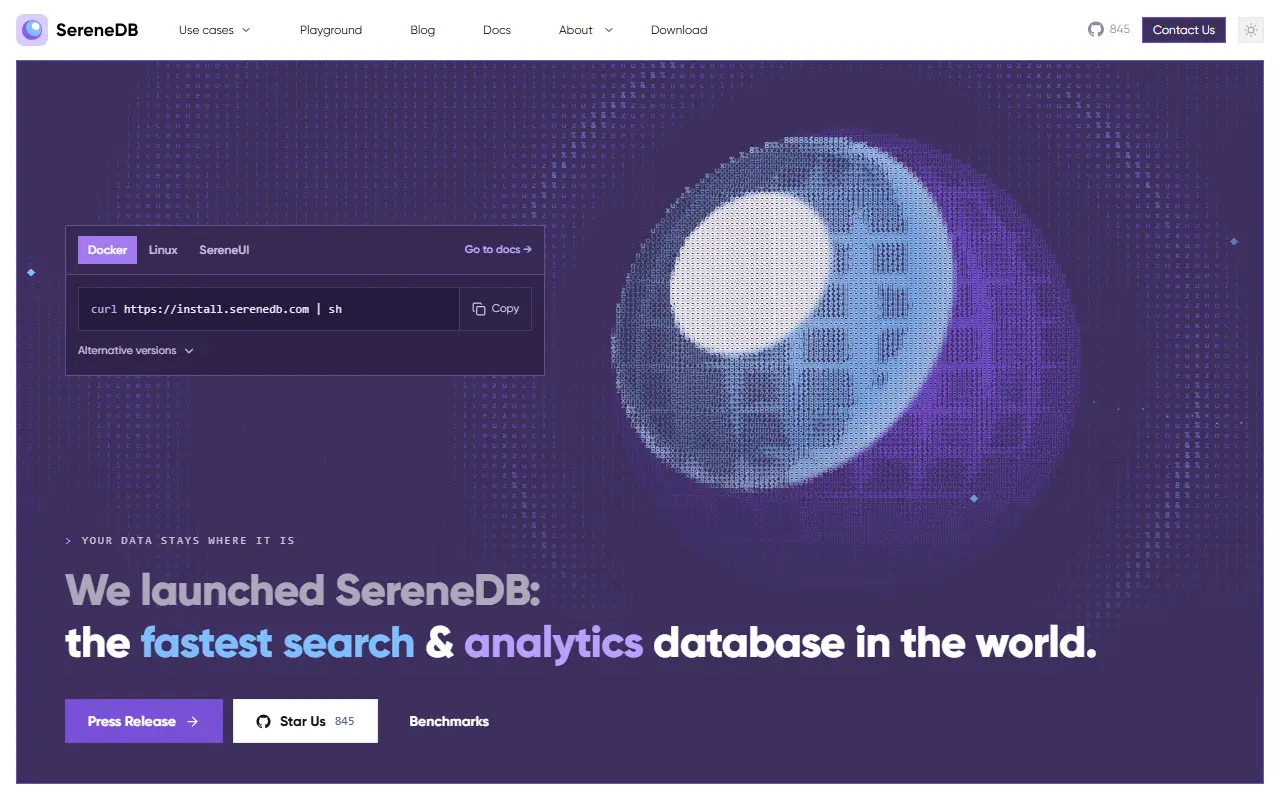
SereneDB is an open-source database that unifies search and analytics. It aims to give the search experience of Elasticsearch and the analytical speed of ClickHouse in one Postgres-compatible system, treating search as a first-class feature of the query engine instead of a separate cluster.
Search is powered by IResearch, a C++ information retrieval library that members of the SereneDB team have developed since 2016. The database supports BM25 ranking, vector and hybrid search, and column-wise updates to keep data fresh. A zero-ETL mode queries Parquet, Iceberg, CSV and JSON data directly on remote storage such as S3 or HDFS without an ingestion pipeline.
The project publishes open benchmarks comparing it with ClickHouse, Elastic, OpenSearch and ParadeDB, which readers can review for themselves, and offers Slack and Telegram communities. SereneDB is written in C++ and licensed under Apache-2.0.
Key features
- Postgres-compatible SQL interface
- Full-text search with BM25 ranking
- Vector and hybrid search
- Column-oriented analytics engine
- Zero-ETL queries on S3 and HDFS data
- Efficient column-wise real-time updates
Good fit for
- Log and observability analytics with search
- Replacing separate search and OLAP systems
SereneDB: questions and answers
- What is SereneDB used for?
- SereneDB is a Postgres-compatible database that combines Elasticsearch-style full-text search with ClickHouse-style analytics in a single engine. It is a good fit for log and observability analytics with search, and replacing separate search and OLAP systems.
- Is SereneDB open source?
- Yes. SereneDB is open source under the Apache-2.0 licence. Its source code is on GitHub at serenedb/serenedb and is written mainly in C++.
- Is SereneDB free?
- Yes. SereneDB is open source, so the software itself is free to use.
- Can I self-host SereneDB?
- Yes. SereneDB can be self-hosted on your own server or infrastructure.
- What is SereneDB an alternative to?
- SereneDB is an open-source alternative to Elastic. Other open-source alternatives to Elastic include ParadeDB, Infinity and GreptimeDB.
- Is SereneDB actively maintained?
- Yes. The most recent commit to SereneDB was on 12 November 2026, and the latest release is v26.11.2, published on 3 November 2026. The project has 1.1k stars on GitHub, with 213 added in the last 30 days.
Open-source alternatives to SereneDB
See all
ParadeDB
Databases
One Postgres for your application data, full-text search, vector retrieval, and aggregatio
AGPL-3.0vs Elastic★ 9.5k
Infinity
Databases
The AI-native database built for LLM applications, providing incredibly fast hybrid search
Apache-2.0vs Pinecone★ 4.8k
GreptimeDB
Databases
GreptimeDB open source: metrics, logs, and traces share one table model on a columnar engi
Apache-2.0vs Elastic★ 6.8k
RediSearch
Search
A query and indexing engine for Redis, providing secondary indexing, full-text search, vec
OSSvs Elastic★ 6.2k
Manticore Search
Search
Open-source search database for full-text, vector, and hybrid search with real-time indexi
GPL-3.0vs Elastic★ 12k
XERJ
Search
XERJ is the new way for AI to search data. Its autoindex capability activates agents to kn
Apache-2.0vs Elastic★ 19k
SaaS alternatives to SereneDB
See all
Elastic
Search
Elastic builds Elasticsearch, a distributed search and analytics engine used for application search, logs, vector search and security analytics.
SaaS
Pinecone
Databases
Managed vector database for semantic search and retrieval apps
SaaS
Amazon Redshift
Databases
Managed cloud data warehouse on AWS for SQL analytics at scale
SaaS
Azure Data Explorer
Databases
Analytics service on Azure for exploring log, telemetry and time-series data with Kusto queries
SaaS
EDB Postgres AI
Databases
Enterprise PostgreSQL distribution, managed service and tooling from EnterpriseDB
SaaS
KX kdb+
Databases
Time-series database used for high-frequency market and sensor data analytics
SaaS