 TrackMedia
 TrackRev

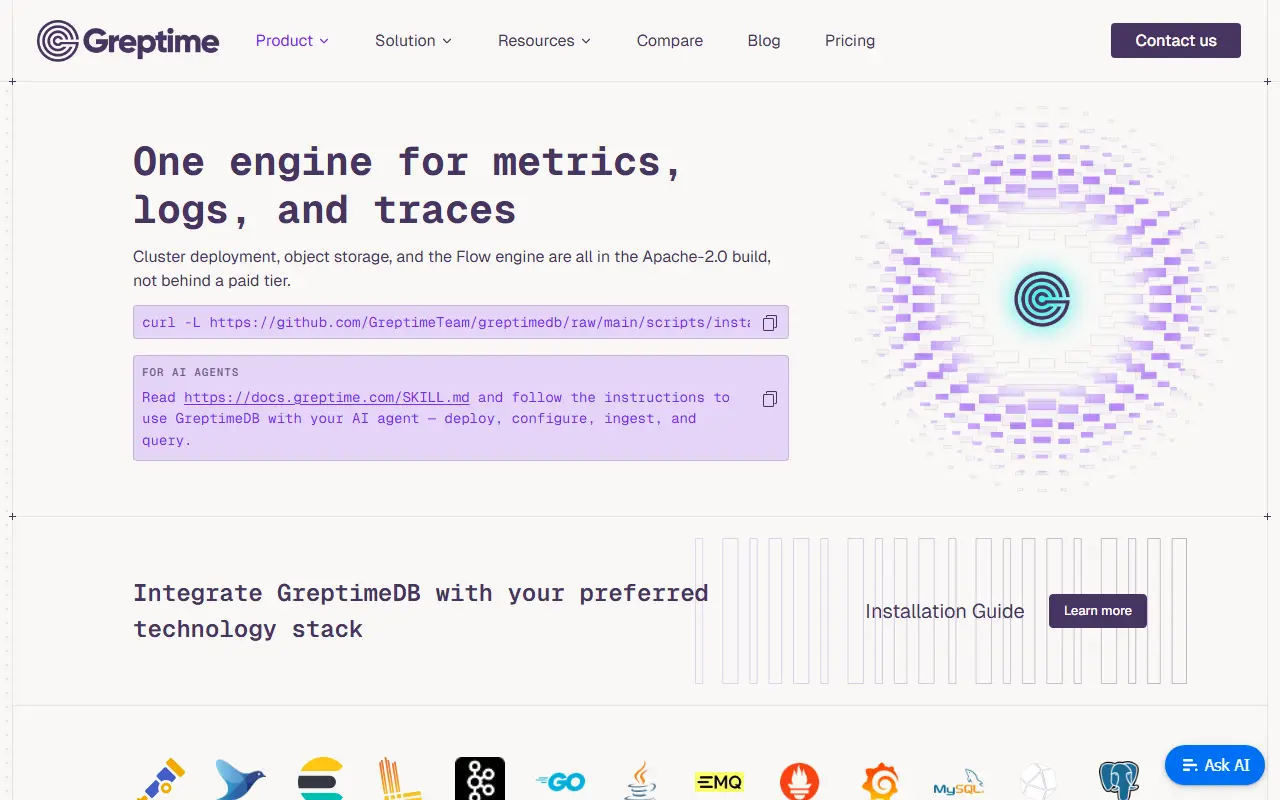
About GreptimeDB
GreptimeDB is an open-source observability database in which metrics, logs and traces share one columnar engine over object storage and one table model of tags, timestamp and fields. When signals share identifiers like service name, host or trace ID, they can be correlated with SQL joins rather than shuttling data between databases.
Ingestion works through OpenTelemetry, Prometheus Remote Write, the Loki push API or Elasticsearch Bulk, and queried with SQL across all signals and PromQL for metrics, so ingestion can migrate one signal at a time without rebuilding collectors. The README lists reasons to use it: replacing a Prometheus plus Loki or Elasticsearch combination with one backend, outgrowing Prometheus on cardinality or retention without the Thanos or Mimir complexity, long retention on object storage, and storing GenAI telemetry next to infrastructure signals.
GreptimeDB is written in Rust, with an Apache-2.0 licensed core, and is run self-hosted on your own infrastructure. Stable, canary and nightly builds are offered. It suits platform and SRE teams wanting a consolidated, cost-conscious observability backend.
Key features
- Metrics, logs and traces in one engine
- Columnar storage on object storage
- SQL and PromQL queries
- Ingestion via OpenTelemetry and Prometheus
- Loki and Elasticsearch ingestion APIs
- High-cardinality data support
Good fit for
- Consolidating Prometheus, Loki and Elasticsearch
- Long-term retention of telemetry on object storage
- Correlating traces and logs with SQL joins
GreptimeDB: questions and answers
- What is GreptimeDB used for?
- GreptimeDB is an open-source observability database that stores metrics, logs and traces in one columnar engine on object storage, queryable with SQL and PromQL. It is a good fit for consolidating Prometheus, Loki and Elasticsearch; long-term retention of telemetry on object storage; and correlating traces and logs with SQL joins.
- Is GreptimeDB open source?
- Yes. GreptimeDB is open source under the Apache-2.0 licence. Its source code is on GitHub at GreptimeTeam/greptimedb and is written mainly in Rust.
- Is GreptimeDB free?
- Yes. GreptimeDB is open source, so the software itself is free to use. Paid plans are also available, starting at $290 per month.
- Can I self-host GreptimeDB?
- Yes. GreptimeDB can be self-hosted on your own server or infrastructure.
- What is GreptimeDB an alternative to?
- GreptimeDB is an open-source alternative to Elastic, Splunk, Axiom and Azure Data Explorer. Other open-source alternatives to Elastic include OpenObserve and Quickwit.
- Is GreptimeDB actively maintained?
- Yes. The most recent commit to GreptimeDB was on 12 November 2026, and the latest release is v1.3.0, published on 28 October 2026. The project has 6.8k stars on GitHub, with 77 added in the last 30 days.
Open-source alternatives to GreptimeDB
See all
OpenObserve
Monitoring & Observability
High-performance, unified observability for the AI era. 140x lower storage cost.
AGPL-3.0vs Datadog★ 23k
Quickwit
Monitoring & Observability
Cloud-native OSS search engine for observability
Apache-2.0vs Datadog★ 12k
Grafana Loki
Monitoring & Observability
Like Prometheus, but for logs.
AGPL-3.0vs Datadog★ 29k
Kibana
Monitoring & Observability
Your window into all of your data
OSSvs Splunk★ 21k
InfluxDB
Databases
Scalable datastore for metrics, events, and real-time analytics
Apache-2.0vs KX kdb+★ 32k
VictoriaMetrics
Monitoring & Observability
VictoriaMetrics: fast, cost-effective monitoring solution and time series database
Apache-2.0vs Datadog★ 18k
SaaS alternatives to GreptimeDB
See all
Elastic
Search
Elastic builds Elasticsearch, a distributed search and analytics engine used for application search, logs, vector search and security analytics.
SaaS
Splunk
Monitoring & Observability
Splunk is a data platform for security and observability that collects, searches and analyzes machine data to detect threats and prevent downtime.
SaaS
Axiom
Monitoring & Observability
Cloud service for ingesting, storing and querying logs, traces and event data
SaaS
Azure Data Explorer
Databases
Analytics service on Azure for exploring log, telemetry and time-series data with Kusto queries
SaaS
Observe
Monitoring & Observability
Observability platform that stores telemetry in a data lake for querying logs, metrics and traces
SaaS
KX kdb+
Databases
Time-series database used for high-frequency market and sensor data analytics
SaaS