#1
A free, privacy-respecting metasearch engine that aggregates results from many search services without tracking or profiling users, designed for self-hosting.
- GitHub stars
- 39k
- Last commit
- yesterday
- Licence
- AGPL-3.0
- Self-hosted
- Yes
docs.searxng.org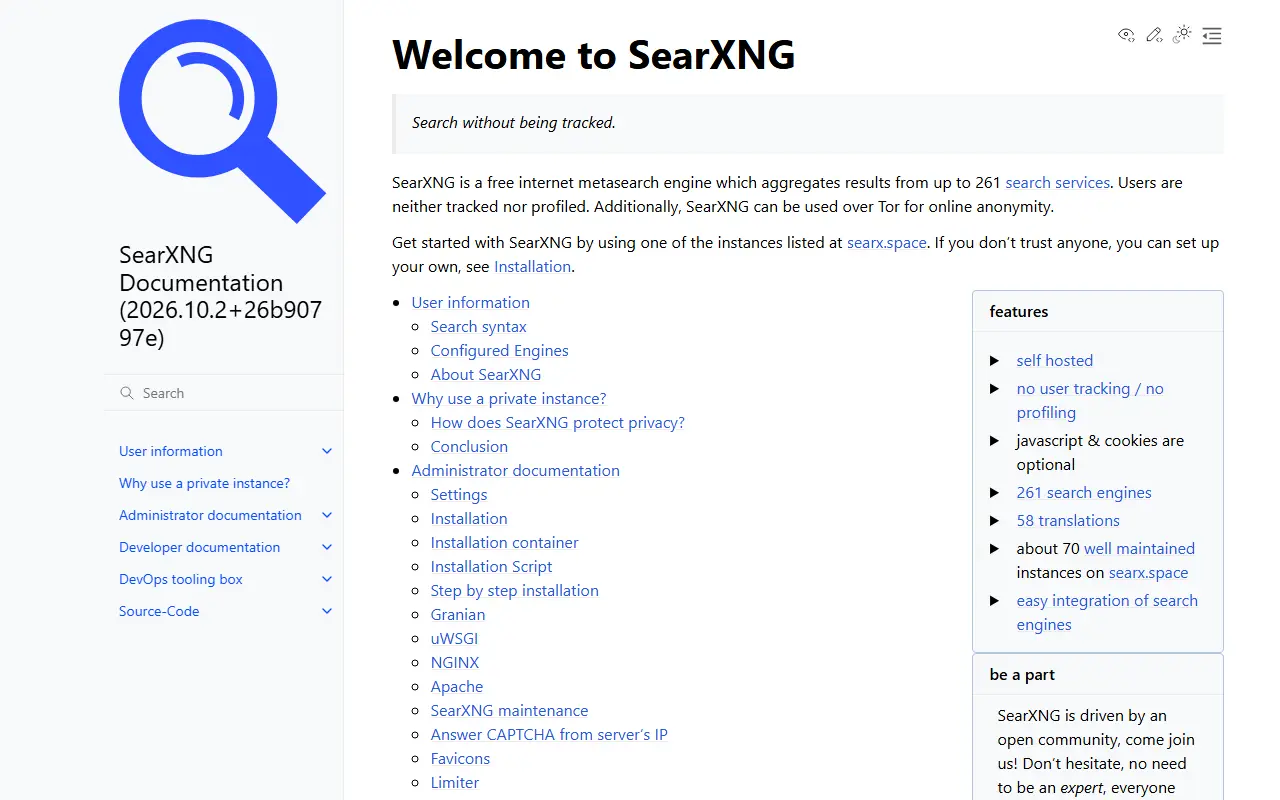
SearXNG is a free internet metasearch engine. It sends your query to many search services and databases, merges the results into one page, and does so without tracking or profiling the people who use it. Topics list engines such as Google, Bing, Brave, DuckDuckGo, Qwant and Startpage among the sources it can combine.
The documentation is organized for both users and administrators. Users get search syntax, a list of configured engines and an explanation of why a private instance matters. Administrators get settings in settings.yml, engine configuration, plugins, a bot-protection limiter, optional Redis or Valkey storage, and installation guides covering containers, an installation script and step-by-step setups with Granian or uWSGI behind NGINX or Apache. A long catalog of engines extends beyond web search to sources such as arXiv, Crossref, GitHub and Mastodon.
SearXNG is written in Python under the AGPL-3.0 license. Because it is meant to be self-hosted, you can run your own instance for yourself or a group; many volunteers also publicly host instances. It appeals to people who want to reduce reliance on any one search engine and keep their queries private.
Key features
- Aggregates results from many search engines
- No user tracking or profiling
- Configurable engines and plugins
- Container and script-based installation
- Optional Redis or Valkey integration
- Bot protection limiter
Pricing: Free and open source under the AGPL-3.0 license.
#2
An open-source AI platform for enterprise search and chat that indexes knowledge from 50+ apps and works with any LLM, deployable on your own infrastructure.
- GitHub stars
- 33k
- Last commit
- today
- Latest release
- v5.1.2
- Self-hosted
- Yes
onyx.app
Onyx is an open-source AI platform that acts as a knowledge and context layer for teams and their AI agents. It connects to more than 50 applications, pulls in documents along with their metadata and permissions, and builds an internal representation so that LLMs can answer questions grounded in what your company actually knows.
The project argues that this indexed approach gives more reliable, lower-latency and cheaper context than approaches that have an agent search many tools iteratively through MCP. Features include agentic RAG on a hybrid index, a Deep Research mode for multi-step reports, custom agents with their own knowledge, instructions and actions, and live web search through providers such as Serper, Google PSE, Brave and SearXNG. Sandboxes and skills extend what models can do, and the chat interface works with every major LLM.
Onyx emphasizes data sovereignty through flexible self-hosted deployments, with a single-command deploy option. The code is written in Python and Next.js, and the license is listed as 'Other' on GitHub, so check the terms for the enterprise features. It suits organizations that want a private, ChatGPT-style assistant connected to internal documents.
Key features
- Connectors to 50+ workplace applications
- Hybrid index with agentic RAG
- Deep Research multi-step reports
- Custom agents with their own knowledge
- Web search via Serper, Brave and others
- Works with any LLM
- Indexing that respects source permissions
Pricing: Business costs $25 per user per month on monthly billing, or $20 per user per month billed annually, with a free trial. Enterprise pricing and deployment options are by contact.
#3
A fast search engine API written in Rust that adds typo-tolerant, filterable and hybrid semantic search to websites and apps, available self-hosted or as a cloud service.
- GitHub stars
- 60k
- Last commit
- yesterday
- Latest release
- v1.56.2
- Self-hosted
- Yes
- Hosted version
- Available
meilisearch.com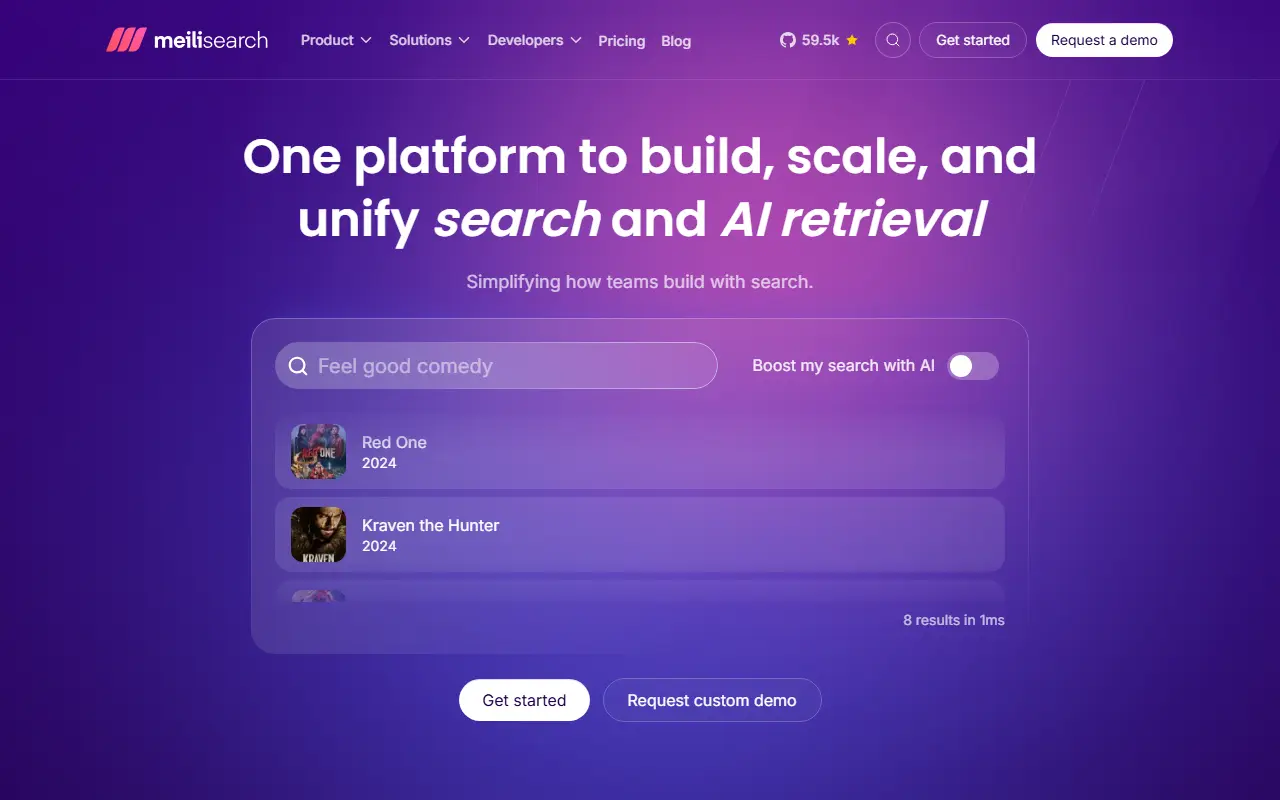
Meilisearch is a search engine exposed through an API, written in Rust and designed to be dropped into applications and websites. It aims to give developers a good search experience quickly, with features that work out of the box rather than needing extensive tuning.
Its capabilities include hybrid search that combines semantic and full-text results, search-as-you-type with a target response time under 50 milliseconds, typo tolerance, filtering and faceted search, sorting and geosearch. The topics also describe it as a vector database for AI use cases. The project maintains example applications for movies, ecommerce with facets and filters, conversational home booking, personalization and a multi-tenant CRM, which show how the features fit together.
The license is listed as 'Other', so confirm the terms for your use case. Meilisearch can be run on your own infrastructure, and Meilisearch Cloud offers it as a managed service. It is a common pick for site search, product catalogs and in-app search where a lighter alternative to a large cluster is attractive.
Key features
- Hybrid semantic and full-text search
- Instant search-as-you-type results
- Typo tolerance and fuzzy matching
- Filtering and faceted search
- Sorting and geosearch
- Vector storage for AI search
- REST API with example demo apps
Pricing: Self-hosting is free under the MIT license. Meilisearch Cloud starts at $20 per month with a 14-day free trial, billed by usage or instance resources; Enterprise is quoted on request.
#4
A vector database and similarity search engine written in Rust, offering filtering over stored vectors and payloads, available self-hosted or as Qdrant Cloud.
- GitHub stars
- 36k
- Last commit
- today
- Latest release
- v1.20.0
- Licence
- Apache-2.0
- Self-hosted
- Yes
- Hosted version
- Available
qdrant.tech
Qdrant is a vector database and similarity search engine. It stores points, which are vectors plus an attached payload, and exposes an API to store, search and manage them. That makes it a building block for semantic search, recommendations, image search and other applications that rely on embeddings from neural networks.
A key selling point is extended filtering support, so a vector query can be combined with conditions on the payload, which is useful for faceted search and matching. The engine is written in Rust and the maintainers point to benchmarks for its speed and reliability under load. Topics mention HNSW indexing and nearest-neighbor search, and there are client libraries, demo projects, integrations and a collection of agent skills that bring vector search into AI coding assistants.
Qdrant is Apache-2.0 licensed and can run on your own infrastructure. It is also available as the fully managed Qdrant Cloud, which includes a free tier. Teams building retrieval-augmented generation, recommendation and similarity features use it as the storage and retrieval layer for their embeddings.
Key features
- Vector storage with attached payloads
- Filtering combined with vector search
- HNSW-based nearest-neighbor search
- REST-style API with client libraries
- Agent skills for AI coding assistants
- Self-hosted or managed Qdrant Cloud
Pricing: A free-forever cloud tier is available. The Standard tier is usage-based, from $25; Premium requires a minimum spend and Hybrid and Private Cloud are quoted by the team.
#5
An open-source, cloud-native vector database for scalable similarity search over embeddings, with distributed, standalone and lightweight Python modes.
- GitHub stars
- 47k
- Last commit
- yesterday
- Latest release
- v3.0.6
- Licence
- Apache-2.0
- Self-hosted
- Yes
- Hosted version
- Available
milvus.io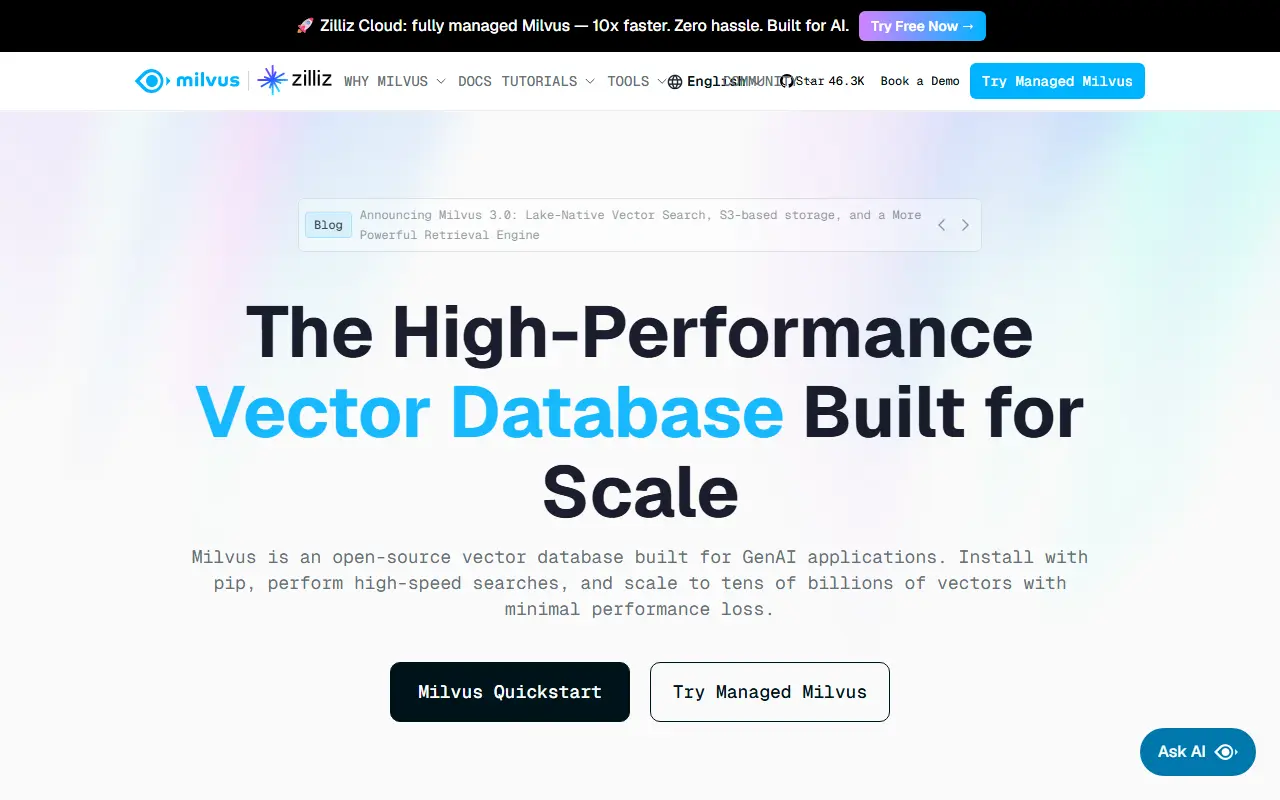
Milvus is an open-source vector database designed to scale. It supports AI applications by handling large volumes of unstructured data, including text, images and mixed-media content. It is written in Go and C++ with hardware acceleration for CPUs and GPUs, and it is released under the Apache-2.0 license.
The architecture is fully distributed and Kubernetes-native, so it can scale out horizontally while staying current through streaming updates in real time. Smaller deployments are covered too: a Standalone mode runs on a single machine, and Milvus Lite is a lightweight version installed with pip for quick starts in Python. The pymilvus SDK and its MilvusClient are used to create collections, ingest data and run vector searches.
Milvus can be self-hosted, or consumed as a managed service through Zilliz Cloud, which offers Serverless, Dedicated and bring-your-own-cloud options. The project is hosted by the LF AI & Data Foundation, with Zilliz as its major contributor. It suits teams building retrieval-augmented generation, semantic search and recommendation systems.
Key features
- Vector similarity search over embeddings
- Distributed, Kubernetes-native architecture
- Standalone mode for single machines
- Milvus Lite for quick Python starts
- Real-time streaming updates
- CPU and GPU hardware acceleration
Pricing: Open source under Apache 2.0; Zilliz Cloud offers a managed service with Serverless, Dedicated and BYOC options.
#6
A fast, typo-tolerant, in-memory search engine for site and app search, pitched as an open-source Algolia alternative and an easier-to-run Elasticsearch alternative.
- GitHub stars
- 27k
- Last commit
- 2 days ago
- Latest release
- v30.2
- Licence
- GPL-3.0
- Self-hosted
- Yes
- Hosted version
- Available
typesense.org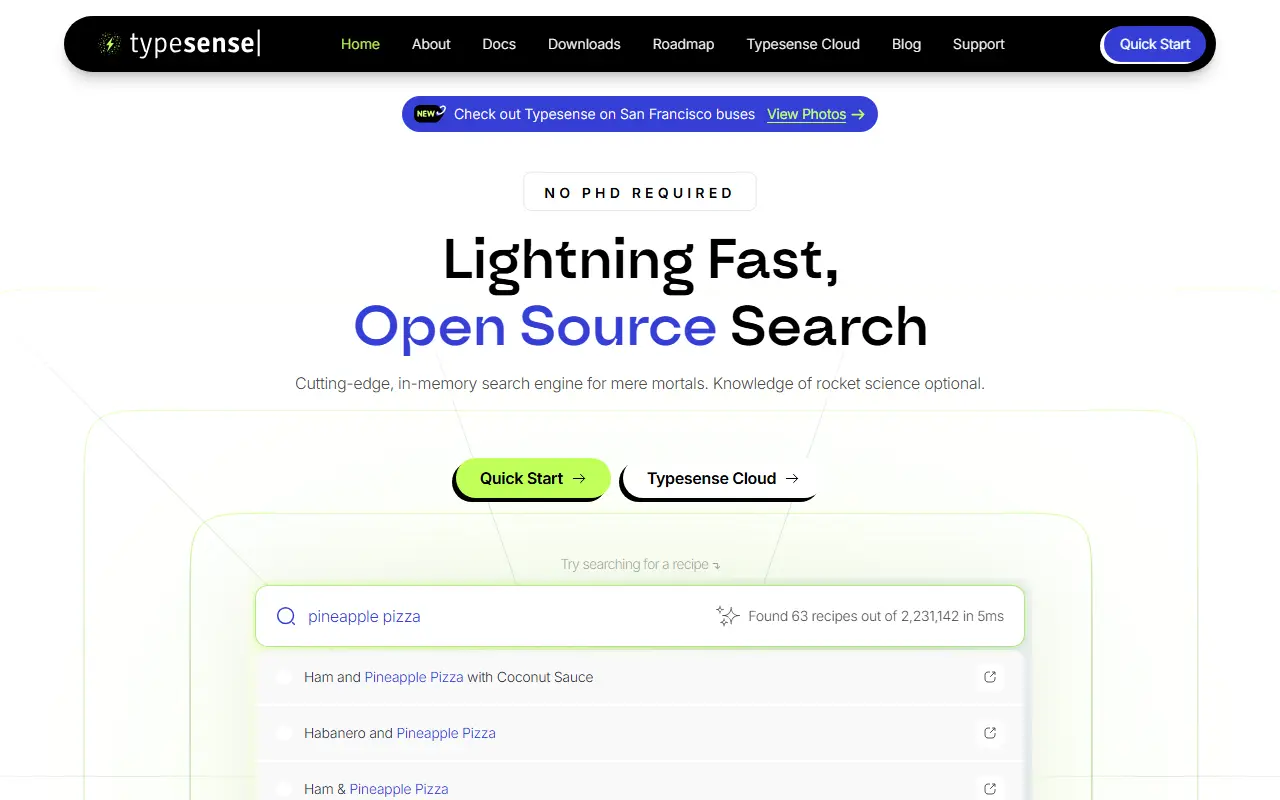
Typesense is an open-source search engine for building fast, typo-tolerant search experiences in websites and applications. It is pitched as an open-source substitute for Algolia and Pinecone, and as a simpler option than Elasticsearch. It keeps its index in memory and is written in C++.
The project's feature topics include typo tolerance and fuzzy matching, full-text search, faceting, geosearch, synonyms, merchandising rules and instant search, and it supports semantic and hybrid search. Public demos let you try it on large datasets, such as 32 million songs from MusicBrainz, 28 million books from OpenLibrary, a recipe set, Linux kernel commit messages, an ecommerce store experience, a geosearch listing browser and semantic search over Hacker News comments.
Typesense is licensed under GPL-3.0 and can be run on your own servers, and a managed Typesense Cloud service is also available. Documentation, a roadmap, a Slack community and video introductions are provided. It suits developers who want Algolia-style search with the option to self-host and keep costs predictable.
Key features
- Typo-tolerant, in-memory search
- Faceting, filtering and synonyms
- Geosearch for location-based results
- Semantic and hybrid search
- Merchandising controls for ranking
- Self-hosted or Typesense Cloud

Kibana is the web interface for querying, visualizing and managing data stored in Elasticsearch, used for dashboards, observability and analytics.
- GitHub stars
- 21k
- Last commit
- yesterday
- Latest release
- v9.5.6
- Self-hosted
- Yes
- Hosted version
- Available
elastic.co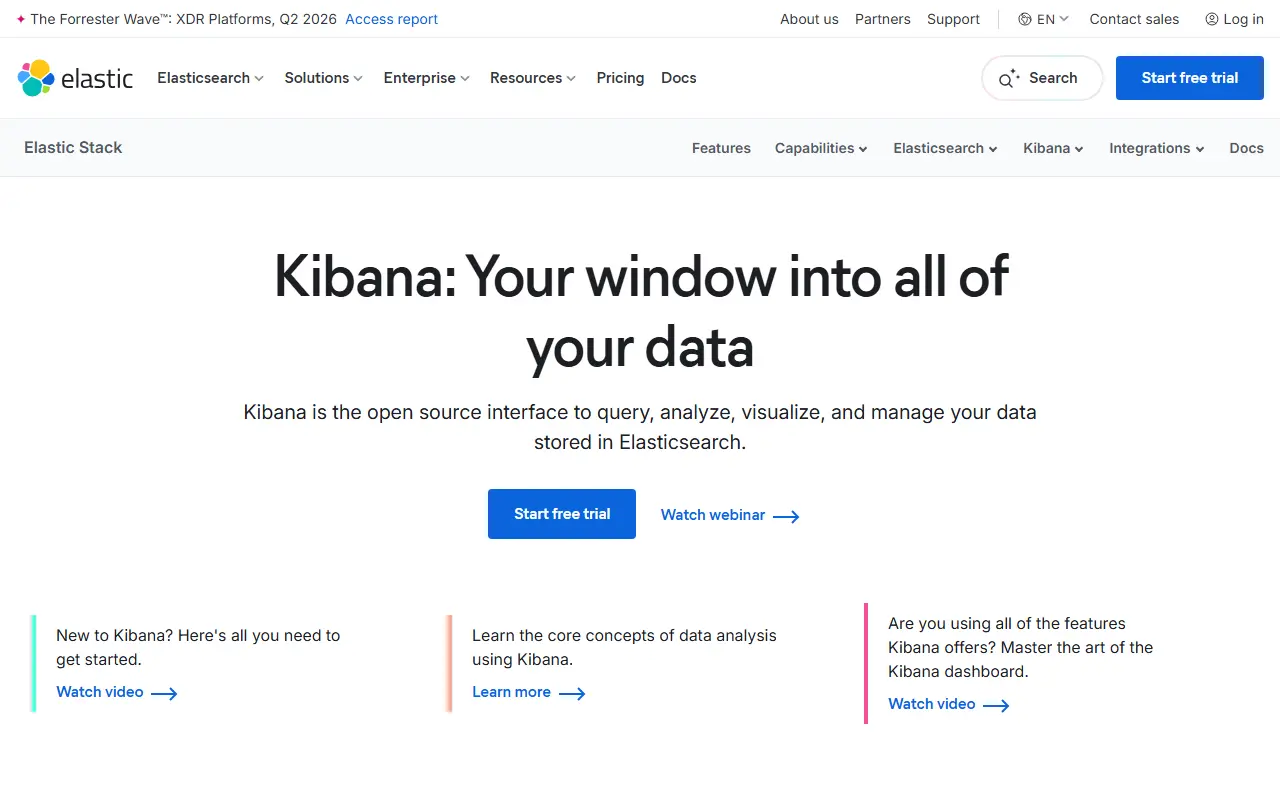
Kibana is the user interface that sits on top of Elasticsearch. It lets people query, analyze, visualize and manage the data stored there, turning indexes into charts, metrics views and dashboards. It is part of the Elastic Stack and is commonly used for log analysis, observability and general analytics work.
Teams build visualizations and assemble them into shared dashboards, explore documents with search, and use the interface to manage parts of an Elasticsearch deployment. The project advises running Kibana and Elasticsearch at the same version, with major versions required to match, because mismatches can cause problems and support may ask for an upgrade first.
The code is written in TypeScript. The repository lists its license as 'Other' rather than a standard SPDX identifier, so the license files should be read for the exact terms. Kibana can be downloaded and run on your own infrastructure, and Elastic also offers a hosted version through its Cloud service.
Key features
- Query and explore Elasticsearch data
- Visualizations and metrics charts
- Shared dashboards for monitoring
- Observability views for logs and metrics
- Management tools for Elasticsearch data
- Hosted option through Elastic Cloud

A cloud-native vector database that stores objects and embeddings and combines semantic search with keyword filtering, RAG and reranking in one query interface.
- GitHub stars
- 17k
- Last commit
- yesterday
- Latest release
- v1.40.5
- Self-hosted
- Yes
- Hosted version
- Available
weaviate.io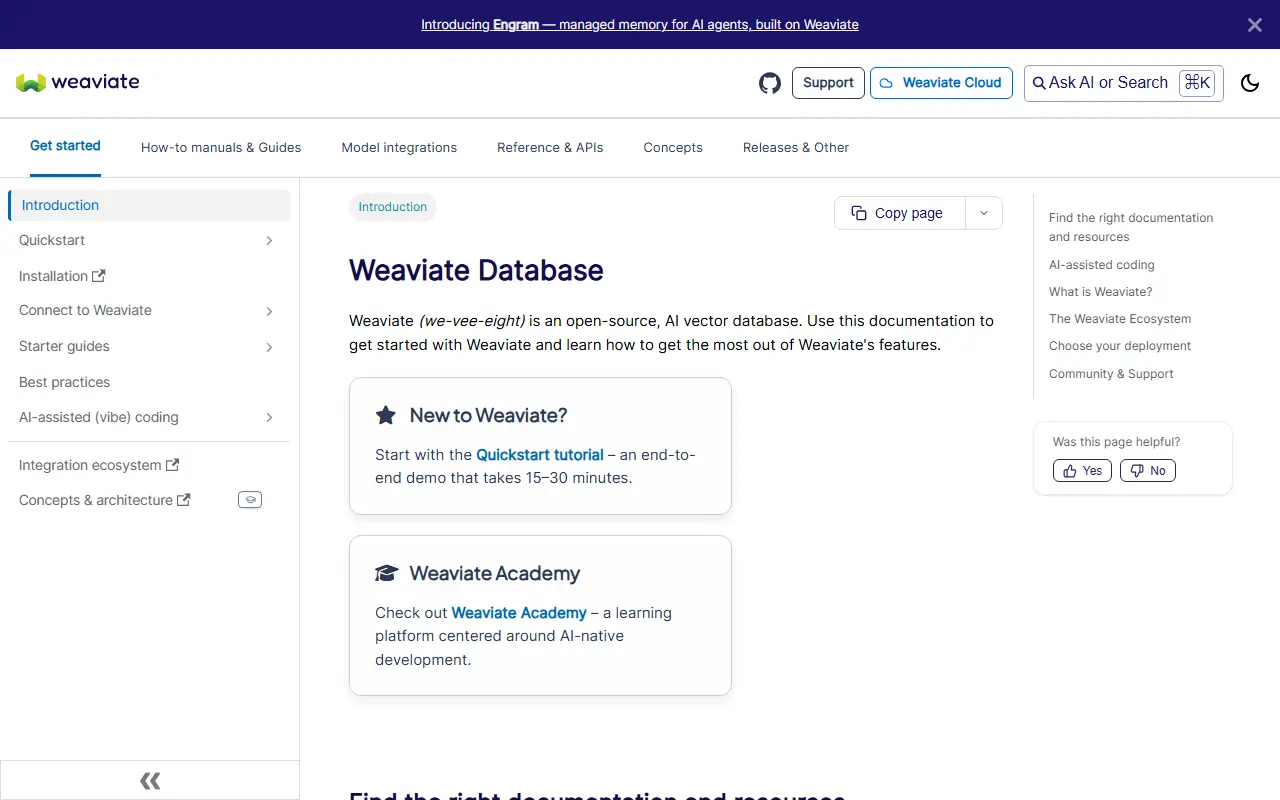
Weaviate is a vector database that stores both data objects and their vector embeddings, enabling semantic search at scale. One query interface can blend vector similarity search, keyword filtering, retrieval-augmented generation and reranking, and it is written in Go as a cloud-native system.
Common applications are RAG pipelines, semantic and image search, recommenders, chatbots and content classification. Vectors can be created automatically on import by integrated models from providers such as OpenAI, Cohere and Hugging Face, or you can import pre-computed embeddings. For production, it offers built-in multi-tenancy, replication and role-based access control. Topics reference approximate nearest neighbor search and HNSW indexing.
Weaviate can be deployed with Docker, on Kubernetes, or through the managed Weaviate Cloud, with guides for AWS and GCP, and the documentation includes quickstarts for both cloud and a local Docker instance. Its license is listed as 'Other' on GitHub, so check the repository terms. It suits teams building AI applications that need a scalable store for embeddings alongside structured filters.
Key features
- Stores objects and vectors together
- Hybrid vector and keyword search
- Integrated vectorizer models or bring your own
- Multi-tenancy and replication
- Role-based access control
- Docker, Kubernetes and Weaviate Cloud options

Sphinx is a documentation generator that supports reStructuredText and MyST Markdown, with features like cross-referencing, multiple output formats, themes, extensions, and internationalization.
- GitHub stars
- 8.1k
- Last commit
- 4 days ago
- Latest release
- v9.2.0
sphinx-doc.org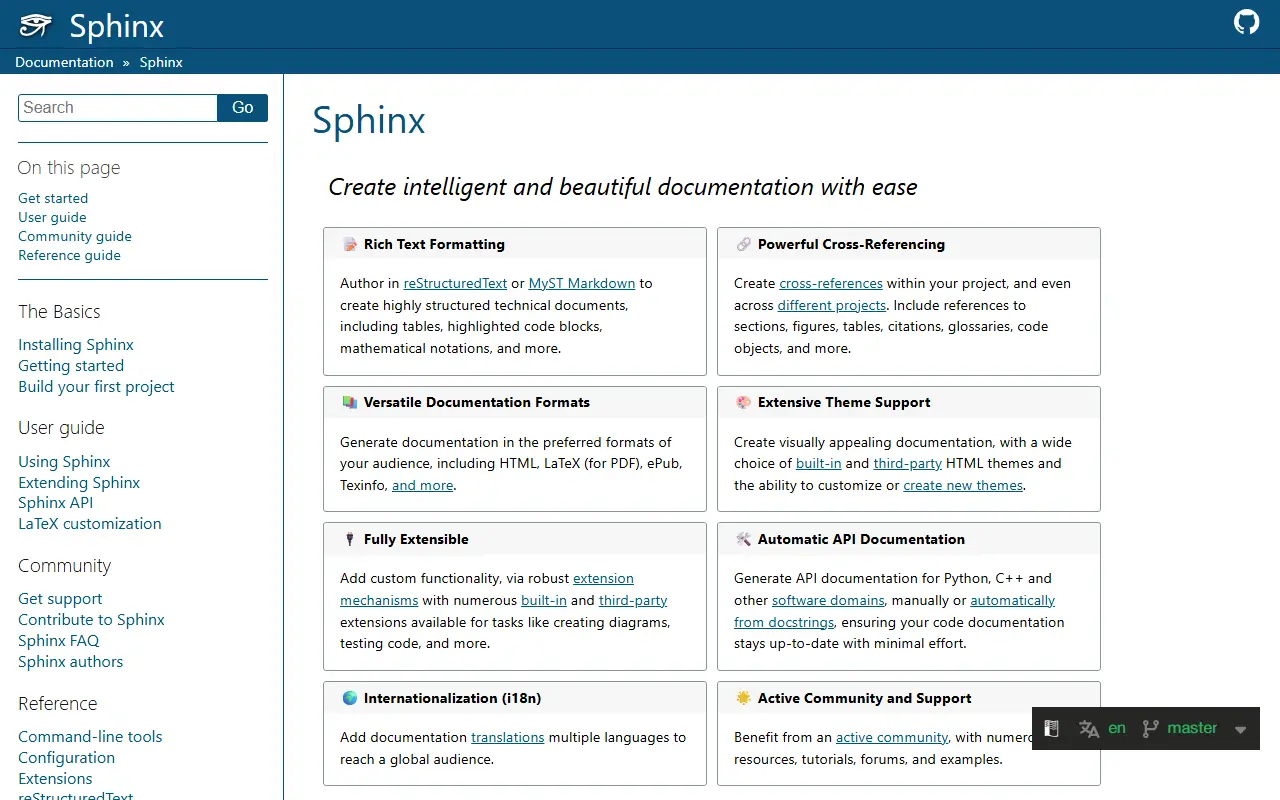
Sphinx is a documentation generator that allows authors to write in reStructuredText or MyST Markdown to create structured technical documents. It supports tables, highlighted code blocks, mathematical notations, and cross-references within and across projects.
The tool can generate documentation in formats such as HTML, LaTeX (for PDF), ePub, and Texinfo. It offers built-in and third-party HTML themes, extension mechanisms for custom functionality, and automatic API documentation for Python, C++, and other software domains.
Key features
- Rich text formatting with reStructuredText or MyST Markdown
- Cross-referencing within and across projects
- Multiple output formats: HTML, LaTeX, ePub, Texinfo
- Extensive theme support with built-in and third-party themes
- Extensible via built-in and third-party extensions
- Automatic API documentation for Python, C++, and other domains

YaCy is a decentralized search engine with its own crawler and index that you can run privately, on an intranet or as part of a peer-to-peer network.
- GitHub stars
- 4.1k
- Last commit
- 9 days ago
- Self-hosted
- Yes
yacy.net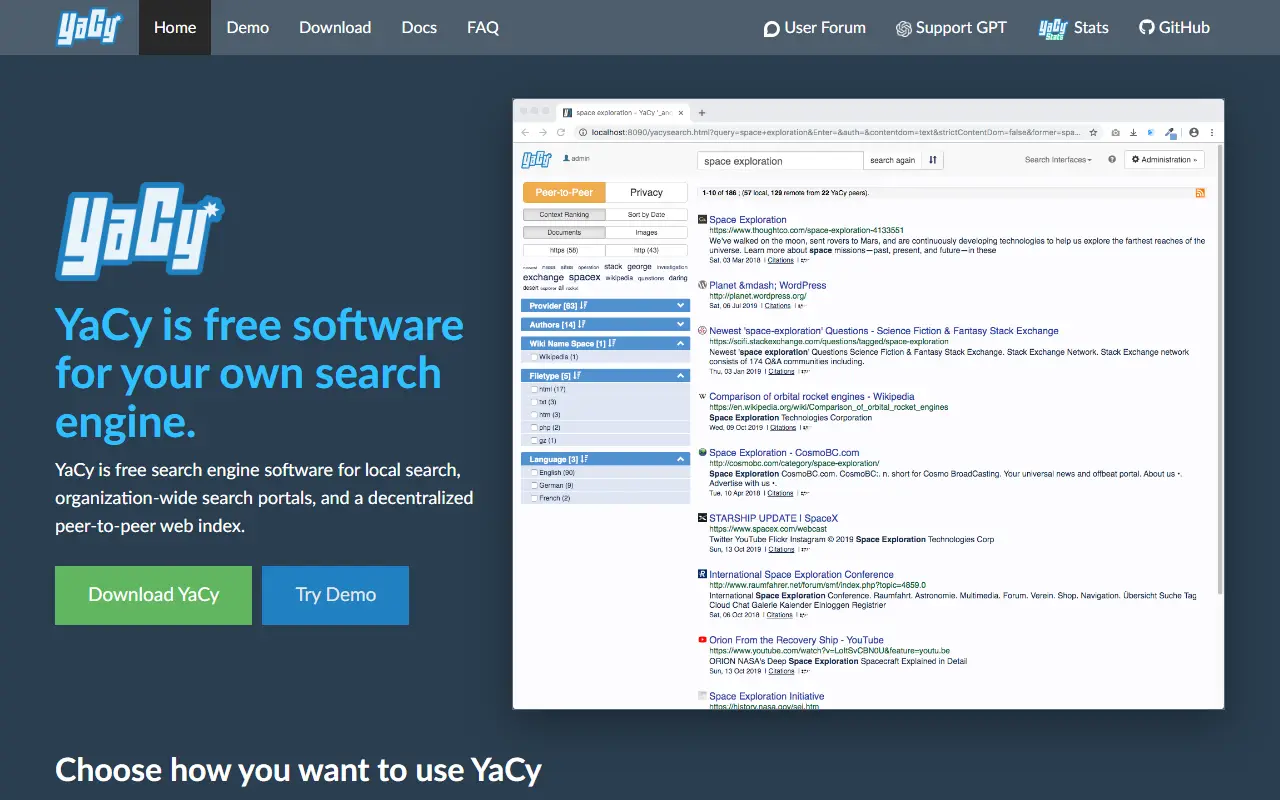
YaCy is a complete search engine application: a server that hosts a search index, a web interface for searching and creating the index, and a production-ready crawler with a scheduler to keep the index fresh. It can run as a node in a distributed peer-to-peer network or as a private search portal.
YaCy search portals can also be placed inside an intranet, where the README says they can replace commercial enterprise search products, and a network scanner helps discover HTTP, FTP and SMB servers to index. The project was created with privacy as a primary motivation, and running a personal search engine avoids handing queries to a central provider. It is written in Java and tagged for decentralized search and privacy protection.
The repository license is shown as 'Other' on GitHub, reflecting the GPL family of licenses, so check the terms. YaCy is self-hosted on your own machine or server. It suits privacy-minded users, organizations that need intranet search and communities that want a decentralized alternative to commercial search.
Key features
- Web crawler with scheduler
- Peer-to-peer distributed search index
- Web interface for search and indexing
- Intranet search portal mode
- Network scanner for HTTP, FTP and SMB
- Designed with privacy as priority
Pricing: Free and open source software.
7 more Amazon Kendra alternatives
Amazon Kendra alternatives: questions
- What is the best open-source alternative to Amazon Kendra?
- SearXNG is the top-ranked open-source alternative to Amazon Kendra on Enlisted: A free, privacy-respecting metasearch engine that aggregates results from many search services without tracking or profiling users, designed for self-hosting. Other strong options are Onyx, Meilisearch, Qdrant and Milvus.
- What are the best commercial alternatives to Amazon Kendra?
- Mindbreeze, Sinequa, Azure AI Search, Amazon OpenSearch Service and IBM Watson Discovery are among the hosted, closed-source alternatives to Amazon Kendra listed on Enlisted, which lists 16 in total. Compare their pricing and features on each tool page.
- Are these Amazon Kendra alternatives free?
- All 17 are open source, so the code is free to use under its licence, and all of them can be self-hosted on your own server or computer. 7 also offer a paid or managed cloud version if you'd rather not host it yourself.
- How is this list of Amazon Kendra alternatives ranked?
- By a score built from GitHub stars, star growth over the last 30 days and how recently the code changed. 14 of these projects shipped code in the last 30 days. Data is refreshed daily, and nobody can pay to move up.
 TrackMedia
 TrackRev