7,363 open-source and SaaS tools, with GitHub stats refreshed every day.

6 alternatives ranked by real activity

Open-source Netcore Cloud alternatives

A curated, ranked list of the 6 best open-source alternatives to Netcore Cloud.

The best open-source alternative to Netcore Cloud is Postal. If that doesn't suit you, other good options are Mautic, Plunk, Notifuse and Laudspeaker.

Netcore Cloud alternatives are mainly email marketing tools. 4 of them shipped code in the last 30 days, 6 can be self-hosted, and 2 use a permissive licence.

Last updated October 3, 2026 · ranked by GitHub stars, growth and recent commits

Postal

Postal is an open-source mail delivery platform for sending and receiving email, comparable to Sendgrid, Mailgun or Postmark but run on your own servers.

GitHub stars
17k
Last commit
2 days ago
Latest release
3.3.7
Licence
MIT
Self-hosted
Yes
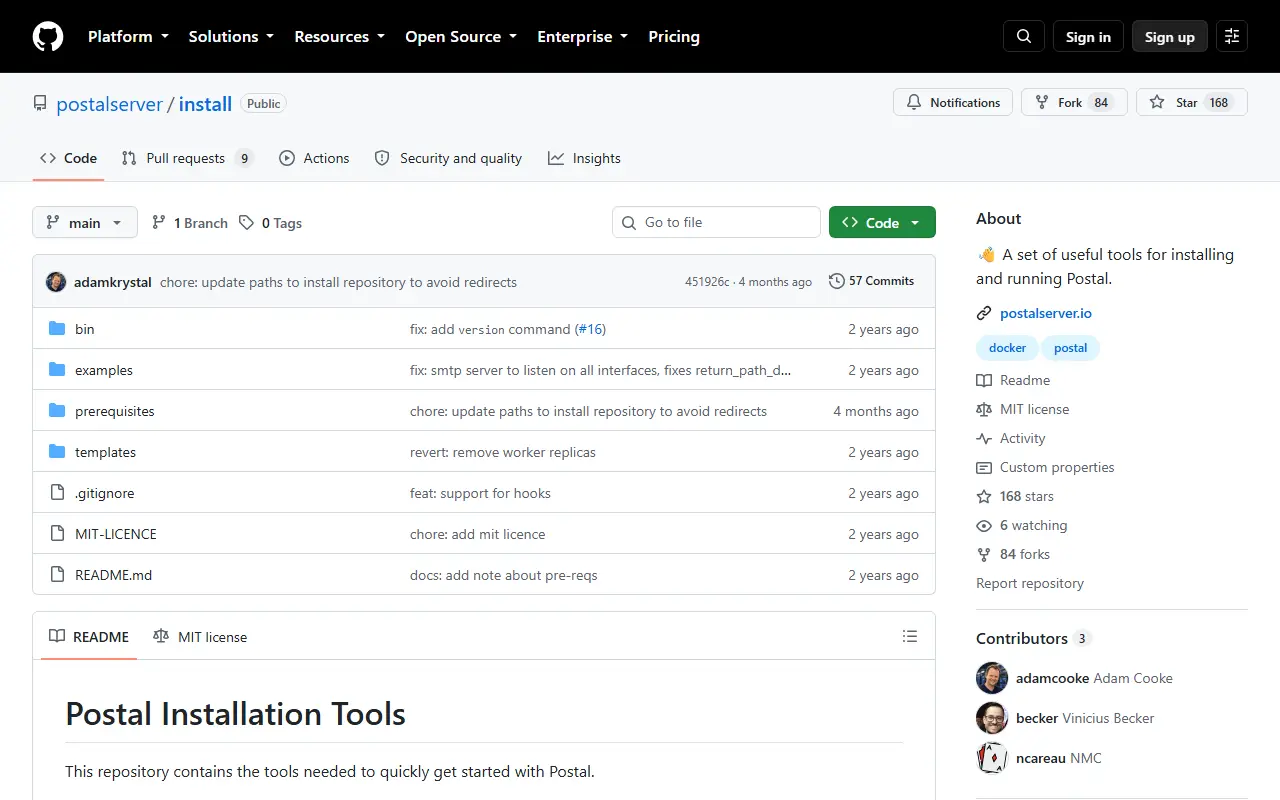
postalserver.ioPostal homepage screenshot

Postal is a complete mail server for websites and web servers that handles both outgoing and incoming email. The project describes it as an open-source take on services such as Sendgrid, Mailgun and Postmark, ready to run on your own servers rather than rented as a hosted API.

It is written in Ruby and released under the MIT license. The project provides documentation with installation instructions, an FAQ and features list, a separate repository of installation tools, and community support through GitHub Discussions and Discord. Repository topics list Ruby, mail, SMTP and mail server.

Because it is self-hosted, Postal suits teams that want control over their own email delivery infrastructure instead of relying on a hosted provider, such as websites that send transactional messages.

Key features

  • Outgoing and incoming email handling
  • Self-hosted alternative to Sendgrid and Mailgun
  • SMTP mail server written in Ruby
  • Installation tools and documentation
  • Community support on Discord

Pricing: Free and open source under the MIT license.

Read more about PostalWebsite GitHub

Mautic

Open-source marketing automation platform for email campaigns, segmentation and multi-channel marketing that you can host yourself.

GitHub stars
11k
Last commit
yesterday
Latest release
7.2.1
Self-hosted
Yes
Hosted version
Available
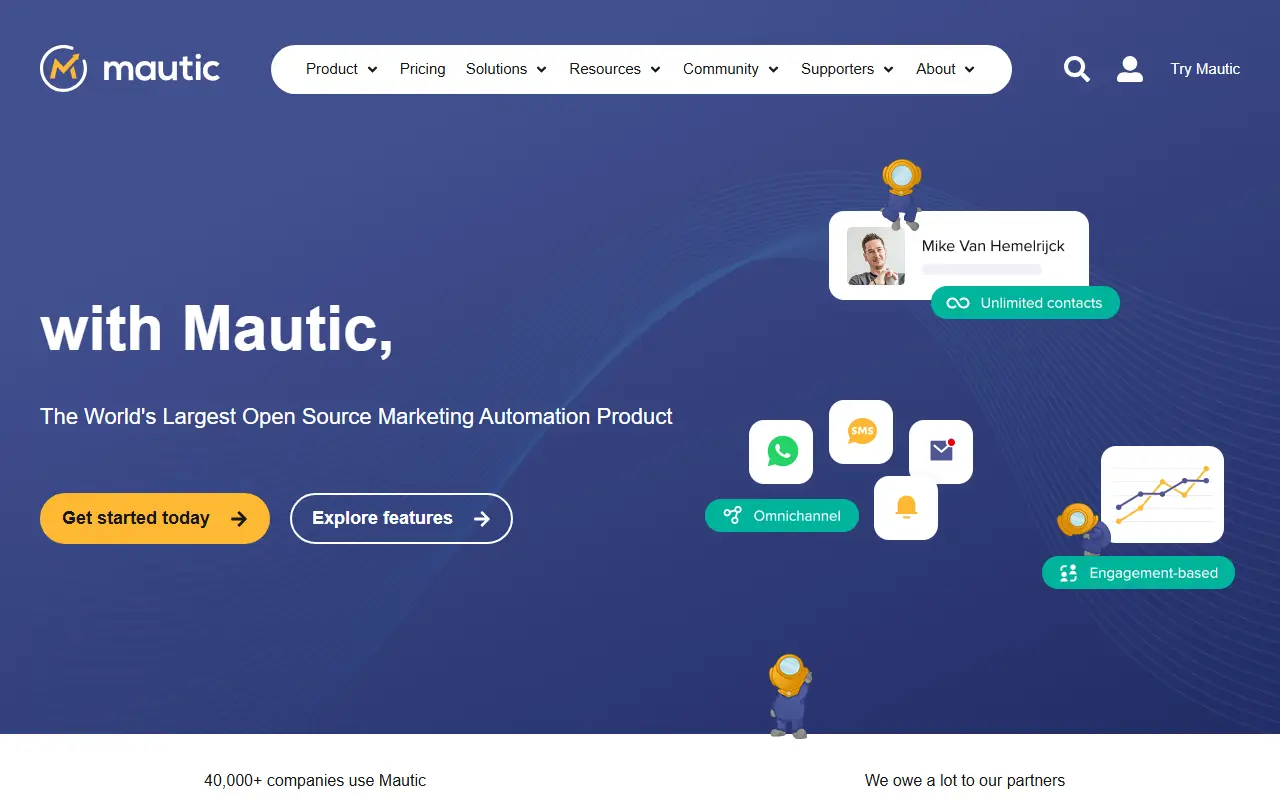
mautic.orgMautic homepage screenshot

Mautic is open-source marketing automation software. It lets businesses and organizations build integrated marketing campaigns, including email marketing, while keeping control of their own data. The project is supported by a worldwide community of contributors and presents privacy and extensibility as core goals.

The README highlights several advantages over conventional hosted tools: it is free to use, you can run it on your own infrastructure with your own database, there is no vendor lock-in, integrations can be built as needed, and both the frontend and backend are customizable. It also describes multi-channel marketing without extra cost and unlimited segmentation and automation.

Mautic is written in PHP. It can be downloaded and self-hosted, or you can request a trial of a hosted option, and community channels and a blog share news, releases and strategy. Its license is stated in the repository. It suits marketing teams that want automation without relying entirely on a third-party SaaS provider.

Key features

  • Email marketing and campaign automation
  • Contact segmentation
  • Multi-channel marketing
  • Customizable frontend and backend
  • Custom integrations
  • Own your data in your own database

Pricing: Managed Mautic hosting through a partner starts from 275 euros a month billed quarterly (247.50 on annual billing) for Essential and from 1,237 euros a month for Professional; Enterprise is custom.

Read more about MauticWebsite GitHub

Plunk

An open-source email platform for transactional email, campaigns and workflow automation, offered as a self-hostable alternative to SendGrid and Mailgun.

GitHub stars
5.5k
Last commit
yesterday
Latest release
v0.15.0
Licence
AGPL-3.0
Self-hosted
Yes
Hosted version
Available
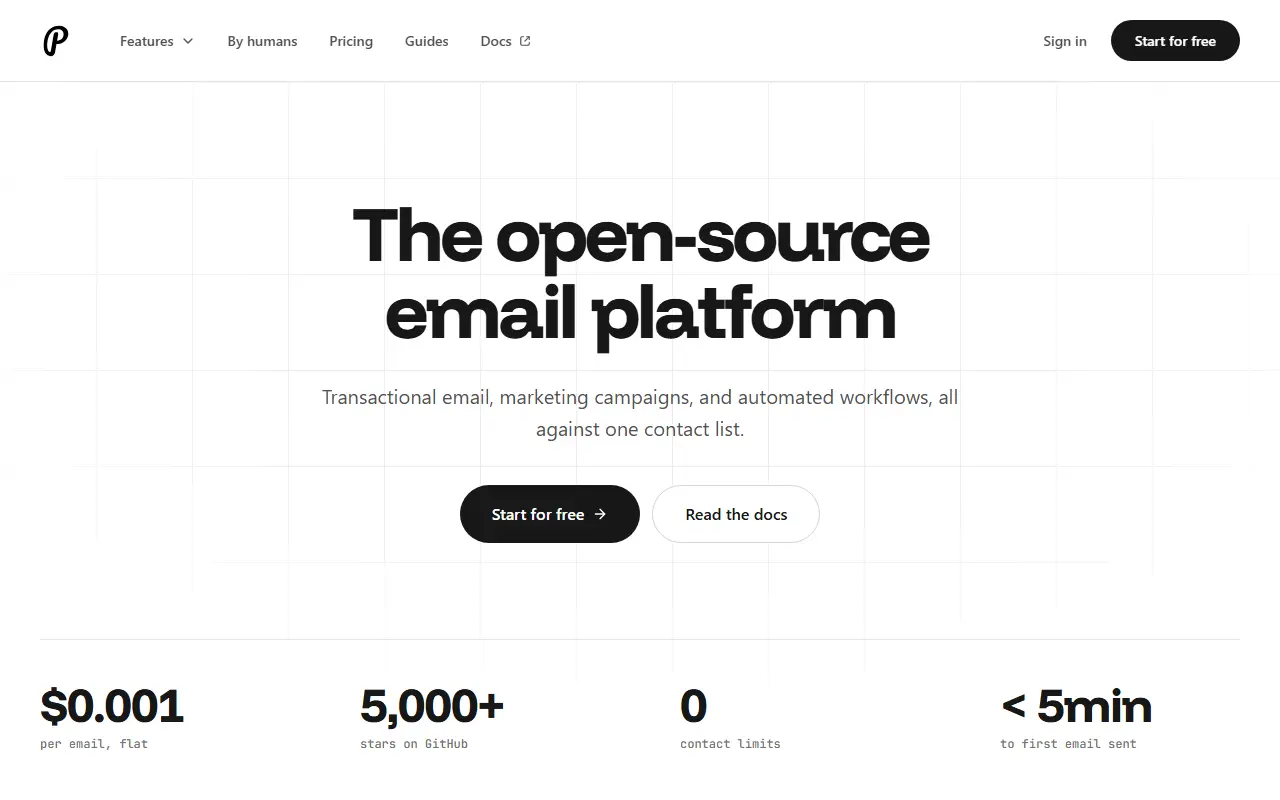
useplunk.comPlunk homepage screenshot

Plunk is an open-source email platform that combines transactional email, marketing campaigns and workflow automation in a single product. Developers can send messages from an API with templates and variable substitution, or use Plunk as an SMTP relay so that existing tools and frameworks can send through it.

Marketing features include campaigns for newsletters and product updates, dynamic segments, and contact management with custom fields and activity history. Workflows add triggers, delays and conditional logic, analytics track opens, clicks and bounces, custom domains are verified with DKIM and SPF, and inbound emails can be received and routed with custom rules.

Plunk is positioned as an open-source, self-hosted alternative to services such as SendGrid, Resend and Mailgun. It is licensed under AGPL-3.0, written in TypeScript, and can be deployed from an official Docker image following the project's documentation. The README cites a rate of $0.001 per email with no contact limits.

Key features

  • Transactional email API with templates
  • SMTP relay for existing tools
  • Campaigns for newsletters and updates
  • Workflow automation with delays and conditions
  • Dynamic contact segments
  • Open, click and bounce analytics
  • Inbound email routing
  • Custom sending domains with DKIM and SPF

Pricing: Free plan sends 1,000 emails a month. The paid plan charges $0.001 per email with unlimited contacts, and the software can be self-hosted for free.

Read more about PlunkWebsite GitHub

Notifuse

Self-hosted newsletter, email marketing, and transactional email platform with a visual MJML editor, Liquid templating, automations, and seven sending providers.

GitHub stars
2.2k
Last commit
2 days ago
Latest release
v41.0
Self-hosted
Yes
Hosted version
Available
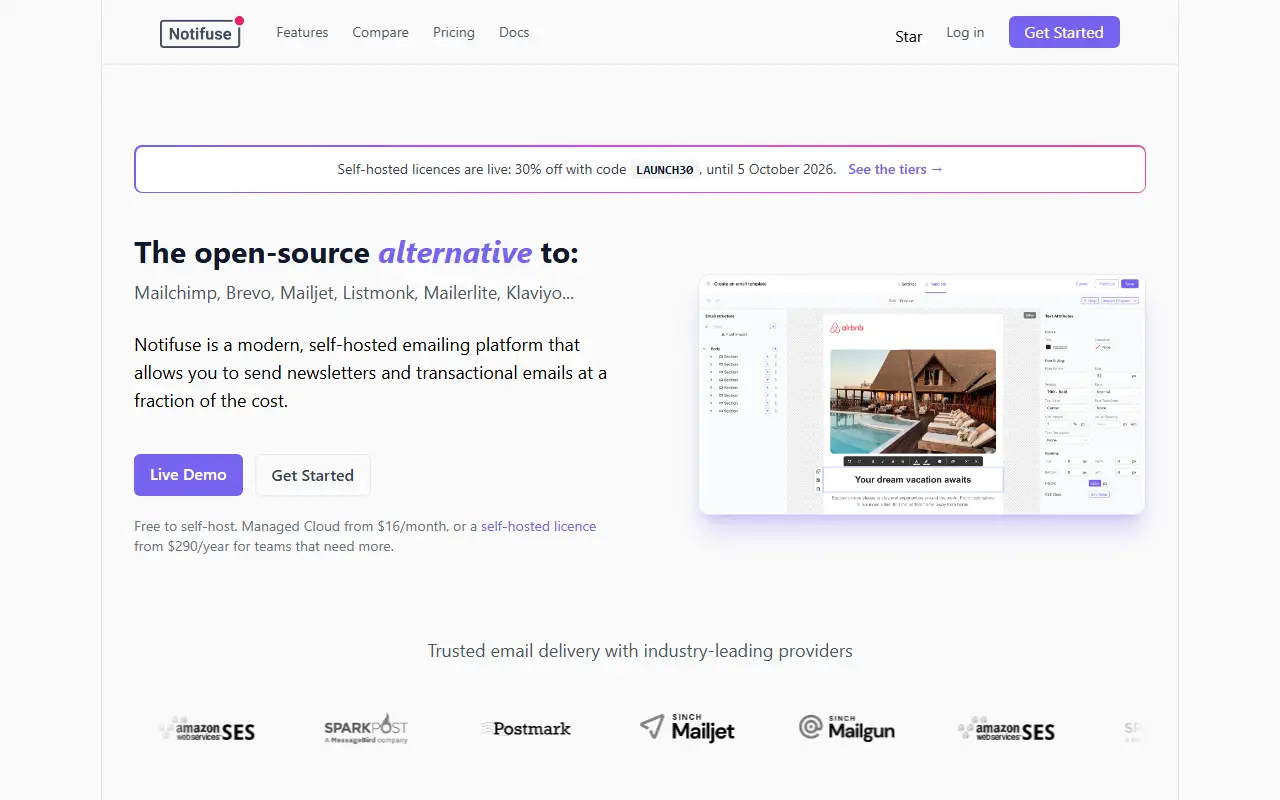
notifuse.comNotifuse homepage screenshot

Notifuse is a modern, self-hosted emailing platform for sending newsletters and transactional email at a fraction of the cost of hosted services. It is built with Go and React and presented as an open-source alternative to Mailchimp, Brevo, Mailjet, Listmonk, MailerLite, and Klaviyo. The input lists its license only as other.

Email marketing features include a drag-and-drop visual builder with MJML components and live preview, campaign scheduling, A/B testing of subject lines, content, and send times, list segmentation, and contact profiles with custom fields. Automations use a visual canvas with nodes for delays, emails, branches, filters, list changes, A/B tests, and webhooks, and Liquid templating personalizes messages. Messages are sent through seven providers, with topics naming Amazon SES, Mailgun, Postmark, and SendGrid.

For people who prefer not to run it themselves, Notifuse Cloud offers managed hosting, which the README says starts at 16 dollars per month, and a live demo is available. It suits marketers and developers who want lower costs and control over subscriber data.

Key features

  • Visual MJML email builder
  • Campaign scheduling and A/B testing
  • Visual automation flow builder
  • Liquid templating
  • Seven sending providers including Amazon SES
  • Transactional email API

Pricing: Self-hosting is free, with yearly licences from $290 for extra capabilities. Managed Notifuse Cloud starts at $16 per month with no per-email or per-seat charges.

Read more about NotifuseWebsite GitHub

Laudspeaker

Laudspeaker is a customer engagement and product onboarding platform with visual journeys across email, SMS, push and webhooks, no longer actively developed.

GitHub stars
2.6k
Last commit
2 mo ago
Latest release
v.1.7.0
Self-hosted
Yes

Laudspeaker is an open-source customer engagement and product onboarding platform. It was positioned as an alternative to tools such as Braze, OneSignal, Customer.io, Appcues and Pendo, and lets teams design product onboarding flows and send messages triggered by product events across several channels.

Its main features were a visual journey builder for complex workflows, a segment builder that targets users by attributes, completed actions and previous campaigns, multiple channels including push, email, SMS and webhooks, and A/B tests and personalization with Liquid templating and external API calls. It was built with NestJS, React and TypeScript, and planned to integrate with data warehouses and the modern data stack.

The README now states that Laudspeaker is no longer under active development or being supported. It mentions a Laudspeaker Cloud and a paid self-deployed enterprise plan, though availability is uncertain given that notice. The repository lists its licence as other. Anyone considering it should treat it as an archived project and check current status before building on it.

Key features

  • Visual journey builder
  • Segment builder based on behavior
  • Email, SMS, push, and webhook channels
  • A/B testing and Liquid personalization
  • Event-triggered messaging
  • NestJS and React codebase
Read more about LaudspeakerWebsite GitHub

Dittofeed

Open-source customer engagement platform for sending broadcasts and automated journeys over email, SMS, push, WhatsApp and Slack.

GitHub stars
3k
Last commit
6 mo ago
Latest release
v0.23.0
Licence
MIT
Self-hosted
Yes
Hosted version
Available
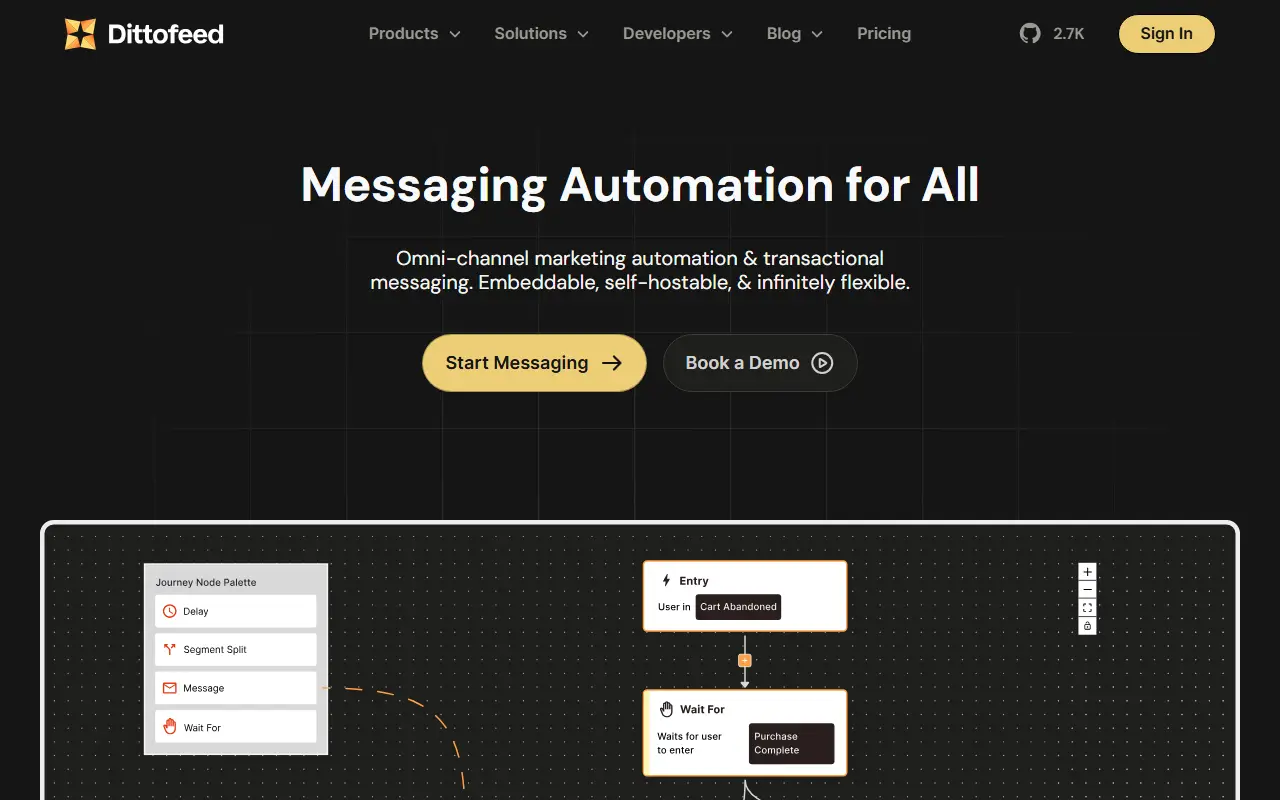
dittofeed.comDittofeed homepage screenshot

Dittofeed is an omni-channel customer engagement platform. Teams use it to send one-off broadcasts or build automated, event-driven user journeys that reach people by email, mobile push notifications, SMS, WhatsApp, Slack and other channels. The project positions itself as a developer-friendly, open-source alternative to OneSignal, Customer.io and Segment Engage.

A typical setup starts by connecting user data through Segment, reverse ETL or the Dittofeed API. You then build segments with multiple operators, design message templates in HTML, MJML or a low-code editor, and send through providers such as SendGrid or Amazon SES. A dashboard tracks message performance, and the tools can be embedded in another product through an iframe or a headless React component.

The core is written in TypeScript and licensed under MIT. It can be self-hosted with Docker Compose or deployed to Render, and a hosted cloud trial is also offered. According to the README, features such as multi-tenancy, embedding and white-labeling belong to a separate licensed, closed-source codebase that you can ask the team about.

Key features

  • Broadcasts and automated event-based journeys
  • Email, SMS, push, WhatsApp and Slack channels
  • Segments built from user data with multiple operators
  • HTML, MJML and low-code template editor
  • Integrations with SendGrid and Amazon SES
  • Message performance dashboard
  • Embeddable via iframe or React component

Pricing: Self-hosting is free. Dittofeed Cloud Pro costs $75 per month for 10,000 unique users with a 14-day trial; support and enterprise licenses are priced on request.

Read more about DittofeedWebsite GitHub

Netcore Cloud alternatives: questions

What is the best open-source alternative to Netcore Cloud?
Postal is the top-ranked open-source alternative to Netcore Cloud on Enlisted: Postal is an open-source mail delivery platform for sending and receiving email, comparable to Sendgrid, Mailgun or Postmark but run on your own servers. Other strong options are Mautic, Plunk, Notifuse and Laudspeaker.
Are these Netcore Cloud alternatives free?
All 6 are open source, so the code is free to use under its licence, and all of them can be self-hosted on your own server or computer. 4 also offer a paid or managed cloud version if you'd rather not host it yourself.
How is this list of Netcore Cloud alternatives ranked?
By a score built from GitHub stars, star growth over the last 30 days and how recently the code changed. 4 of these projects shipped code in the last 30 days. Data is refreshed daily, and nobody can pay to move up.

People also look for alternatives to…

View all