#1
An open-source feature flag and remote config platform with segments, A/B testing and SDKs, deployable self-hosted, in a private cloud or as a managed cloud service.
- GitHub stars
- 7.2k
- Last commit
- today
- Latest release
- v2.290.0
- Licence
- BSD-3-Clause
- Self-hosted
- Yes
- Hosted version
- Available
flagsmith.com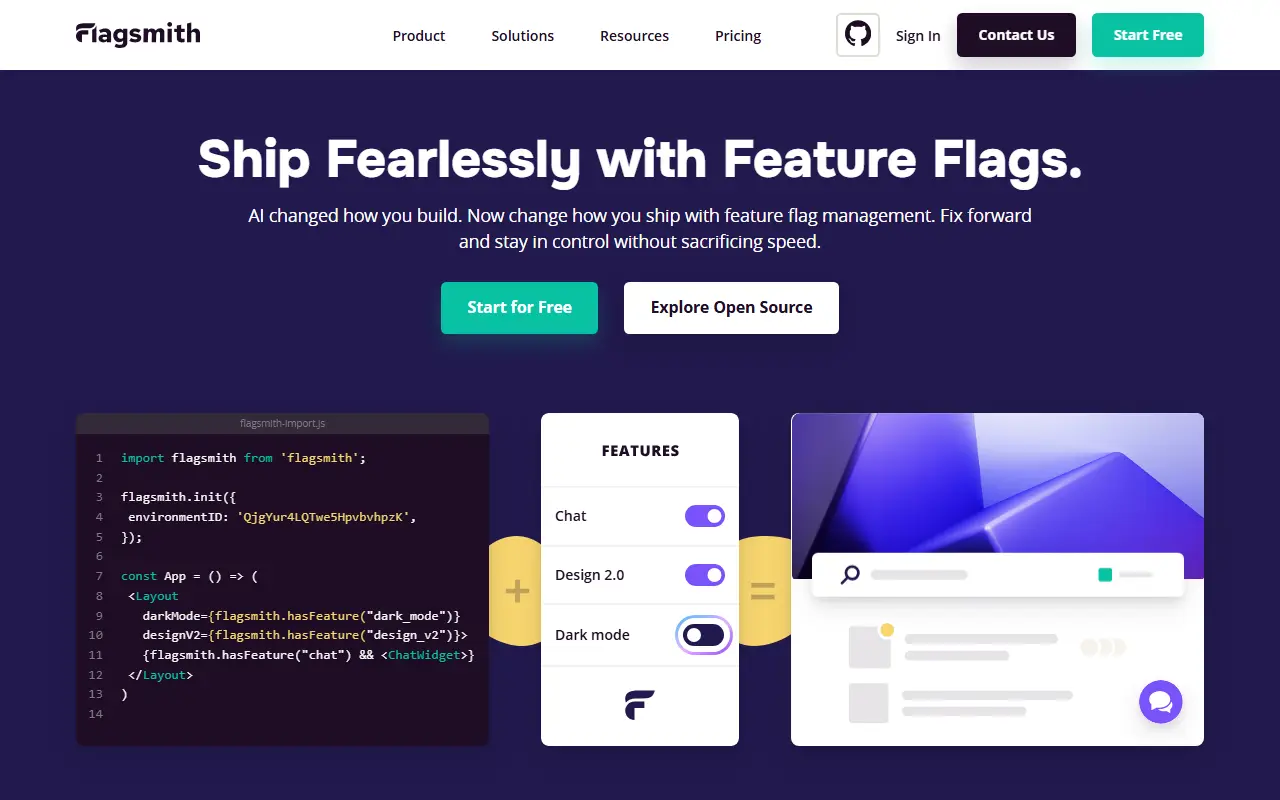
Flagsmith is a feature management platform, released as open source, offering feature flags, remote configuration and experimentation. It provides three deployment options: self-hosted, available as a free open-source build or as a fully supported Enterprise edition, a private cloud and a standard cloud service. Its partnership with OpenFeature is intended to avoid vendor lock-in.
Teams wrap sections of code in flags and toggle features on or off remotely for different environments, users or segments without deploying new code. Segments let you release to beta testers and gather feedback, and A/B and multivariate tests run on top of segments. Organisation management covers orgs, projects and roles for team members, and SDKs cover more than 15 languages with support for frameworks such as React and Next.js, plus integrations and an MCP server.
Flagsmith is written in Python and React, ships as Docker images and is released under the BSD 3-Clause licence for the open-source build. It suits product and engineering teams that want controlled rollouts and remote configuration across web, mobile and server-side applications.
Key features
- Feature flags with remote toggling
- Remote configuration values
- Segments for targeted releases
- A/B and multivariate testing
- Organisations, projects and roles
- SDKs for 15+ languages
- Integrations and MCP server
Pricing: Free plan with 50,000 requests a month. Start-Up costs $45 and Scale-Up $300 per month ($40 and $250 billed yearly), each with a 14-day trial; Enterprise is quoted.
#2
An open-source product platform combining analytics, session replay, feature flags, experiments, surveys and error tracking, with AI that turns signals into reports.
- GitHub stars
- 41k
- Last commit
- today
- Latest release
- desktop-v0.61.1016
- Self-hosted
- Yes
- Hosted version
- Available
posthog.com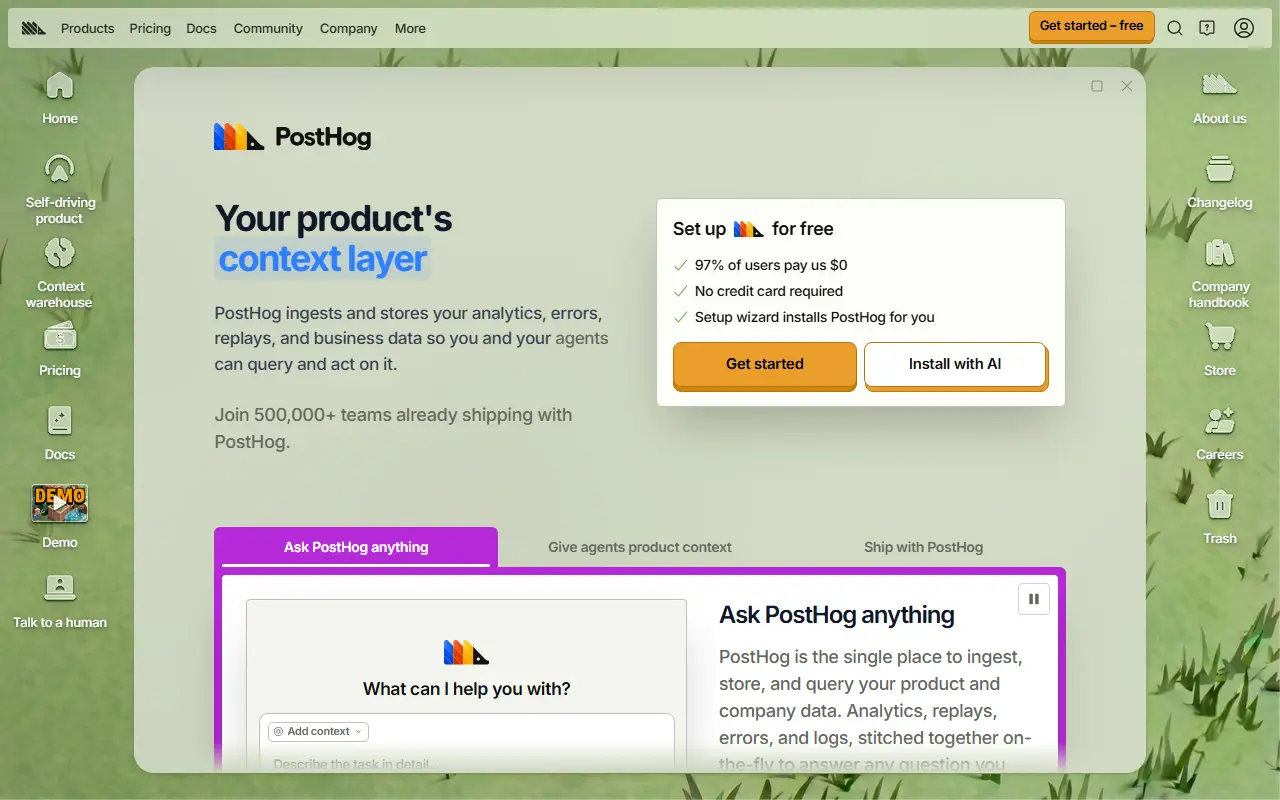
PostHog is an open-source platform that bundles the tools product teams use to understand and improve what they ship. It captures event data, user sessions and errors in one place, and its newer self-driving mode aims to turn signals such as errors, rage clicks and failed queries into researched reports and pull requests that engineers review and merge.
The product suite includes product analytics with autocapture or manual instrumentation and SQL analysis, web analytics with a dashboard resembling Google Analytics, session replays for web and mobile, feature flags, experiments with statistical measurement, surveys, error tracking, logs, a data warehouse and a customer data platform. The back end is Python and the front end is React and TypeScript.
PostHog's repository license is listed as 'Other' on GitHub, so check which parts are open source and which are enterprise-only. It can be self-hosted, and the company also runs a managed cloud service. It suits product and engineering teams that prefer a single tool over separate analytics, flagging and replay vendors.
Key features
- Product analytics with autocapture and SQL
- Web analytics dashboard
- Session replay for web and mobile
- Feature flags and experiments
- Surveys and error tracking
- Data warehouse and customer data platform
- AI-assisted detection of product issues
Pricing: Every product has a free monthly tier with no credit card needed. Pay-as-you-go charges only for usage beyond the free limits; per-unit rates are not shown here and volume discounts are available.
#3
Open-source marketing automation platform for email campaigns, segmentation and multi-channel marketing that you can host yourself.
- GitHub stars
- 11k
- Last commit
- 2 days ago
- Latest release
- 7.2.2
- Self-hosted
- Yes
- Hosted version
- Available
mautic.org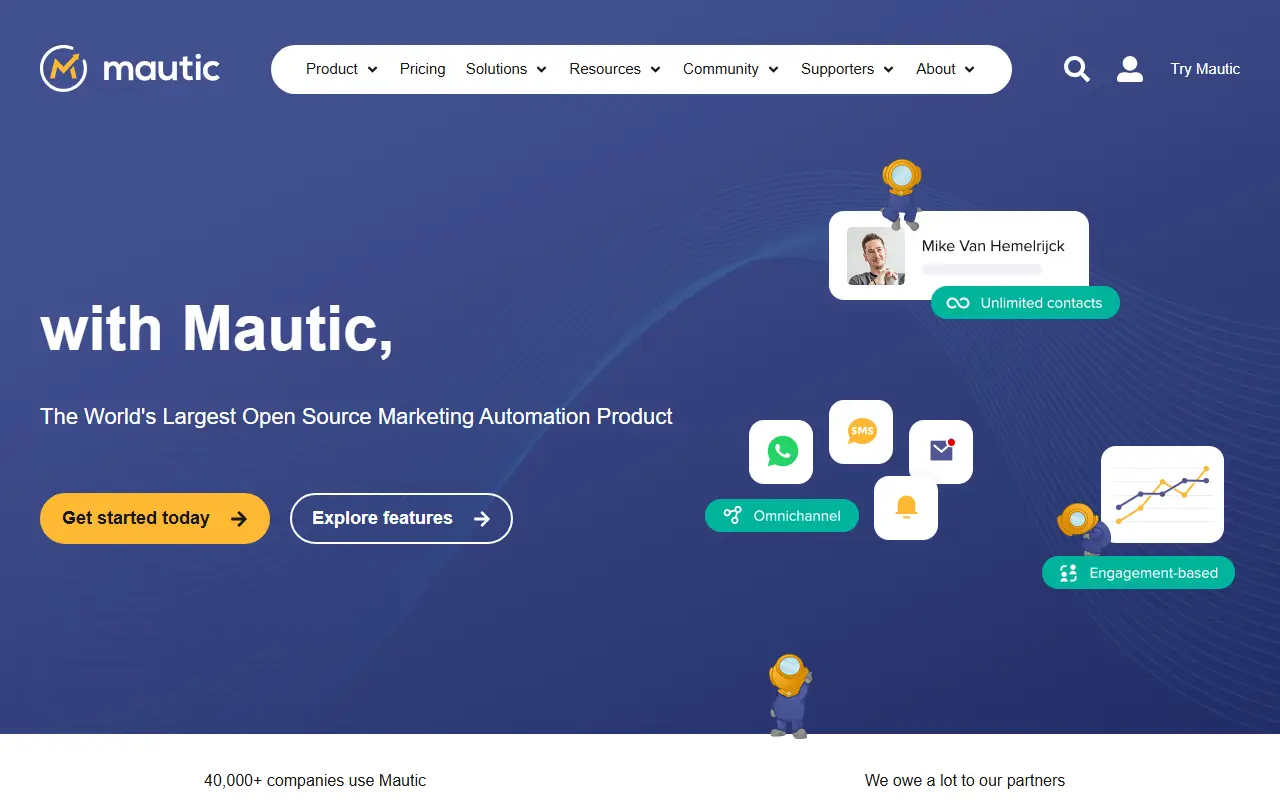
Mautic is open-source marketing automation software. It lets businesses and organizations build integrated marketing campaigns, including email marketing, while keeping control of their own data. The project is supported by a worldwide community of contributors and presents privacy and extensibility as core goals.
The README highlights several advantages over conventional hosted tools: it is free to use, you can run it on your own infrastructure with your own database, there is no vendor lock-in, integrations can be built as needed, and both the frontend and backend are customizable. It also describes multi-channel marketing without extra cost and unlimited segmentation and automation.
Mautic is written in PHP. It can be downloaded and self-hosted, or you can request a trial of a hosted option, and community channels and a blog share news, releases and strategy. Its license is stated in the repository. It suits marketing teams that want automation without relying entirely on a third-party SaaS provider.
Key features
- Email marketing and campaign automation
- Contact segmentation
- Multi-channel marketing
- Customizable frontend and backend
- Custom integrations
- Own your data in your own database
Pricing: Managed Mautic hosting through a partner starts from 275 euros a month billed quarterly (247.50 on annual billing) for Essential and from 1,237 euros a month for Professional; Enterprise is custom.
#4
An open-source platform for feature flags, A/B experimentation and product analytics that queries your data warehouse, available in the cloud or self-hosted.
- GitHub stars
- 8.6k
- Last commit
- today
- Latest release
- v5.2.0
- Self-hosted
- Yes
- Hosted version
- Available
growthbook.io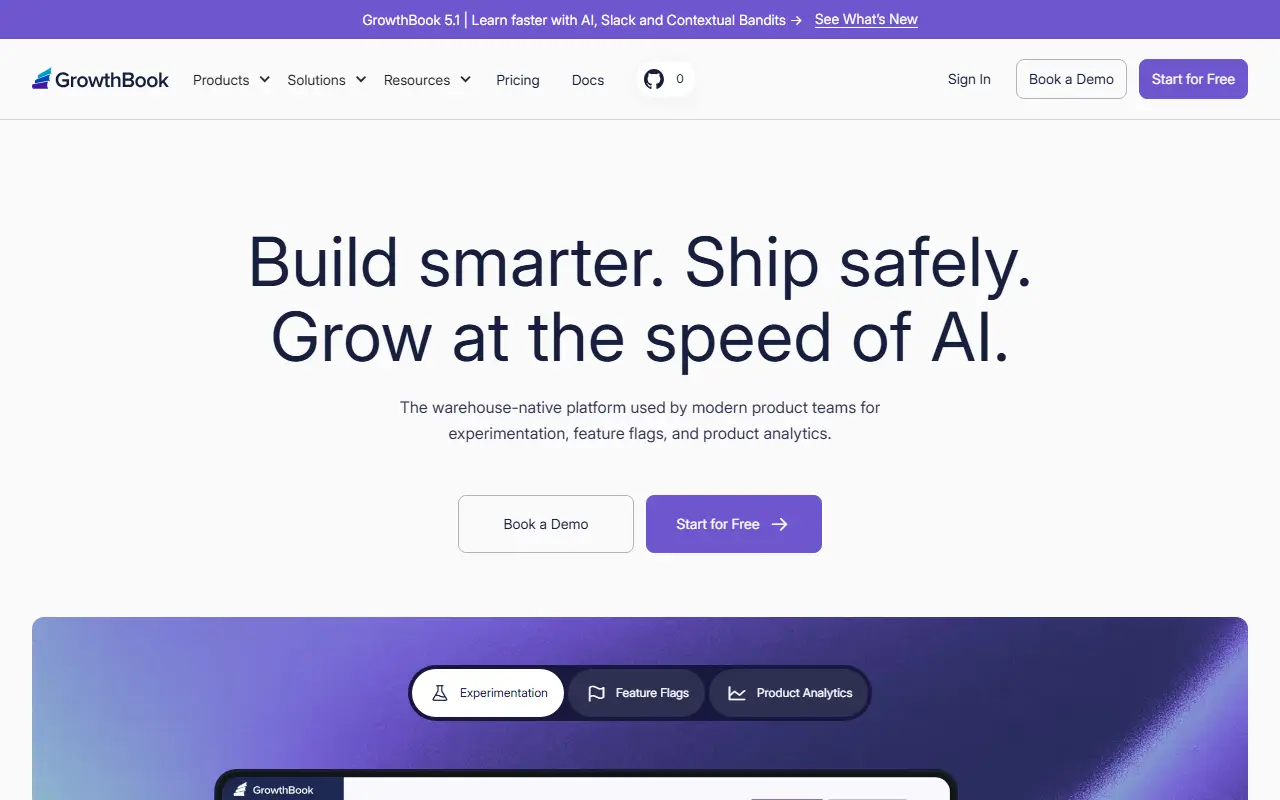
GrowthBook combines feature flagging, experimentation and product analytics in one open-source platform. The project's stated philosophy is that most companies cannot build an in-house platform of this kind, so it aims to give them the flexibility of one without the effort, instead of paying for closed SaaS tools or stitching together unmaintained libraries.
Feature flags support targeting, gradual rollouts and experiments, with 24 SDKs including React, Python, Android and iOS. The statistics engine offers methods such as CUPED, sequential and Bayesian testing, post-stratification, bandits and sample ratio mismatch checks. It is warehouse native, querying data sources such as BigQuery, Snowflake and Databricks, with metrics defined in flexible SQL. A built-in analytics suite supports dashboards, and there are webhooks, a REST API and an MCP server.
You can start with a free GrowthBook Cloud account or run it yourself with Docker and the prebuilt public image. The repository lists the licence as Other, so review the licence terms for the exact conditions on the open-source and enterprise parts. It suits product and data teams that want to run experiments on their own warehouse data.
Key features
- Feature flags with advanced targeting
- A/B tests with a Bayesian stats engine
- Warehouse-native data source queries
- SQL-based metric definitions
- Built-in product analytics dashboards
- 24 SDKs across many languages
- REST API, webhooks and MCP server
Pricing: Free Starter cloud plan and a free self-hosted Open Source edition. Pro costs $40 per seat per month for up to 30 users; Enterprise is custom.
#5
RudderStack's open-source customer data pipeline in Go, a warehouse-first Segment alternative for collecting events and delivering them to warehouses and tools.
- GitHub stars
- 4.5k
- Last commit
- yesterday
- Latest release
- v1.93.0
- Self-hosted
- Yes
- Hosted version
- Available
rudderstack.com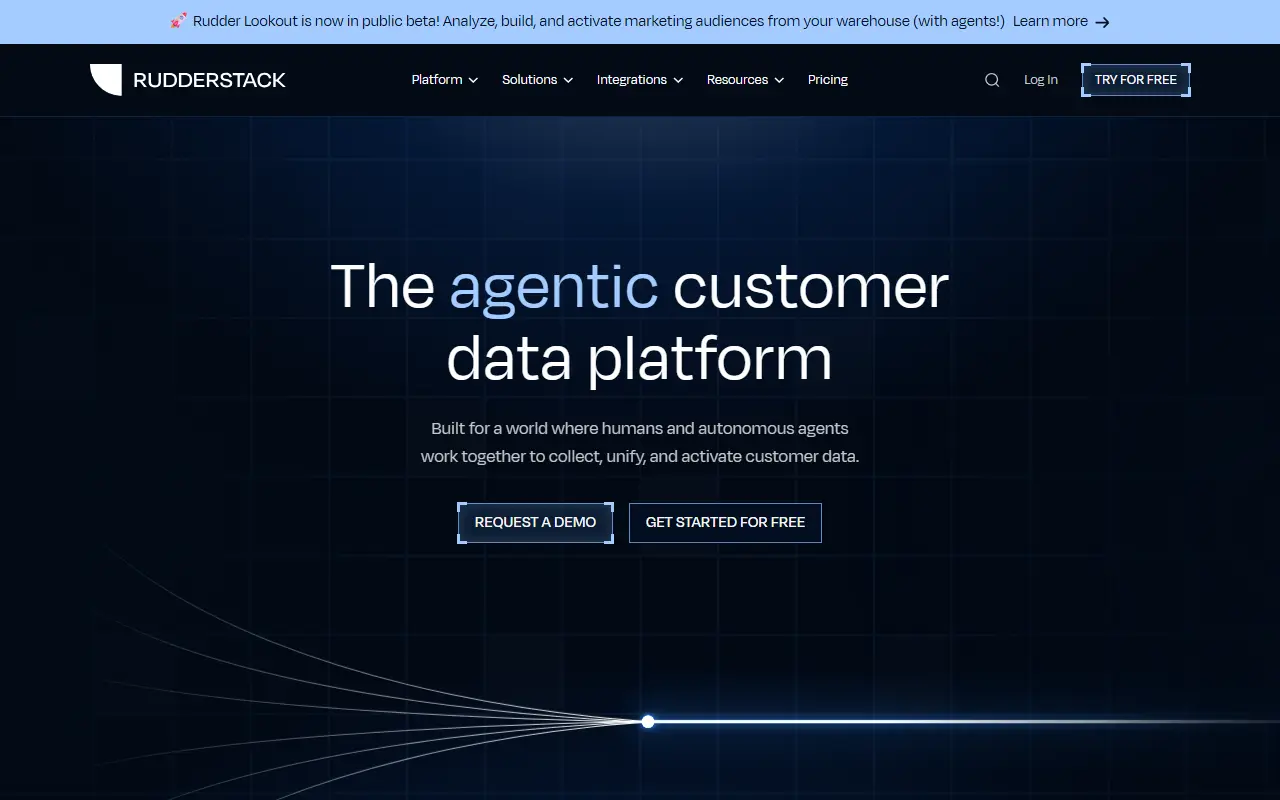
Rudder Server is the core of RudderStack, a customer data platform for developers. It provides data pipelines that collect data from applications, websites and SaaS platforms and then deliver it to your data warehouse and business tools, positioning itself as a privacy and security focused alternative to Segment.
RudderStack treats the warehouse as a first-class destination, with configurable near real-time sync, and it is built API-first around SDKs and event source integrations. It supports event streaming as well as cloud-to-warehouse ELT, with Cloud Extract integrations, transformations and a broad library of destination and warehouse integrations including BigQuery, Redshift and Snowflake.
The server is written in Go, and the project offers RudderStack Cloud with a free tier for teams that do not want to host it. The README highlights a built-in error handling and retry system for reliability. Documentation, a changelog, a blog and a Slack community are linked from the README.
Key features
- Event collection with SDKs
- Warehouse-first pipeline design
- Event streaming and cloud-to-warehouse ELT
- Transformations on event data
- Large library of destinations
- Retry and error handling for reliability
Pricing: Free plan covers 250K events a month. Growth costs $265 per month for 1 million events with a 30-day trial, and 15% off annual billing; Enterprise is custom.
#6
Open-source customer engagement platform for sending broadcasts and automated journeys over email, SMS, push, WhatsApp and Slack.
- GitHub stars
- 3.1k
- Last commit
- 1 mo ago
- Latest release
- v0.23.0
- Licence
- MIT
- Self-hosted
- Yes
- Hosted version
- Available
dittofeed.com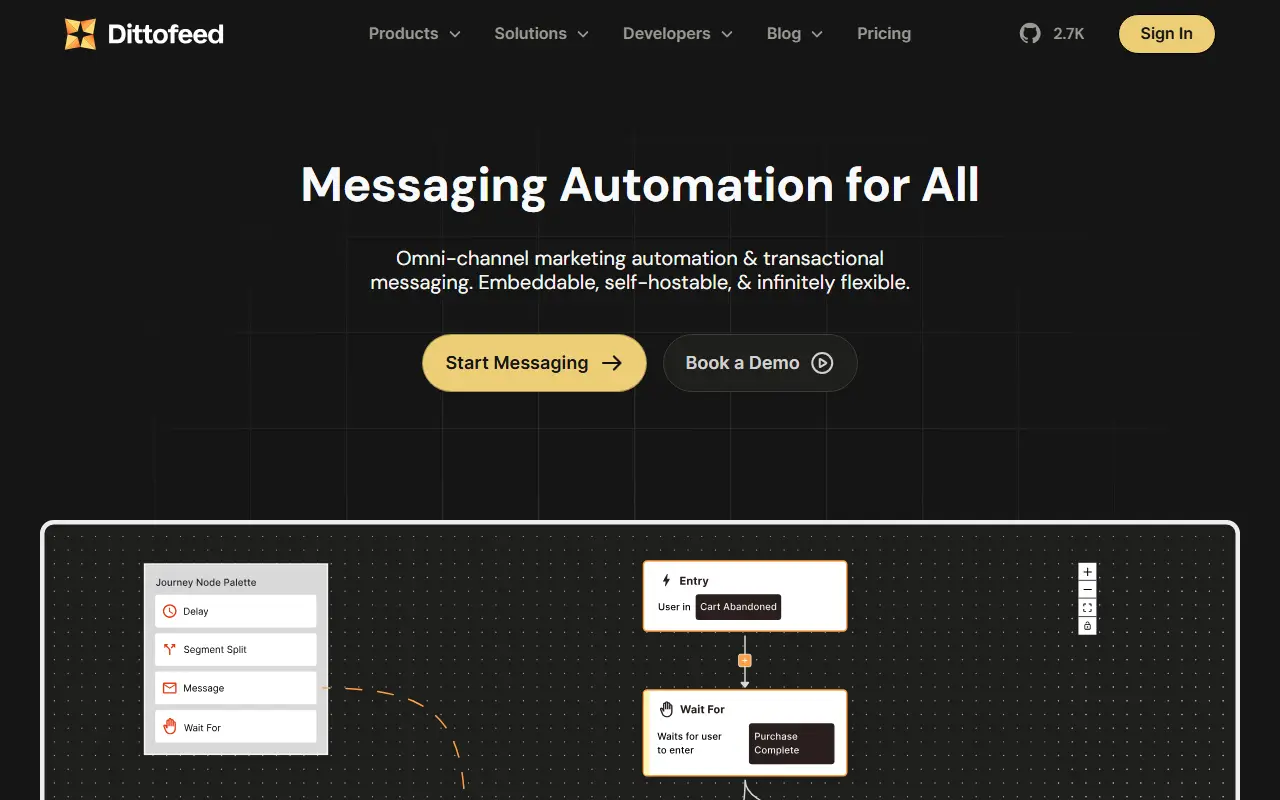
Dittofeed is an omni-channel customer engagement platform. Teams use it to send one-off broadcasts or build automated, event-driven user journeys that reach people by email, mobile push notifications, SMS, WhatsApp, Slack and other channels. The project positions itself as a developer-friendly, open-source alternative to OneSignal, Customer.io and Segment Engage.
A typical setup starts by connecting user data through Segment, reverse ETL or the Dittofeed API. You then build segments with multiple operators, design message templates in HTML, MJML or a low-code editor, and send through providers such as SendGrid or Amazon SES. A dashboard tracks message performance, and the tools can be embedded in another product through an iframe or a headless React component.
The core is written in TypeScript and licensed under MIT. It can be self-hosted with Docker Compose or deployed to Render, and a hosted cloud trial is also offered. According to the README, features such as multi-tenancy, embedding and white-labeling belong to a separate licensed, closed-source codebase that you can ask the team about.
Key features
- Broadcasts and automated event-based journeys
- Email, SMS, push, WhatsApp and Slack channels
- Segments built from user data with multiple operators
- HTML, MJML and low-code template editor
- Integrations with SendGrid and Amazon SES
- Message performance dashboard
- Embeddable via iframe or React component
Pricing: Self-hosting is free. Dittofeed Cloud Pro costs $75 per month for 10,000 unique users with a 14-day trial; support and enterprise licenses are priced on request.
#7
Laudspeaker is an open source customer engagement platform with a visual journey builder, but its README says it is no longer actively developed.
- GitHub stars
- 2.6k
- Last commit
- 4 mo ago
- Latest release
- v.1.7.0
- Hosted version
- Available
Laudspeaker is an open source customer engagement and product onboarding platform, positioned as an alternative to Braze, Customer.io, Appcues and similar tools. It is written in TypeScript on NestJS and React.
Its main features are a visual journey builder, a segment builder that can use attributes and actions, messaging over push, email, SMS and webhooks, and A/B tests with Liquid templating and external API calls for personalization. The README says it has been used to send over 500 million messages.
The README opens with a notice that Laudspeaker is no longer under active development or being supported. Its status section shows a public beta, and the roadmap lists items such as data warehouse syncing and SSO as planned. The code is under AGPL-3.0 apart from an ee directory reserved for an enterprise licence.
Key features
- Visual journey builder
- Segmentation by attributes and actions
- Push, email, SMS and webhooks
- A/B tests with Liquid templating
- Event-triggered messaging
Insider One alternatives: questions
- What is the best open-source alternative to Insider One?
- Flagsmith is the top-ranked open-source alternative to Insider One on Enlisted: An open-source feature flag and remote config platform with segments, A/B testing and SDKs, deployable self-hosted, in a private cloud or as a managed cloud service. Other strong options are PostHog, Mautic, GrowthBook and RudderStack.
- What are the best commercial alternatives to Insider One?
- WebEngage, MoEngage, CleverTap, Customer.io and Netcore Cloud are among the hosted, closed-source alternatives to Insider One listed on Enlisted, which lists 23 in total. Compare their pricing and features on each tool page.
- Are these Insider One alternatives free?
- All 7 are open source, so the code is free to use under its licence, and all of them can be self-hosted on your own server or computer. 7 also offer a paid or managed cloud version if you'd rather not host it yourself.
- How is this list of Insider One alternatives ranked?
- By a score built from GitHub stars, star growth over the last 30 days and how recently the code changed. 5 of these projects shipped code in the last 30 days. Data is refreshed daily, and nobody can pay to move up.
 TrackMedia
 TrackRev