
 PagerDuty
 Atlassian Statuspage
 Uptime.com
 FireHydrant
 Rootly
 Honeybadger
 Catchpoint
 Checkly
 Cronitor
 Dead Man's Snitch
 AppSignal
 Hyperping
 Dotcom-Monitor
 Uptrends
 updown.io
 xMatters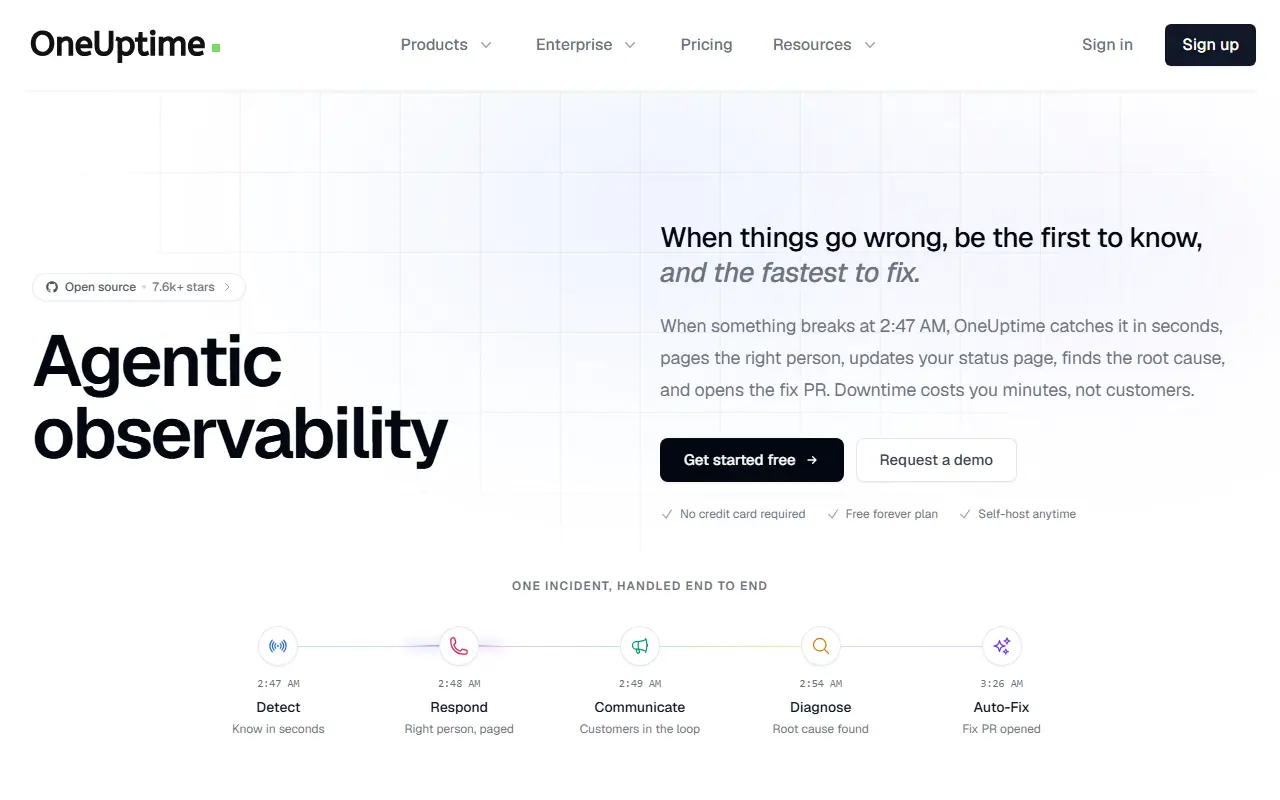
About OneUptime
OneUptime is an open-source monitoring and observability platform that aims to replace a shelf of separate SaaS tools. It covers uptime monitoring, status pages, on-call and alerting, incident management, logs, traces, metrics, APM and error tracking in one application, and adds AI-assisted features such as helping find the root cause and proposing a fix.
Its README maps each module to the tools it can replace: Pingdom and UptimeRobot for uptime checks across websites, APIs, ports, SSL and DNS, StatusPage.io for branded public and private status pages, PagerDuty and Opsgenie for schedules, escalation policies and SMS, call, push or Slack alerts, Incident.io for declaring and triaging incidents with post-mortems, Datadog and New Relic for traces and dashboards, Loggly for logs, and Sentry for exceptions.
The Community Edition is open source under Apache 2.0 and free to self-host, and OneUptime Cloud offers a free-forever plan with no credit card. It is written in TypeScript. It suits small and mid-sized engineering teams that want one platform for reliability work rather than integrating many vendors.
Key features
- Uptime monitoring for sites, APIs and ports
- Branded public and private status pages
- On-call schedules and escalation policies
- Incident management with post-mortems
- Logs, traces, metrics and APM
- Error tracking with stack traces
Good fit for
- →Replacing Pingdom, StatusPage and PagerDuty
- →Publishing a status page during incidents
- →Centralizing monitoring for a small SRE team
- Built with
- TypeScript
- Tags
- monitoring
- observability
- status-page
- incident-management
- on-call
- apm
- uptime
- self-hosted
- logs
OneUptime: questions and answers
- What is OneUptime used for?
- OneUptime is an open-source platform that combines uptime monitoring, status pages, on-call, incident management, logs, traces, metrics and error tracking in one self-hostable app. It is a good fit for replacing Pingdom, StatusPage and PagerDuty; publishing a status page during incidents; and centralizing monitoring for a small SRE team.
- Is OneUptime open source?
- Yes. OneUptime is open source under a custom licence. Its source code is on GitHub at OneUptime/oneuptime and is written mainly in TypeScript.
- Is OneUptime free?
- Yes. OneUptime is open source, so the software itself is free to use under the terms of its own licence. A managed cloud version is also available, with paid plans from $22 per month.
- Can I self-host OneUptime?
- Yes. OneUptime can be self-hosted on your own server or infrastructure.
- What is OneUptime an alternative to?
- OneUptime is an open-source alternative to Datadog, Better Stack, Pingdom and incident.io. Other open-source alternatives to Better Stack include OpenStatus, Uptime Kuma and Upptime.
- Is OneUptime actively maintained?
- Yes. The most recent commit to OneUptime was on 2 October 2026, and the latest release is 14.0.11, published on 1 October 2026. The project has 7.7k stars on GitHub.
Open-source alternatives to OneUptime
See all
OpenStatus
Monitoring & Observability
🫖 Status page with uptime monitoring & API monitoring as code 🫖
AGPL-3.0vs Pingdom★ 9.2k
Uptime Kuma
Monitoring & Observability
A self-hosted monitoring tool
MITvs UptimeRobot★ 92k
Upptime
Monitoring & Observability
⬆️ GitHub Actions uptime monitor & status page by @AnandChowdhary
MITvs UptimeRobot★ 17k
Gatus
Monitoring & Observability
Create beautiful, automated status pages with advanced monitoring. Track HTTP, DNS, TCP en
Apache-2.0vs UptimeRobot★ 12k
Peekaping
Monitoring & Observability
Open Source Uptime Kuma Alternative
MITvs UptimeRobot★ 1.2k
CheckCle
Monitoring & Observability
CheckCle is a self-hosted, open-source monitoring platform for seamless, real-time full-st
MITvs UptimeRobot★ 3.3k
SaaS alternatives to OneUptime
See all
Datadog
Monitoring & Observability
Datadog is a cloud monitoring and observability platform that brings metrics, logs and traces from applications, tools and services into one place.
SaaS
Better Stack
Monitoring & Observability
Uptime monitoring, on-call alerts, status pages and log management in one product
SaaS
Pingdom
Monitoring & Observability
Pingdom is a website monitoring service that checks uptime and page performance from outside locations and alerts teams when a site has problems.
SaaS
incident.io
Monitoring & Observability
Incident response and on-call platform that works inside Slack
SaaS
Sentry
Monitoring & Observability
Sentry is an error tracking and application performance monitoring platform that helps developers find, trace and fix problems in web, mobile and backend code.
SaaS
New Relic
Monitoring & Observability
Observability platform for application performance, infrastructure and logs
SaaS