#1
A self-hosted monitoring tool that checks websites, ports, DNS and containers, sends alerts through many notification services and publishes status pages.
- GitHub stars
- 94k
- Last commit
- yesterday
- Latest release
- 2.5.11
- Licence
- MIT
- Self-hosted
- Yes
uptime.kuma.pet
Uptime Kuma is a self-hosted tool that watches whether your services are up and tells you when they are not. You run it on your own server, point it at the endpoints you care about, and it records response times, certificate details and outages in a responsive web dashboard.
Supported monitor types include HTTP(S), TCP, keyword and JSON query checks, WebSocket, ping, DNS records, push-based heartbeats, Steam game servers and Docker containers, with checks as frequent as every 20 seconds. Alerts can go to Telegram, Discord, Gotify, Slack, Pushover, email over SMTP and more than 90 other notification services. You can publish several status pages and map them to your own domains.
It is MIT licensed and mainly distributed as a Docker image, with a Docker Compose setup and a non-Docker route that uses Node.js and pm2. Extras include proxy support, two-factor authentication, multiple UI languages and ping charts. Network file systems such as NFS are not supported for its data directory.
Key features
- Monitors HTTP, TCP, DNS, ping and Docker containers
- Checks as often as every 20 seconds
- Alerts through 90+ notification services
- Multiple status pages on custom domains
- Certificate details and ping charts
- Two-factor authentication and proxy support
Pricing: Free and open source under the MIT license; you host it yourself.
#2
ntfy is an HTTP-based publish-subscribe service for sending push notifications to phones and desktops with simple PUT or POST requests.
- GitHub stars
- 35k
- Last commit
- 2 days ago
- Latest release
- v2.37.2
- Licence
- Apache-2.0
- Self-hosted
- Yes
- Hosted version
- Available
ntfy.sh
ntfy, pronounced notify, is a simple pub-sub notification service built on HTTP. Scripts on any computer can send notifications to a phone or desktop with a PUT or POST request, for example from curl, without signing up for an account. The server is written in Go, released under the Apache-2.0 license, and easy to run on your own infrastructure.
A free public instance runs at ntfy.sh, and there are open-source Android apps on Google Play and F-Droid, plus an iOS app on the App Store. The maintainer also sells ntfy Pro plans on ntfy.sh for people who prefer not to self-host or want to support development, and donations are accepted through GitHub Sponsors and Liberapay. Documentation covers getting started, the mobile apps, the API, installation and self-hosting, and building from source. Community chat is available on Discord and Matrix.
Key features
- Send notifications with plain PUT or POST requests
- Topic-based publish and subscribe model
- Android app on Google Play and F-Droid
- iOS app and desktop notifications
- Self-hostable Go server
- Free public instance at ntfy.sh
Pricing: ntfy can be used free without signing up, or self-hosted. Paid plans are Supporter $6, Pro $12 and Business $25 per month, with lower rates on annual billing.
#3
A developer-focused platform for error tracking and performance monitoring that helps teams detect, trace and fix issues, with SDKs for most programming languages.
- GitHub stars
- 46k
- Last commit
- today
- Latest release
- 26.10.1
- Self-hosted
- Yes
- Hosted version
- Available
sentry.io
Sentry is a debugging platform that helps developers detect, trace and fix problems in their applications. It collects crash reports and errors from running software, groups them into issues, and adds the context needed to understand what happened, alongside performance monitoring for slow requests and transactions.
Integration happens through official SDKs covering web, mobile, desktop, server and game platforms, from JavaScript, Python and PHP to Go, Rust, Java, Kotlin, Swift, Flutter, Unity, Unreal Engine and Godot. The server itself is a Python application built on Django, and topics also mention CSP report collection and application performance monitoring.
Sentry is source available, and its license is listed as 'Other' on GitHub rather than a standard open-source license. It can be run on your own infrastructure, and the company also operates the hosted service at sentry.io. It is used by engineering teams of all sizes as a first stop when something breaks in production.
Key features
- Error and crash tracking
- Application performance monitoring
- Official SDKs for many languages and frameworks
- Issue grouping with debugging context
- CSP report collection
- Self-hosted or hosted deployment
Pricing: Free Developer plan for one user. Team is $26 per month and Business $80 per month when billed annually, with unlimited users; Enterprise is custom. Usage above the included quota is billed pay-as-you-go.
#4
k6 is an open-source load testing tool where tests are written as JavaScript code and run on a fast Go engine.
- GitHub stars
- 32k
- Last commit
- yesterday
- Latest release
- v2.3.0
- Licence
- AGPL-3.0
- Hosted version
- Available
grafana.com
k6 is a load-testing tool for developers and testers, described as unit testing for performance. Test scripts are written in JavaScript and executed by an embedded engine written in Go, combining scripting familiarity with efficient load generation. It is maintained under the Grafana organization and released under the AGPL-3.0 license.
Because tests are code, scripts can be modularized, version controlled and run from the command line, in CI or across a Kubernetes cluster. k6 supports HTTP, WebSockets, gRPC and browser protocols, and an extension ecosystem adds more. Results can be summarized or exported as granular metrics to the service of your choice, and the tool integrates natively with Grafana Cloud for test execution and analysis. For people who prefer not to write code, k6 Studio is a desktop app that generates scripts.
Key features
- Load tests written as JavaScript code
- Go engine for efficient traffic generation
- HTTP, WebSocket, gRPC and browser protocols
- Extension ecosystem for added capabilities
- Flexible metrics export to other services
- k6 Studio desktop app for no-code scripts
Pricing: The Grafana Cloud page, which covers k6 performance tests, lists a free plan, Pro from $19 per month plus usage, and Enterprise starting at a $25,000 per year spend commit.
Apprise API is a self-hosted gateway, run as a Docker container, that sends push notifications to more than 150 services through one API.
- GitHub stars
- 18k
- Last commit
- yesterday
- Latest release
- v2.2.0
- Licence
- BSD-2-Clause
- Self-hosted
- Yes
hub.docker.com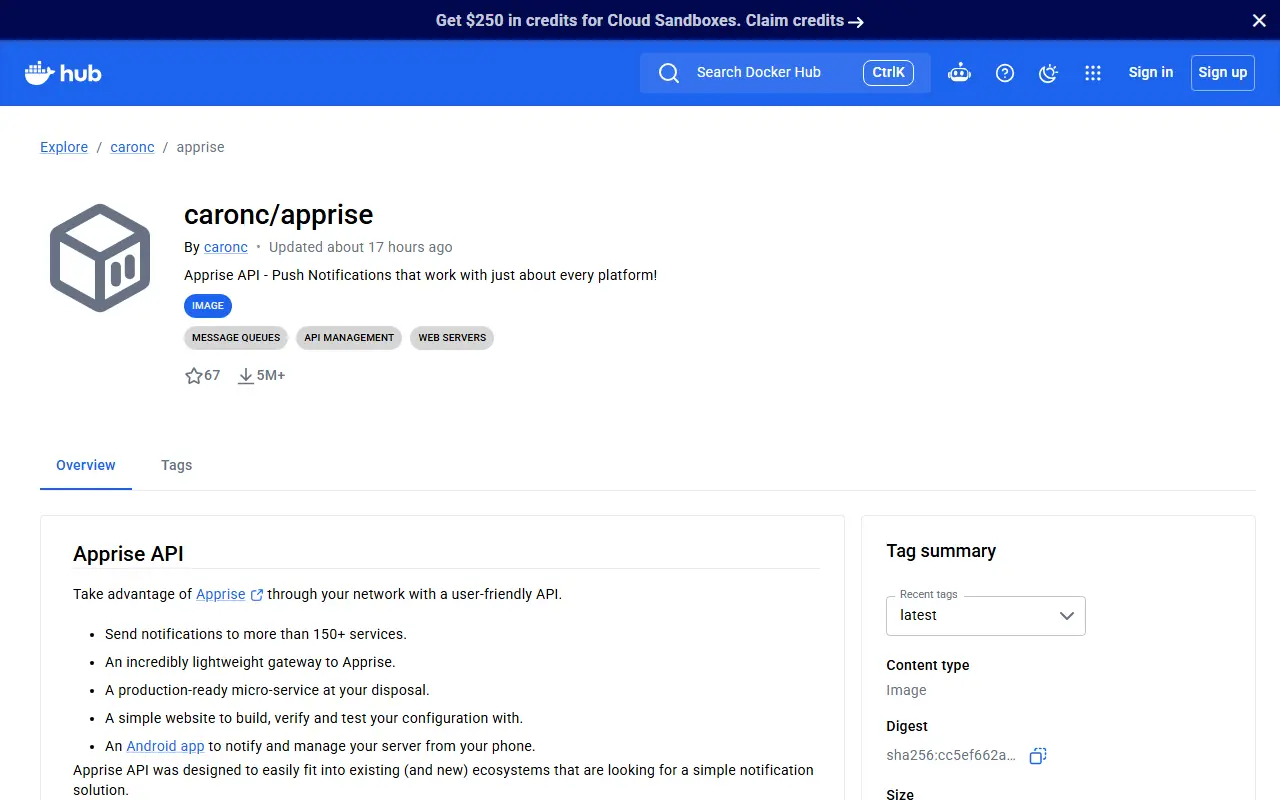
Apprise API puts the Apprise notification library behind a network API. It runs as a lightweight micro-service, available as the caronc/apprise Docker image, and is described as sending notifications to more than 150 services.
A built-in Configuration Manager lets you save, review and test your notification setup from a browser. Notifications are sent to Apprise URLs for the services you pick, and a health endpoint at /status returns 200 when the server is healthy and 417 when there is a problem.
An Android companion app, Apprise Mobile, can send a message, photo or file to one destination, a group or every configured destination. It connects to your running Apprise API server. The project is BSD-2-Clause licensed.
Key features
- Notifications to many services through one API
- Browser-based configuration manager
- Health check endpoint
- Android companion app
- Custom plugin directory
- Run with Docker or Docker Compose

A simple self-hosted push notification server that sends messages through a REST API and delivers them in real time over WebSocket, with a web UI and Android app.
- GitHub stars
- 16k
- Last commit
- 4 days ago
- Latest release
- v3.1.1
- Self-hosted
- Yes
gotify.net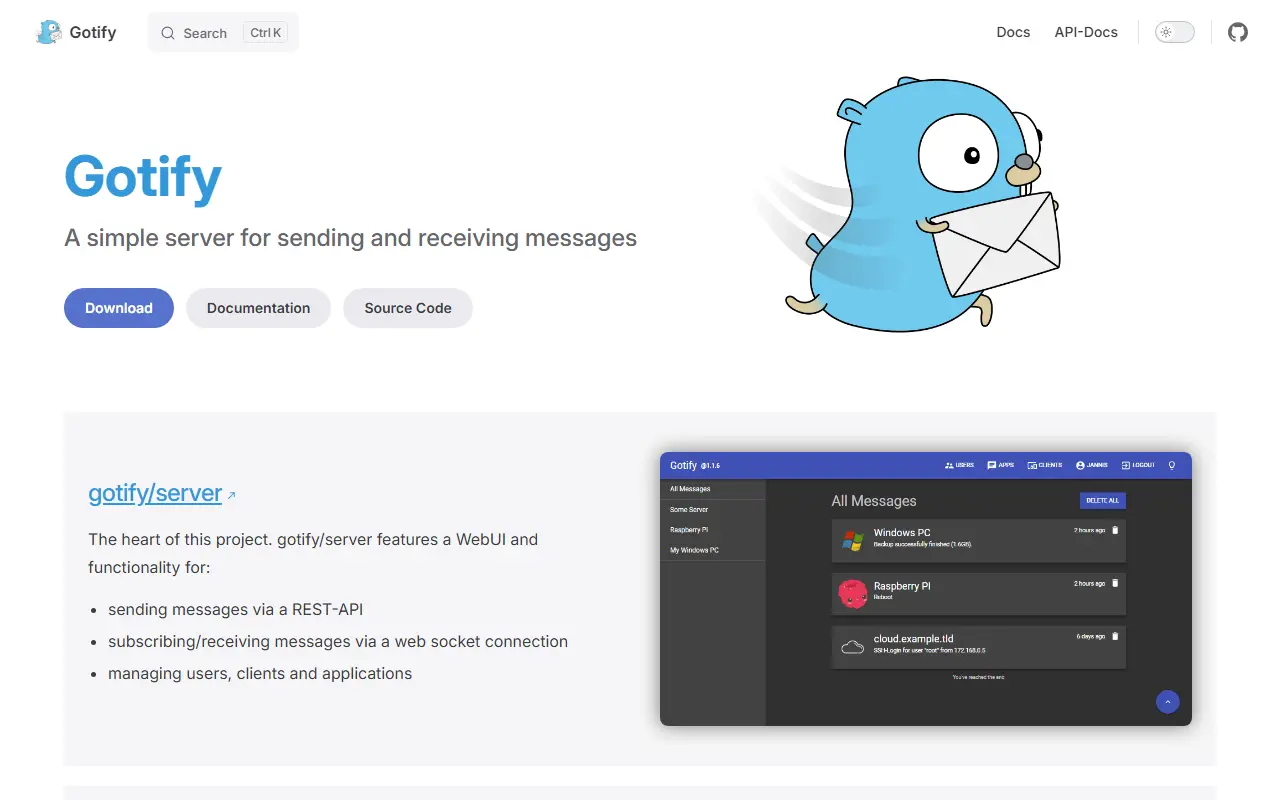
Gotify is a compact server that lets you push messages and receive them live. The authors built it because few open-source options existed for the job and many of those were abandoned, and because they wanted something that could be self-hosted. Messages go in through a REST API and come out through a WebSocket, and the server includes a clean web interface.
Core capabilities include managing users, clients and applications, a plugin system, a command line tool for sending messages, and an Android app that is available from Google Play and F-Droid. The web UI is built with React, and the server itself is written in Go. Documentation covers installation, configuration, the REST API and setting up a development environment, and the project welcomes contributions of all kinds.
Gotify is open source and uses semantic versioning. The repository lists the MIT license in its text, while GitHub metadata shows it as 'Other'. Because you run it yourself, your notifications stay on your own infrastructure. It is popular with self-hosters who want scripts, servers and monitoring tools to push alerts to their phone.
Key features
- Send messages through a REST API
- Receive messages in real time via WebSocket
- User, client and application management
- Plugin system for extensions
- Web UI and CLI
- Android app on Google Play and F-Droid
Pricing: Free and open source; the README states the MIT License.
#7
A cron job and background task monitoring service that alerts you when expected pings do not arrive, available as a hosted service or to self-host.
- GitHub stars
- 11k
- Last commit
- 3 days ago
- Latest release
- v5.0.3
- Licence
- BSD-3-Clause
- Self-hosted
- Yes
- Hosted version
- Available
healthchecks.io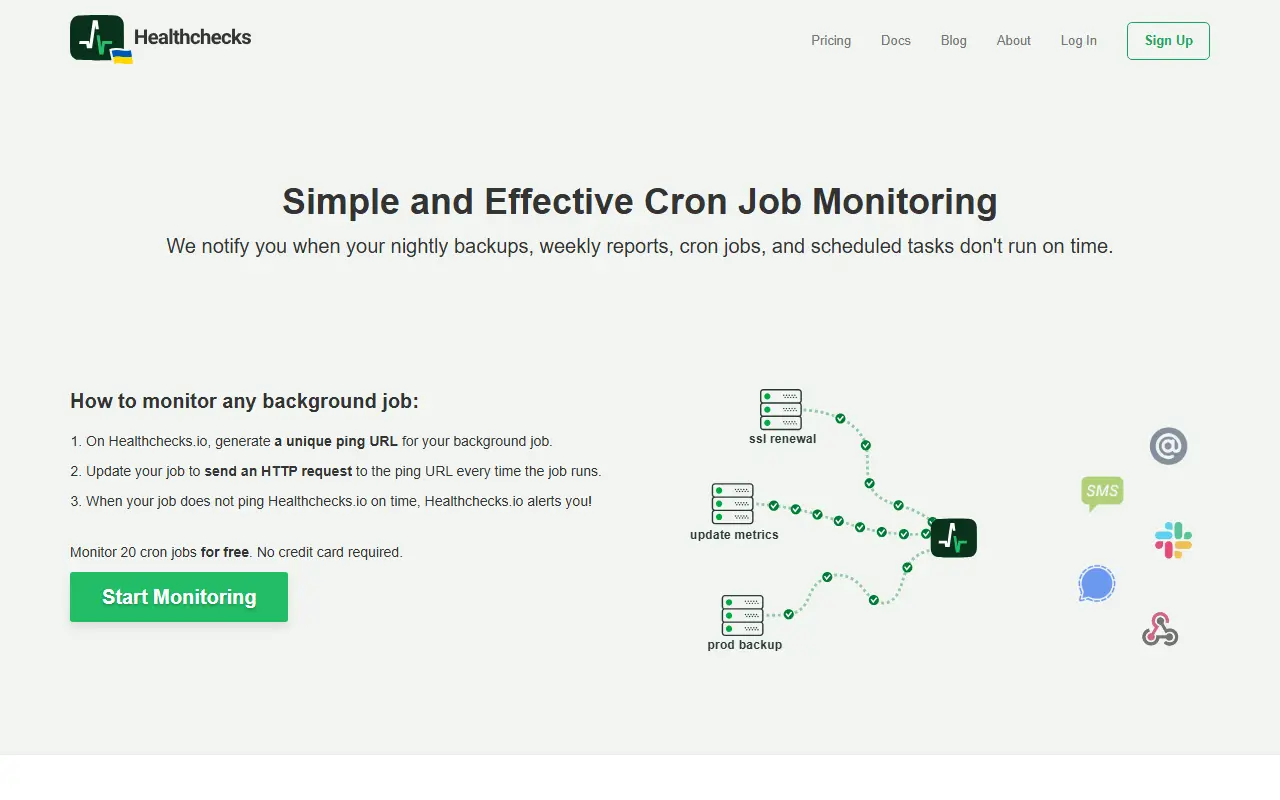
Healthchecks is a monitoring service for cron jobs and scheduled tasks. Each job sends a ping over HTTP or email when it runs, and Healthchecks raises an alert whenever an expected ping fails to show up in time. This catches silent failures of backups, imports and other background work that would otherwise go unnoticed.
Every check has a period, which is the expected time between pings, and a grace time, which says how long to wait before alerting, or it can follow a cron expression instead. The product includes a live web dashboard, an API, more than 25 notification integrations, monthly email reports, WebAuthn two-factor authentication and team features such as projects, members and read-only access. Status badges with hard-to-guess public URLs can be embedded in READMEs or status pages.
Healthchecks is written in Python with Django and uses PostgreSQL, MySQL or MariaDB. It is licensed under the BSD 3-Clause licence and can be self-hosted, with a Dockerfile and prebuilt Docker images provided, or used as the hosted service at healthchecks.io.
Key features
- Ping-based cron job monitoring
- Period and grace time settings
- Cron expression schedules
- 25+ notification integrations
- Live dashboard and API
- Team projects and read-only access
- Public status badges
Pricing: Free Hobbyist plan monitors 20 jobs. Paid plans cost $5 (Supporter), $20 (Business) and $80 (Business Plus) per month; paying annually saves 20%.
#8
An open-source platform that combines uptime monitoring, status pages, on-call, incident management, logs, traces, metrics and error tracking in one self-hostable app.
- GitHub stars
- 7.8k
- Last commit
- today
- Latest release
- 14.0.108
- Self-hosted
- Yes
- Hosted version
- Available
oneuptime.com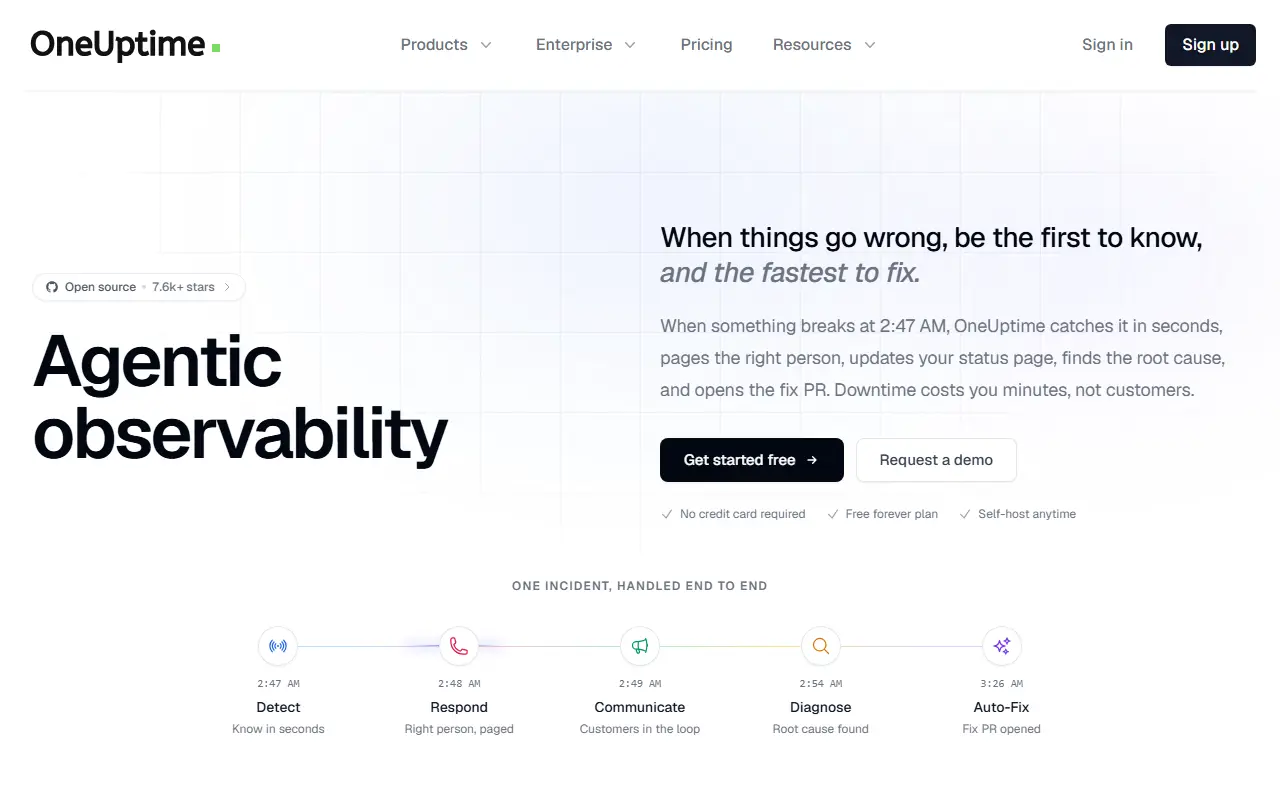
OneUptime is an open-source monitoring and observability platform that aims to replace a shelf of separate SaaS tools. It covers uptime monitoring, status pages, on-call and alerting, incident management, logs, traces, metrics, APM and error tracking in one application, and adds AI-assisted features such as helping find the root cause and proposing a fix.
Its README maps each module to the tools it can replace: Pingdom and UptimeRobot for uptime checks across websites, APIs, ports, SSL and DNS, StatusPage.io for branded public and private status pages, PagerDuty and Opsgenie for schedules, escalation policies and SMS, call, push or Slack alerts, Incident.io for declaring and triaging incidents with post-mortems, Datadog and New Relic for traces and dashboards, Loggly for logs, and Sentry for exceptions.
The Community Edition is open source under Apache 2.0 and free to self-host, and OneUptime Cloud offers a free-forever plan with no credit card. It is written in TypeScript. It suits small and mid-sized engineering teams that want one platform for reliability work rather than integrating many vendors.
Key features
- Uptime monitoring for sites, APIs and ports
- Branded public and private status pages
- On-call schedules and escalation policies
- Incident management with post-mortems
- Logs, traces, metrics and APM
- Error tracking with stack traces
Pricing: Free plan with one status page. Growth is $22 and Scale $99 per month with 14-day trials; Enterprise is custom. Monitors, SMS, telemetry and AI use are billed on top.
#9
Official Dockerfiles for Zabbix, the open-source enterprise monitoring platform, for running its server, web interface, and agents in containers.
- GitHub stars
- 2.9k
- Last commit
- today
- Latest release
- 8.0.0
- Licence
- AGPL-3.0
- Self-hosted
- Yes
zabbix.com
This repository holds the official Dockerfiles for Zabbix, an enterprise-class open-source distributed monitoring solution. Zabbix tracks many parameters of a network as well as the health and integrity of servers, and the Dockerfiles are used for automated builds published to the public Docker Hub registry. The repository is licensed under AGPL-3.0.
Zabbix itself offers flexible notifications, such as email alerts for nearly any event, along with reporting and data visualization based on stored data, which makes it useful for capacity planning. The images are provided on several base operating systems, including Alpine, CentOS, Oracle Linux, and Ubuntu, and the README includes usage instructions for running the components with Docker.
The project is aimed at system administrators and DevOps teams who want to deploy Zabbix in containers instead of installing packages by hand, whether for a lab or a production monitoring stack. The Zabbix website and Docker Hub organization provide the downloads and further documentation.
Key features
- Official Zabbix Dockerfiles
- Images for Alpine, CentOS, Oracle Linux, and Ubuntu
- Published to Docker Hub
- Server, web, and agent components in containers
- Email alerting and reporting from Zabbix
- Capacity planning data visualization
Pricing: Zabbix software has no license fee. Paid support subscriptions start at $325 per month for Silver and from $825 for Gold, billed annually; Platinum, Enterprise and Global are quoted.
#10
Kubernetes operator for synthetic monitoring that runs health checks as pods, defined as manifests and reported as Prometheus metrics.
- GitHub stars
- 2.3k
- Last commit
- yesterday
- Latest release
- v3.0.33
- Licence
- Apache-2.0
- Self-hosted
- Yes
kuberhealthy.github.io
Kuberhealthy is a Kubernetes operator for synthetic monitoring and continuous validation. It schedules, tracks, and manages short-lived pods that run checks against your cluster or applications, and it ships the results as metrics to Prometheus. It is written in Go and released under the Apache-2.0 license.
Checks are defined through the HealthCheck custom resource definition, so monitoring logic becomes Kubernetes manifests that can be shipped alongside an application. Because each check runs in a container, it can be written in any language, such as Go, Python, Rust, or bash, and can run multi-step workflows that mimic a real user: logging in, creating a record, verifying it, and cleaning it up.
Its topics place it in continuous testing and delivery workflows as well as monitoring. Kuberhealthy suits platform and SRE teams that want end-to-end confidence that their clusters and services actually work, beyond simple resource metrics.
Key features
- Synthetic checks run as Kubernetes pods
- HealthCheck custom resource definition
- Checks in any language that fits a container
- Multi-step user-like workflows
- Prometheus metrics export
- Checks managed as code
Pricing: Free and open source under the Apache-2.0 license.
Dead Man's Snitch alternatives: questions
- What is the best open-source alternative to Dead Man's Snitch?
- Uptime Kuma is the top-ranked open-source alternative to Dead Man's Snitch on Enlisted: A self-hosted monitoring tool that checks websites, ports, DNS and containers, sends alerts through many notification services and publishes status pages. Other strong options are ntfy, Sentry, k6 and Apprise.
- What are the best commercial alternatives to Dead Man's Snitch?
- Cronitor, Checkly, PagerDuty, Better Stack and Cronwatch are among the hosted, closed-source alternatives to Dead Man's Snitch listed on Enlisted, which lists 13 in total. Compare their pricing and features on each tool page.
- Are these Dead Man's Snitch alternatives free?
- All 10 are open source, so the code is free to use under its licence, and all of them can be self-hosted on your own server or computer. 5 also offer a paid or managed cloud version if you'd rather not host it yourself.
- How is this list of Dead Man's Snitch alternatives ranked?
- By a score built from GitHub stars, star growth over the last 30 days and how recently the code changed. 10 of these projects shipped code in the last 30 days. Data is refreshed daily, and nobody can pay to move up.
 TrackMedia
 TrackRev