
About ntfy
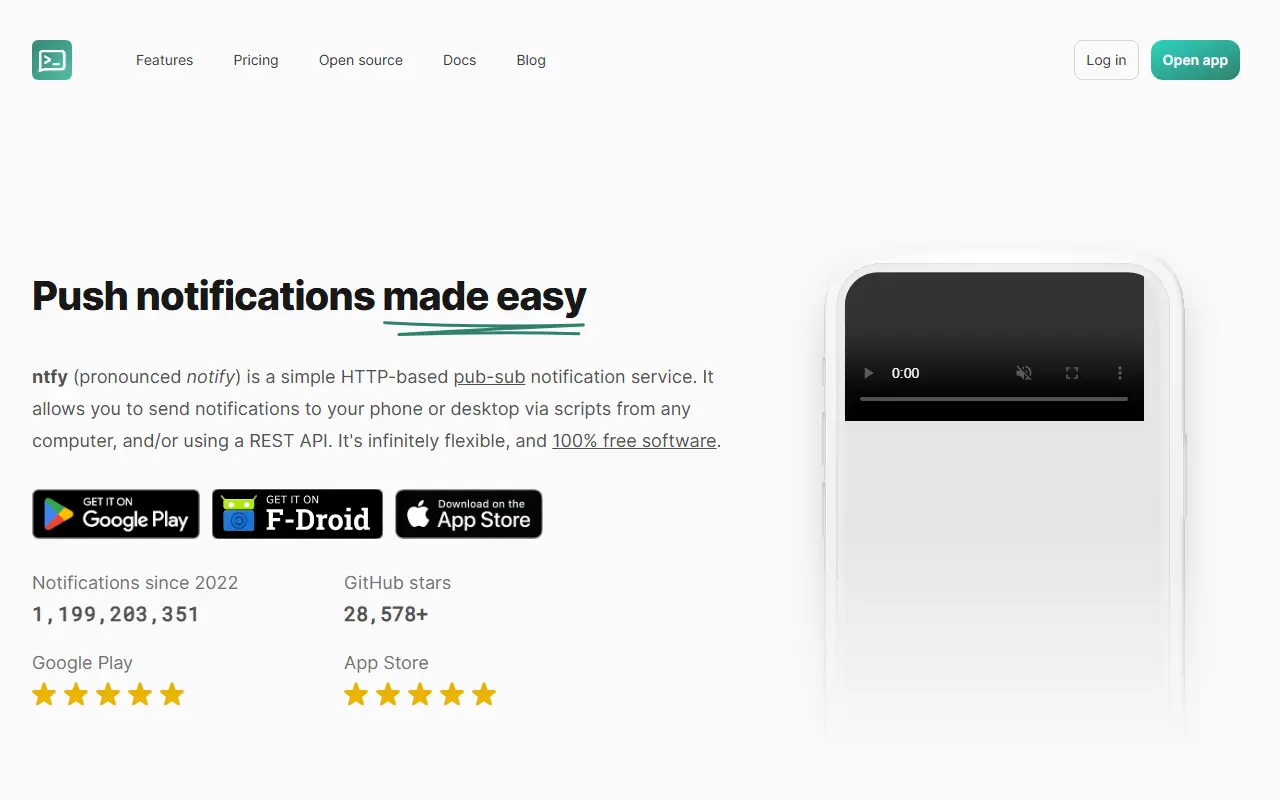
ntfy, pronounced notify, is a simple pub-sub notification service built on HTTP. Scripts on any computer can send notifications to a phone or desktop with a PUT or POST request, for example from curl, without signing up for an account. The server is written in Go, released under the Apache-2.0 license, and easy to run on your own infrastructure.
A free public instance runs at ntfy.sh, and there are open-source Android apps on Google Play and F-Droid, plus an iOS app on the App Store. The maintainer also sells ntfy Pro plans on ntfy.sh for people who prefer not to self-host or want to support development, and donations are accepted through GitHub Sponsors and Liberapay. Documentation covers getting started, the mobile apps, the API, installation and self-hosting, and building from source. Community chat is available on Discord and Matrix.
Key features
- Send notifications with plain PUT or POST requests
- Topic-based publish and subscribe model
- Android app on Google Play and F-Droid
- iOS app and desktop notifications
- Self-hostable Go server
- Free public instance at ntfy.sh
Good fit for
- →Alerts from cron jobs and shell scripts
- →Push notifications for self-hosted services
- Built with
- Go
- Tags
- push-notifications
- pubsub
- self-hosted
- rest-api
- curl
- notifications
- android
- golang
ntfy: questions and answers
- What is ntfy used for?
- ntfy is an HTTP-based publish-subscribe service for sending push notifications to phones and desktops with simple PUT or POST requests. It is a good fit for alerts from cron jobs and shell scripts, and push notifications for self-hosted services.
- Is ntfy open source?
- Yes. ntfy is open source under the Apache-2.0 licence. Its source code is on GitHub at binwiederhier/ntfy and is written mainly in Go.
- Is ntfy free?
- Yes. ntfy is open source, so the software itself is free to use. A managed cloud version is also available, with paid plans from $6 per month.
- Can I self-host ntfy?
- Yes. ntfy can be self-hosted on your own server or infrastructure.
- What are some alternatives to ntfy?
- Similar open-source tools in the Workflow Automation category include Dagu, n8n and Temporal. SaaS products in the same category include MacroDroid, Tasker and ActRun AI.
- Is ntfy actively maintained?
- Yes. The most recent commit to ntfy was on 29 September 2026, and the latest release is v2.28.0, published on 27 August 2026. The project has 35k stars on GitHub.
Open-source alternatives to ntfy
See all
Dagu
Workflow Automation
Self-hostable workflow orchestrator for teams whose main work isn't orchestration. Declara
GPL-3.0vs AWS Step Functions★ 4.2k
n8n
Workflow Automation
n8n is a workflow automation platform that uniquely combines AI capabilities with business
OSSvs Zapier★ 206k
Temporal
Workflow Automation
Temporal service
MITvs AWS Step Functions★ 23k
Windmill
Workflow Automation
Open-source developer platform to power your entire infra and turn scripts into webhooks,
OSSvs Retool★ 18k
Trigger.dev
Workflow Automation
Trigger.dev – build and deploy durable AI agents and workflows
Apache-2.0★ 16k
StackStorm
Workflow Automation
StackStorm (aka "IFTTT for Ops") is event-driven automation for auto-remediation, incident
Apache-2.0vs Tines★ 6.5k
SaaS alternatives to ntfy
See all
MacroDroid
Workflow Automation
Android automation app that uses triggers, actions and constraints to run macros
SaaS
Tasker
Workflow Automation
Android app that automates device actions using profiles, tasks and plugins
SaaSActRun AI
Workflow Automation
AI agent that turns plain-English requests into tasks across email, Slack, Stripe, files and browser
SaaSAify
Workflow Automation
No-code visual workflow builder connecting webhooks, forms, payments, AI tools and messaging apps
SaaS
Albato
Workflow Automation
No-code automation platform connecting business apps with prebuilt integrations
SaaS
Apify
Workflow Automation
Cloud platform and marketplace for web scraping and browser automation actors
SaaS