7,363 open-source and SaaS tools, with GitHub stats refreshed every day.

12 alternatives ranked by real activity

Open-source Atlassian Statuspage alternatives

A curated, ranked list of the 12 best open-source alternatives to Atlassian Statuspage.

The best open-source alternative to Atlassian Statuspage is Uptime Kuma. If that doesn't suit you, other good options are Upptime, Cachet, Gatus and OpenStatus.

Atlassian Statuspage alternatives are mainly monitoring & observability tools. 7 of them shipped code in the last 30 days, 12 can be self-hosted, and 7 use a permissive licence.

Last updated October 2, 2026 · ranked by GitHub stars, growth and recent commits

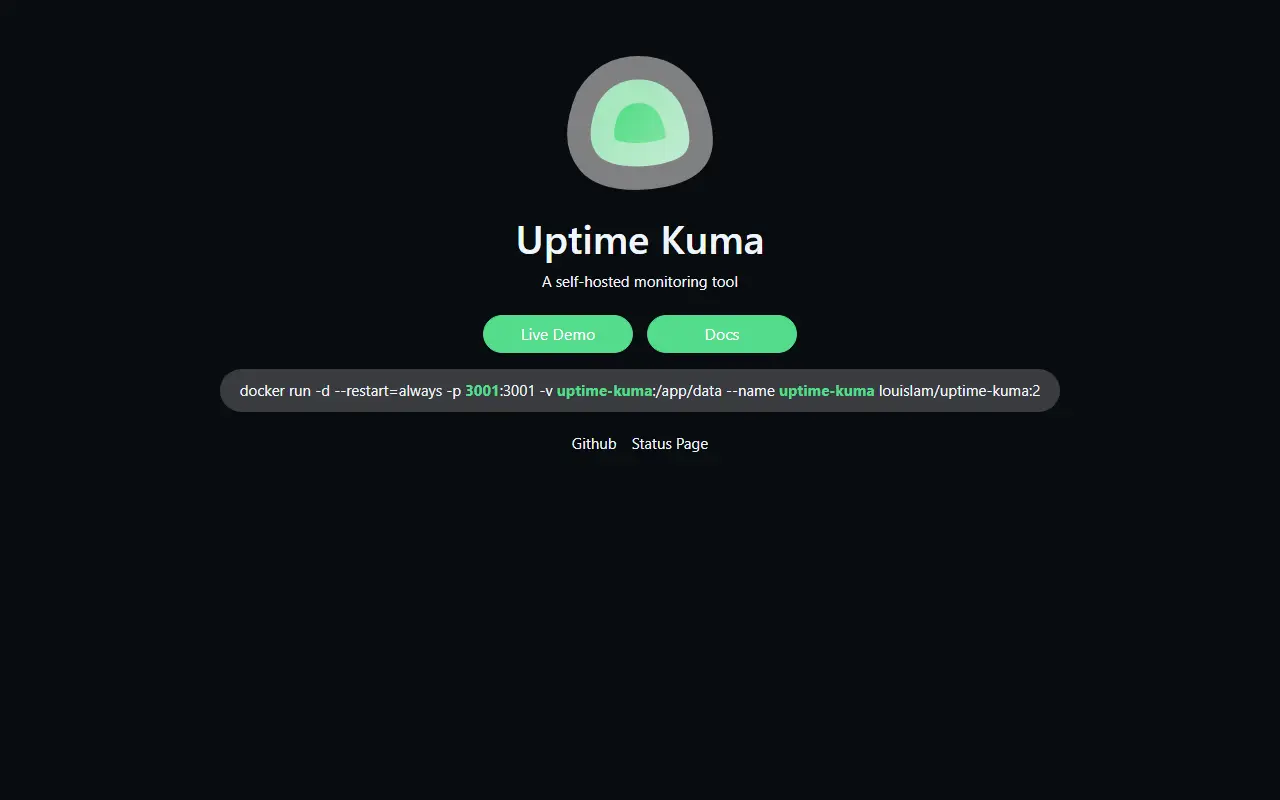
Uptime Kuma

A self-hosted monitoring tool that checks websites, ports, DNS and containers, sends alerts through many notification services and publishes status pages.

GitHub stars
92k
Last commit
yesterday
Latest release
2.5.5
Licence
MIT
Self-hosted
Yes
uptime.kuma.petUptime Kuma homepage screenshot

Uptime Kuma is a self-hosted tool that watches whether your services are up and tells you when they are not. You run it on your own server, point it at the endpoints you care about, and it records response times, certificate details and outages in a responsive web dashboard.

Supported monitor types include HTTP(S), TCP, keyword and JSON query checks, WebSocket, ping, DNS records, push-based heartbeats, Steam game servers and Docker containers, with checks as frequent as every 20 seconds. Alerts can go to Telegram, Discord, Gotify, Slack, Pushover, email over SMTP and more than 90 other notification services. You can publish several status pages and map them to your own domains.

It is MIT licensed and mainly distributed as a Docker image, with a Docker Compose setup and a non-Docker route that uses Node.js and pm2. Extras include proxy support, two-factor authentication, multiple UI languages and ping charts. Network file systems such as NFS are not supported for its data directory.

Key features

  • Monitors HTTP, TCP, DNS, ping and Docker containers
  • Checks as often as every 20 seconds
  • Alerts through 90+ notification services
  • Multiple status pages on custom domains
  • Certificate details and ping charts
  • Two-factor authentication and proxy support

Pricing: Free and open source under the MIT license; you host it yourself.

Read more about Uptime KumaWebsite GitHub

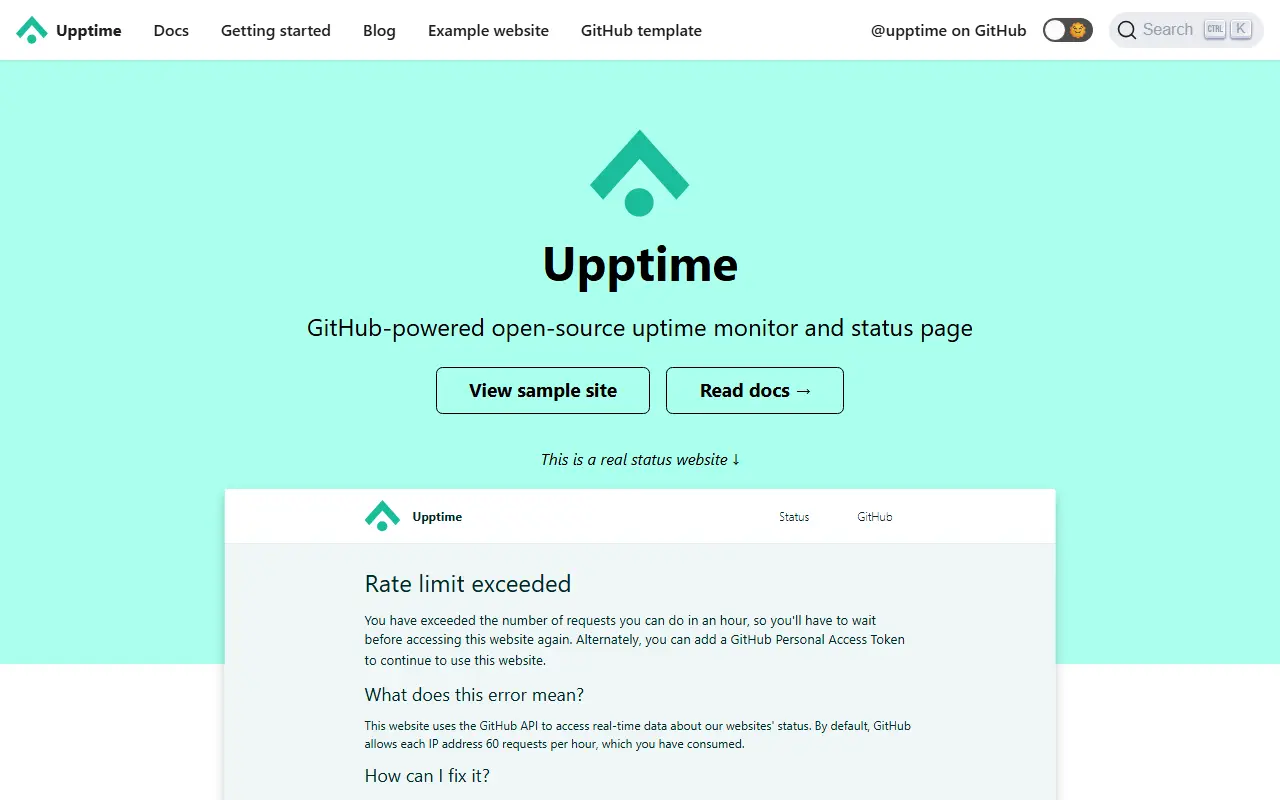
Upptime

Upptime is an open-source uptime monitor and status page that runs entirely on GitHub Actions, Issues and Pages.

GitHub stars
17k
Last commit
yesterday
Latest release
v2.0.0
Licence
MIT
Self-hosted
Yes
upptime.js.orgUpptime homepage screenshot

Upptime is an uptime monitor and status page that runs entirely on GitHub Actions, GitHub Issues and GitHub Pages, so no separate server is needed. Scheduled workflow runs check your endpoints as often as every five minutes and record response times by committing the data to git.

When downtime is detected, GitHub Issues are opened and closed automatically to track incidents. A status page built with Svelte is published through GitHub Pages and displays uptime, response times and incident history. Configuration lives in a single file, and every change and event leaves an audit trail in the git history.

The project is MIT licensed and was created by Anand Chowdhary as an affordable, flexible monitor that he could control himself. It costs nothing extra for anyone already using GitHub, because there is no subscription or external server. Deleting the repository also removes the data, since all history is stored in it.

Key features

  • Scheduled uptime checks via GitHub Actions
  • Response time history committed to git
  • Automatic incident issues on downtime
  • Status page hosted on GitHub Pages
  • Single-file configuration
  • No separate server needed

Pricing: Free and open source under MIT; it runs inside your own GitHub repository without a separate subscription.

Read more about UpptimeWebsite GitHub

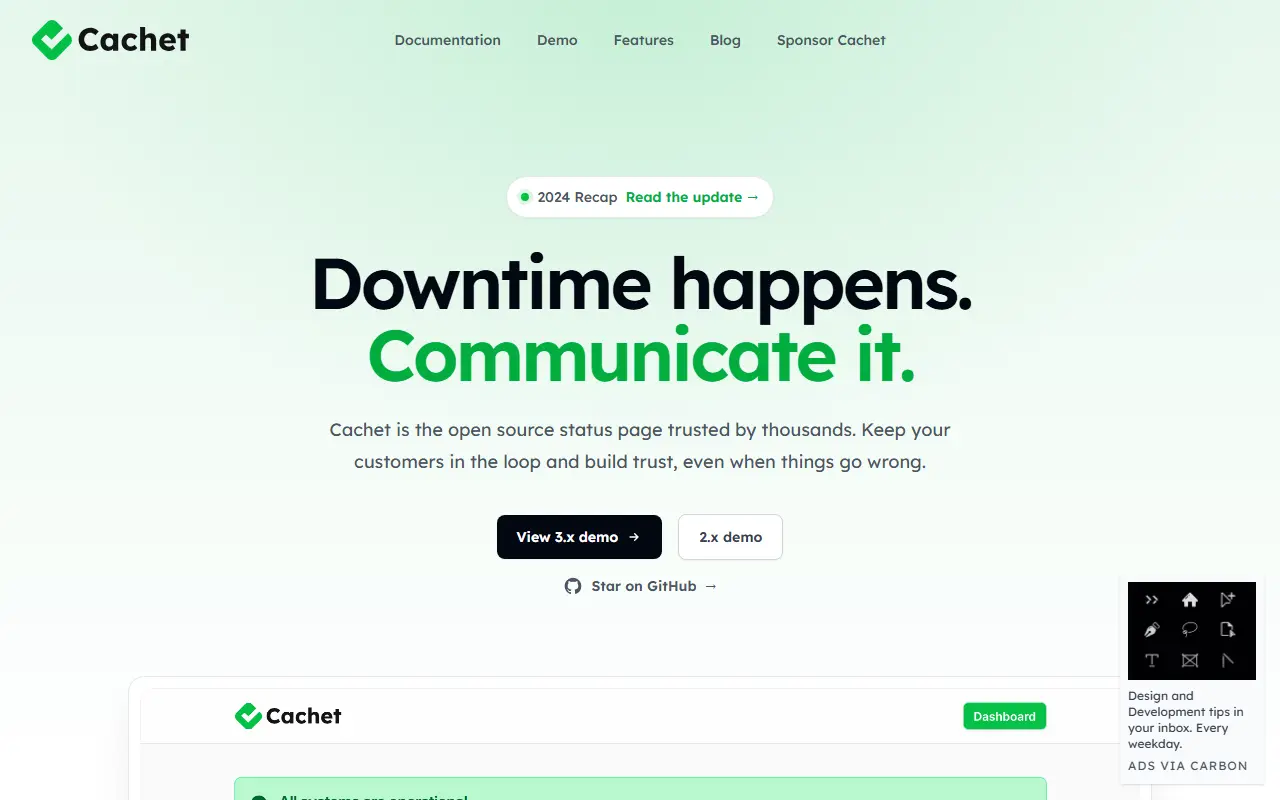
Cachet

A self-hosted status page system built with Laravel that lets you publish service status, incidents and updates to your users.

GitHub stars
15k
Last commit
4 days ago
Latest release
v2.4.1
Self-hosted
Yes
cachethq.ioCachet homepage screenshot

Cachet is an open-source status page system you host yourself. It gives teams a public page to show whether services are up, announce incidents and publish updates, which reduces support load when something breaks. It is built with PHP and the Laravel framework.

The project is in the middle of a rebuild: the README includes an announcement about Cachet 3.x and links to the plans, and a demo of the v3 dashboard is available that resets itself every 30 minutes. Requirements are PHP 8.3 or later, Composer and one of MariaDB, MySQL, PostgreSQL or SQLite. Documentation covers installing and upgrading, and vulnerabilities should be reported by email to the project.

Cachet's license is listed as 'Other' on GitHub, so check the repository terms. It is run on your own server and suits startups and larger organizations that want to control the hosting of their status communications instead of paying for a hosted status page service.

Key features

  • Public status page for services
  • Incident and update publishing
  • Built as a Laravel application
  • Works with MariaDB, MySQL, PostgreSQL or SQLite
  • Cachet 3.x rebuild with demo
  • Documentation for installs and upgrades
Read more about CachetWebsite GitHub

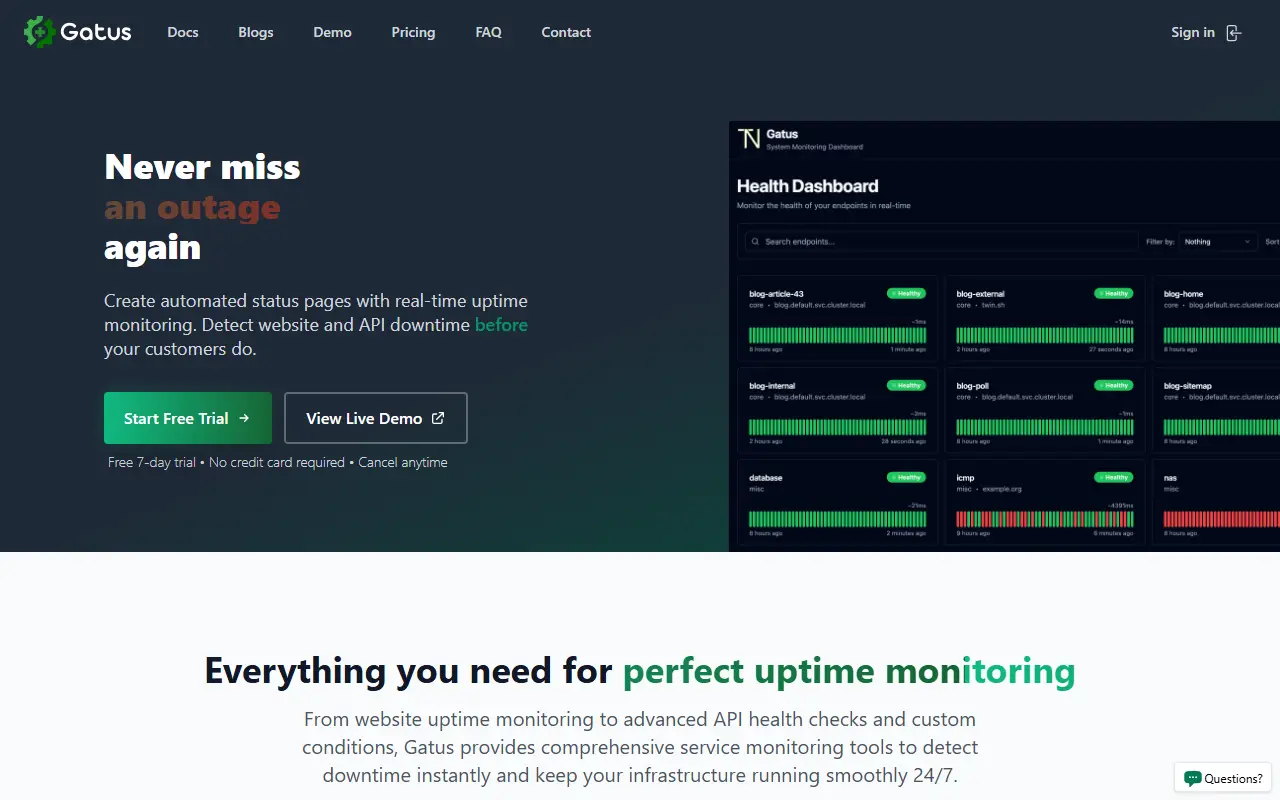
Gatus

A developer-oriented health dashboard and status page that checks services over HTTP, ICMP, TCP and DNS and sends alerts to many chat and paging tools.

GitHub stars
12k
Last commit
2 days ago
Latest release
v5.37.0
Licence
Apache-2.0
Self-hosted
Yes
Hosted version
Available
gatus.ioGatus homepage screenshot

Gatus is a developer-oriented health dashboard and status page for monitoring services. Each endpoint is checked using HTTP, ICMP, TCP or DNS queries, and the result is evaluated against a list of conditions covering values such as the status code, response time, certificate expiration and response body.

Checks can be paired with alerting through Slack, Microsoft Teams, PagerDuty, Discord, Twilio and many more providers, and the documentation lists dozens of alert integrations, from email and Matrix to Opsgenie and ntfy. Configuration is done in a file, with support for external endpoints, announcements, suites in alpha, storage options, tunneling and a web UI. Incident support is part of the pitch.

Gatus is written in Go and licensed under Apache-2.0, and it is easy to deploy with Docker or in Kubernetes. The author runs it in his own cluster to watch core applications. Anyone who prefers not to run it can use the managed offering at gatus.io.

Key features

  • HTTP, ICMP, TCP and DNS health checks
  • Conditions on status, latency and certificates
  • Alerts to Slack, Teams, PagerDuty and more
  • Public status page and dashboard
  • Simple file-based configuration
  • Docker and Kubernetes deployment

Pricing: Free and open source under Apache-2.0; a managed option is available at gatus.io.

Read more about GatusWebsite GitHub

OpenStatus

An open-source status page and uptime monitoring platform where monitors and pages are declared as code in YAML or Terraform, available managed or self-hosted.

GitHub stars
9.2k
Last commit
today
Licence
AGPL-3.0
Self-hosted
Yes
Hosted version
Available
openstatus.devOpenStatus homepage screenshot

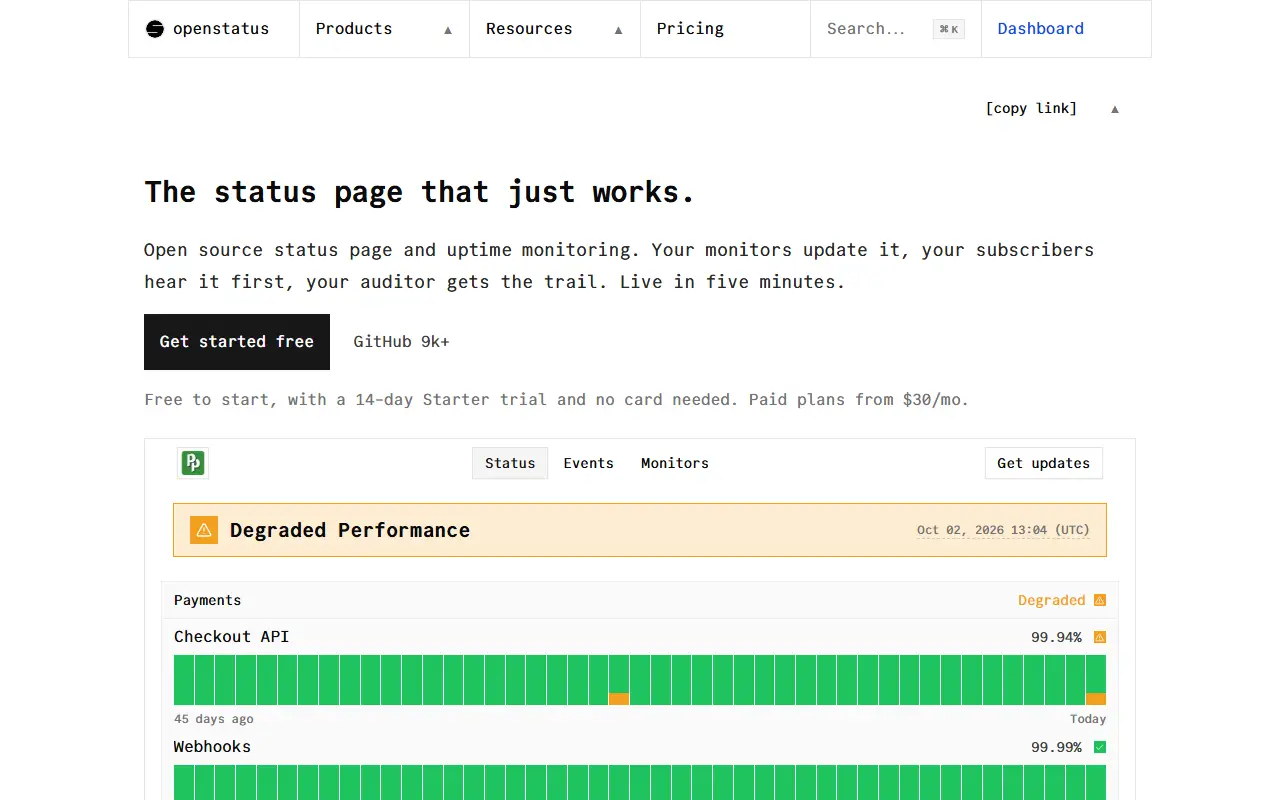
Openstatus is an uptime monitoring and status page platform, open source and built around infrastructure as code. Monitors, status pages and alert channels are written in YAML or Terraform and applied through the CLI or CI, and they can also be operated by AI assistants such as Claude, ChatGPT or Cursor through an MCP server.

The platform combines status pages and monitoring in one tool. Status pages can use custom domains and password protection, schedule maintenance windows, and notify subscribers by email, RSS or webhooks. Monitoring checks servers, websites and APIs from 28 regions across three cloud providers in parallel, with alerts through Slack, Discord, PagerDuty, email and more. Incident management lets teams open and manage incidents from the dashboard or Slack, with severity, a commander and a full timeline.

Openstatus is available as a managed service or can be self-hosted under the AGPL-3.0 licence, and private locations run in a very small Docker image. The README highlights flat pricing with unlimited members, with a JSON CLI, typed API and audit log for every change. It suits engineering teams that want monitoring configured in version control.

Key features

  • Monitors and status pages as code
  • YAML and Terraform configuration
  • Uptime checks from 28 global regions
  • Custom domains and maintenance windows
  • Incident management with timelines
  • MCP server and JSON CLI
  • Subscriber notifications by email and RSS

Pricing: Free Hobby plan with one monitor. Starter is $30, Pro $100 and Scale $500 per month, with 2 months free on annual billing and a 14-day Starter trial. Enterprise is custom.

Read more about OpenStatusWebsite GitHub

OneUptime

An open-source platform that combines uptime monitoring, status pages, on-call, incident management, logs, traces, metrics and error tracking in one self-hostable app.

GitHub stars
7.7k
Last commit
today
Latest release
14.0.11
Self-hosted
Yes
Hosted version
Available
oneuptime.comOneUptime homepage screenshot

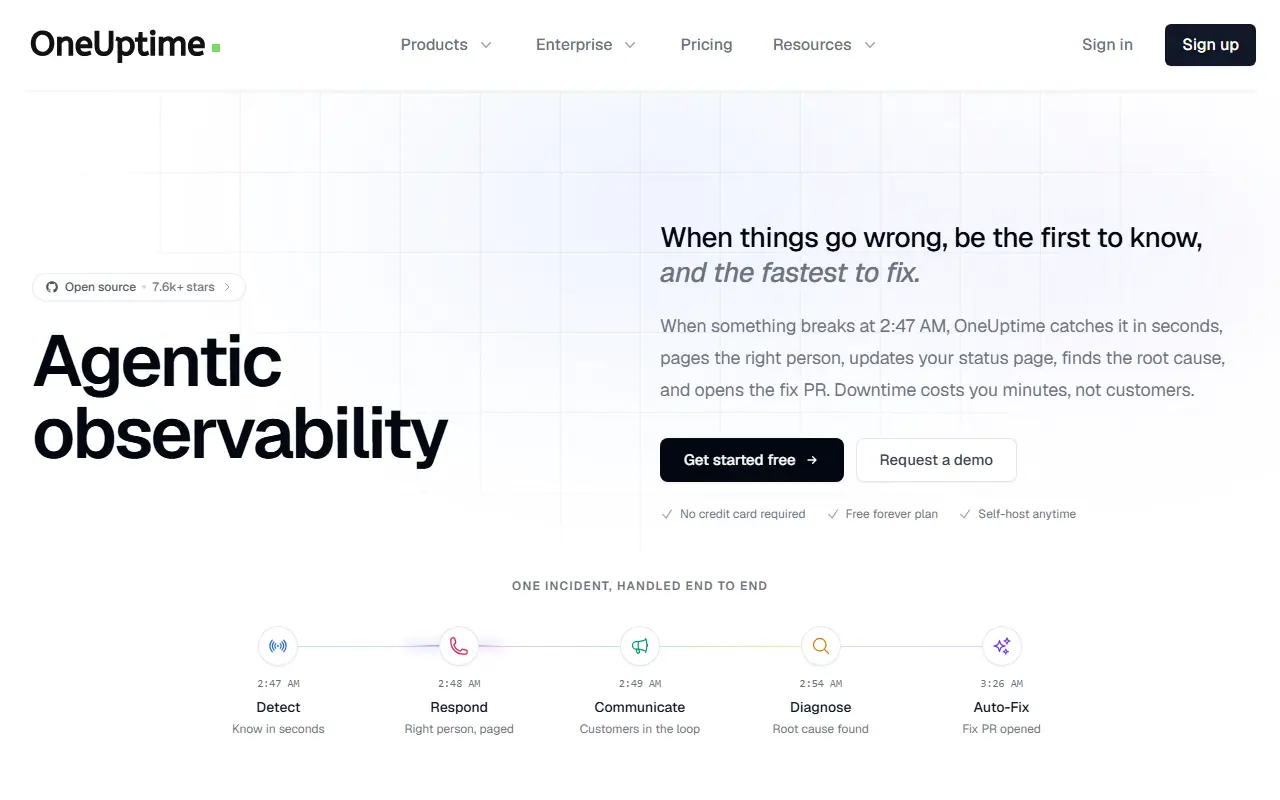
OneUptime is an open-source monitoring and observability platform that aims to replace a shelf of separate SaaS tools. It covers uptime monitoring, status pages, on-call and alerting, incident management, logs, traces, metrics, APM and error tracking in one application, and adds AI-assisted features such as helping find the root cause and proposing a fix.

Its README maps each module to the tools it can replace: Pingdom and UptimeRobot for uptime checks across websites, APIs, ports, SSL and DNS, StatusPage.io for branded public and private status pages, PagerDuty and Opsgenie for schedules, escalation policies and SMS, call, push or Slack alerts, Incident.io for declaring and triaging incidents with post-mortems, Datadog and New Relic for traces and dashboards, Loggly for logs, and Sentry for exceptions.

The Community Edition is open source under Apache 2.0 and free to self-host, and OneUptime Cloud offers a free-forever plan with no credit card. It is written in TypeScript. It suits small and mid-sized engineering teams that want one platform for reliability work rather than integrating many vendors.

Key features

  • Uptime monitoring for sites, APIs and ports
  • Branded public and private status pages
  • On-call schedules and escalation policies
  • Incident management with post-mortems
  • Logs, traces, metrics and APM
  • Error tracking with stack traces

Pricing: Free plan with one status page. Growth is $22 and Scale $99 per month with 14-day trials; Enterprise is custom. Monitors, SMS, telemetry and AI use are billed on top.

Read more about OneUptimeWebsite GitHub

Kener

A lightweight, customizable status page system built with SvelteKit and Node.js, quick to run with Docker and easy to style to match your brand.

GitHub stars
5.2k
Last commit
today
Latest release
v4.1.6
Licence
MIT
Self-hosted
Yes
kener.ingKener homepage screenshot

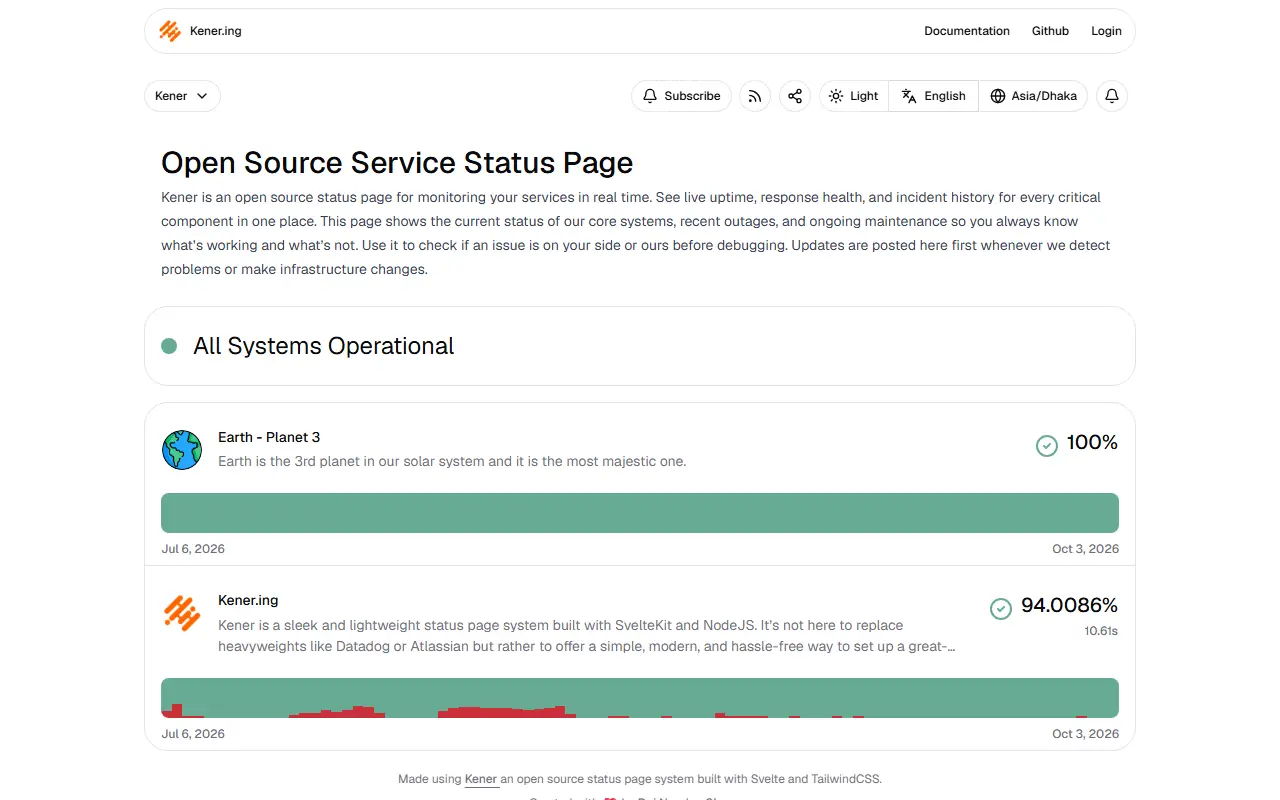
Kener is a status page system built with SvelteKit and Node.js. It aims to give teams a simple, modern way to publish a good-looking status page with minimal effort, covering the essentials without extra complexity.

The project stresses minimal overhead, a clean interface and easy branding customization. Docker is the recommended way to run it, with published images on Docker Hub and the GitHub container registry, variants for deployment under a subpath such as /status, and a compose file for building from local source. The README warns to set a strong secret key and the public origin URL before the first start.

Kener is MIT-licensed and free. Its README is candid that it is not meant to replace large platforms like Datadog or Atlassian, but to offer a lighter option for communicating service status. The name comes from an Assamese word meaning how is it going.

Key features

  • Status pages built with SvelteKit
  • Brand customization
  • Docker images and compose files
  • Subpath deployment support
  • Lightweight Node.js runtime

Pricing: Free and open source under the MIT licence.

Read more about KenerWebsite GitHub

Vigil

Self-hosted Rust status page that monitors servers and services and sends alerts through Slack, email, SMS and many other channels.

GitHub stars
1.9k
Last commit
5 mo ago
Latest release
v1.29.0
Licence
MPL-2.0
Self-hosted
Yes
crates.ioVigil homepage screenshot

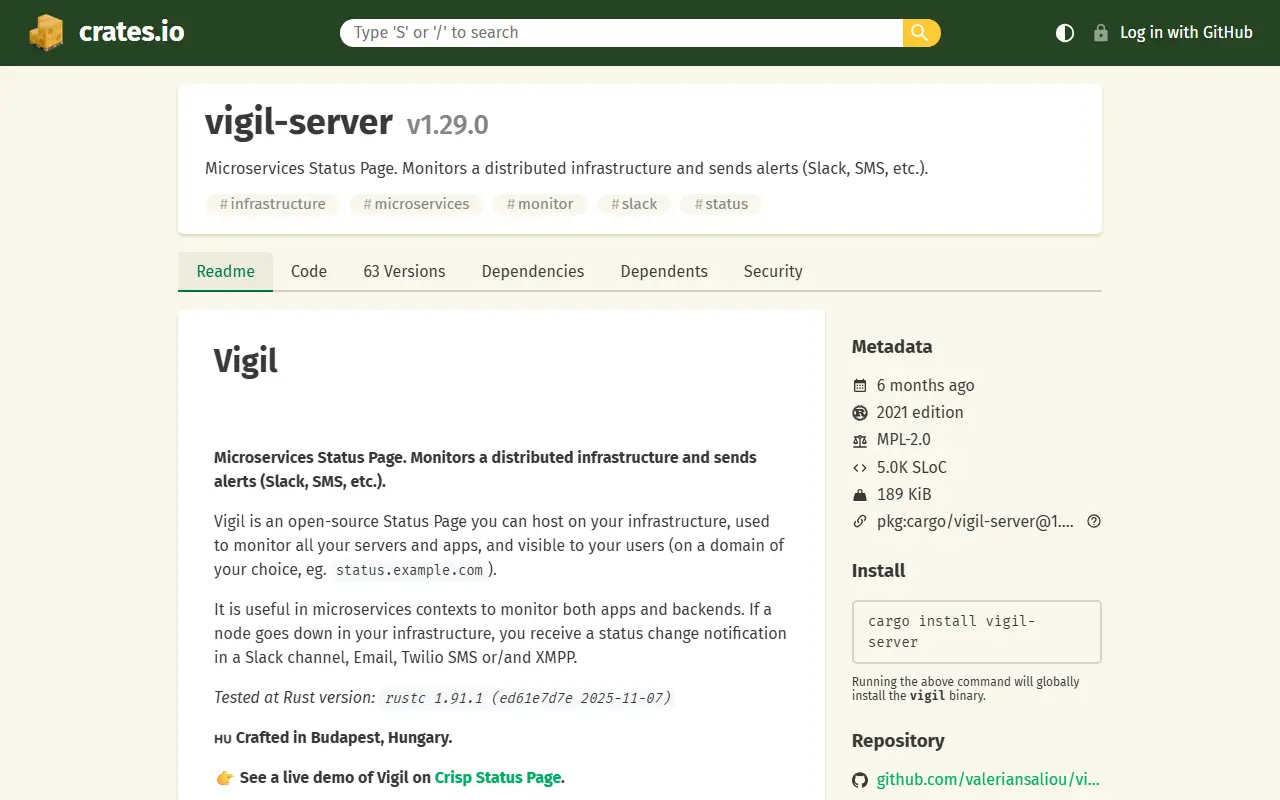
Vigil is an open-source status page and monitoring system you run on your own infrastructure. It watches your servers and apps, shows their health to users on a domain you choose, such as status.example.com, and notifies your team when a service goes down or recovers. It is particularly aimed at microservices setups where both backends and apps need monitoring.

Vigil can probe HTTP, TCP, SSH and ICMP targets for reachability, and applications can also report their own health through the Vigil Reporter library. Notification channels include email, Twilio SMS, Slack, Zulip, Telegram, Pushover, Gotify, XMPP, Matrix, Cisco Webex and generic webhooks. The generated status page can also carry announcements, for example to warn users about planned maintenance.

The software is written in Rust, licensed under MPL-2.0, and published as a crate on crates.io. Because you host it yourself, you control where checks run and how the public page looks, and you can place it on a separate domain from your main product. The README links a live demo on a public status page.

Key features

  • Automatic probing of HTTP, TCP, SSH and ICMP targets
  • Application health reporting through a reporter library
  • Public status page on your own domain
  • Alerts via Slack, email, SMS and webhooks
  • Announcements for planned maintenance
  • Support for Matrix, Telegram, Zulip and XMPP

Pricing: Free and open source under MPL-2.0.

Read more about VigilWebsite GitHub

Lunalytics

Self-hosted uptime monitor built with Node.js and React, with status pages, incident management, role-based access and many notification options.

GitHub stars
738
Last commit
2 mo ago
Latest release
0.10.23
Self-hosted
Yes
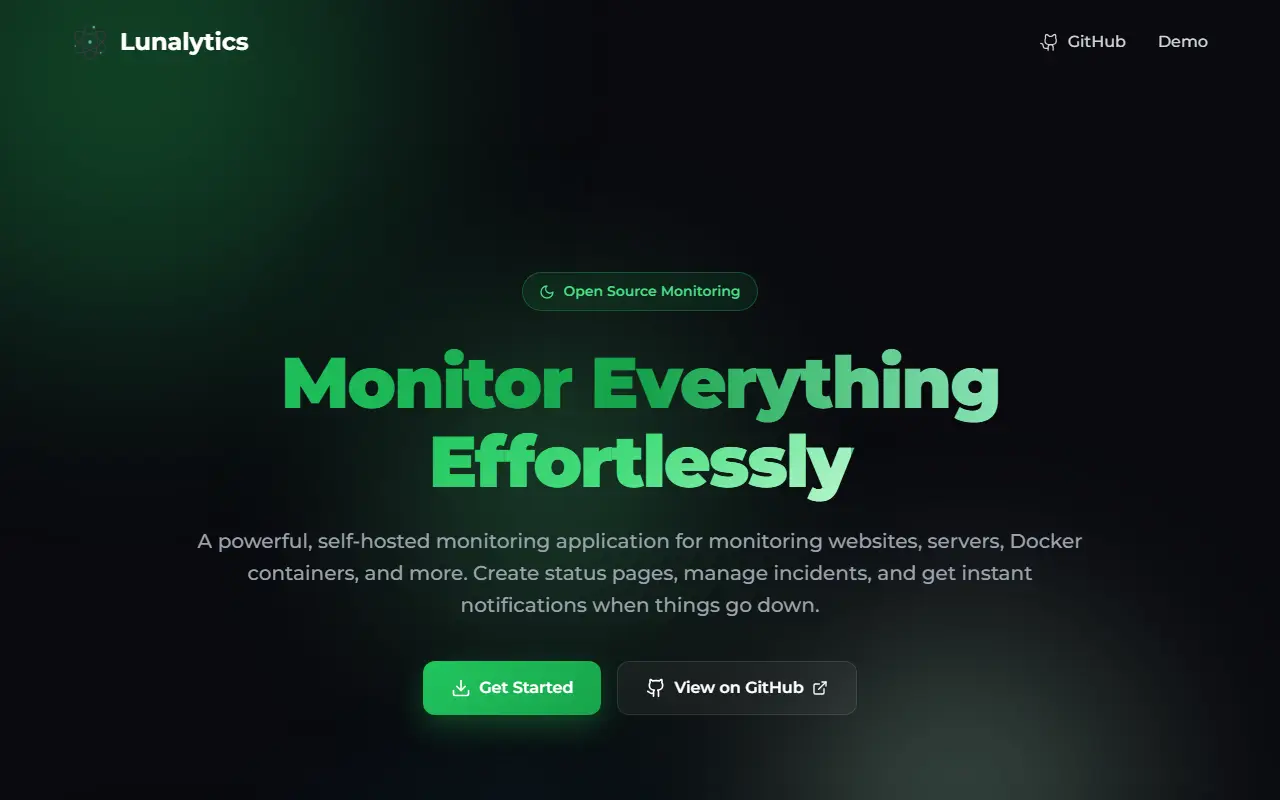
lunalytics.xyzLunalytics homepage screenshot

Lunalytics is an open-source monitoring tool for tracking whether your services are up. It is built with Node.js and React and aimed at individuals and small teams that want a simple, self-hosted alternative to commercial uptime services. The README notes that it is in beta and under active development, so occasional breakage should be expected.

It can monitor HTTP(S), TCP, ping, JSON query, push-based and Docker container checks. Teams can create fully customizable status and dashboard pages, manage incidents, support multiple users with role-based access control, and customize profiles and themes. Single sign-on works with providers such as Authentik, Authelia and Keycloak, as well as Discord, Google, GitHub, Slack and Twitch. Notifications can go through Apprise, Discord, SMTP email, Home Assistant, Pushover, Slack, Telegram or webhooks.

Installation is via Docker or Docker Compose, or from source with Node.js 22.14 or later. The roadmap shows PostgreSQL and SQLite support completed and MongoDB still planned. A live demo, documentation and Discord community are linked. The repository metadata lists the license as Other, so check the license file for exact terms.

Key features

  • Uptime checks for HTTP, TCP, ping and Docker containers
  • JSON query and push monitors
  • Customizable public status pages
  • Incident management
  • Role-based access control for multiple users
  • SSO with Authentik, Keycloak and social providers
  • Alerts to Slack, Telegram, email and webhooks
Read more about LunalyticsWebsite GitHub

Statping

Statping is a self-hosted, GPL-licensed status page and monitoring server written in Go, with graphs, notifications and support for MySQL, Postgres or SQLite.

GitHub stars
7.3k
Last commit
2 yr ago
Latest release
v0.90.74
Licence
GPL-3.0
Self-hosted
Yes

Statping is a status page and monitoring server for websites and applications. It is aimed at teams and individuals who want a self-hosted alternative to hosted status-page services, automatically checking configured services and rendering a status page with graphs and history.

It is built in Go and ships as a single precompiled binary with no extra runtime dependencies, so it runs on Linux, macOS, Windows, or even a Raspberry Pi, and its Docker image is only about 16MB. The project recommends running the Statping instance on separate infrastructure from the services it monitors, so that a server crash does not also take down the status page. A free mobile app for iOS and Android lets users view services and receive offline notifications.

Statping supports MySQL, Postgres or SQLite as its database, and it exposes an API, a Docker image and installers for EC2, Mac, Linux and Windows. It is released under the GPL-3.0 license, with a live demo available for evaluation.

Key features

  • Automatic monitoring of websites and applications
  • Beautiful status page with history graphs
  • Notifications when a service goes down
  • MySQL, Postgres or SQLite database support
  • Lightweight single-binary deployment
  • Free iOS and Android companion app

Pricing: Free and open source under the GPL-3.0 license.

Read more about StatpingWebsite GitHub

2 more Atlassian Statuspage alternatives

Atlassian Statuspage alternatives: questions

What is the best open-source alternative to Atlassian Statuspage?
Uptime Kuma is the top-ranked open-source alternative to Atlassian Statuspage on Enlisted: A self-hosted monitoring tool that checks websites, ports, DNS and containers, sends alerts through many notification services and publishes status pages. Other strong options are Upptime, Cachet, Gatus and OpenStatus.
Are these Atlassian Statuspage alternatives free?
All 12 are open source, so the code is free to use under its licence, and all of them can be self-hosted on your own server or computer. 3 also offer a paid or managed cloud version if you'd rather not host it yourself.
How is this list of Atlassian Statuspage alternatives ranked?
By a score built from GitHub stars, star growth over the last 30 days and how recently the code changed. 7 of these projects shipped code in the last 30 days. Data is refreshed daily, and nobody can pay to move up.

People also look for alternatives to…

View all