 TrackMedia
 TrackRev

About Cachet
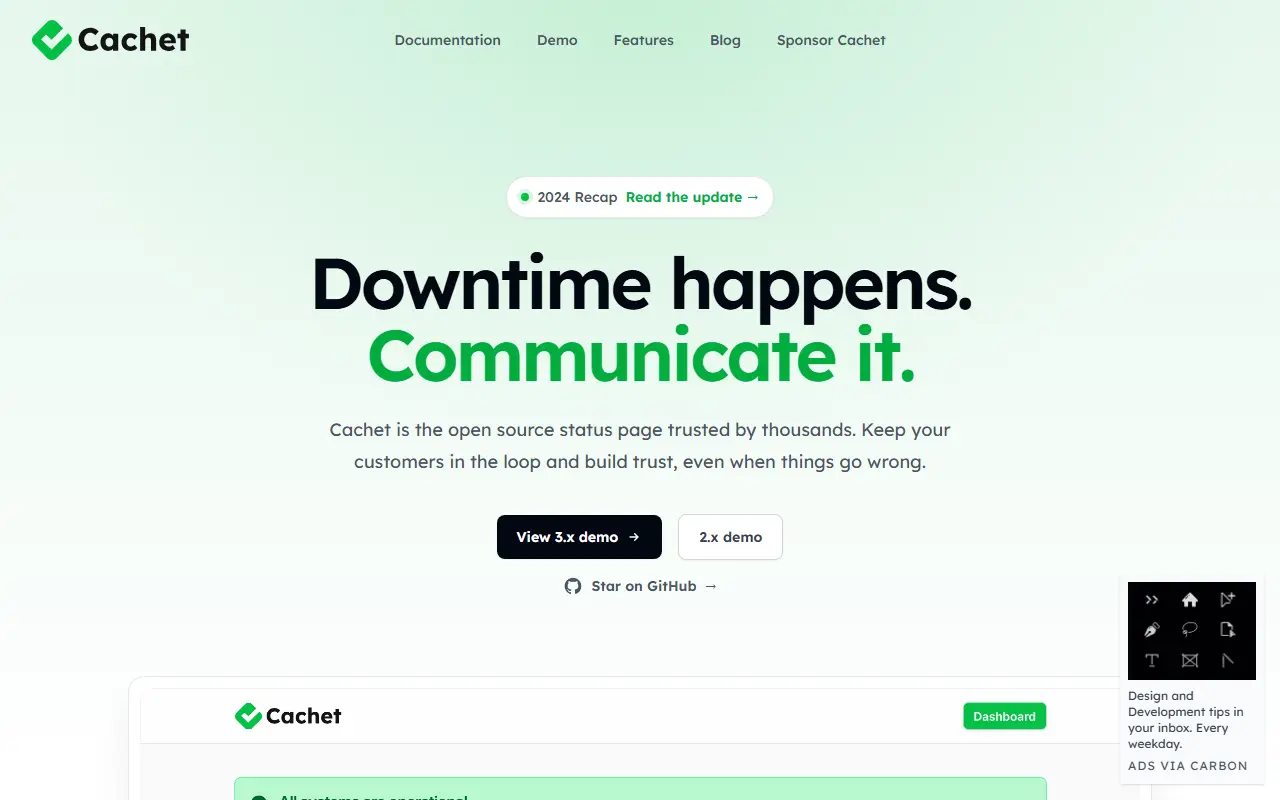
Cachet is an open-source status page system you host yourself. It gives teams a public page to show whether services are up, announce incidents and publish updates, which reduces support load when something breaks. It is built with PHP and the Laravel framework.
The project is in the middle of a rebuild: the README includes an announcement about Cachet 3.x and links to the plans, and a demo of the v3 dashboard is available that resets itself every 30 minutes. Requirements are PHP 8.3 or later, Composer and one of MariaDB, MySQL, PostgreSQL or SQLite. Documentation covers installing and upgrading, and vulnerabilities should be reported by email to the project.
Cachet's license is listed as 'Other' on GitHub, so check the repository terms. It is run on your own server and suits startups and larger organizations that want to control the hosting of their status communications instead of paying for a hosted status page service.
Key features
- Public status page for services
- Incident and update publishing
- Built as a Laravel application
- Works with MariaDB, MySQL, PostgreSQL or SQLite
- Cachet 3.x rebuild with demo
- Documentation for installs and upgrades
Good fit for
- Communicating outages to customers
- Self-hosted alternative to hosted status pages
- Internal service status boards
Cachet: questions and answers
- What is Cachet used for?
- Cachet is a self-hosted status page system built with Laravel that lets you publish service status, incidents and updates to your users. It is a good fit for communicating outages to customers and internal service status boards.
- Is Cachet open source?
- Yes. Cachet is open source under a custom licence. Its source code is on GitHub at cachethq/cachet and is written mainly in PHP.
- Is Cachet free?
- Yes. Cachet is open source, so the software itself is free to use under the terms of its own licence.
- Can I self-host Cachet?
- Yes. Cachet can be self-hosted on your own server or infrastructure; there is no official hosted version.
- What is Cachet an alternative to?
- Cachet is an open-source alternative to Instatus, Statuspal, Atlassian Statuspage and Hosted Status Page. Other open-source alternatives to Instatus include Gatus, Statping and Upptime.
- Is Cachet actively maintained?
- Yes. The most recent commit to Cachet was on 11 November 2026, and the latest release is v2.4.1, published on 7 November 2023. The project has 15k stars on GitHub, with 11 added in the last 30 days.
Open-source alternatives to Cachet
See all
Gatus
Monitoring & Observability
Create beautiful, automated status pages with advanced monitoring. Track HTTP, DNS, TCP en
Apache-2.0vs UptimeRobot★ 13k
Statping
Monitoring & Observability
Status Page for monitoring your websites and applications with beautiful graphs, analytics
GPL-3.0vs Statuspal★ 7.3k
Upptime
Monitoring & Observability
⬆️ GitHub Actions uptime monitor & status page by @AnandChowdhary
MITvs UptimeRobot★ 17k
Kener
Monitoring & Observability
Stunning status pages, batteries included!
MITvs Atlassian Statuspage★ 5.2k
Uptime Kuma
Monitoring & Observability
A self-hosted monitoring tool
MITvs UptimeRobot★ 94k
OpenStatus
Monitoring & Observability
🫖 Status page with uptime monitoring & API monitoring as code 🫖
AGPL-3.0vs Pingdom★ 9.3k
SaaS alternatives to Cachet
See all
Instatus
Monitoring & Observability
Hosted status pages with incident updates and subscriber notifications
SaaS
Statuspal
Monitoring & Observability
Status page and incident communication service with built-in monitoring
SaaS
Atlassian Statuspage
Monitoring & Observability
Hosted status page and incident communication tool from Atlassian
SaaS
Hosted Status Page
Monitoring & Observability
Branded multi-region status pages with uptime monitoring, incident management and maintenance windows
SaaS
Better Stack
Monitoring & Observability
Uptime monitoring, on-call alerts, status pages and log management in one product
SaaS
Hyperping
Monitoring & Observability
Uptime monitoring with status pages and on-call alerting
SaaS