#1
A self-hosted monitoring tool that checks websites, ports, DNS and containers, sends alerts through many notification services and publishes status pages.
- GitHub stars
- 94k
- Last commit
- yesterday
- Latest release
- 2.5.11
- Licence
- MIT
- Self-hosted
- Yes
uptime.kuma.pet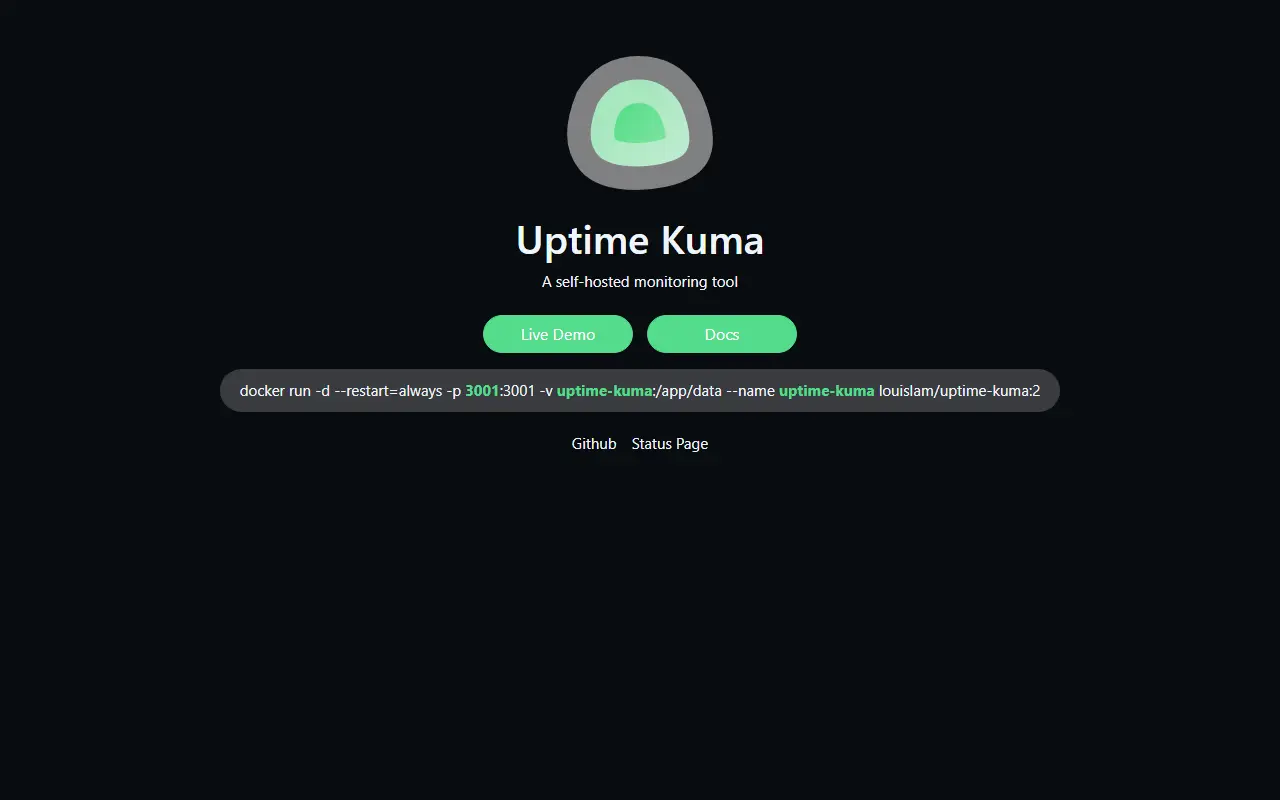
Uptime Kuma is a self-hosted tool that watches whether your services are up and tells you when they are not. You run it on your own server, point it at the endpoints you care about, and it records response times, certificate details and outages in a responsive web dashboard.
Supported monitor types include HTTP(S), TCP, keyword and JSON query checks, WebSocket, ping, DNS records, push-based heartbeats, Steam game servers and Docker containers, with checks as frequent as every 20 seconds. Alerts can go to Telegram, Discord, Gotify, Slack, Pushover, email over SMTP and more than 90 other notification services. You can publish several status pages and map them to your own domains.
It is MIT licensed and mainly distributed as a Docker image, with a Docker Compose setup and a non-Docker route that uses Node.js and pm2. Extras include proxy support, two-factor authentication, multiple UI languages and ping charts. Network file systems such as NFS are not supported for its data directory.
Key features
- Monitors HTTP, TCP, DNS, ping and Docker containers
- Checks as often as every 20 seconds
- Alerts through 90+ notification services
- Multiple status pages on custom domains
- Certificate details and ping charts
- Two-factor authentication and proxy support
Pricing: Free and open source under the MIT license; you host it yourself.
#2
A developer-oriented health dashboard and status page that checks services over HTTP, ICMP, TCP and DNS and sends alerts to many chat and paging tools.
- GitHub stars
- 13k
- Last commit
- yesterday
- Latest release
- v5.38.0
- Licence
- Apache-2.0
- Self-hosted
- Yes
- Hosted version
- Available
gatus.io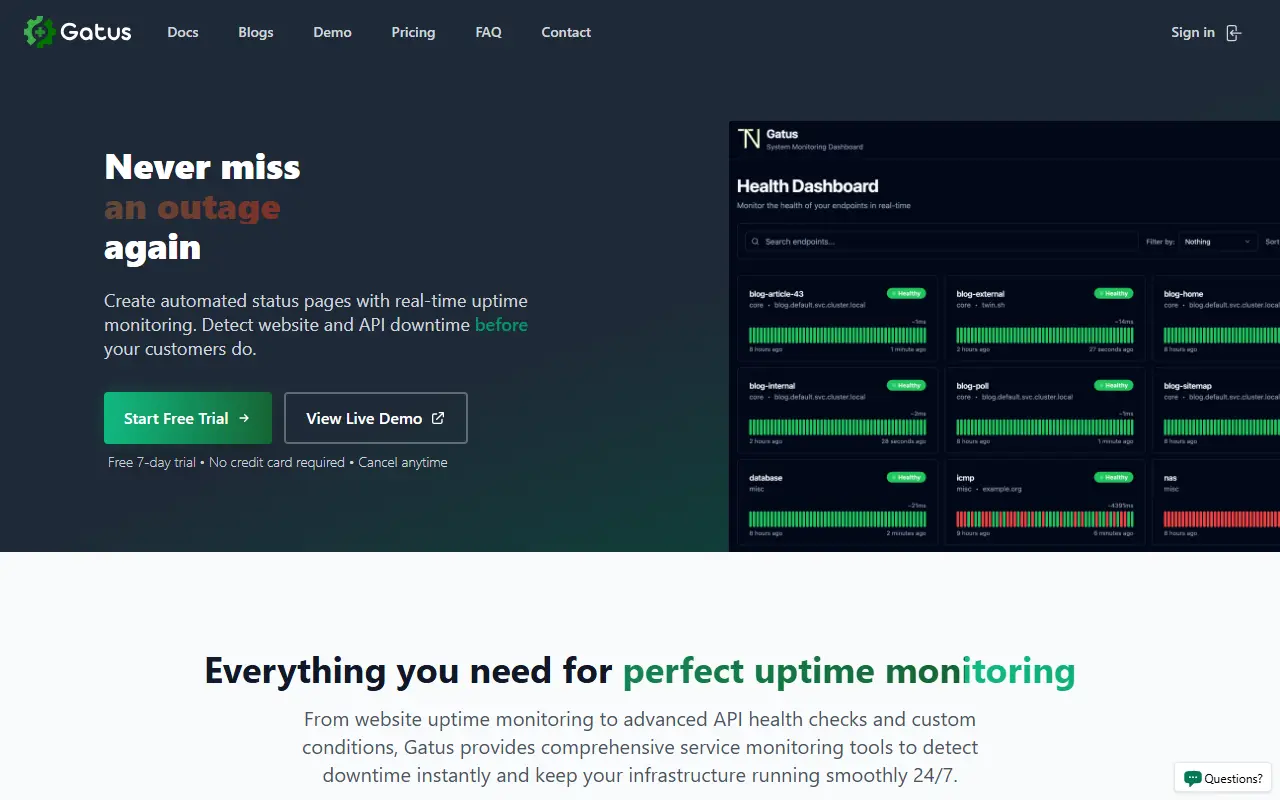
Gatus is a developer-oriented health dashboard and status page for monitoring services. Each endpoint is checked using HTTP, ICMP, TCP or DNS queries, and the result is evaluated against a list of conditions covering values such as the status code, response time, certificate expiration and response body.
Checks can be paired with alerting through Slack, Microsoft Teams, PagerDuty, Discord, Twilio and many more providers, and the documentation lists dozens of alert integrations, from email and Matrix to Opsgenie and ntfy. Configuration is done in a file, with support for external endpoints, announcements, suites in alpha, storage options, tunneling and a web UI. Incident support is part of the pitch.
Gatus is written in Go and licensed under Apache-2.0, and it is easy to deploy with Docker or in Kubernetes. The author runs it in his own cluster to watch core applications. Anyone who prefers not to run it can use the managed offering at gatus.io.
Key features
- HTTP, ICMP, TCP and DNS health checks
- Conditions on status, latency and certificates
- Alerts to Slack, Teams, PagerDuty and more
- Public status page and dashboard
- Simple file-based configuration
- Docker and Kubernetes deployment
Pricing: Free and open source under Apache-2.0; a managed option is available at gatus.io.
#3
A self-hosted status page system built with Laravel that lets you publish service status, incidents and updates to your users.
- GitHub stars
- 15k
- Last commit
- 2 days ago
- Latest release
- v2.4.1
- Self-hosted
- Yes
cachethq.io
Cachet is an open-source status page system you host yourself. It gives teams a public page to show whether services are up, announce incidents and publish updates, which reduces support load when something breaks. It is built with PHP and the Laravel framework.
The project is in the middle of a rebuild: the README includes an announcement about Cachet 3.x and links to the plans, and a demo of the v3 dashboard is available that resets itself every 30 minutes. Requirements are PHP 8.3 or later, Composer and one of MariaDB, MySQL, PostgreSQL or SQLite. Documentation covers installing and upgrading, and vulnerabilities should be reported by email to the project.
Cachet's license is listed as 'Other' on GitHub, so check the repository terms. It is run on your own server and suits startups and larger organizations that want to control the hosting of their status communications instead of paying for a hosted status page service.
Key features
- Public status page for services
- Incident and update publishing
- Built as a Laravel application
- Works with MariaDB, MySQL, PostgreSQL or SQLite
- Cachet 3.x rebuild with demo
- Documentation for installs and upgrades

A lightweight, customizable status page system built with SvelteKit and Node.js, quick to run with Docker and easy to style to match your brand.
- GitHub stars
- 5.2k
- Last commit
- 4 days ago
- Latest release
- v4.2.1
- Licence
- MIT
- Self-hosted
- Yes
kener.ing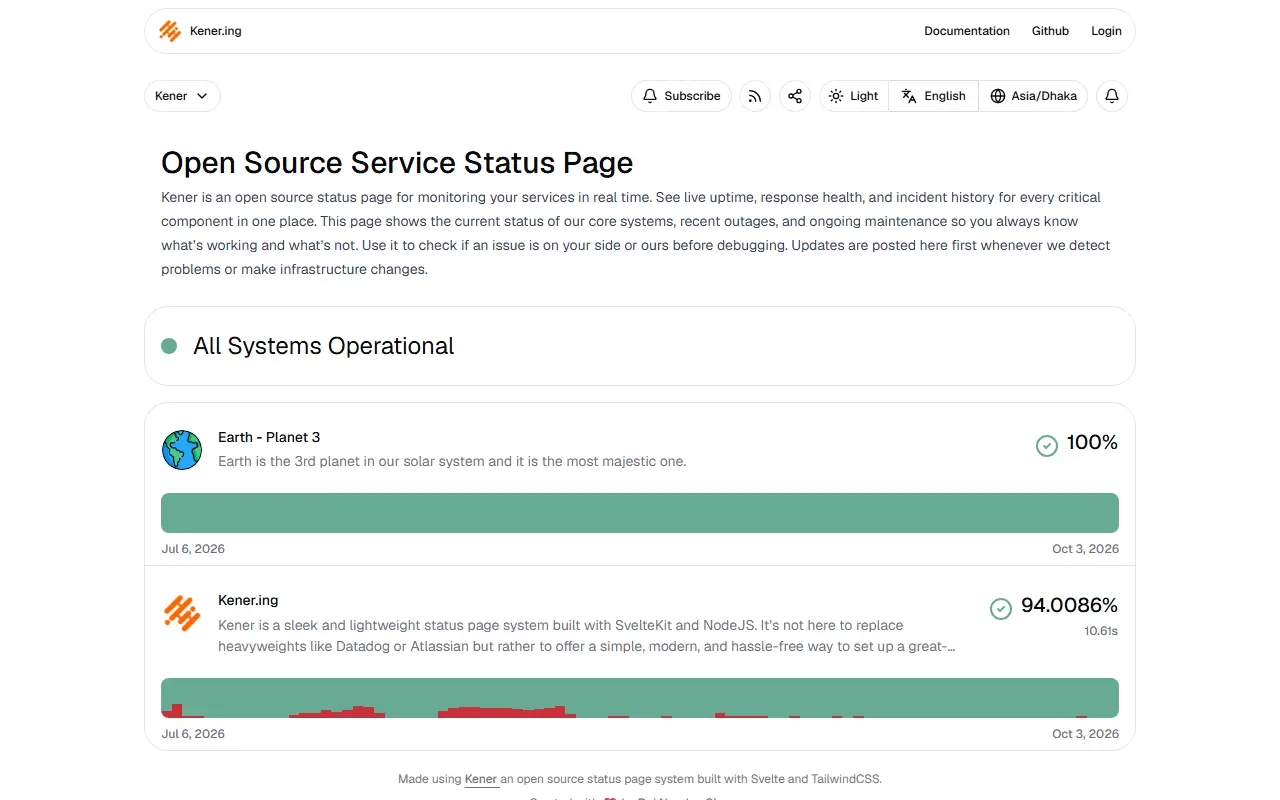
Kener is a status page system built with SvelteKit and Node.js. It aims to give teams a simple, modern way to publish a good-looking status page with minimal effort, covering the essentials without extra complexity.
The project stresses minimal overhead, a clean interface and easy branding customization. Docker is the recommended way to run it, with published images on Docker Hub and the GitHub container registry, variants for deployment under a subpath such as /status, and a compose file for building from local source. The README warns to set a strong secret key and the public origin URL before the first start.
Kener is MIT-licensed and free. Its README is candid that it is not meant to replace large platforms like Datadog or Atlassian, but to offer a lighter option for communicating service status. The name comes from an Assamese word meaning how is it going.
Key features
- Status pages built with SvelteKit
- Brand customization
- Docker images and compose files
- Subpath deployment support
- Lightweight Node.js runtime
Pricing: Free and open source under the MIT licence.
#5
Statping is a status page and uptime monitoring server written in Go that checks websites and apps, shows graphs and sends alerts.
- GitHub stars
- 7.3k
- Last commit
- 2 yr ago
- Latest release
- v0.90.74
- Licence
- GPL-3.0
- Self-hosted
- Yes
Statping is a status page generator and monitoring server for websites and applications. It fetches the status of your services and renders a status page with graphs and analytics. It can store data in MySQL, Postgres or SQLite and runs on several operating systems.
It is written in Go, so a precompiled binary for your operating system is all that is needed, and it can run on a Raspberry Pi. The Docker image is about 16 MB, and the binary for other systems at most about 17 MB. The authors advise running it away from the systems being monitored so the page stays up when those servers fail.
Notifications go out by SMTP email and through a Slack incoming webhook, and Go plugins allow user-created notifiers. The status page can be restyled with SASS variables, and Statping can create an SSL certificate for it. A mobile app on the App Store and Google Play views services and receives offline alerts. The project is GPL-3.0 licensed.
Key features
- Status page with graphs and analytics
- Choice of MySQL, Postgres or SQLite storage
- Email via SMTP and Slack webhook notifications
- Status page styling with SASS variables
- Mobile app for services and offline alerts
- Automatic SSL certificate for the status page
Statuspage is an open-source Python generator that creates and updates a status page hosted for free on GitHub, using issues for incidents.
- GitHub stars
- 3.9k
- Last commit
- 3 yr ago
- Latest release
- 0.8.1
- Licence
- MIT
Statuspage is a command-line generator that builds a status page and hosts it on GitHub. Incidents are GitHub issues, and labels mark which systems are affected and how severe the problem is.
After installing with pip, you create a GitHub personal access token with the public_repo and write:repo_hook scopes and run the create command. You name the repository and list the systems to show, for example Website, CDN and API. The tool creates a new repo and prints links to its issue tracker and the status page.
To report an incident, open a new issue and pick the affected system labels and a severity label such as major outage, degraded performance or investigating. Then run the update command to refresh the page. Systems can be added or removed later and existing pages upgraded with an upgrade command. Binaries for macOS and Linux are also available. MIT licence.
Key features
- Hosts the status page for free on GitHub
- Issues show incidents, labels show severity
- Installs with pip or prebuilt binaries
- Choose severity labels for each incident
- Add or remove monitored systems later
- Upgrade existing pages with a command
Status page and uptime monitor that runs on Cloudflare Workers with CRON Triggers and KV storage, and sends Slack, Discord or Telegram alerts.
- GitHub stars
- 2.8k
- Last commit
- 2 yr ago
- Latest release
- v1.2.0
- Licence
- MIT
- Self-hosted
- Yes
- Hosted version
- Available
This project watches a list of websites or APIs and publishes a status page showing the current state plus a daily history. It runs entirely on Cloudflare Workers, using CRON Triggers to schedule the checks and Workers KV to store results.
When a monitored site changes status it can notify you on Slack, Discord or Telegram. Slack and Discord use incoming webhook URLs stored as secrets, and Telegram needs a chat id in a secret variable. The sites to watch, the page title, logo and the number of days shown in the histogram are set in config.yaml.
Deployment works two ways: the Cloudflare Deploy Button, which clones the repository and deploys with GitHub Actions, or a manual setup with the Wrangler CLI where you create the KV namespace and secrets yourself. The prerequisites list a Workers account and a workers domain; the README says it also works on Workers Free.
Key features
- Monitors websites and shows daily history
- Slack, Telegram and Discord notifications on status change
- Built on Workers, CRON Triggers and KV storage
- One-click deploy with the Cloudflare Deploy Button and GitHub Actions
- Manual deploy with the Wrangler CLI
- Configurable histogram length in config.yaml
- Runs on the Workers Free plan with a 2-minute cron interval
Statuspal alternatives: questions
- What is the best open-source alternative to Statuspal?
- Uptime Kuma is the top-ranked open-source alternative to Statuspal on Enlisted: A self-hosted monitoring tool that checks websites, ports, DNS and containers, sends alerts through many notification services and publishes status pages. Other strong options are Gatus, Cachet, Kener and Statping.
- What are the best commercial alternatives to Statuspal?
- Instatus, Atlassian Statuspage, Hosted Status Page, FoundersDeck and Hyperping are among the hosted, closed-source alternatives to Statuspal listed on Enlisted, which lists 11 in total. Compare their pricing and features on each tool page.
- Are these Statuspal alternatives free?
- All 7 are open source, so the code is free to use under its licence, and all of them can be self-hosted on your own server or computer. 2 also offer a paid or managed cloud version if you'd rather not host it yourself.
- How is this list of Statuspal alternatives ranked?
- By a score built from GitHub stars, star growth over the last 30 days and how recently the code changed. 4 of these projects shipped code in the last 30 days. Data is refreshed daily, and nobody can pay to move up.
 TrackMedia
 TrackRev