
About StatusGator
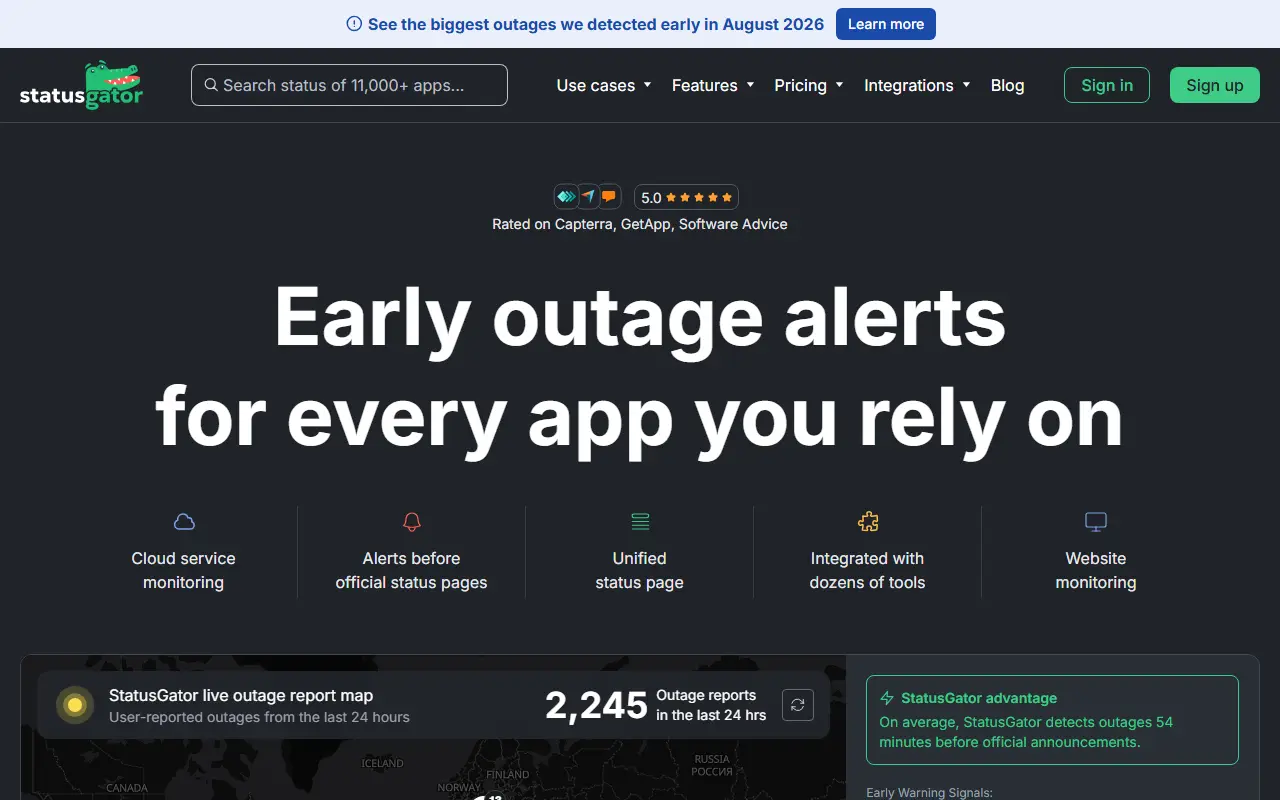
StatusGator is a commercial service that watches the status pages of the cloud services and vendors a team depends on and brings their outage information into one dashboard. Instead of checking many separate pages, teams get alerts when a provider reports a problem, which cuts down on support tickets and guesswork.
Beyond aggregation, the platform includes a status page builder with service, website and custom monitors, cloud monitoring, built-in website uptime and ping monitoring, manual incident control, and Early Warning Signals that warn about disruptions before they become public. It integrates with Slack, Microsoft Teams, Discord, Google Chat and Webex, among others.
Use cases listed include IT teams, DevOps, education, enterprise, managed service providers, competitive intelligence, e-commerce and SaaS providers that want custom status pages for their own product. StatusGator is hosted, with Business, Enterprise and Education plans on its plans page.
Key features
- Aggregates third-party vendor status pages
- Status pages with custom monitors
- Early Warning Signals before public outages
- Website uptime and ping monitoring
- Manual incident control
- Chat and ticketing integrations
Good fit for
- →Knowing when a vendor outage affects you
- →Publishing a status page for your own product
- →Reducing help desk tickets during outages
- Tags
- status-page
- outage-monitoring
- uptime-monitoring
- cloud-monitoring
- incident-management
- alerting
StatusGator: questions and answers
- What is StatusGator used for?
- StatusGator aggregates the status pages of third-party cloud services and offers its own status pages and monitoring for teams. It is a good fit for knowing when a vendor outage affects you, publishing a status page for your own product and reducing help desk tickets during outages.
- Is StatusGator free?
- Yes. StatusGator has a free plan, and paid plans start at $79 per month. A free trial is also available.
- Is StatusGator open source?
- No. StatusGator is proprietary (closed-source) software and can't be self-hosted. In the Monitoring & Observability category, open-source options include Uptime Kuma, Checkmate and OpenStatus.
- What are some alternatives to StatusGator?
- StatusGator competes with Atlassian Statuspage, Instatus and Statuspal.
Open-source alternatives to StatusGator
See all
Uptime Kuma
Monitoring & Observability
A self-hosted monitoring tool
MITvs UptimeRobot★ 92k
Checkmate
Monitoring & Observability
Checkmate is an open-source, self-hosted tool designed to track and monitor server hardwar
AGPL-3.0vs UptimeRobot★ 11k
OpenStatus
Monitoring & Observability
🫖 Status page with uptime monitoring & API monitoring as code 🫖
AGPL-3.0vs Pingdom★ 9.2k
Keep
Monitoring & Observability
The open-source AIOps and alert management platform
OSSvs BigPanda★ 12k
OneUptime
Monitoring & Observability
Complete open-source monitoring and observability platform.
OSSvs Datadog★ 7.7k
Apache HertzBeat
Monitoring & Observability
AI-powered open source real-time monitoring system for metrics, logs, alerts, and observab
Apache-2.0vs Datadog★ 7.4k
SaaS alternatives to StatusGator
See all
Atlassian Statuspage
Monitoring & Observability
Hosted status page and incident communication tool from Atlassian
SaaS
Instatus
Monitoring & Observability
Hosted status pages with incident updates and subscriber notifications
SaaS
Statuspal
Monitoring & Observability
Status page and incident communication service with built-in monitoring
SaaS
Better Stack
Monitoring & Observability
Uptime monitoring, on-call alerts, status pages and log management in one product
SaaS
Hyperping
Monitoring & Observability
Uptime monitoring with status pages and on-call alerting
SaaS
UptimeRobot
Monitoring & Observability
Website, port and keyword uptime checks with alerting and status pages
SaaS