7,380 open-source and SaaS tools, with GitHub stats refreshed every day.

3 alternatives ranked by real activity

Open-source Catchpoint alternatives

A curated, ranked list of the 3 best open-source alternatives to Catchpoint.

The best open-source alternative to Catchpoint is OpenStatus. If that doesn't suit you, other good options are OneUptime and Sitespeed.io.

Catchpoint alternatives are mainly monitoring & observability tools. 3 of them shipped code in the last 30 days, 3 can be self-hosted, and 1 uses a permissive licence.

Last updated October 2, 2026 · ranked by GitHub stars, growth and recent commits

OpenStatus

An open-source status page and uptime monitoring platform where monitors and pages are declared as code in YAML or Terraform, available managed or self-hosted.

GitHub stars
9.2k
Last commit
today
Licence
AGPL-3.0
Self-hosted
Yes
Hosted version
Available
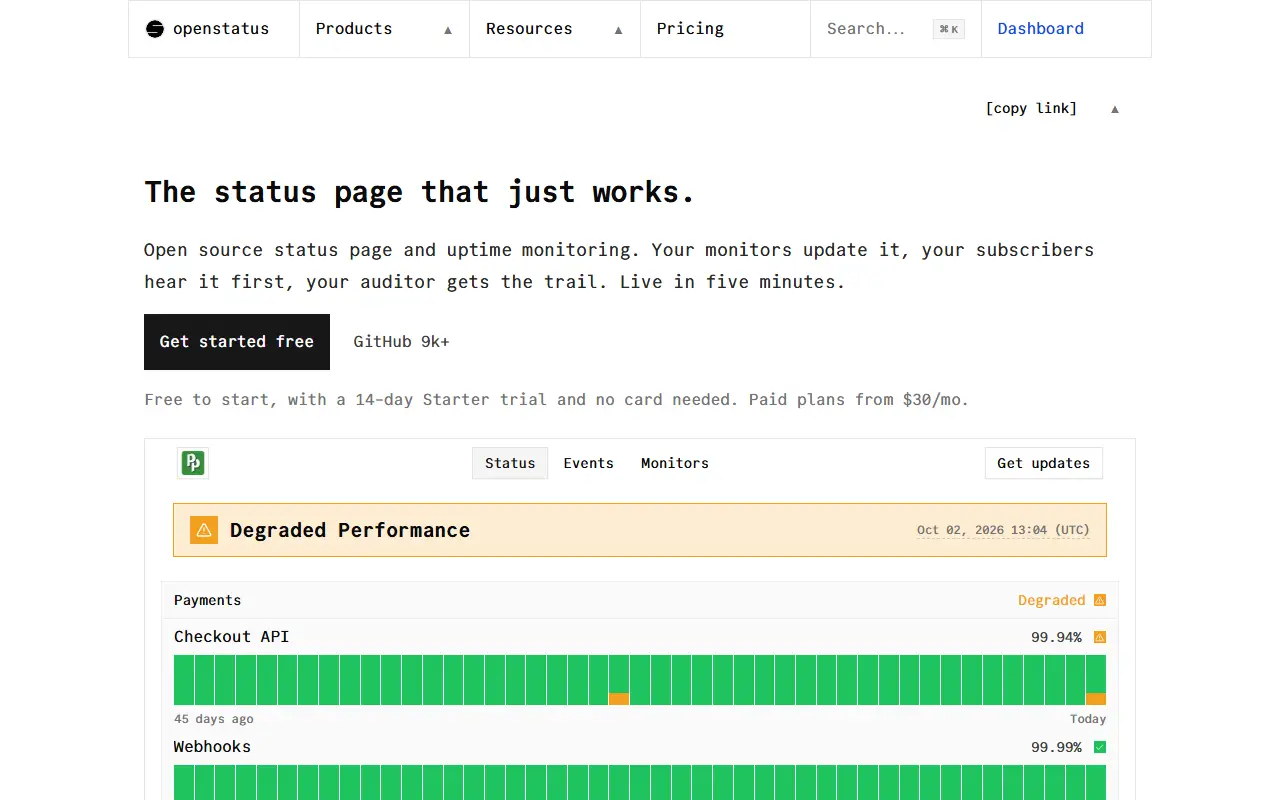
openstatus.devOpenStatus homepage screenshot

Openstatus is an uptime monitoring and status page platform, open source and built around infrastructure as code. Monitors, status pages and alert channels are written in YAML or Terraform and applied through the CLI or CI, and they can also be operated by AI assistants such as Claude, ChatGPT or Cursor through an MCP server.

The platform combines status pages and monitoring in one tool. Status pages can use custom domains and password protection, schedule maintenance windows, and notify subscribers by email, RSS or webhooks. Monitoring checks servers, websites and APIs from 28 regions across three cloud providers in parallel, with alerts through Slack, Discord, PagerDuty, email and more. Incident management lets teams open and manage incidents from the dashboard or Slack, with severity, a commander and a full timeline.

Openstatus is available as a managed service or can be self-hosted under the AGPL-3.0 licence, and private locations run in a very small Docker image. The README highlights flat pricing with unlimited members, with a JSON CLI, typed API and audit log for every change. It suits engineering teams that want monitoring configured in version control.

Key features

  • Monitors and status pages as code
  • YAML and Terraform configuration
  • Uptime checks from 28 global regions
  • Custom domains and maintenance windows
  • Incident management with timelines
  • MCP server and JSON CLI
  • Subscriber notifications by email and RSS

Pricing: Free Hobby plan with one monitor. Starter is $30, Pro $100 and Scale $500 per month, with 2 months free on annual billing and a 14-day Starter trial. Enterprise is custom.

OneUptime

An open-source platform that combines uptime monitoring, status pages, on-call, incident management, logs, traces, metrics and error tracking in one self-hostable app.

GitHub stars
7.7k
Last commit
today
Latest release
14.0.11
Self-hosted
Yes
Hosted version
Available
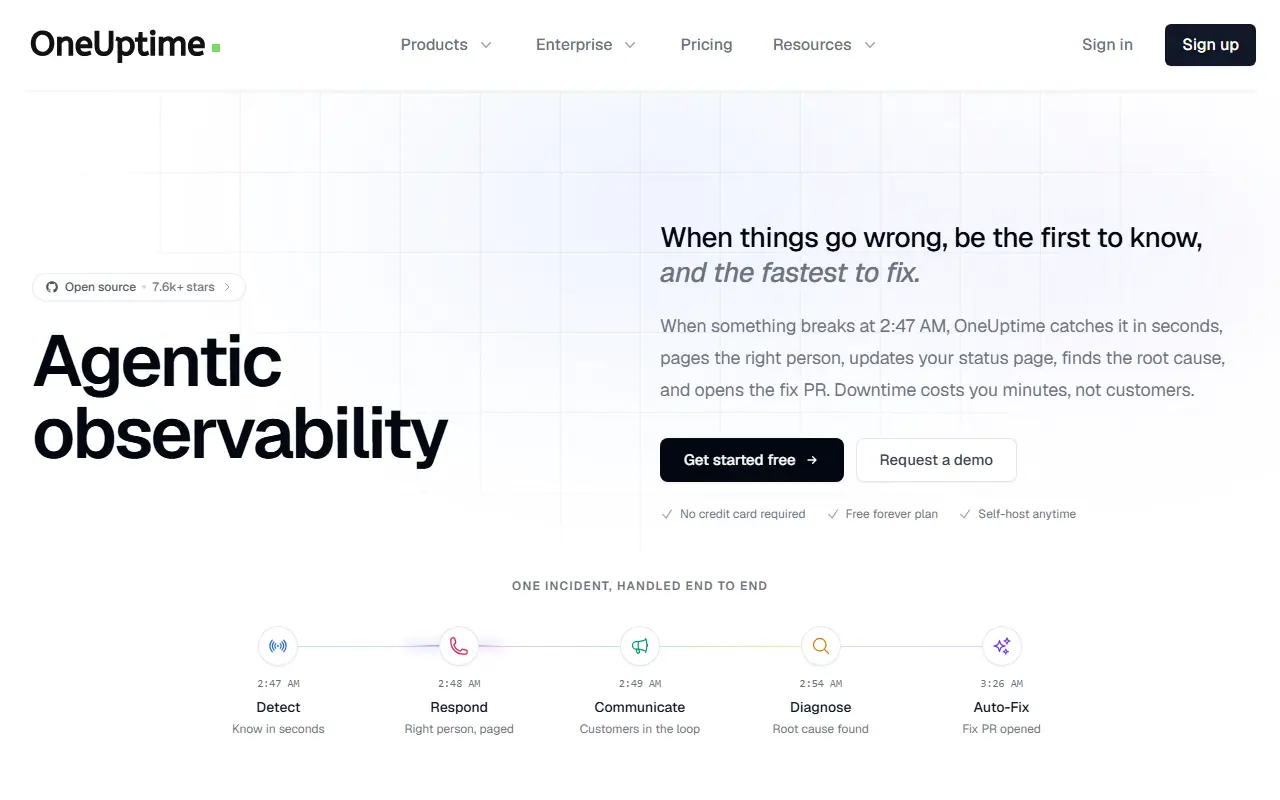
oneuptime.comOneUptime homepage screenshot

OneUptime is an open-source monitoring and observability platform that aims to replace a shelf of separate SaaS tools. It covers uptime monitoring, status pages, on-call and alerting, incident management, logs, traces, metrics, APM and error tracking in one application, and adds AI-assisted features such as helping find the root cause and proposing a fix.

Its README maps each module to the tools it can replace: Pingdom and UptimeRobot for uptime checks across websites, APIs, ports, SSL and DNS, StatusPage.io for branded public and private status pages, PagerDuty and Opsgenie for schedules, escalation policies and SMS, call, push or Slack alerts, Incident.io for declaring and triaging incidents with post-mortems, Datadog and New Relic for traces and dashboards, Loggly for logs, and Sentry for exceptions.

The Community Edition is open source under Apache 2.0 and free to self-host, and OneUptime Cloud offers a free-forever plan with no credit card. It is written in TypeScript. It suits small and mid-sized engineering teams that want one platform for reliability work rather than integrating many vendors.

Key features

  • Uptime monitoring for sites, APIs and ports
  • Branded public and private status pages
  • On-call schedules and escalation policies
  • Incident management with post-mortems
  • Logs, traces, metrics and APM
  • Error tracking with stack traces

Pricing: Free plan with one status page. Growth is $22 and Scale $99 per month with 14-day trials; Enterprise is custom. Monitors, SMS, telemetry and AI use are billed on top.

Sitespeed.io

sitespeed.io tests and monitors website speed using real browsers and reports Core Web Vitals; it is open source and runs on your own infrastructure.

GitHub stars
5k
Last commit
2 days ago
Latest release
v42.7.0
Licence
MIT
Self-hosted
Yes
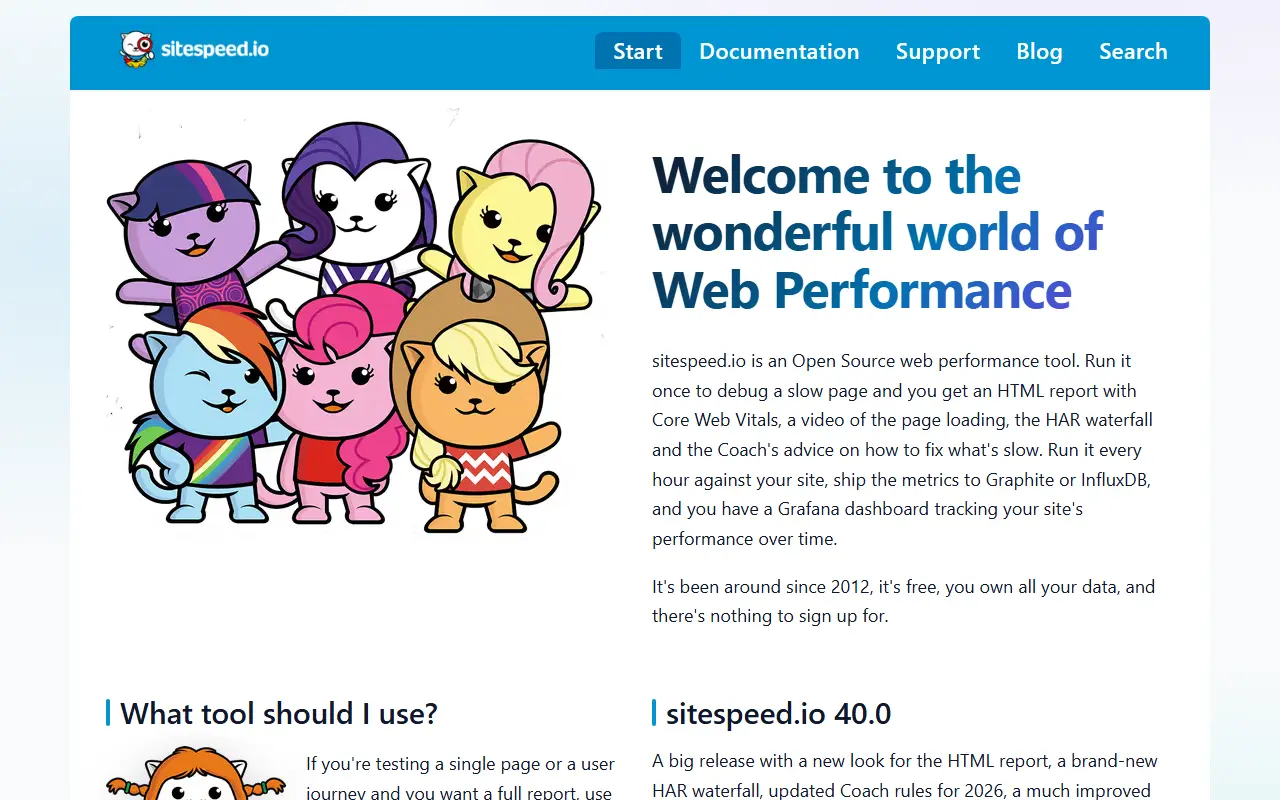
sitespeed.ioSitespeed.io homepage screenshot

sitespeed.io is open-source software for measuring web performance. You run it against a page or a set of pages, and it drives real browsers to measure how fast they load, producing an HTML report that includes Core Web Vitals and a video recording, so you can debug a slow page or compare changes over time.

It can be installed with Docker or Node.js, supports basic and advanced configuration, and includes guidance for mobile testing. Teams run it from CI or on a schedule to monitor performance continuously and catch regressions. The repository lists metrics, performance analysis and dashboards among its topics, and the project is active on Bluesky and Mastodon with a public changelog.

sitespeed.io is written in JavaScript and licensed under MIT. It runs on your own machines or servers, so no hosted account is needed. It suits front-end developers, performance engineers and operations teams that want self-controlled performance budgets and monitoring.

Key features

  • Real browser performance testing
  • HTML reports with Core Web Vitals
  • Video recordings of page loads
  • Docker and Node.js installation
  • Mobile testing support
  • Continuous monitoring from CI or schedules

Pricing: Free and open source under the MIT license.

Catchpoint alternatives: questions

What is the best open-source alternative to Catchpoint?
OpenStatus is the top-ranked open-source alternative to Catchpoint on Enlisted: An open-source status page and uptime monitoring platform where monitors and pages are declared as code in YAML or Terraform, available managed or self-hosted. Other strong options are OneUptime and Sitespeed.io.
Are these Catchpoint alternatives free?
All 3 are open source, so the code is free to use under its licence, and all of them can be self-hosted on your own server or computer. 2 also offer a paid or managed cloud version if you'd rather not host it yourself.
How is this list of Catchpoint alternatives ranked?
By a score built from GitHub stars, star growth over the last 30 days and how recently the code changed. 3 of these projects shipped code in the last 30 days. Data is refreshed daily, and nobody can pay to move up.

People also look for alternatives to…

View all