 TrackMedia
 TrackRev

About Locust
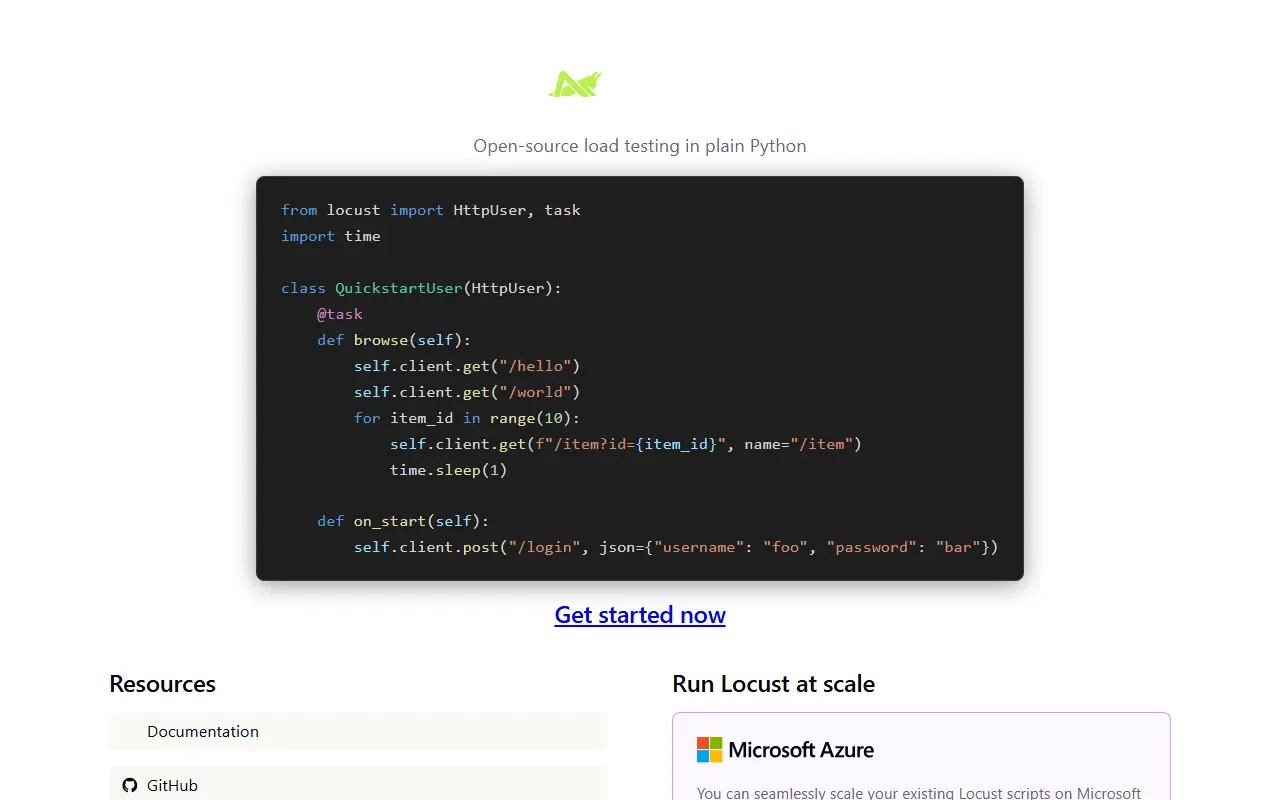
Locust is an open-source performance and load testing tool for HTTP and other protocols. Tests are defined as ordinary Python code, so you can use loops, conditions and any Python library, and your design is never restricted by a GUI or a domain-specific language. It is released under the MIT license. Scenarios can be edited in a normal IDE and kept under version control like other code.
Locust runs each simulated user in its own greenlet, so tests read like blocking code instead of callbacks. It is event-based using gevent, which lets a single process handle many thousands of concurrent users, and load tests can be distributed over multiple machines. You can run it from the command line or through a web interface that shows throughput, response times and errors in real time, with data exportable for later analysis. A pluggable architecture lets you extend it.
Key features
- Test scenarios written in plain Python
- Distributed load generation across machines
- Web UI with real-time throughput and errors
- Command-line mode for CI pipelines
- Event-based design for many concurrent users
- Pluggable architecture for extensions
Good fit for
- Load testing web APIs from Python code
- Finding performance limits before launch
Locust: questions and answers
- What is Locust used for?
- Locust is an open-source load testing tool where user scenarios are written in plain Python and can run distributed across machines. It is a good fit for load testing web APIs from Python code and finding performance limits before launch.
- Is Locust open source?
- Yes. Locust is open source under the MIT licence. Its source code is on GitHub at locustio/locust and is written mainly in Python.
- Is Locust free?
- Yes. Locust is open source, so the software itself is free to use.
- What is Locust an alternative to?
- Locust is an open-source alternative to OpenText LoadRunner, BlazeMeter, loader.io and Catchpoint. Other open-source alternatives to OpenText LoadRunner include k6, Gatling and Apache JMeter.
- Is Locust actively maintained?
- Yes. The most recent commit to Locust was on 10 November 2026, and the latest release is 2.47.0, published on 21 October 2026. The project has 28k stars on GitHub, with 74 added in the last 30 days.
Open-source alternatives to Locust
See all
k6
Testing & QA
A modern load testing tool, using Go and JavaScript
AGPL-3.0vs OpenText LoadRunner★ 32k
Gatling
Testing & QA
Modern Load Testing as Code
Apache-2.0vs OpenText LoadRunner★ 7k
Apache JMeter
Testing & QA
Apache JMeter open-source load testing tool for analyzing and measuring the performance of
Apache-2.0vs OpenText LoadRunner★ 9.6k
Artillery
Testing & QA
The complete load testing platform. Everything you need for production-grade load tests. S
MPL-2.0vs OpenText LoadRunner★ 9.1k
Tsung
Open source
Tsung is a high-performance benchmark framework for various protocols including HTTP, XMPP
GPL-2.0vs OpenText LoadRunner★ 2.6k
Karate
Testing & QA
Test Automation Made Simple
MITvs Postman★ 9k
SaaS alternatives to Locust
See all
OpenText LoadRunner
Testing & QA
Performance and load testing software for enterprise applications
SaaS
BlazeMeter
Testing & QA
Continuous testing platform for load testing and API testing from Perforce
SaaS
loader.io
Testing & QA
Cloud load testing service for web apps and APIs from SendGrid
SaaS
Catchpoint
Monitoring & Observability
Internet performance monitoring with synthetic tests from global vantage points
SaaS
ReadyAPI
API Tools
SmartBear suite for functional, security and load testing of REST, SOAP and GraphQL APIs
SaaS
WebLOAD
Monitoring & Observability
Enterprise-grade load testing tool for recording scripts, running tests at scale, and analyzing results
SaaS