7,363 open-source and SaaS tools, with GitHub stats refreshed every day.

6 alternatives ranked by real activity

Open-source BlazeMeter alternatives

A curated, ranked list of the 6 best open-source alternatives to BlazeMeter.

The best open-source alternative to BlazeMeter is k6. If that doesn't suit you, other good options are Locust, Apache JMeter, Artillery and Karate.

BlazeMeter alternatives are mainly testing & QA tools. 6 of them shipped code in the last 30 days, 6 can be self-hosted, and 5 use a permissive licence.

Last updated October 3, 2026 · ranked by GitHub stars, growth and recent commits

k6

k6 is an open-source load testing tool where tests are written as JavaScript code and run on a fast Go engine.

GitHub stars
32k
Last commit
today
Latest release
v2.3.0
Licence
AGPL-3.0
Hosted version
Available
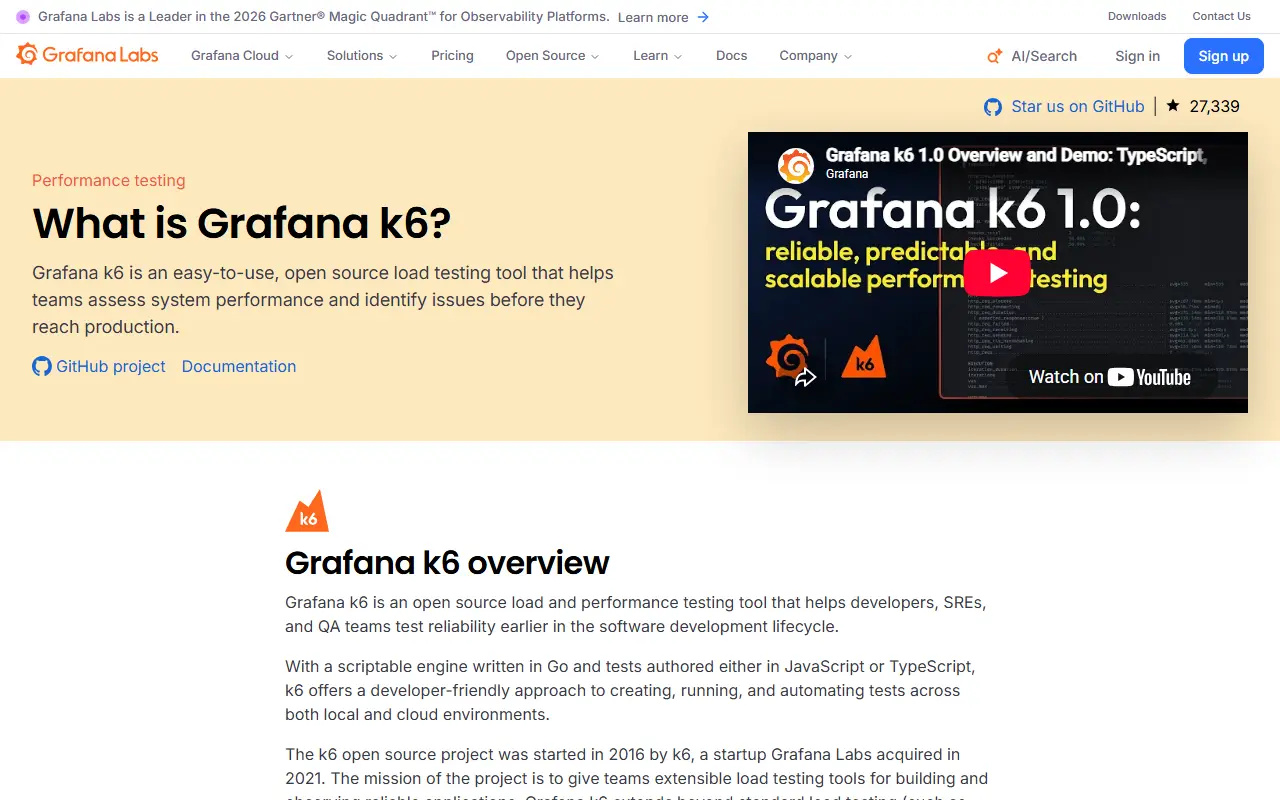
grafana.comk6 homepage screenshot

k6 is a load-testing tool for developers and testers, described as unit testing for performance. Test scripts are written in JavaScript and executed by an embedded engine written in Go, combining scripting familiarity with efficient load generation. It is maintained under the Grafana organization and released under the AGPL-3.0 license.

Because tests are code, scripts can be modularized, version controlled and run from the command line, in CI or across a Kubernetes cluster. k6 supports HTTP, WebSockets, gRPC and browser protocols, and an extension ecosystem adds more. Results can be summarized or exported as granular metrics to the service of your choice, and the tool integrates natively with Grafana Cloud for test execution and analysis. For people who prefer not to write code, k6 Studio is a desktop app that generates scripts.

Key features

  • Load tests written as JavaScript code
  • Go engine for efficient traffic generation
  • HTTP, WebSocket, gRPC and browser protocols
  • Extension ecosystem for added capabilities
  • Flexible metrics export to other services
  • k6 Studio desktop app for no-code scripts

Pricing: The Grafana Cloud page, which covers k6 performance tests, lists a free plan, Pro from $19 per month plus usage, and Enterprise starting at a $25,000 per year spend commit.

Read more about k6Website GitHub

Locust

Locust is an open-source load testing tool where user scenarios are written in plain Python and can run distributed across machines.

GitHub stars
28k
Last commit
6 days ago
Latest release
2.46.6
Licence
MIT
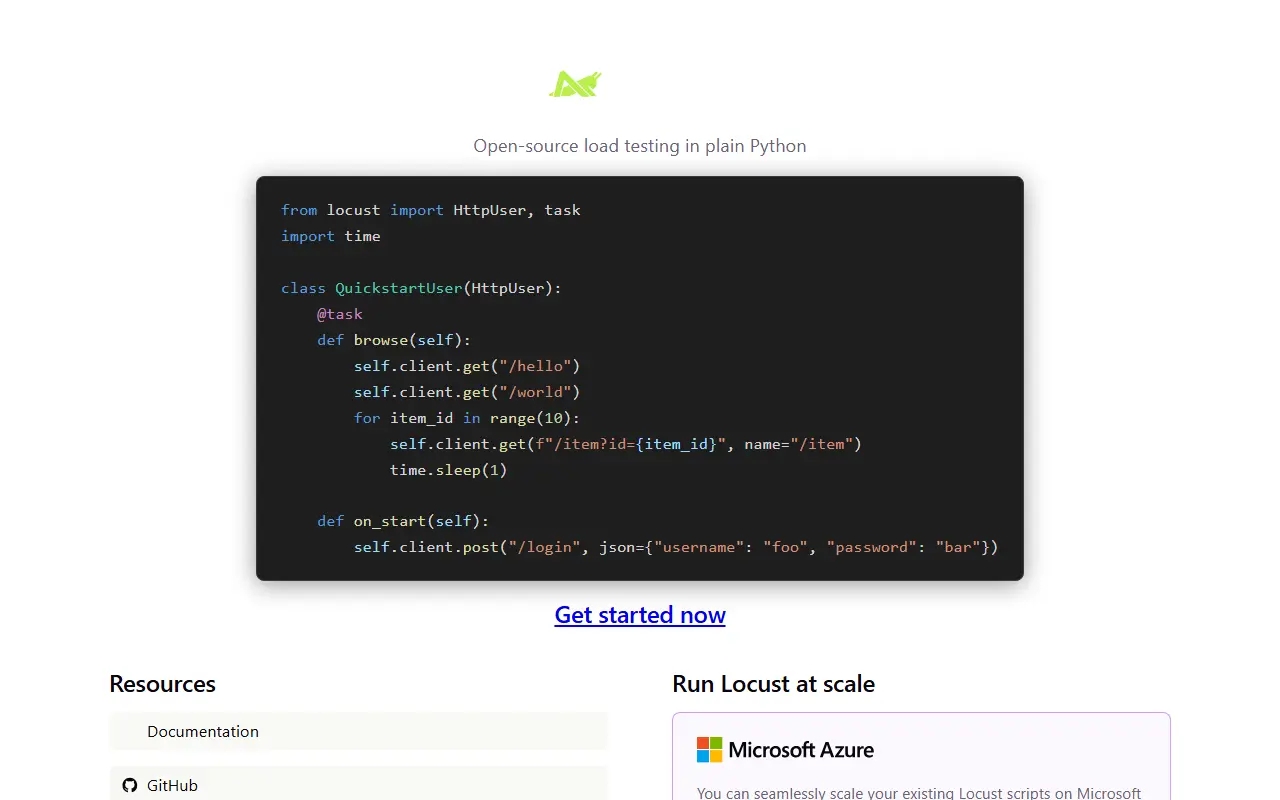
locust.cloudLocust homepage screenshot

Locust is an open-source performance and load testing tool for HTTP and other protocols. Tests are defined as ordinary Python code, so you can use loops, conditions and any Python library, and your design is never restricted by a GUI or a domain-specific language. It is released under the MIT license. Scenarios can be edited in a normal IDE and kept under version control like other code.

Locust runs each simulated user in its own greenlet, so tests read like blocking code instead of callbacks. It is event-based using gevent, which lets a single process handle many thousands of concurrent users, and load tests can be distributed over multiple machines. You can run it from the command line or through a web interface that shows throughput, response times and errors in real time, with data exportable for later analysis. A pluggable architecture lets you extend it.

Key features

  • Test scenarios written in plain Python
  • Distributed load generation across machines
  • Web UI with real-time throughput and errors
  • Command-line mode for CI pipelines
  • Event-based design for many concurrent users
  • Pluggable architecture for extensions

Pricing: Free and open source under the MIT license.

Read more about LocustWebsite GitHub

Apache JMeter

Apache Java tool for load and performance testing of web applications, services and many protocols, with GUI and command-line modes.

GitHub stars
9.6k
Last commit
yesterday
Latest release
rel/v5.6.3
Licence
Apache-2.0
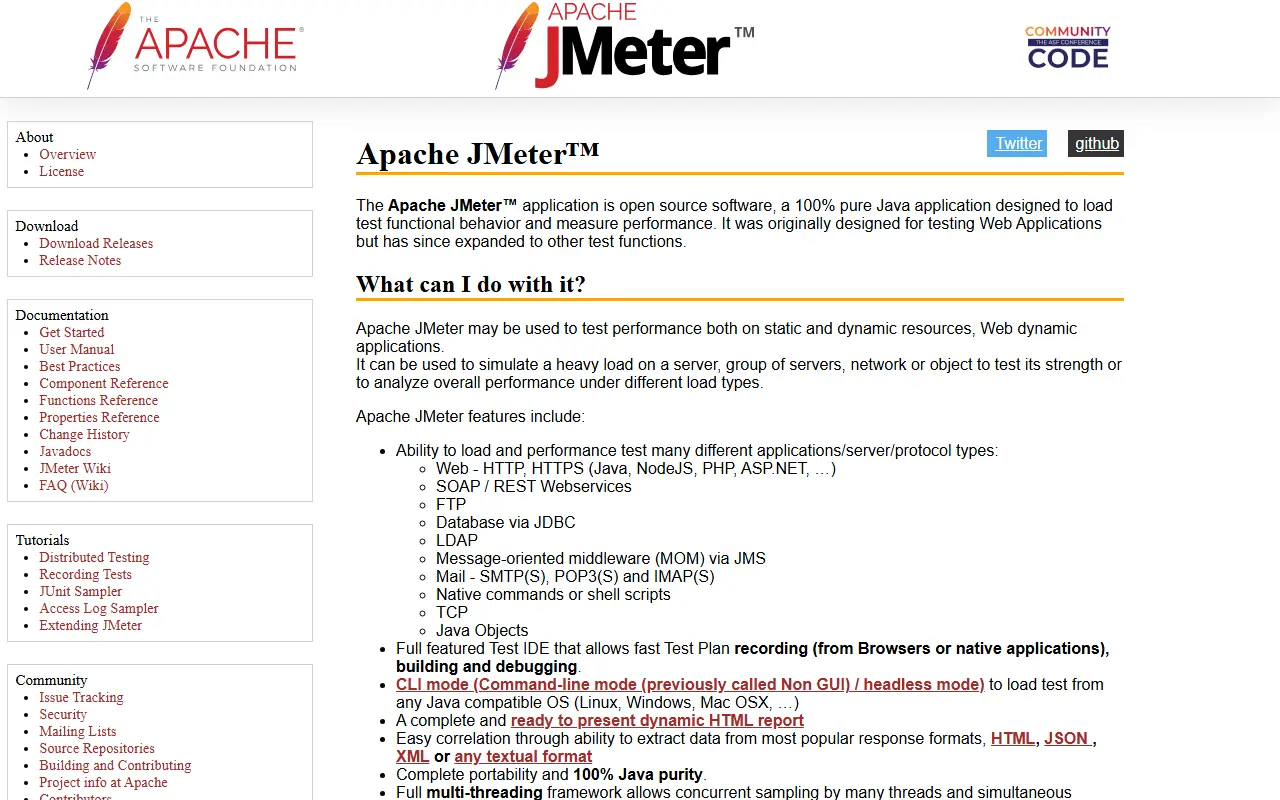
jmeter.apache.orgApache JMeter homepage screenshot

Apache JMeter is an open-source Java application for measuring performance and load testing. It can test static and dynamic web applications and simulate heavy load on a server, group of servers or network to examine strength and overall behavior under different kinds of load.

It supports many protocols, including HTTP and HTTPS, SOAP and REST, FTP, databases through JDBC, LDAP, JMS messaging, SMTP, POP3 and IMAP mail, TCP, native commands and Java objects. A test IDE allows recording test plans from browsers or native applications and building and debugging them. A command-line, headless mode runs tests on any Java-compatible operating system, and reports are produced as dynamic HTML or streamed live to InfluxDB or Graphite.

Correlation is helped by extracting data from HTML, JSON, XML and other text, and the core is extensible through pluggable samplers, scriptable samplers using JSR223 languages such as Groovy, and visualization plugins. JMeter is developed by the Apache Software Foundation under the Apache-2.0 license.

Key features

  • Load testing for HTTP, REST and SOAP services
  • JDBC, LDAP, JMS, FTP and mail protocols
  • Test plan recording and debugging IDE
  • Headless command-line mode
  • HTML reports and InfluxDB or Graphite output
  • Plugin and Groovy scripting extensibility

Pricing: Free and open source under the Apache-2.0 license.

Artillery

A load testing toolkit for HTTP, WebSocket, gRPC and browser-based tests that can run distributed on AWS Lambda or Fargate without managing infrastructure.

GitHub stars
9.1k
Last commit
10 days ago
Latest release
artillery-2.0.34
Licence
MPL-2.0
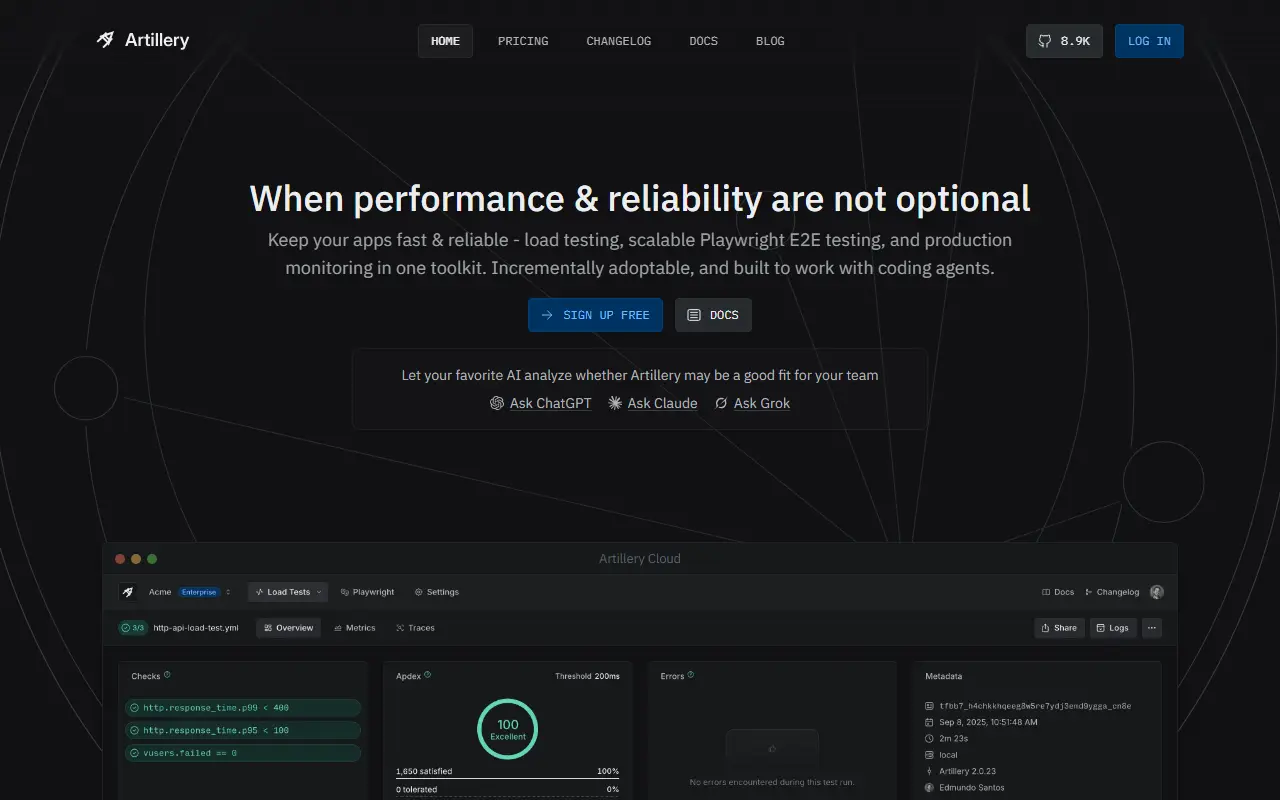
artillery.ioArtillery homepage screenshot

Artillery is a load testing platform for APIs and web applications. It tests HTTP APIs, GraphQL, WebSocket, Socket.io, gRPC, Kinesis and more, and can use real headless browsers through Playwright, so both protocol-level and full browser load tests are possible. Any Node.js module can be used in test scripts.

Tests can scale out as distributed runs on AWS Lambda or AWS Fargate, with no servers to set up or manage. Workload modeling lets you simulate realistic user behavior using chained requests, multi-step scenarios and transactions, there are more than twenty integrations for monitoring, observability and CI/CD, and a plugin API supports extension. Topics mention OpenTelemetry, serverless testing and performance testing.

Most of the code is licensed under MPL-2.0, but some Azure-specific modules use the BSL, which allows evaluation and proof-of-concept use on Azure and requires a commercial licence for commercial or production use. Artillery is written in TypeScript and runs from the command line. It suits developers and SRE teams who want to script load tests as code.

Key features

  • Load tests for HTTP, WebSocket and gRPC
  • Browser load tests with Playwright
  • Distributed runs on AWS Lambda or Fargate
  • Workload modeling with multi-step flows
  • 20+ monitoring and CI/CD integrations
  • Plugin API for extension
  • Use of any Node.js module

Pricing: Free plan for proofs of concept. Team is $199 and Business $499 per month, with 20% off annual billing; enterprise features start at $1199 per month. Paid-plan trials are available on request.

Karate

An open-source framework for test automation that brings API checks, mocks, performance tests and UI automation together under one readable syntax.

GitHub stars
9k
Last commit
yesterday
Latest release
v2.1.3
Licence
MIT
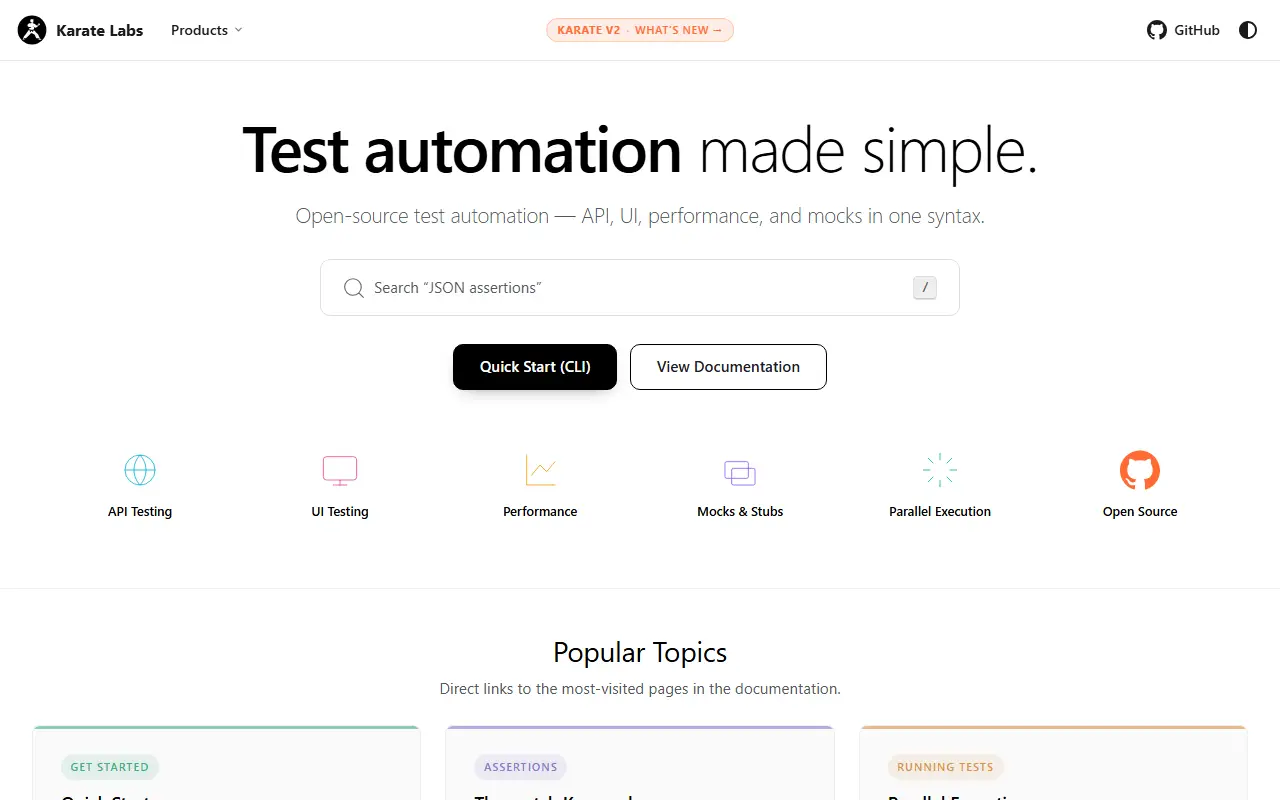
docs.karatelabs.ioKarate homepage screenshot

Karate is an open-source tool that unifies API testing, mocks, performance testing and UI automation in one framework with a single readable syntax. Tests are written as feature files, so people who are not Java developers can read and write them, and the project is written in Java.

Its documentation highlights the match keyword for validating complete responses, headers and arrays, parallel execution of features, scenarios and example rows, reusable flows by calling one feature from another, and test doubles that stand up HTTP, gRPC and message-queue mocks from a feature file. Karate v2 adds virtual threads, a single-binary CLI, JavaScript debugging and soft assertions. There are extensions for VS Code and IntelliJ, plus Karate Agent and Karate Xplorer products.

Tests can be run through JUnit, the command line or CI/CD pipelines. Karate is licensed under MIT, and topics mention BDD, Cucumber, contract testing, load testing and WebDriver. It suits QA engineers and developers who want one tool for API-level and UI-level checks.

Key features

  • API testing in readable feature files
  • Built-in HTTP, gRPC and queue mocks
  • Performance testing from the same tests
  • UI automation with a browser driver
  • Parallel test execution
  • JUnit, CLI and CI/CD runners
  • VS Code and IntelliJ extensions

Pricing: The open-source framework is free. Pro is $64 per user per month ($640 per user per year) and IDE Plus is $100 per user per year; Enterprise is custom. Everything runs self-hosted.

Read more about KarateWebsite GitHub

Gatling

An open-source load testing platform where performance tests are written as code in Java, Kotlin, Scala, JavaScript or TypeScript and run with a non-blocking engine.

GitHub stars
7k
Last commit
3 days ago
Latest release
v3.16.0
Licence
Apache-2.0
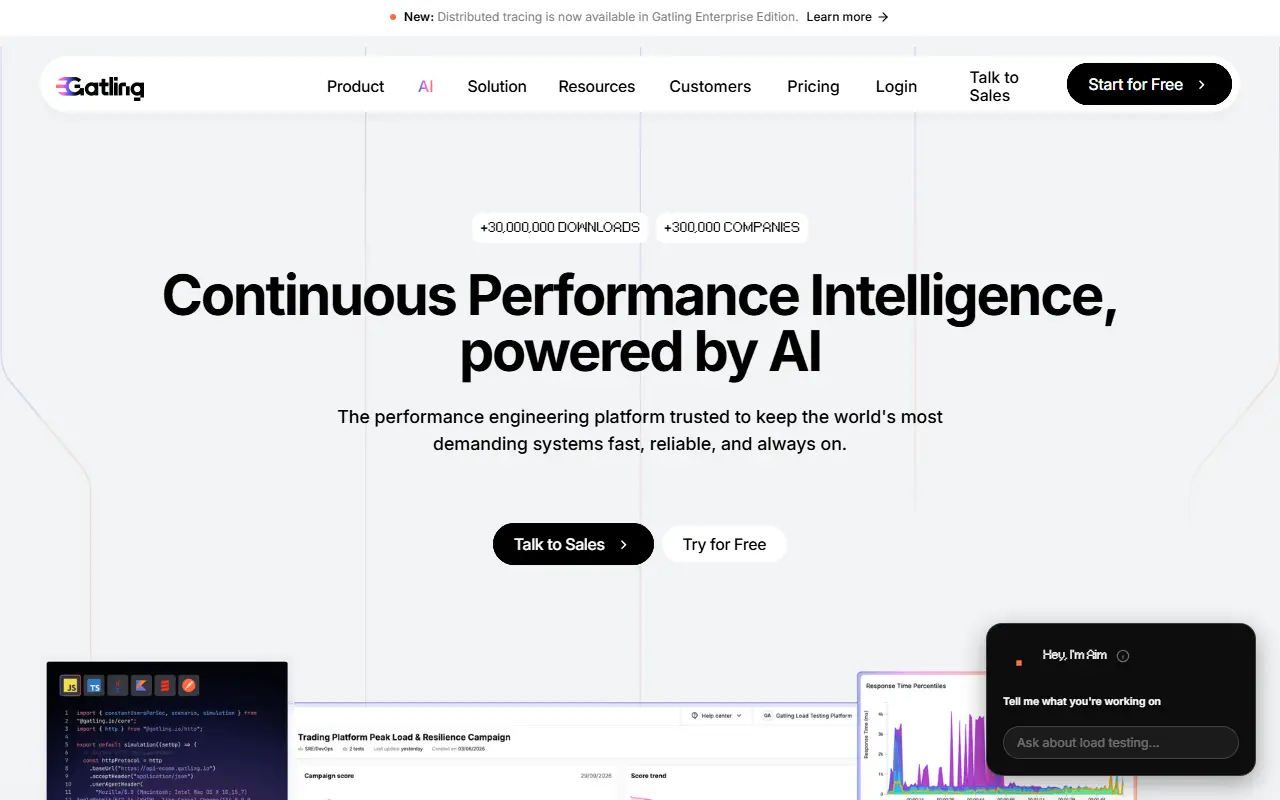
gatling.ioGatling homepage screenshot

Gatling is an open-source load testing and performance engineering platform. Teams write simulations as code with fluent SDKs available for Java, Kotlin, Scala, JavaScript and TypeScript, and keep them in version control rather than in GUIs or XML files.

Officially supported protocols are HTTP, WebSocket, SSE, JMS, gRPC and MQTT, and integrates with CI/CD pipelines, APM tools and DevOps workflows. Its engine is non-blocking and asynchronous, which the authors contrast with older tools that use one thread per user and require large farms of injection servers. Capabilities described include comparing runs to detect regressions, monitoring SLOs and performance objectives, integrating with observability tools and adding automated performance gates to CI/CD.

The project positions itself within a broader idea of continuous performance intelligence, which focuses on measurable objectives and decisions. The open-source code is licensed under Apache-2.0, written in Scala, and is run from your build tools or CI. It suits developers and performance engineers who want repeatable load tests as part of their delivery process.

Key features

  • Load tests written as code
  • SDKs for Java, Kotlin, Scala, JavaScript and TypeScript
  • HTTP, WebSocket, SSE, JMS, gRPC and MQTT support
  • Non-blocking asynchronous engine
  • Run comparison to detect regressions
  • Performance gates in CI/CD

Pricing: The Community Edition is free. Gatling Enterprise starts at €99 per month for Basic and €396 for Team, or €89 and €356 billed annually, with a free trial. Enterprise is on request.

BlazeMeter alternatives: questions

What is the best open-source alternative to BlazeMeter?
k6 is the top-ranked open-source alternative to BlazeMeter on Enlisted: k6 is an open-source load testing tool where tests are written as JavaScript code and run on a fast Go engine. Other strong options are Locust, Apache JMeter, Artillery and Karate.
Are these BlazeMeter alternatives free?
All 6 are open source, so the code is free to use under its licence, and all of them can be self-hosted on your own server or computer. 1 also offers a paid or managed cloud version if you'd rather not host it yourself.
How is this list of BlazeMeter alternatives ranked?
By a score built from GitHub stars, star growth over the last 30 days and how recently the code changed. 6 of these projects shipped code in the last 30 days. Data is refreshed daily, and nobody can pay to move up.

People also look for alternatives to…

View all