 Mendeley
 EndNote
 Paperpile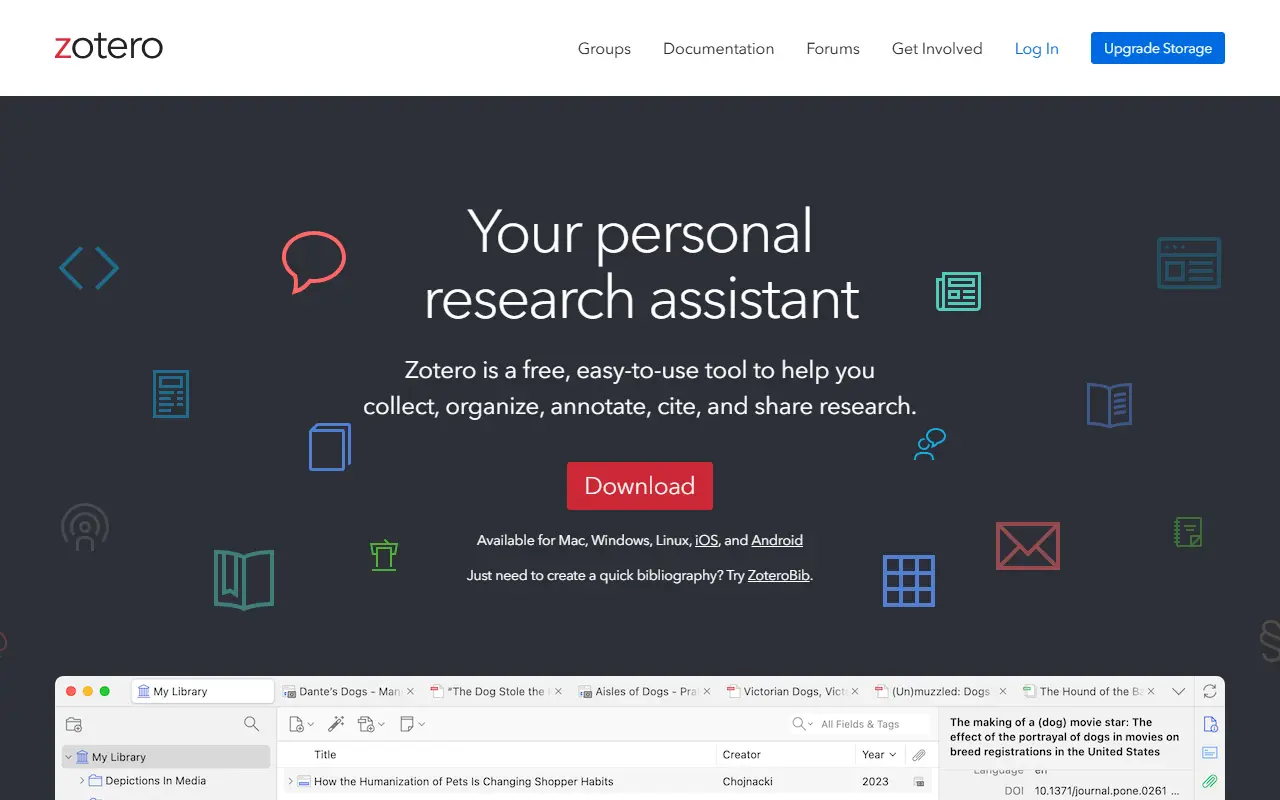
About Zotero
Zotero is a free tool for managing research. It collects references as you browse the web, organizes them into collections with tags and saved searches, and helps you annotate, cite and share them. It is available for Mac, Windows, Linux, iOS and Android, and the source code in this repository is open.
A browser connector senses research material on sites it recognizes and saves it with a click. Citations and bibliographies can be generated for any text editor and directly inside Word, LibreOffice and Google Docs, with support for over 9,000 citation styles. A companion web tool, ZoteroBib, creates quick bibliographies without installing anything.
Syncing across devices is optional, and synced data can also be reached from a web browser. Libraries can be shared in groups, for co-writing a paper, distributing course materials or building a collaborative bibliography, with no limit on how many people join at no cost. The site also offers paid storage upgrades for synced files.
Key features
- One-click capture of web research
- Collections, tags and saved searches
- Citations in over 9,000 styles
- Word, LibreOffice and Google Docs integration
- Optional sync across devices
- Shared group libraries
Good fit for
- →Managing references for a thesis
- →Collaborative bibliographies for research teams
- Built with
- JavaScript
- Tags
- reference-manager
- citations
- research
- bibliography
- academic
- annotation
- open-source
- sync
Zotero: questions and answers
- What is Zotero used for?
- Zotero is a free, open-source reference manager that collects, organizes, annotates, cites and shares research sources. It is a good fit for managing references for a thesis and collaborative bibliographies for research teams.
- Is Zotero open source?
- Yes. Zotero is open source under a custom licence. Its source code is on GitHub at zotero/zotero and is written mainly in JavaScript.
- Is Zotero free?
- Yes. Zotero is open source, so the software itself is free to use under the terms of its own licence. A managed cloud version is also available.
- Can I self-host Zotero?
- Yes. Zotero can be self-hosted on your own server or infrastructure.
- What is Zotero an alternative to?
- Zotero is an open-source alternative to Readwise, DEVONthink, LiquidText and Matter. Other open-source alternatives to Readwise include Memex and Karakeep.
- Is Zotero actively maintained?
- Yes. The most recent commit to Zotero was on 2 October 2026. The project has 15k stars on GitHub.
Open-source alternatives to Zotero
See all
JabRef
Productivity
Desktop app for managing BibTeX and BibLaTeX (.bib) libraries
MITvs Mendeley★ 4.8k
Memex
Note Taking
Browser extension to curate, annotate, and discuss the most valuable content and ideas on
OSSvs Raindrop.io★ 4.7k
Butterfly
Note Taking
🎨 Powerful, minimalistic, cross-platform, opensource note-taking app
AGPL-3.0vs GoodNotes★ 2k
Karakeep
Productivity
Karakeep is the open-source bookmark manager for links, notes, and images. Automatically o
AGPL-3.0vs Raindrop.io★ 29k
TagSpaces
Productivity
TagSpaces is an offline, open source, document manager with tagging support
AGPL-3.0vs DEVONthink★ 5.3k
Anytype
Note Taking
Official Anytype client for MacOS, Linux, and Windows
OSSvs Notion★ 8.9k
SaaS alternatives to Zotero
See all
Readwise
Note Taking
Collects highlights from books and articles for review and export to note apps
SaaS
DEVONthink
Note Taking
Document and research manager for macOS with AI-assisted search
SaaS
LiquidText
Note Taking
PDF and document annotation workspace for connecting excerpts across files
SaaS
Matter
Productivity
Reading app that brings newsletters, feeds and read-later into one place with highlights
SaaS
Glasp
Note Taking
Web highlighter that saves and shares highlights and notes from articles and videos
SaaS
Flexcil
Note Taking
PDF reader and note-taking app with split view for iPad, iPhone, Mac and Windows
SaaS