3 open-source alternatives ranked by real activity

Open-source Consensus alternatives

A curated, ranked list of the 3 best open-source alternatives to Consensus.

The best open-source alternative to Consensus is GPT Researcher. If that doesn't suit you, other good options are Zotero and Scira.

Commercial alternatives to Consensus include Elicit, Grok, NotebookLM and SciSpace. See all 14.

Consensus alternatives are mainly AI tools, but some are also productivity tools. 2 of them shipped code in the last 30 days, 3 can be self-hosted, and 1 uses a permissive licence.

Last updated November 12, 2026 · ranked by GitHub stars, growth and recent commits

GPT Researcher

An autonomous research agent that searches the web and local documents using any LLM provider and writes detailed, cited research reports.

GitHub stars
31k
Last commit
today
Latest release
v3.8.0
Licence
Apache-2.0
Self-hosted
Yes
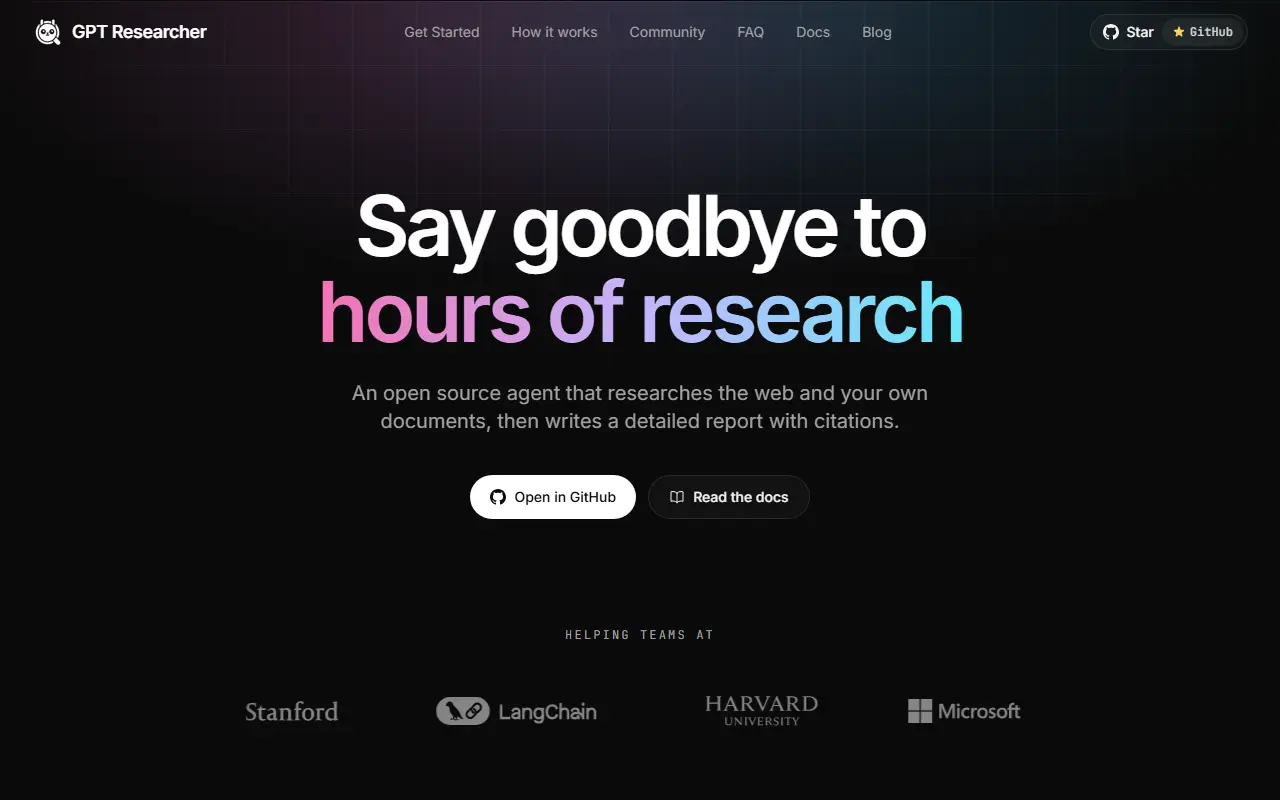
gptr.devGPT Researcher homepage screenshot

GPT Researcher is an open-source autonomous agent that performs deep research on a given task and writes up a report with citations. It can work from web sources and from local documents, and it works with any LLM provider, aiming for factual, unbiased output rather than a quick chatbot answer.

The project positions itself against several limits of manual and LLM-only research: manual work can take weeks, models trained on old data may hallucinate, token limits make long reports hard, and a narrow source set leads to shallow or wrong conclusions. Drawing on Plan-and-Solve and RAG ideas, it splits research into planning and parallelized agent work to increase speed and keep behavior stable. Customization options let you tailor domain-specific research agents, and topics note MCP server support.

GPT Researcher is written in Python and Apache-2.0 licensed, with documentation in several languages and a website at gptr.dev. You run it yourself with your own model API keys, and it suits analysts, students and developers who want automated, source-backed reports on a topic.

Key features

  • Autonomous deep research on any topic
  • Reports with source citations
  • Web and local document research
  • Works with any LLM provider
  • Parallelized agent work for speed
  • MCP server support

Pricing: GPT Researcher is free under the MIT license with no SaaS subscription; you pay only your own LLM and search providers. Managed deployments are arranged by contacting the maintainer.

Zotero

Zotero is a free, open-source reference manager that collects, organizes, annotates, cites and shares research sources.

GitHub stars
16k
Last commit
yesterday
Self-hosted
Yes
Hosted version
Available
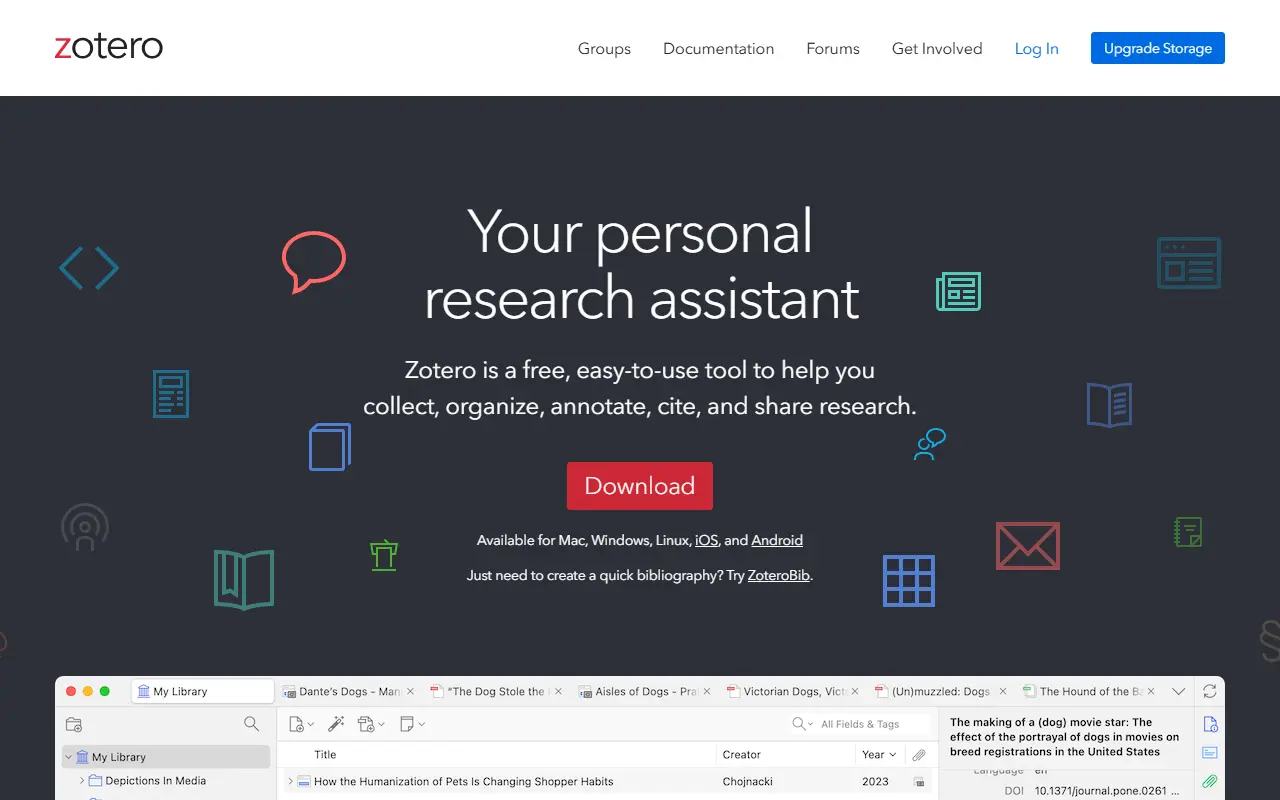
zotero.orgZotero homepage screenshot

Zotero is a free tool for managing research. It collects references as you browse the web, organizes them into collections with tags and saved searches, and helps you annotate, cite and share them. It is available for Mac, Windows, Linux, iOS and Android, and the source code in this repository is open.

A browser connector senses research material on sites it recognizes and saves it with a click. Citations and bibliographies can be generated for any text editor and directly inside Word, LibreOffice and Google Docs, with support for over 9,000 citation styles. A companion web tool, ZoteroBib, creates quick bibliographies without installing anything.

Syncing across devices is optional, and synced data can also be reached from a web browser. Libraries can be shared in groups, for co-writing a paper, distributing course materials or building a collaborative bibliography, with no limit on how many people join at no cost. The site also offers paid storage upgrades for synced files.

Key features

  • One-click capture of web research
  • Collections, tags and saved searches
  • Citations in over 9,000 styles
  • Word, LibreOffice and Google Docs integration
  • Optional sync across devices
  • Shared group libraries

Pricing: Free and open source to use; the website offers optional paid storage upgrades for synced files.

Read more about ZoteroWebsiteGitHub#2 Consensus alternative

Scira

Scira is an open-source AI search and research tool that plans, retrieves and cites sources, accepting questions, PDFs and URLs.

GitHub stars
12k
Last commit
3 mo ago
Licence
AGPL-3.0
Self-hosted
Yes
Hosted version
Available
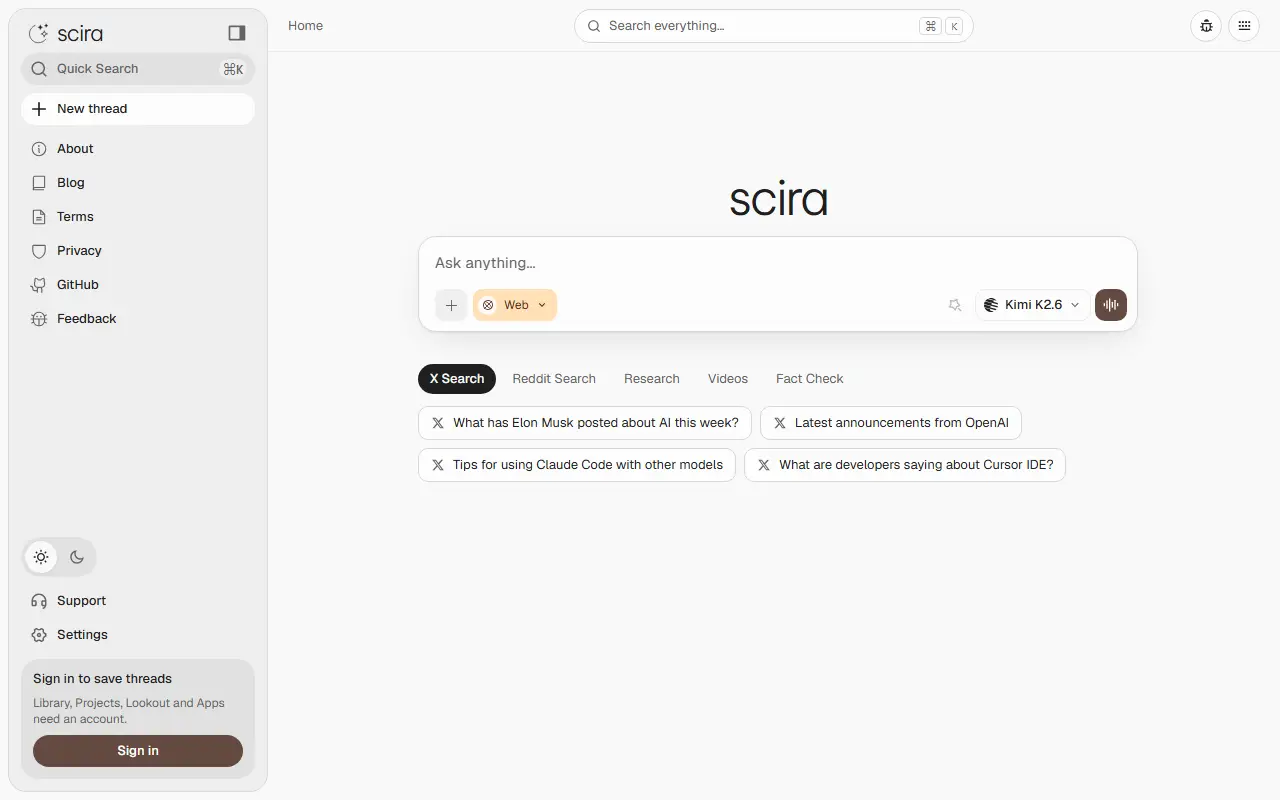
scira.aiScira homepage screenshot

Scira, formerly called MiniPerplx, is a minimalistic AI search tool that finds information online and cites where it came from. The project describes it as an agentic research platform that plans, retrieves and cites, and it is available as a hosted site at scira.ai.

You can start by asking a question, uploading a PDF or pasting a link. Behind it, the README credits the Vercel AI SDK for model integration and streaming, Exa AI for web search and content retrieval, and Upstash for serverless Redis and rate limiting. It is written in TypeScript as a web app you can run yourself with your own provider keys.

Scira is licensed under AGPL-3.0, so modified versions offered over a network must share their source. It suits developers who want a reference AI search app to run or adapt, and individuals who want a cited, minimalistic alternative to conventional search.

Key features

  • AI search with cited sources
  • Agentic research that plans and retrieves
  • PDF upload and URL input
  • Built on the Vercel AI SDK
  • Web search through Exa
  • Self-hostable TypeScript app

Pricing: Free plan allows 3 searches a day. Pro costs $15 per month ($9 with a student email) and Max $60 per month for higher model limits and image generation.

Read more about SciraWebsiteGitHub#3 Consensus alternative

Commercial Consensus alternatives

Hosted, closed-source products that compete with Consensus. Showing 12 of 14.

See every Consensus alternative on its tool page

Consensus alternatives: questions

What is the best open-source alternative to Consensus?
GPT Researcher is the top-ranked open-source alternative to Consensus on Enlisted: An autonomous research agent that searches the web and local documents using any LLM provider and writes detailed, cited research reports. Other strong options are Zotero and Scira.
What are the best commercial alternatives to Consensus?
Elicit, Grok, NotebookLM, SciSpace and Clevia are among the hosted, closed-source alternatives to Consensus listed on Enlisted, which lists 14 in total. Compare their pricing and features on each tool page.
Are these Consensus alternatives free?
All 3 are open source, so the code is free to use under its licence, and all of them can be self-hosted on your own server or computer. 2 also offer a paid or managed cloud version if you'd rather not host it yourself.
How is this list of Consensus alternatives ranked?
By a score built from GitHub stars, star growth over the last 30 days and how recently the code changed. 2 of these projects shipped code in the last 30 days. Data is refreshed daily, and nobody can pay to move up.

People also look for alternatives to…

View all