 TrackMedia
 TrackRev

 Iris.ai
About Consensus
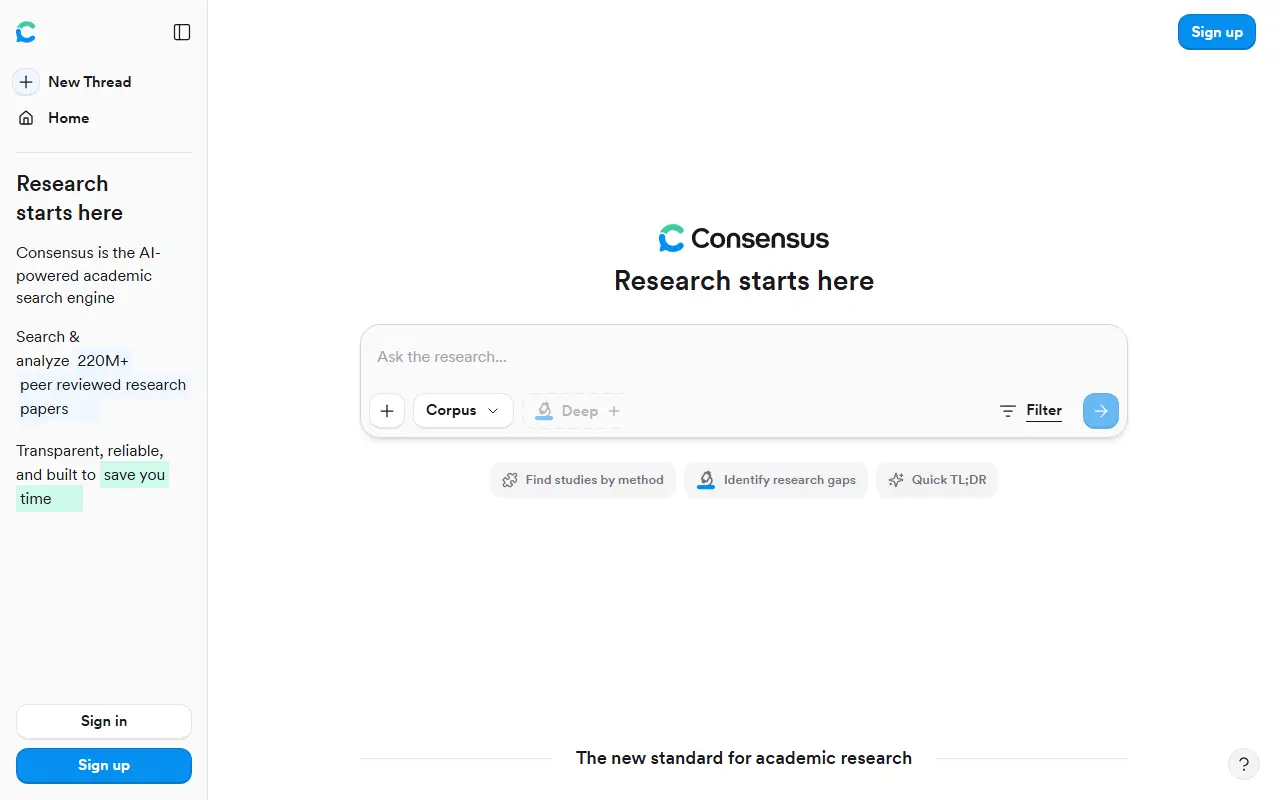
Consensus is an AI workspace for scientific research. It searches and analyses peer-reviewed literature, drawing on more than 250 million papers, including licensed full text from leading publishers. The About page states the mission as helping people find, understand and create good science. It was founded in 2021 by Christian Salem and Eric Olson, and is based in San Francisco.
Deep Search builds a search strategy for a research question by expanding key terms, identifying conflicting arguments and exploring the citation graph, which the company says turns days of literature review into minutes. Filters can be written in natural language, for example limiting to controlled studies or excluding animal and in vitro work.
A Medical mode narrows results to about 50,000 clinical guidelines and 8 million articles from the top 1,000 medical journals. For yes-or-no questions, the Consensus Meter shows how much the evidence agrees or disagrees. Over 170 university libraries partner with Consensus to give students and faculty access.
Key features
- Searches over 250 million research papers
- Deep Search automates literature review
- Medical mode limits results to clinical sources
- Natural-language filters for design and population
- Consensus Meter shows how far evidence agrees
Good fit for
- Literature reviews
- Clinical evidence lookups
- Yes-or-no research questions
- Dissertation research
Consensus: questions and answers
- What is Consensus used for?
- Consensus is an AI research workspace that searches peer-reviewed papers, shows where the evidence agrees and automates literature review. It is a good fit for literature reviews, clinical evidence lookups and yes-or-no research questions.
- Is Consensus free?
- Yes. Consensus has a free plan.
- Is Consensus open source?
- No. Consensus is proprietary (closed-source) software. Open-source alternatives to Consensus include GPT Researcher, Scira and Zotero.
- What are some alternatives to Consensus?
- Consensus competes with Elicit, Perplexity and ChatGPT. For open-source options, see Enlisted's ranked list of open-source Consensus alternatives.
Open-source alternatives to Consensus
See all
GPT Researcher
AI Tools
An autonomous agent that conducts deep research on any data using any LLM providers
Apache-2.0vs Perplexity★ 31k
Scira
AI Tools
Scira (Formerly MiniPerplx) is a minimalistic AI-powered search engine that helps you find
AGPL-3.0vs Perplexity★ 12k
Zotero
Productivity
Zotero is a free, easy-to-use tool to help you collect, organize, annotate, cite, and shar
OSSvs Readwise★ 16k
Handy
AI Tools
A free, open source, and extensible speech-to-text application that works completely offli
MITvs Wispr Flow★ 38k
Open Generative AI
AI Tools
Unrestricted Open-source alternative to AI video platforms — Free AI image & video generat
MITvs Midjourney★ 34k
ComfyUI
AI Tools
The most powerful and modular diffusion model GUI, api and backend with a graph/nodes inte
GPL-3.0vs Midjourney★ 146k
SaaS alternatives to Consensus
See all
Elicit
AI Tools
AI research assistant that finds papers and extracts data for literature reviews
SaaS
Perplexity
AI Tools
Perplexity is an AI answer engine that responds to questions with summarized answers and cited web sources.
SaaS
ChatGPT
AI Tools
ChatGPT is OpenAI's conversational AI assistant for answering questions, writing, coding and analysis through web and mobile apps.
SaaS
Semantic Scholar
Search
A free, AI-powered research tool for scientific literature
SaaS
Paperpile
Productivity
Reference manager that works with Google Docs and the browser
SaaS
Mendeley
Productivity
Reference manager from Elsevier for organizing research papers and citations
SaaS