 TrackMedia
 TrackRev

About H
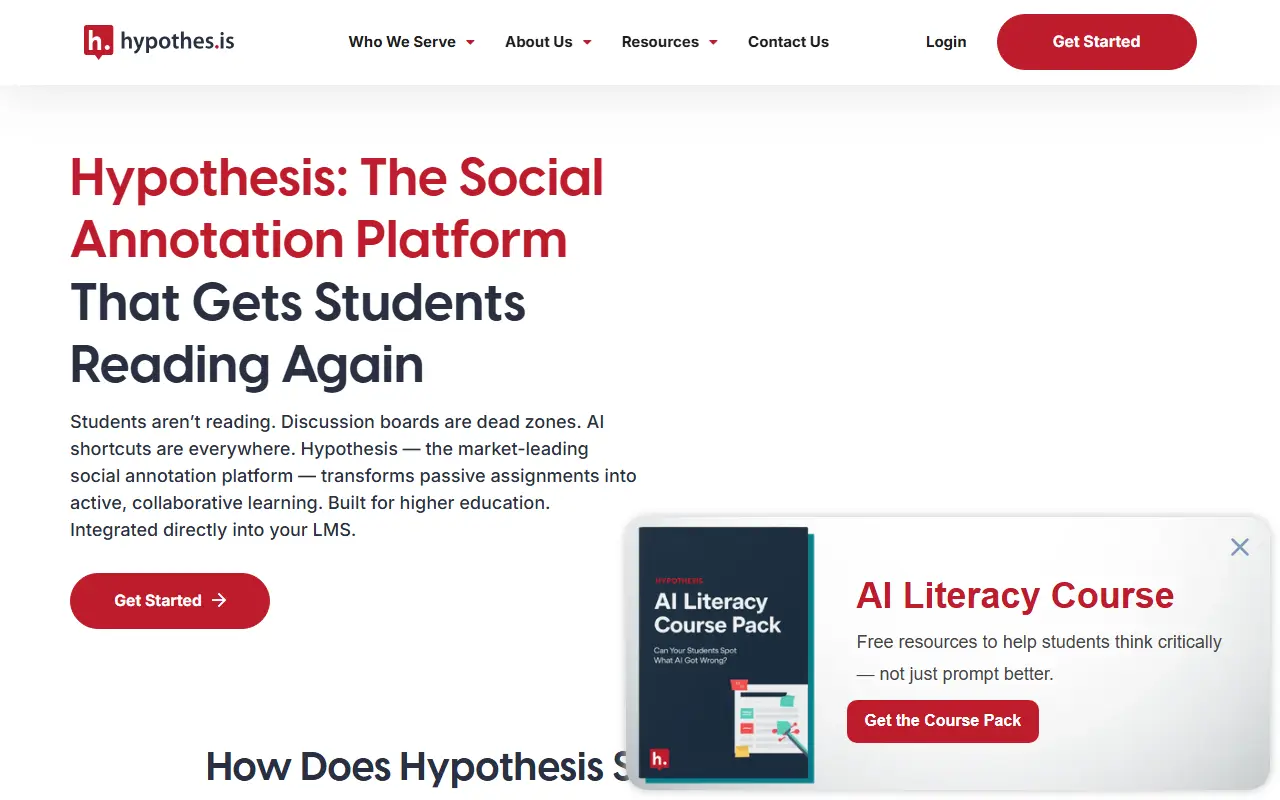
Hypothesis is a social annotation platform aimed at higher education. Students, faculty and colleagues highlight and comment directly on online articles, websites, videos and other content without switching platforms, and replies to an annotation turn it into a discussion over the material.
Users can tag peers inside annotations, which triggers notifications, and the platform integrates directly with a learning management system. The site says more than 300 institutions use it and cites results reported by institutions, such as a 32% increase in class retention and a 24% improvement in grades; these are the vendor's own figures.
It is sold per student per year in tiers: a Free tier with core annotation and private groups, then Bronze, Silver and Gold packages that add LMS integration, seat limits, analytics, auto-grading and training. The pages address colleges and universities, faculty, students, businesses and research.
Key features
- Highlight and comment on web content in place
- Replies to annotations form discussions
- Tagging peers triggers notifications
- Direct LMS integration
- Auto-grading and advanced analytics on Silver
- Hypothesis Academy courses for educators
Good fit for
- Class reading assignments with group annotation
- Course discussions anchored to a text
H: questions and answers
- What is H used for?
- H is a social annotation platform for higher education where students and faculty highlight and comment on web content, integrated with learning management systems. It is a good fit for class reading assignments with group annotation and course discussions anchored to a text.
- Is H open source?
- Yes. H is open source under the BSD-2-Clause licence. Its source code is on GitHub at hypothesis/h and is written mainly in Python.
- Is H free?
- Yes. H is open source, so the software itself is free to use.
- Can I self-host H?
- Yes. H can be self-hosted on your own server or infrastructure.
- What is H an alternative to?
- H is an open-source alternative to Readwise, Glasp, Matter and LiquidText. Other open-source alternatives to Readwise include Zotero, Memex and Wallabag.
- Is H actively maintained?
- Yes. The most recent commit to H was on 11 November 2026, and the latest release is v0.39.0, published on 5 November 2019. The project has 3.2k stars on GitHub.
Open-source alternatives to H
See all
Zotero
Productivity
Zotero is a free, easy-to-use tool to help you collect, organize, annotate, cite, and shar
OSSvs Readwise★ 16k
Memex
Note Taking
Browser extension to curate, annotate, and discuss the most valuable content and ideas on
OSSvs Raindrop.io★ 4.7k
Wallabag
Productivity
With wallabag, archive the web freely. wallabag is a self hostable application for saving
MITvs Instapaper★ 13k
Butterfly
Note Taking
🎨 Powerful, minimalistic, cross-platform, opensource note-taking app
AGPL-3.0vs GoodNotes★ 2.1k
Sioyek
Productivity
Sioyek is a PDF viewer with a focus on textbooks and research papers
GPL-3.0vs Adobe Acrobat★ 10k
Karakeep
Productivity
Karakeep is the open-source bookmark manager for links, notes, and images. Automatically o
AGPL-3.0vs Raindrop.io★ 30k
SaaS alternatives to H
See all
Readwise
Note Taking
Collects highlights from books and articles for review and export to note apps
SaaS
Glasp
Note Taking
Web highlighter that saves and shares highlights and notes from articles and videos
SaaS
Matter
Productivity
Reading app that brings newsletters, feeds and read-later into one place with highlights
SaaS
LiquidText
Note Taking
PDF and document annotation workspace for connecting excerpts across files
SaaS
Flexcil
Note Taking
PDF reader and note-taking app with split view for iPad, iPhone, Mac and Windows
SaaS