7,363 open-source and SaaS tools, with GitHub stats refreshed every day.

4 alternatives ranked by real activity

Open-source Matter alternatives

A curated, ranked list of the 4 best open-source alternatives to Matter.

The best open-source alternative to Matter is Zotero. If that doesn't suit you, other good options are mdSilo, Memex and Archivy.

Matter alternatives are mainly note-taking tools, but some are also productivity tools. 2 of them shipped code in the last 30 days, 4 can be self-hosted, and 1 uses a permissive licence.

Last updated October 3, 2026 · ranked by GitHub stars, growth and recent commits

Zotero

Zotero is a free, open-source reference manager that collects, organizes, annotates, cites and shares research sources.

GitHub stars
15k
Last commit
today
Self-hosted
Yes
Hosted version
Available
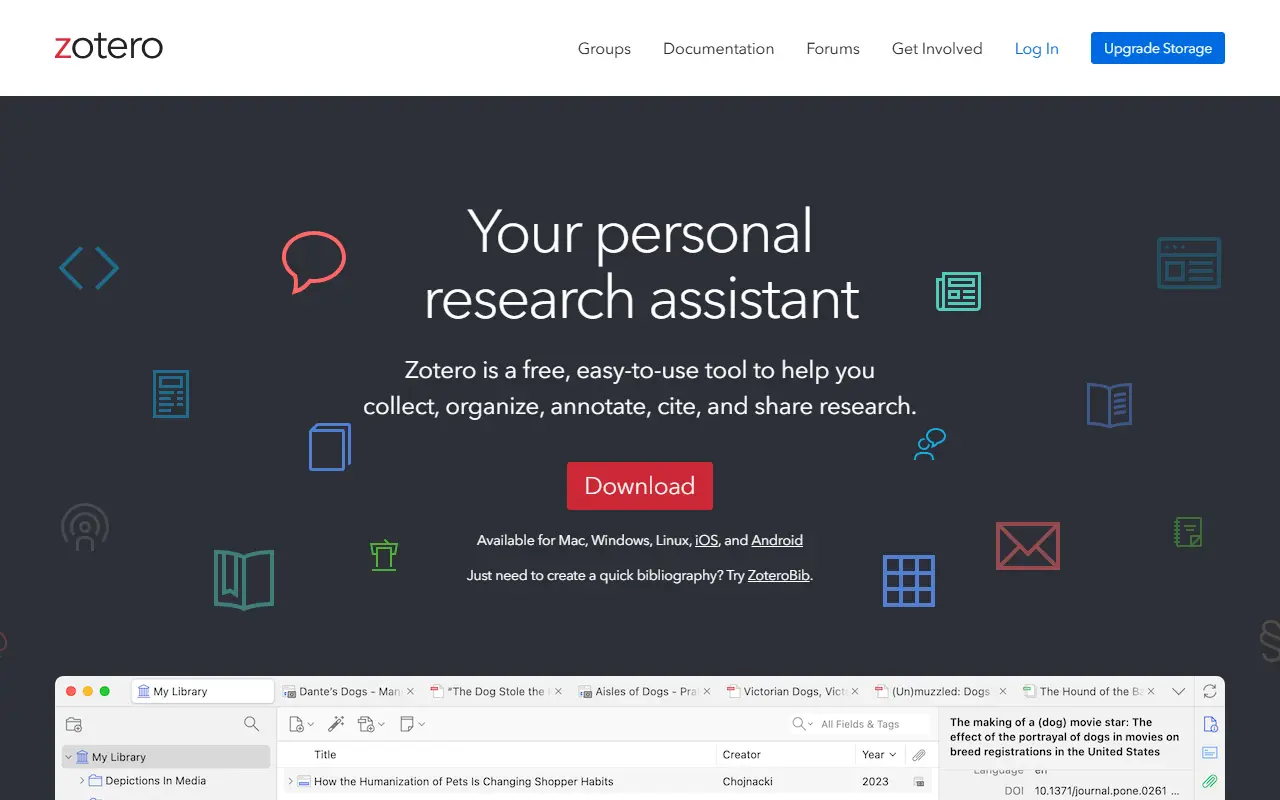
zotero.orgZotero homepage screenshot

Zotero is a free tool for managing research. It collects references as you browse the web, organizes them into collections with tags and saved searches, and helps you annotate, cite and share them. It is available for Mac, Windows, Linux, iOS and Android, and the source code in this repository is open.

A browser connector senses research material on sites it recognizes and saves it with a click. Citations and bibliographies can be generated for any text editor and directly inside Word, LibreOffice and Google Docs, with support for over 9,000 citation styles. A companion web tool, ZoteroBib, creates quick bibliographies without installing anything.

Syncing across devices is optional, and synced data can also be reached from a web browser. Libraries can be shared in groups, for co-writing a paper, distributing course materials or building a collaborative bibliography, with no limit on how many people join at no cost. The site also offers paid storage upgrades for synced files.

Key features

  • One-click capture of web research
  • Collections, tags and saved searches
  • Citations in over 9,000 styles
  • Word, LibreOffice and Google Docs integration
  • Optional sync across devices
  • Shared group libraries

Pricing: Free and open source to use; the website offers optional paid storage upgrades for synced files.

mdSilo

mdSilo is a local-first desktop knowledge base and feed reader built with Tauri, combining a Markdown editor, graph view, kanban and RSS.

GitHub stars
854
Last commit
3 days ago
Latest release
app-v0.5.9
Licence
AGPL-3.0
Self-hosted
Yes
mdsilo.commdSilo homepage screenshot

mdSilo is a lightweight knowledge base for storing ideas and notes, with a built-in feed reader. It is a local-first desktop app built with React and Tauri that works on top of local plain-text files, with no registration and no privacy concerns about cloud accounts.

The editor combines Markdown, WYSIWYG and mind map modes with diagrams, tables, math, highlighted code blocks, slash commands, a hovering toolbar and export to PDF or PNG. Notes can be explored in chronicle, graph and task views, and a kanban board helps manage a personal knowledge base like a project. The feed reader covers RSS, Atom and podcasts, and full-text search works across content.

Apps are available for Windows, macOS and Linux from the releases page or can be built from source with Rust and Node.js. The editor uses ProseMirror, the project has a roadmap including PDF and epub annotation, and it is licensed under AGPL-3.0.

Key features

  • Markdown, WYSIWYG and mind map editing
  • Graph, chronicle and task views
  • Kanban board for knowledge projects
  • RSS, Atom and podcast reader
  • Full-text search
  • Plain-text local file storage
  • Export to PDF and PNG

Pricing: Free and open source under the AGPL-3.0 license.

Memex

Memex by WorldBrain is a browser extension for curating, annotating and discussing web content, with full-text search over what you have saved.

GitHub stars
4.7k
Last commit
10 mo ago
Latest release
2.2.0
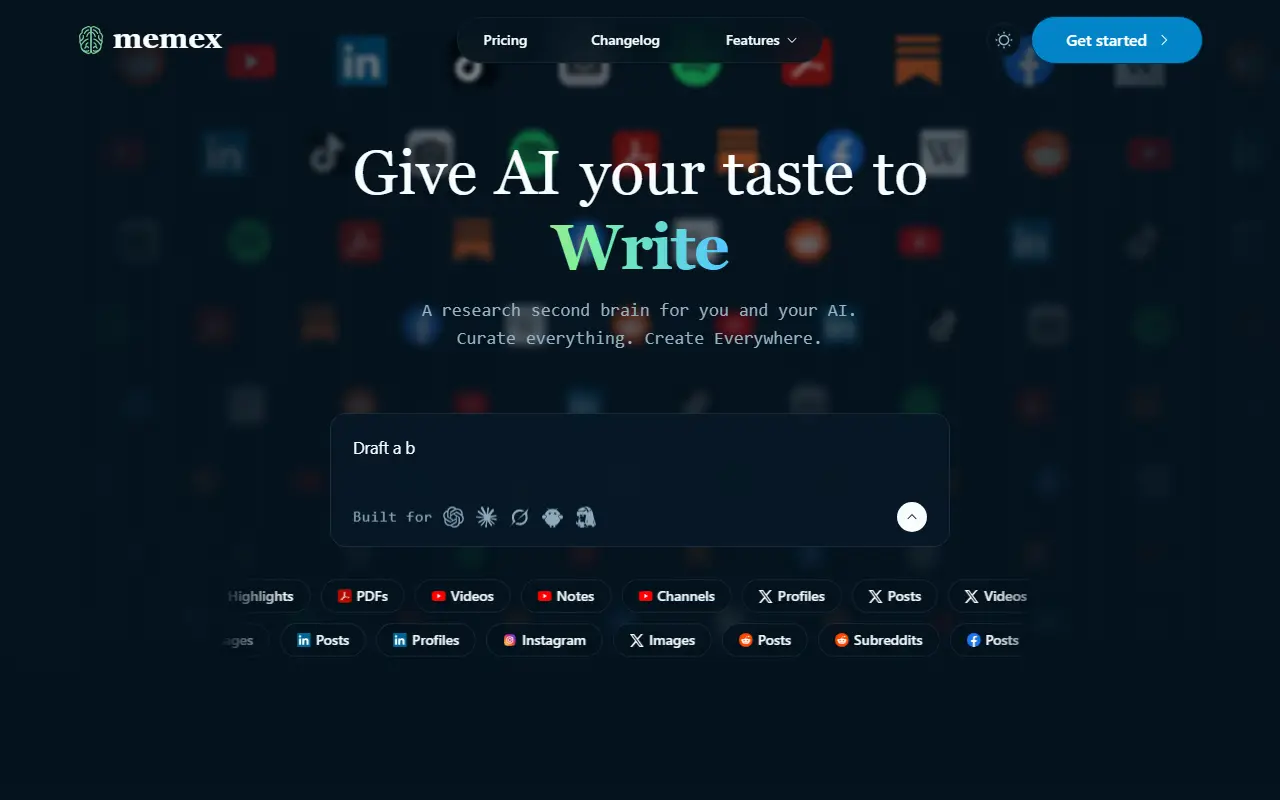
worldbrain.ioMemex homepage screenshot

Memex is a browser extension from WorldBrain for curating, annotating and discussing valuable content and ideas on the web, whether you work as an individual, a team or a community. It is available as an extension for Chrome and Firefox and focuses on research and note-taking from the pages you read.

The repository topics emphasize annotations and full-text search, so saved pages and your highlights and notes can be found again later. The product's homepage also states that Memex exposes its dashboard actions through the Model Context Protocol (MCP), with a discovery manifest and a gateway that returns matching actions on demand, so AI tools can work with it.

The code is written in TypeScript and is public on GitHub, but the repository metadata does not give a license, so check the project terms before reuse. The extension runs inside your browser, and sharing and discussion features depend on the vendor's own services.

Key features

  • Annotate and highlight web pages
  • Full-text search of saved content
  • Curate collections for sharing
  • Browser extension for Chrome and Firefox
  • MCP access to dashboard actions

Archivy

Archivy is a free, MIT-licensed, self-hostable Python knowledge base and wiki with bidirectional links, bookmark archiving and full-text search via Elasticsearch.

GitHub stars
3.3k
Last commit
3 yr ago
Latest release
v1.7.4
Licence
MIT
Self-hosted
Yes
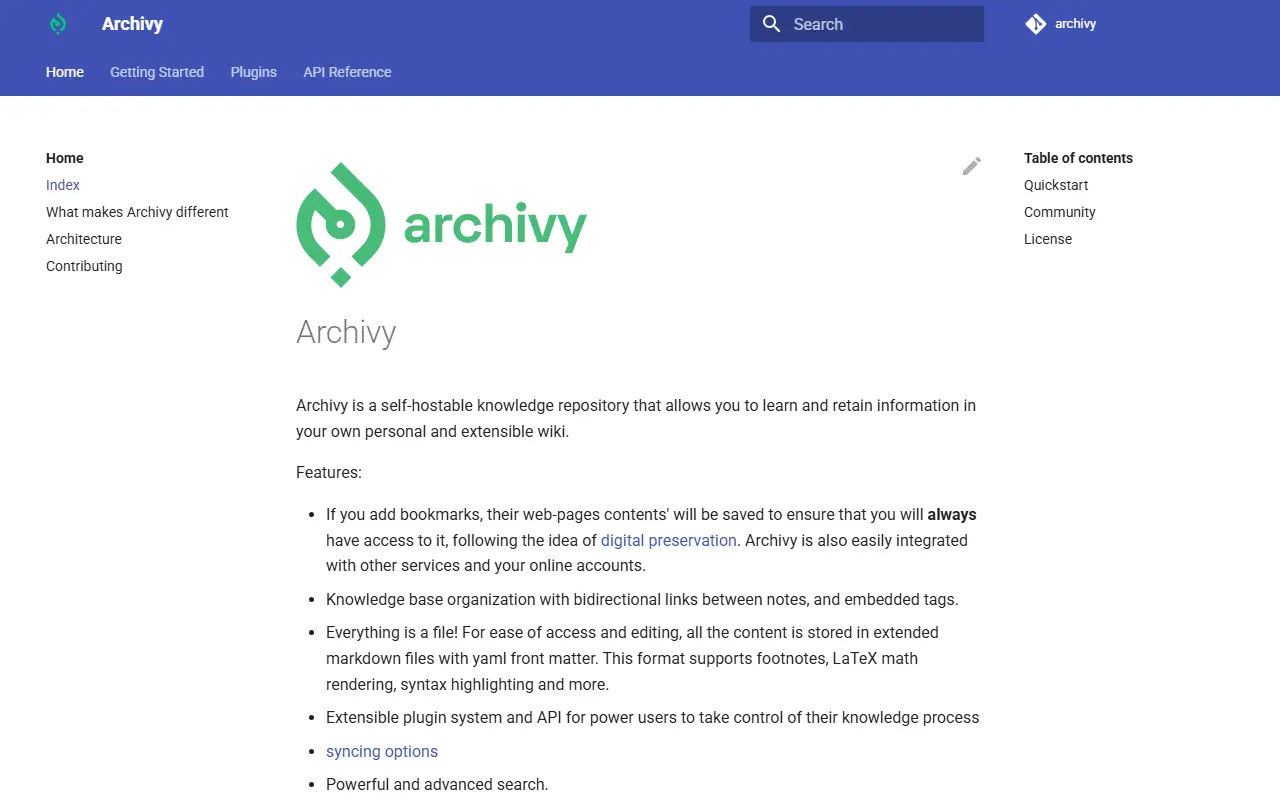
archivy.github.ioArchivy homepage screenshot

Archivy is a self-hostable knowledge repository meant to help individuals learn and retain information in their own personal, extensible wiki. It is aimed at people building a 'digital brain' or personal knowledge base who want full control over their data rather than relying on a cloud note service.

Bookmarked web pages have their content saved for digital preservation, and notes support bidirectional links and embedded tags for organizing the knowledge base. Everything is stored as extended markdown files with YAML front matter, which supports footnotes, LaTeX math, syntax highlighting and other markdown extensions, and content can be searched with the help of Elasticsearch. An extensible plugin system and API let power users customize their workflow, and sync options and image upload are also supported.

Archivy is installed with pip or Docker, after which an init command and a CLI-created user account get it running locally on port 5000. It is written in Python and released under the MIT license. The roadmap mentions annotations and a multi-user permission system as upcoming features.

Key features

  • Bidirectional links between notes
  • Bookmark content preservation
  • Markdown files with YAML front matter
  • Elasticsearch-powered full-text search
  • Extensible plugin system and API
  • Image upload support

Pricing: Free and open source under the MIT license.

Matter alternatives: questions

What is the best open-source alternative to Matter?
Zotero is the top-ranked open-source alternative to Matter on Enlisted: Zotero is a free, open-source reference manager that collects, organizes, annotates, cites and shares research sources. Other strong options are mdSilo, Memex and Archivy.
Are these Matter alternatives free?
All 4 are open source, so the code is free to use under its licence, and all of them can be self-hosted on your own server or computer. 1 also offers a paid or managed cloud version if you'd rather not host it yourself.
How is this list of Matter alternatives ranked?
By a score built from GitHub stars, star growth over the last 30 days and how recently the code changed. 2 of these projects shipped code in the last 30 days. Data is refreshed daily, and nobody can pay to move up.

People also look for alternatives to…

View all