
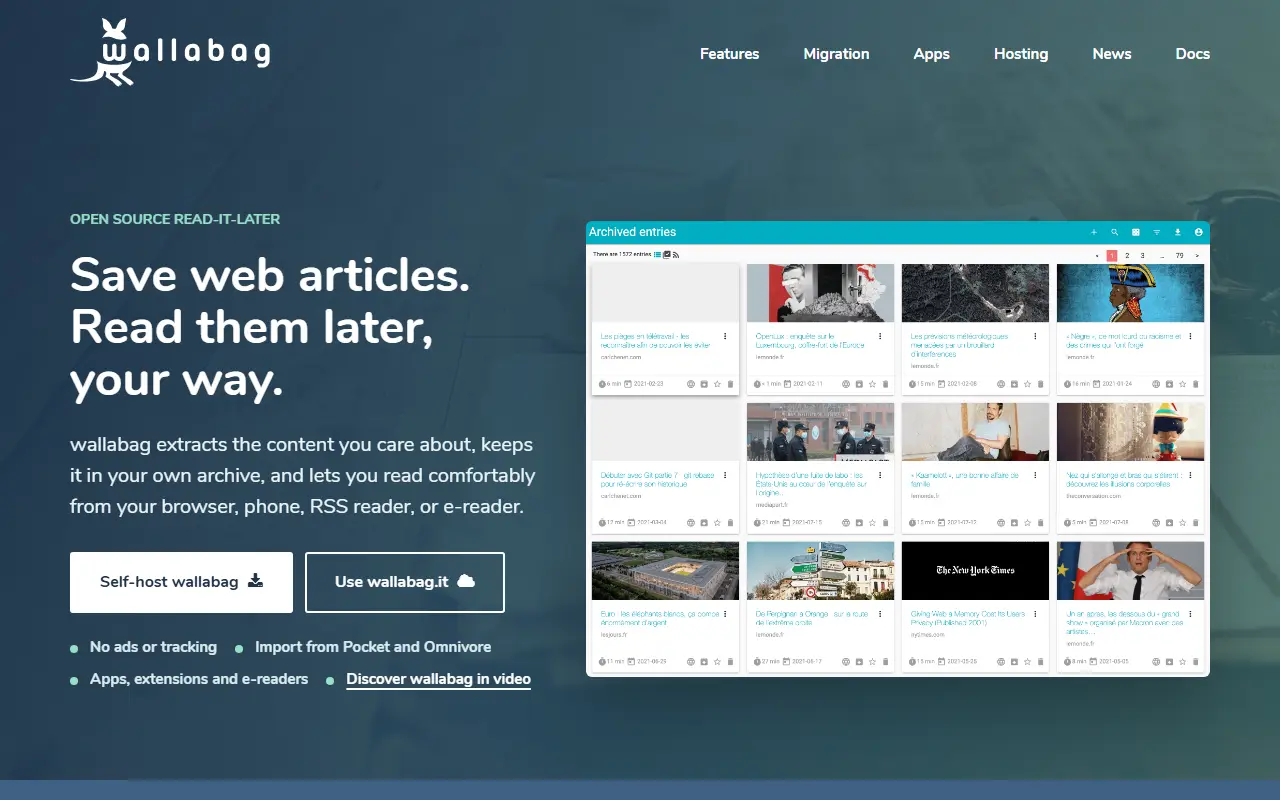
About Wallabag
wallabag is a web application for saving pages to read later. You click to save an article, and wallabag extracts the main content so that pop-ups and other page clutter do not get in the way when you open it again. Saved articles can be classified, so a growing reading list stays organized.
The project can be installed on your own server or used through an account on the hosted service at wallabag.it. Companion projects cover an Android app, an iOS app and a browser extension, and a GNOME desktop reader exists that is not maintained by the project itself. Content extraction relies on the Graby and php-readability libraries together with the ftr-site-config rules, and translations are managed on Weblate.
wallabag is written in PHP on the Symfony framework and released under the MIT license. Installation requires configuring a virtual host after running the documented commands, and other installation methods are described in the documentation at doc.wallabag.org. Its name is always written in lowercase, as the maintainers point out.
Key features
- Save web pages for later reading
- Content extraction that removes page clutter
- Article classification and organization
- Android and iOS apps
- Browser extension for one-click saving
- Self-hosted on a PHP and Symfony stack
Good fit for
- →Building a private reading list
- →Hosting your own read-it-later service
- Built with
- PHP
- Tags
- read-it-later
- bookmarks
- self-hosted
- php
- symfony
- article-saving
- reader-mode
Wallabag: questions and answers
- What is Wallabag used for?
- Wallabag is a self-hostable read-it-later web app that saves web pages, strips clutter and lets you classify and read articles on your own schedule. It is a good fit for building a private reading list and hosting your own read-it-later service.
- Is Wallabag open source?
- Yes. Wallabag is open source under the MIT licence. Its source code is on GitHub at wallabag/wallabag and is written mainly in PHP.
- Is Wallabag free?
- Yes. Wallabag is open source, so the software itself is free to use. A managed cloud version is also available.
- Can I self-host Wallabag?
- Yes. Wallabag can be self-hosted on your own server or infrastructure.
- What is Wallabag an alternative to?
- Wallabag is an open-source alternative to Instapaper, Raindrop.io and Pinboard. Other open-source alternatives to Instapaper include Karakeep and Linkwarden.
- Is Wallabag actively maintained?
- Yes. The most recent commit to Wallabag was on 28 September 2026, and the latest release is 2.6.14, published on 7 October 2025. The project has 13k stars on GitHub.
Open-source alternatives to Wallabag
See all
Karakeep
Productivity
Karakeep is the open-source bookmark manager for links, notes, and images. Automatically o
AGPL-3.0vs Raindrop.io★ 29k
Linkwarden
Productivity
Collect, read, annotate, and fully preserve what matters. Open-source, self-hostable bookm
AGPL-3.0vs Raindrop.io★ 20k
Shiori
Productivity
Simple bookmark manager built with Go
MITvs Raindrop.io★ 12k
Shaarli
Productivity
The personal, minimalist, super-fast, database free, bookmarking service - community repo
OSSvs Pinboard★ 3.9k
LinkAce
Productivity
LinkAce is a self-hosted archive to collect links of your favorite websites.
GPL-3.0vs Raindrop.io★ 3.3k
Linkding
Productivity
A self-hosted bookmarking service that is designed to be minimal, fast and easy to set up.
MITvs Raindrop.io★ 11k
SaaS alternatives to Wallabag
See all
Instapaper
Productivity
Read-it-later app for saving and reading articles without distractions
SaaS
Raindrop.io
Productivity
Bookmark manager with collections, tags and full-text search
SaaS
Pinboard
Productivity
Paid bookmarking service with tagging and page archiving
SaaS
Feedly
Productivity
RSS reader and content curation tool with AI feeds and team boards
SaaS
Readwise
Note Taking
Collects highlights from books and articles for review and export to note apps
SaaS
Bookmarker
Productivity
Bookmark manager with AI analysis, auto tags and descriptions, and smart search
SaaS