7,380 open-source and SaaS tools, with GitHub stats refreshed every day.

4 alternatives ranked by real activity

Open-source SciSpace alternatives

A curated, ranked list of the 4 best open-source alternatives to SciSpace.

The best open-source alternative to SciSpace is Open Notebook. If that doesn't suit you, other good options are GPT Researcher, SurfSense and Scira.

SciSpace alternatives are mainly AI tools. 3 of them shipped code in the last 30 days, 4 can be self-hosted, and 2 use a permissive licence.

Last updated October 3, 2026 · ranked by GitHub stars, growth and recent commits

Open Notebook

A privacy-focused, self-hosted alternative to Google's NotebookLM that supports many AI providers, multimodal sources, podcast generation and search.

GitHub stars
40k
Last commit
today
Latest release
v1.14.0
Licence
MIT
Self-hosted
Yes
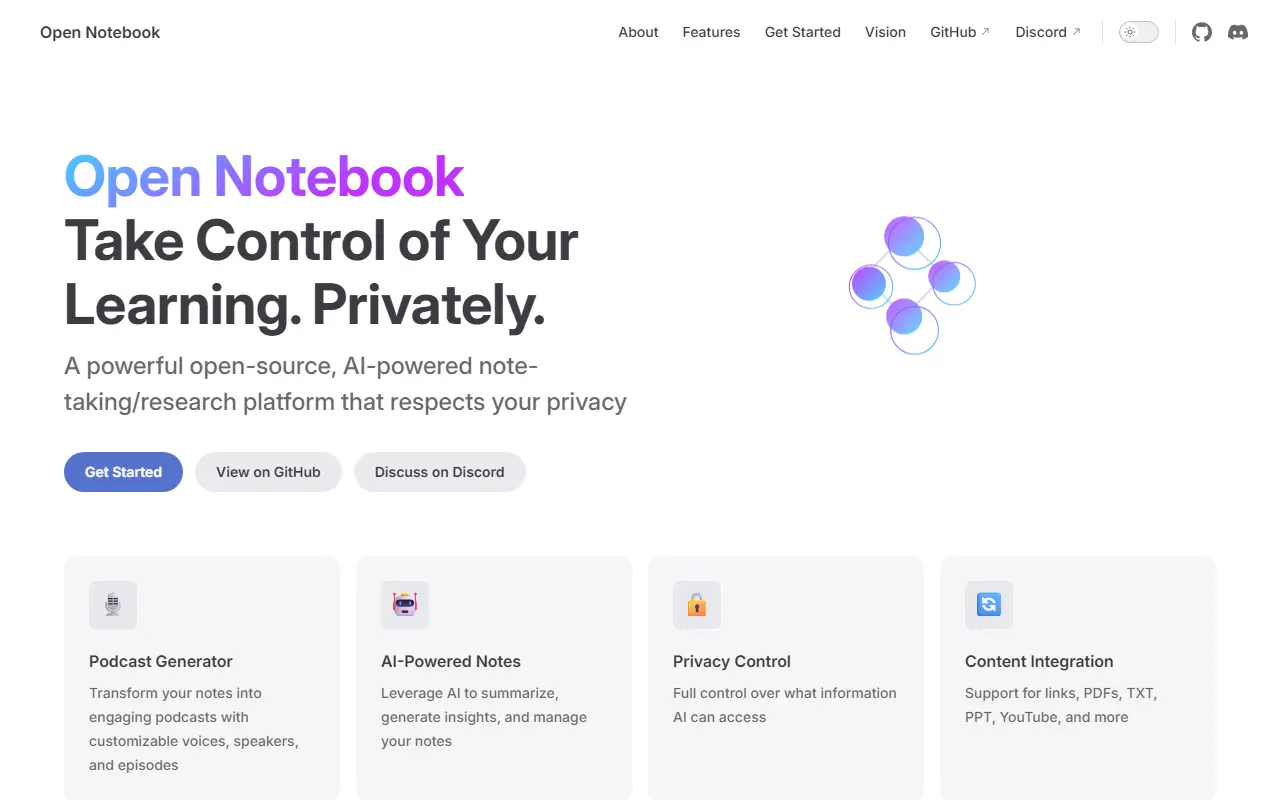
open-notebook.aiOpen Notebook homepage screenshot

Open Notebook is a privacy-oriented, open-source option for people who want something like Google's NotebookLM for researching and learning with AI. It is written in TypeScript and released under the MIT license. The project describes itself as private, multi-model and fully local, so your research material stays on infrastructure you control instead of a single cloud provider.

It supports more than a dozen AI providers, including OpenAI, Anthropic, Ollama and LM Studio, and lets you organize multimodal content such as PDFs, videos, audio and web pages. Features include podcasts with several speakers, keyword and vector search over everything you add, and chat conversations grounded in your own sources. The interface is available in several languages, including Portuguese, Chinese, Japanese, Russian and Bengali.

The README compares Open Notebook with Google NotebookLM across privacy and control, choice of AI provider and more, and links a getting-started guide, user guide, feature list and deployment instructions. A Discord server is open for help and workflow ideas. It suits students, researchers and knowledge workers who want a NotebookLM-style workflow with their own choice of models.

Key features

  • Self-hosted NotebookLM-style research notebooks
  • Support for many AI providers and local models
  • PDFs, video, audio and web page sources
  • Multi-speaker podcast generation
  • Full-text and vector search
  • Chat grounded in your sources
  • Interface in multiple languages

Pricing: Free and open source under the MIT license.

GPT Researcher

An autonomous research agent that searches the web and local documents using any LLM provider and writes detailed, cited research reports.

GitHub stars
30k
Last commit
yesterday
Latest release
v3.7.0
Licence
Apache-2.0
Self-hosted
Yes
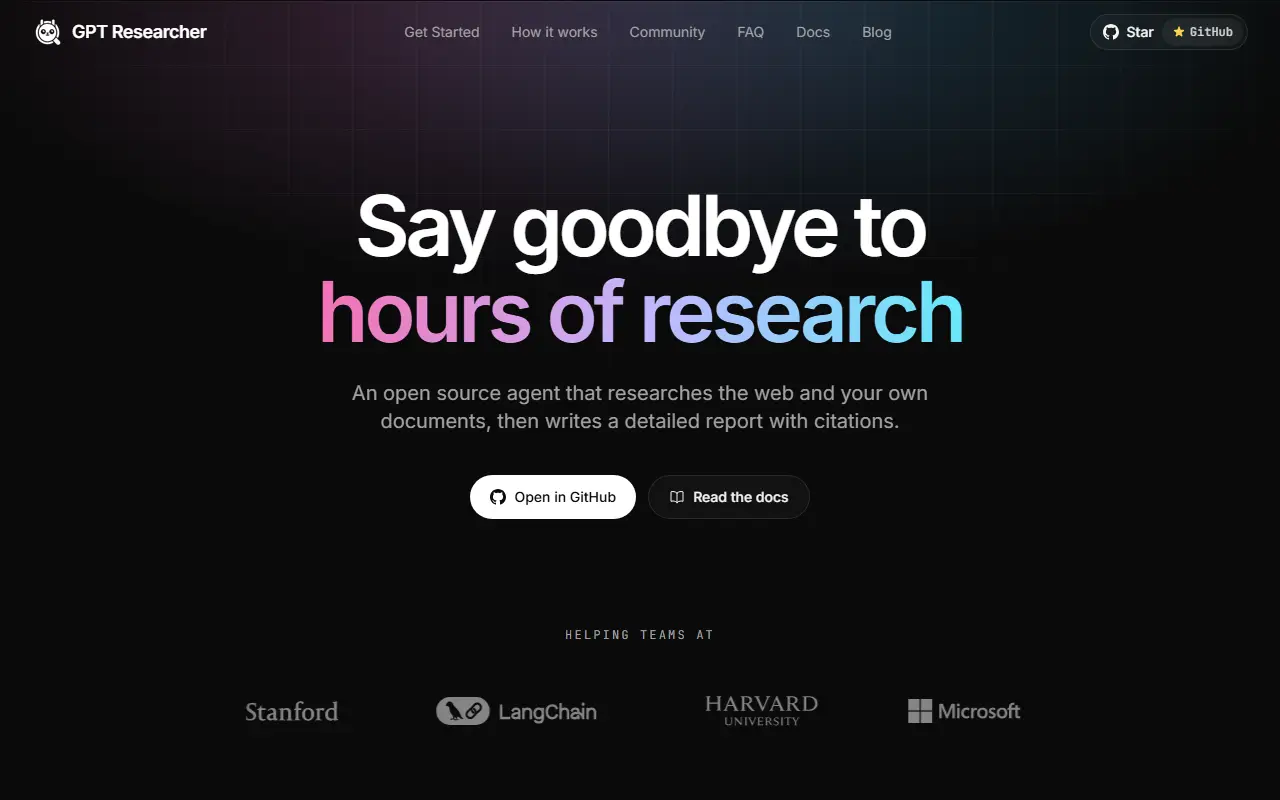
gptr.devGPT Researcher homepage screenshot

GPT Researcher is an open-source autonomous agent that performs deep research on a given task and writes up a report with citations. It can work from web sources and from local documents, and it works with any LLM provider, aiming for factual, unbiased output rather than a quick chatbot answer.

The project positions itself against several limits of manual and LLM-only research: manual work can take weeks, models trained on old data may hallucinate, token limits make long reports hard, and a narrow source set leads to shallow or wrong conclusions. Drawing on Plan-and-Solve and RAG ideas, it splits research into planning and parallelized agent work to increase speed and keep behavior stable. Customization options let you tailor domain-specific research agents, and topics note MCP server support.

GPT Researcher is written in Python and Apache-2.0 licensed, with documentation in several languages and a website at gptr.dev. You run it yourself with your own model API keys, and it suits analysts, students and developers who want automated, source-backed reports on a topic.

Key features

  • Autonomous deep research on any topic
  • Reports with source citations
  • Web and local document research
  • Works with any LLM provider
  • Parallelized agent work for speed
  • MCP server support

Pricing: GPT Researcher is free under the MIT license with no SaaS subscription; you pay only your own LLM and search providers. Managed deployments are arranged by contacting the maintainer.

SurfSense

A private, air-gapped desktop alternative to NotebookLM that turns your own documents into cited answers, briefings, slide decks, reports, study guides and podcasts.

GitHub stars
16k
Last commit
today
Latest release
v2.0.3
Self-hosted
Yes
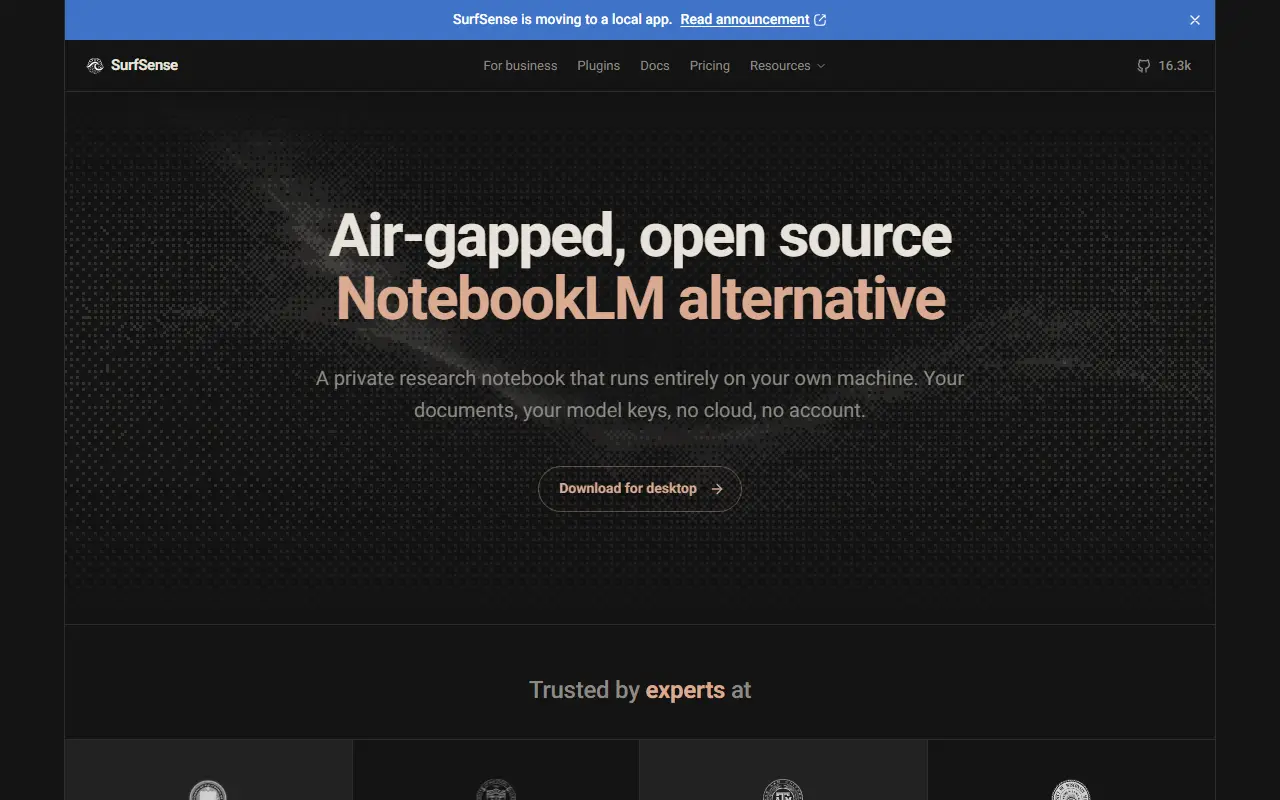
surfsense.comSurfSense homepage screenshot

SurfSense is a free, open-source desktop app positioned as an air-gapped alternative to NotebookLM. You drop in documents you already have, ask questions and receive answers with citations to the sources, then convert the same material into a briefing, slide deck, report, study guide or podcast. Everything runs on your own machine, which makes it suitable for documents you cannot upload to a cloud service.

The search index lives on your disk, you choose the model, and the app uploads nothing. You may supply your own model API key, or have the app download a local model, and no account is required. Installers are provided for Windows x64, macOS on Apple Silicon, and Linux as an AppImage or deb package. The project also links documentation, a comparison with other tools, pricing information and a Discord community, and topics mention RAG, agents and web scraping.

SurfSense is written in Python, and its license is listed as 'Other' on GitHub, so confirm the terms. It suits researchers, analysts and professionals handling confidential material who want NotebookLM-style features while keeping data local.

Key features

  • Cited answers from your own documents
  • Briefings, decks, reports and study guides
  • Podcast-style audio generation
  • Runs entirely on your machine
  • Bring your own model or use a local one
  • Desktop installers for Windows, macOS and Linux

Pricing: The app is free forever, with a 30-day plugin licence included. An Individual licence is $120 a year ($60 in the first year at the early-bird price); Enterprise is custom.

Scira

Scira is an open-source AI search and research tool that plans, retrieves and cites sources, accepting questions, PDFs and URLs.

GitHub stars
12k
Last commit
1 mo ago
Licence
AGPL-3.0
Self-hosted
Yes
Hosted version
Available
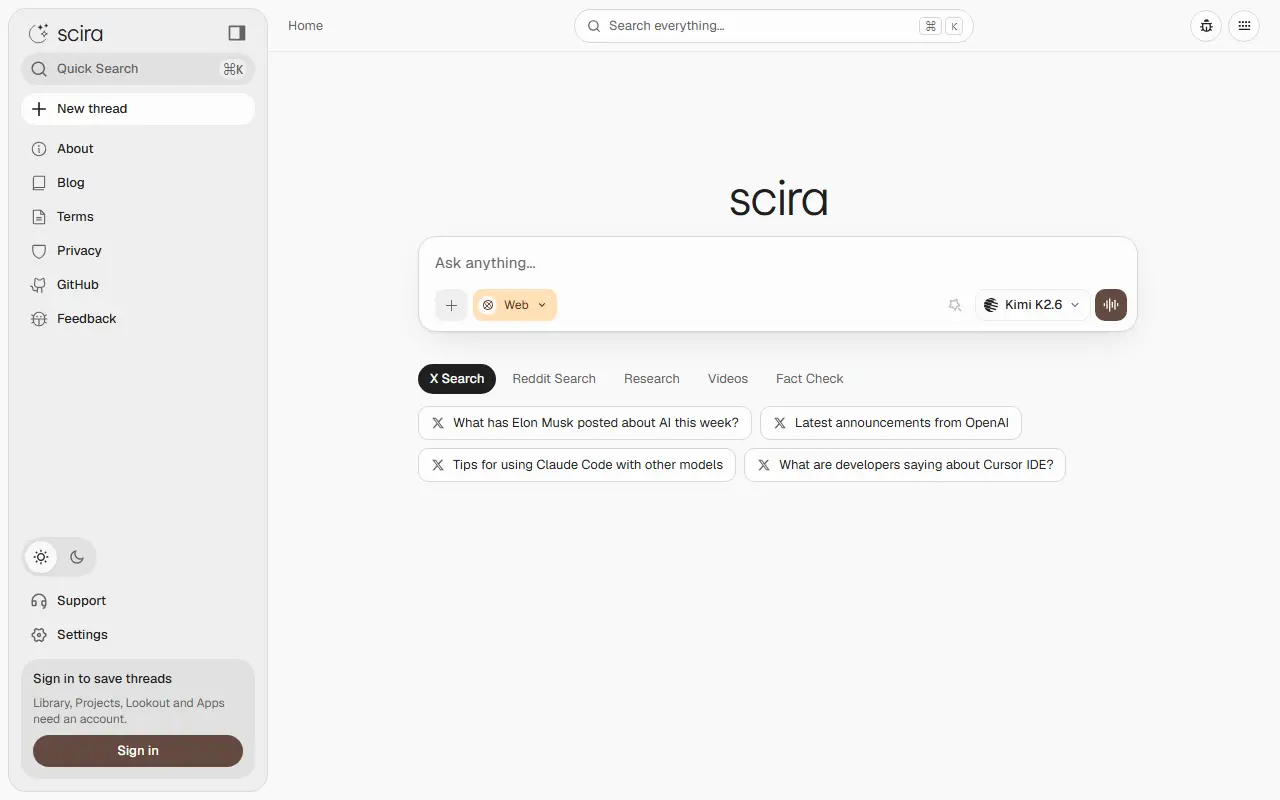
scira.aiScira homepage screenshot

Scira, formerly called MiniPerplx, is a minimalistic AI search tool that finds information online and cites where it came from. The project describes it as an agentic research platform that plans, retrieves and cites, and it is available as a hosted site at scira.ai.

You can start by asking a question, uploading a PDF or pasting a link. Behind it, the README credits the Vercel AI SDK for model integration and streaming, Exa AI for web search and content retrieval, and Upstash for serverless Redis and rate limiting. It is written in TypeScript as a web app you can run yourself with your own provider keys.

Scira is licensed under AGPL-3.0, so modified versions offered over a network must share their source. It suits developers who want a reference AI search app to run or adapt, and individuals who want a cited, minimalistic alternative to conventional search.

Key features

  • AI search with cited sources
  • Agentic research that plans and retrieves
  • PDF upload and URL input
  • Built on the Vercel AI SDK
  • Web search through Exa
  • Self-hostable TypeScript app

Pricing: Free plan allows 3 searches a day. Pro costs $15 per month ($9 with a student email) and Max $60 per month for higher model limits and image generation.

SciSpace alternatives: questions

What is the best open-source alternative to SciSpace?
Open Notebook is the top-ranked open-source alternative to SciSpace on Enlisted: A privacy-focused, self-hosted alternative to Google's NotebookLM that supports many AI providers, multimodal sources, podcast generation and search. Other strong options are GPT Researcher, SurfSense and Scira.
Are these SciSpace alternatives free?
All 4 are open source, so the code is free to use under its licence, and all of them can be self-hosted on your own server or computer. 1 also offers a paid or managed cloud version if you'd rather not host it yourself.
How is this list of SciSpace alternatives ranked?
By a score built from GitHub stars, star growth over the last 30 days and how recently the code changed. 3 of these projects shipped code in the last 30 days. Data is refreshed daily, and nobody can pay to move up.

People also look for alternatives to…

View all