
 Payhip
 Shoplazza
 Nuvemshop
 Shift4Shop
 Foxy
Foxy Gumroad
 Volusion
 Zoho Commerce
 Snipcart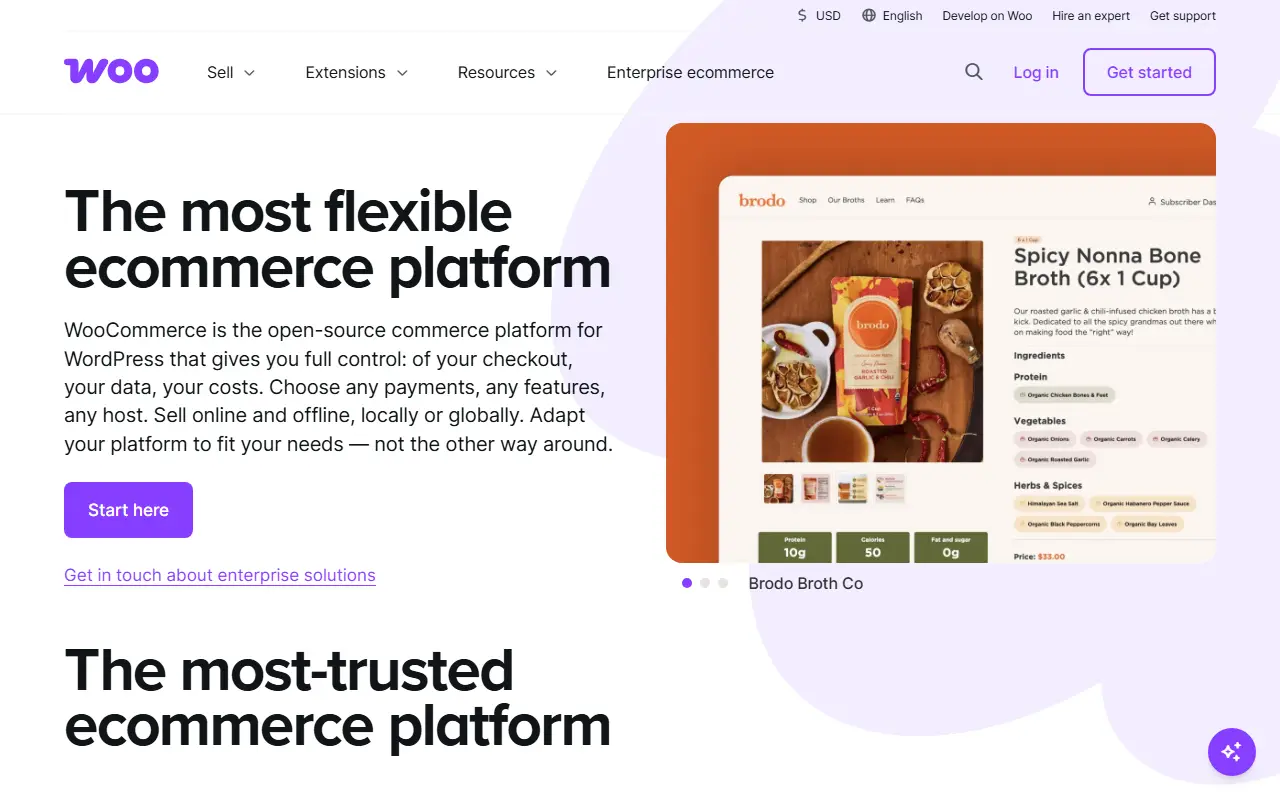
About WooCommerce
WooCommerce is a customizable ecommerce platform that runs on WordPress, written mainly in PHP. The GitHub repository is a monorepo with the plugins, packages and tooling for developing the core WooCommerce plugin together with its extensions, so it is where the project's code, issues and development discussions live.
Developers working on it need Node.js, PNPM, PHP 7.4 or higher and Composer, and a POSIX-compliant operating system is assumed, with WSL recommended on Windows. The project maintains a development blog and a developer account on X for updates, and the topics reference React, since parts of its admin interface use it.
Because it is built on WordPress, merchants typically run WooCommerce on their own hosting, adding products, payments and shipping through extensions. The repository lists the license as Other, so check the licence terms in the repository. It suits small and mid-sized shops, agencies and developers who already work in the WordPress ecosystem.
Key features
- Ecommerce functionality on WordPress
- Extensions add features to the core
- Monorepo of plugins and packages
- PHP codebase with React-based admin parts
- Developer blog and documentation
- Large ecosystem of third-party extensions
Good fit for
- →Adding a shop to a WordPress site
- →Agencies building custom online stores
- →Developing WooCommerce extensions
- Built with
- PHP
- Tags
- ecommerce
- wordpress
- php
- online-store
- plugin
- woocommerce
- shopping-cart
- monorepo
WooCommerce: questions and answers
- What is WooCommerce used for?
- WooCommerce is a customizable open-source ecommerce platform built as a plugin for WordPress; this repository is the monorepo for the core plugin and its extensions. It is a good fit for adding a shop to a WordPress site, agencies building custom online stores and developing WooCommerce extensions.
- Is WooCommerce open source?
- Yes. WooCommerce is open source under a custom licence. Its source code is on GitHub at woocommerce/woocommerce and is written mainly in PHP.
- Is WooCommerce free?
- Yes. WooCommerce is open source, so the software itself is free to use under the terms of its own licence.
- Can I self-host WooCommerce?
- Yes. WooCommerce can be self-hosted on your own server or infrastructure.
- What is WooCommerce an alternative to?
- WooCommerce is an open-source alternative to BigCommerce, Ecwid, Shopify and Square Online. Other open-source alternatives to BigCommerce include Bagisto, PrestaShop and OpenCart.
- Is WooCommerce actively maintained?
- Yes. The most recent commit to WooCommerce was on 2 October 2026, and the latest release is 11.1.2, published on 22 September 2026. The project has 11k stars on GitHub.
Open-source alternatives to WooCommerce
See all
Bagisto
E-commerce
Open Source eCommerce & Multi-Vendor Marketplace Platform Built with Laravel for Enterpris
MITvs BigCommerce★ 28k
PrestaShop
E-commerce
PrestaShop is the universal open-source software platform to build your e-commerce solutio
OSSvs BigCommerce★ 9.2k
OpenCart
E-commerce
A free shopping cart system. OpenCart is an open source PHP-based online e-commerce soluti
OSSvs Shopify★ 8.2k
EverShop
E-commerce
🛍️ Typescript E-commerce Platform
GPL-3.0vs BigCommerce★ 10k
Magento Open Source
E-commerce
Prior to making any Submission(s), you must sign an Adobe Contributor License Agreement, a
OSL-3.0vs BigCommerce★ 12k
nopCommerce
E-commerce
ASP.NET Core eCommerce software. nopCommerce is a free and open-source shopping cart.
OSSvs BigCommerce★ 10k
SaaS alternatives to WooCommerce
See all
BigCommerce
E-commerce
Hosted ecommerce platform with built-in B2B features and headless options
SaaS
Ecwid
E-commerce
Embeddable online store that adds a shop to an existing website
SaaS
Shopify
E-commerce
Hosted ecommerce platform for online stores, point of sale and checkout
SaaS
Square Online
E-commerce
Online store builder tied to Square payments and point of sale
SaaS
Big Cartel
E-commerce
Store builder aimed at artists, makers and independent merchants
SaaS
Sellfy
E-commerce
Storefront for creators selling digital products, subscriptions and print on demand
SaaS