6,598 open-source and SaaS tools, with GitHub stats refreshed every day.

8 alternatives ranked by real activity

Open-source Swell alternatives

A curated, ranked list of the 8 best open-source alternatives to Swell.

The best open-source alternative to Swell is Medusa. If that doesn't suit you, other good options are Saleor, Spree Commerce, EverShop and Sylius.

Swell alternatives are mainly E-commerce tools. 6 of them shipped code in the last 30 days, 8 can be self-hosted, and 3 use a permissive licence.

Last updated October 2, 2026 · ranked by GitHub stars, growth and recent commits

Medusa

A TypeScript commerce platform with a customization framework and modular building blocks for B2B and direct-to-consumer stores, marketplaces and other commerce apps.

GitHub stars
37k
Last commit
today
Latest release
v2.21.2
Self-hosted
Yes
Hosted version
Available
medusajs.comMedusa homepage screenshot

Medusa is an open-source commerce platform that includes its own framework for customizing behavior. Rather than a fixed storefront product, it supplies foundational commerce building blocks, so developers can assemble custom commerce applications without reinventing core logic such as carts, orders and payments.

The framework and modules can power advanced B2B or direct-to-consumer stores, marketplaces, distributor platforms, point-of-sale systems and service businesses. Its core commerce modules are open source and published on npm, while Enterprise Edition features are marked separately in the repository. It is written in TypeScript on Node.js, and its topics mention AI coding tools alongside the standard e-commerce stack. Release notes and an integrations catalog help teams keep a project current and connected to payment, shipping and other services.

For hosting, Medusa Cloud is a managed environment tuned for Medusa apps with automated deployments, scaling and maintenance, and you can also run the code locally or on your own servers by following the documentation. The license is listed as 'Other', so review which components are covered by which terms.

Key features

  • Modular commerce building blocks
  • Framework for custom commerce logic
  • Support for B2B and direct-to-consumer stores
  • Core modules published on npm
  • Managed Medusa Cloud hosting
  • Integrations and release notes

Pricing: Medusa Cloud starts at $29 per month (Develop), then $99 (Launch) and $299 (Scale) per month; Enterprise is custom. The open-source software itself is free.

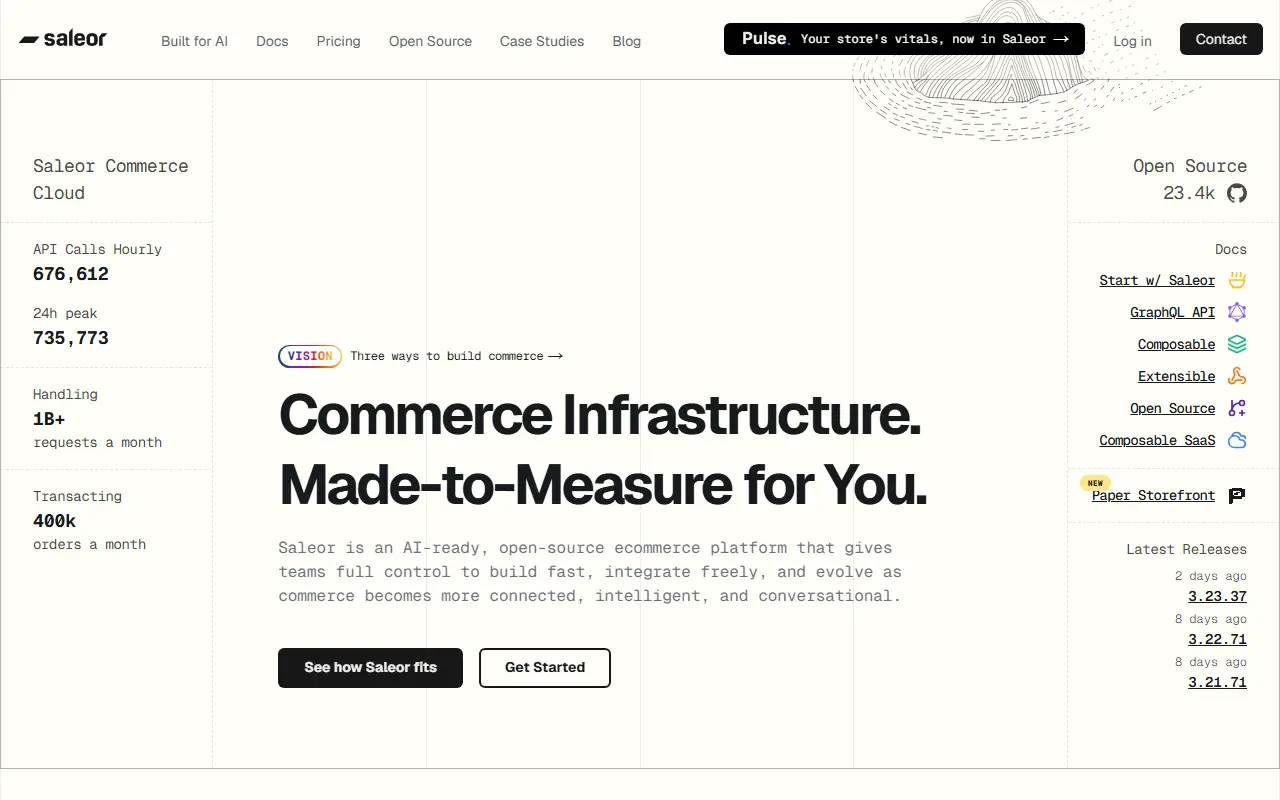
Saleor

An API-only, GraphQL-native headless commerce platform written in Python for composable, multichannel online stores.

GitHub stars
23k
Last commit
today
Latest release
3.23.37
Licence
BSD-3-Clause
Self-hosted
Yes
Hosted version
Available
saleor.ioSaleor homepage screenshot

Saleor Core is an open-source headless commerce platform written in Python. It is API-only and GraphQL-native, so storefronts, dashboards and other clients talk to the backend exclusively through its API, which makes it a building block for composable commerce rather than a monolithic store application.

The project highlights several design choices: technology-agnostic, with no monolithic plugin system or lock-in; GraphQL only rather than a mix of API styles; open source with a single version and no feature fragmentation; cloud native; and native multichannel, with per-channel control over pricing, currencies, stock and products. Extension happens through webhooks and apps instead of modifying core code. Topics also mention product information management and order management.

Saleor is BSD-3-Clause licensed. The wider platform includes a separate dashboard and a storefront, and the README links documentation and community channels. You can self-host the core or use the vendor's cloud offering, and it suits engineering teams building custom shops, marketplaces and multi-country commerce experiences.

Key features

  • GraphQL-native, API-only architecture
  • Native multichannel pricing and stock control
  • Extensible through webhooks and apps
  • Product and order management
  • Technology-agnostic composable design
  • Separate dashboard and storefront projects

Pricing: Cloud Sandboxes are free for non-commercial use. Select is $1599 per month and Volume $3999 per month, each with a GMV allowance and a percentage fee above it; Enterprise is negotiated.

Spree Commerce

An open-source Ruby commerce platform for marketplaces, B2B and headless stores, shipping a REST API, TypeScript SDKs, an admin dashboard and a storefront.

GitHub stars
16k
Last commit
today
Latest release
v5.6.1
Licence
BSD-3-Clause
Self-hosted
Yes
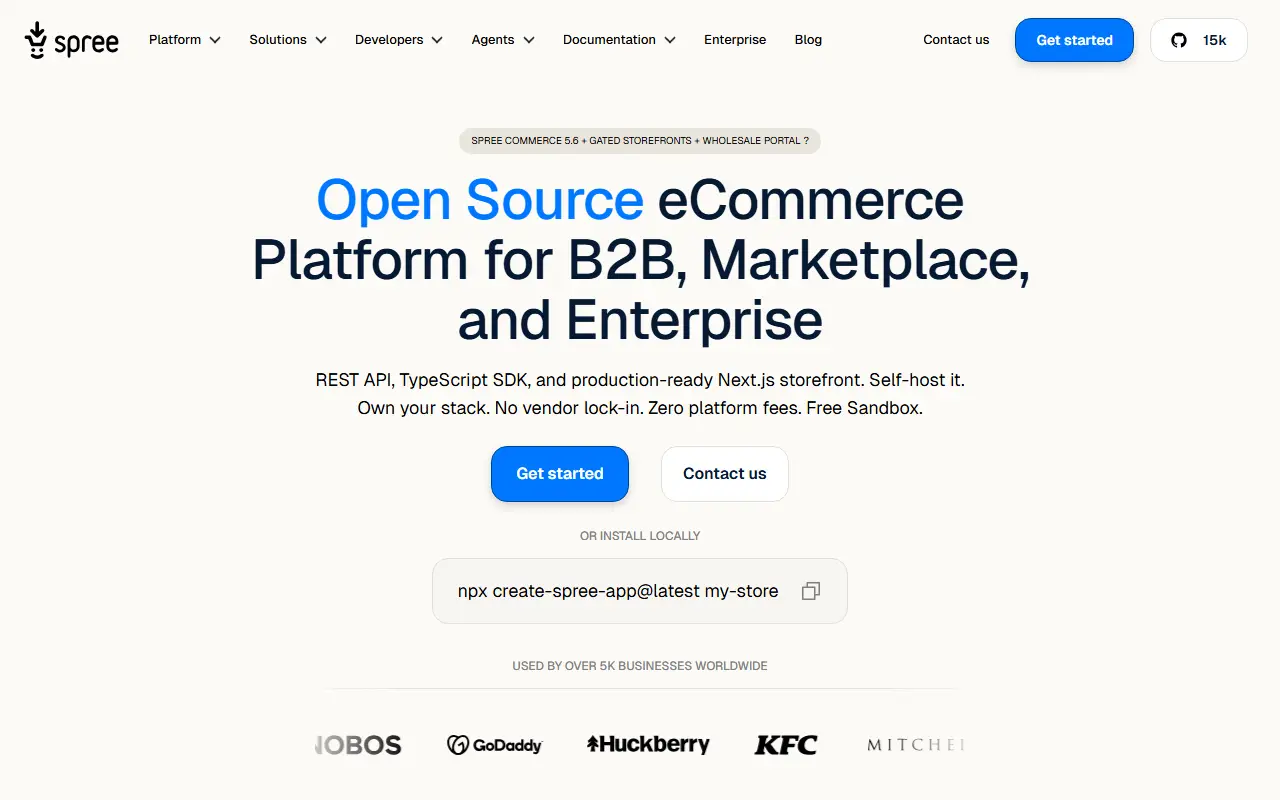
spreecommerce.orgSpree Commerce homepage screenshot

Spree is an open-source commerce platform written in Ruby. It bundles a full REST API, TypeScript SDKs, an admin dashboard written in React and a Next.js storefront ready for production, and the BSD 3-Clause license means you keep ownership of your code, data and infrastructure. The project's pitch is self-hosting with no platform fees and no vendor lock-in.

It is designed as a set of commerce primitives that adapt to different business models. For multi-vendor marketplaces it offers seller onboarding with configurable checklists, orders split by seller, commission rules, a payout ledger that uses Stripe Connect, and a dedicated seller panel. For B2B and wholesale it covers tiered volume pricing in price lists, customer groups, company accounts that have several locations, contacts, tax exemptions, and separate catalogs per segment. It also supports headless direct-to-consumer, cross-border and omnichannel selling alongside existing ERP, PIM and payment systems.

Spree has been developed since 2008, with documentation, an API reference, a roadmap and a Discord community. It suits engineering teams that want an owned, customizable commerce backend rather than a hosted store builder.

Key features

  • Complete REST API and TypeScript SDKs
  • React admin dashboard
  • Production-ready Next.js storefront
  • Multi-vendor marketplace tools with payouts
  • B2B price lists and customer groups
  • Headless and omnichannel selling

Pricing: Free and open source under the BSD-3-Clause license, with no platform fees.

EverShop

TypeScript-focused ecommerce platform using GraphQL and React, designed for developers who want a modular, fully customizable storefront.

GitHub stars
10k
Last commit
yesterday
Latest release
v2.2.1
Licence
GPL-3.0
Self-hosted
Yes
evershop.ioEverShop homepage screenshot

EverShop is an open-source ecommerce platform built with TypeScript, GraphQL and React. It is designed for developers and provides essential commerce features in a modular architecture that can be customized extensively, so teams can build tailored shopping experiences without starting from scratch.

The platform can be started quickly from a Docker image, which saves installing dependencies by hand, and a full installation guide is available. Its documentation covers extension development and theme development, which is how most customization is done, and a demo store lets you see the storefront and admin before installing anything.

EverShop is licensed under GPL-3.0 and runs on your own infrastructure. The project is community driven, with a Discord channel for questions and an issue tracker for bug reports and feature requests. It suits developers and agencies who prefer a JavaScript and TypeScript stack for online stores.

Key features

  • TypeScript-first ecommerce platform
  • GraphQL API with a React storefront
  • Modular, customizable architecture
  • Extension and theme development
  • Docker image for quick start
  • Public demo store to try

Pricing: The self-hosted edition is free. Hosted Personal ($10) and Professional ($20) plans are listed per month but marked as coming soon.

Sylius

A headless, open-source ecommerce framework built on PHP, Symfony and API Platform, with a REST API and a behavior-driven development workflow.

GitHub stars
8.5k
Last commit
4 days ago
Latest release
v2.3.0
Licence
MIT
Self-hosted
Yes
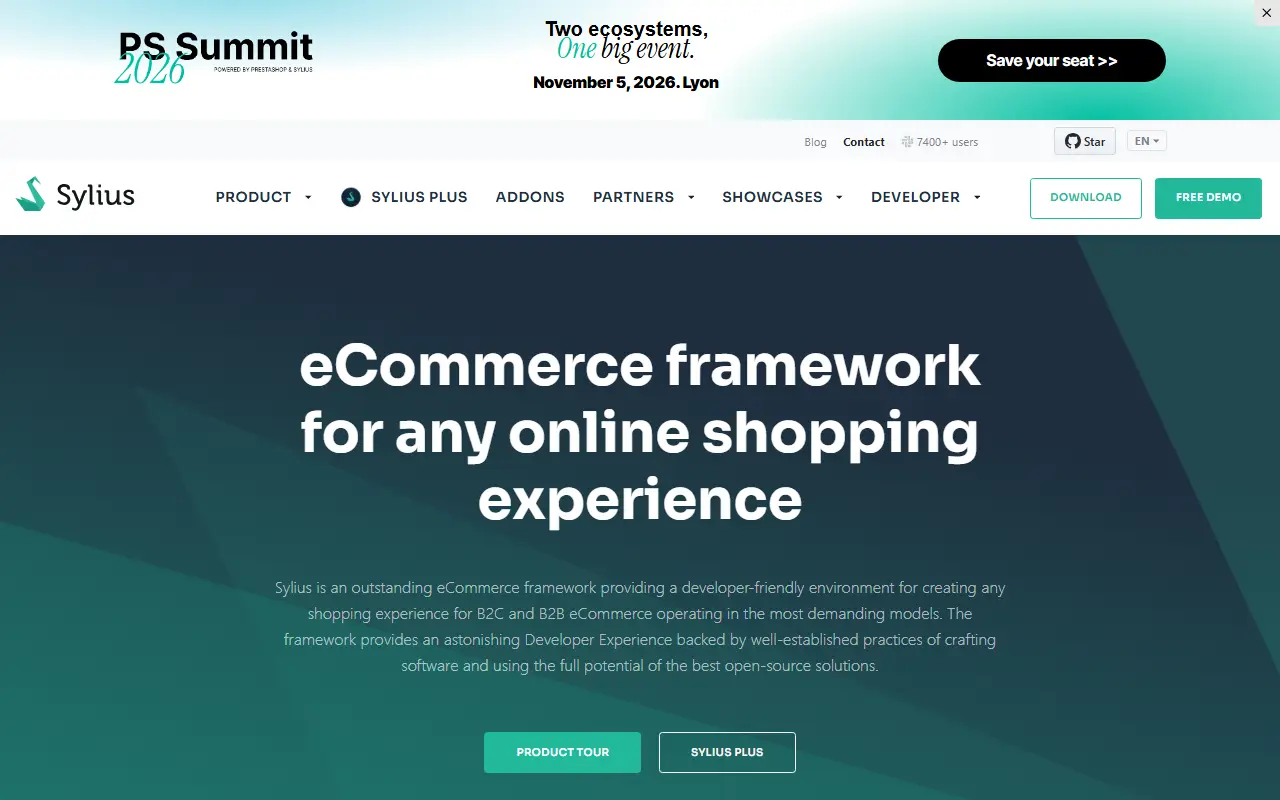
sylius.comSylius homepage screenshot

Sylius is an open-source ecommerce framework built on Symfony, described as headless and based on PHP, Symfony and API Platform. It targets developers who need an online store tailored to specific business requirements rather than a fixed, off-the-shelf shop.

The code base is developed with full-stack behavior-driven development, using PHPUnit and Behat, and the project stresses code quality and testing culture. A REST API makes it possible to integrate the store with other systems and build customer experiences on any device. Installation is done through Composer, documentation lives at docs.sylius.com, and community support is available through Slack and Stack Overflow.

Sylius is licensed under MIT. The company also sells Sylius Plus, a commercial edition with modular features such as one-page checkout, a B2B suite, multi-store management, partial order fulfillment, returns handling, loyalty features and inventory spanning multiple sources, along with SLA-backed support. Plugins are available from the Sylius Store marketplace.

Key features

  • Headless ecommerce on Symfony
  • REST API built with API Platform
  • Installed through Composer packages
  • Behavior-driven development with Behat
  • Plugins from the Sylius Store
  • Optional commercial Sylius Plus modules

Pricing: Core is free under the MIT licence; Sylius Plus is a separate commercial edition with a licence and SLA-backed support.

Vendure

A headless commerce platform written in TypeScript on NestJS and GraphQL, with a React admin dashboard and a plugin-first architecture, released as open source.

GitHub stars
8.5k
Last commit
today
Latest release
v3.7.3
Self-hosted
Yes
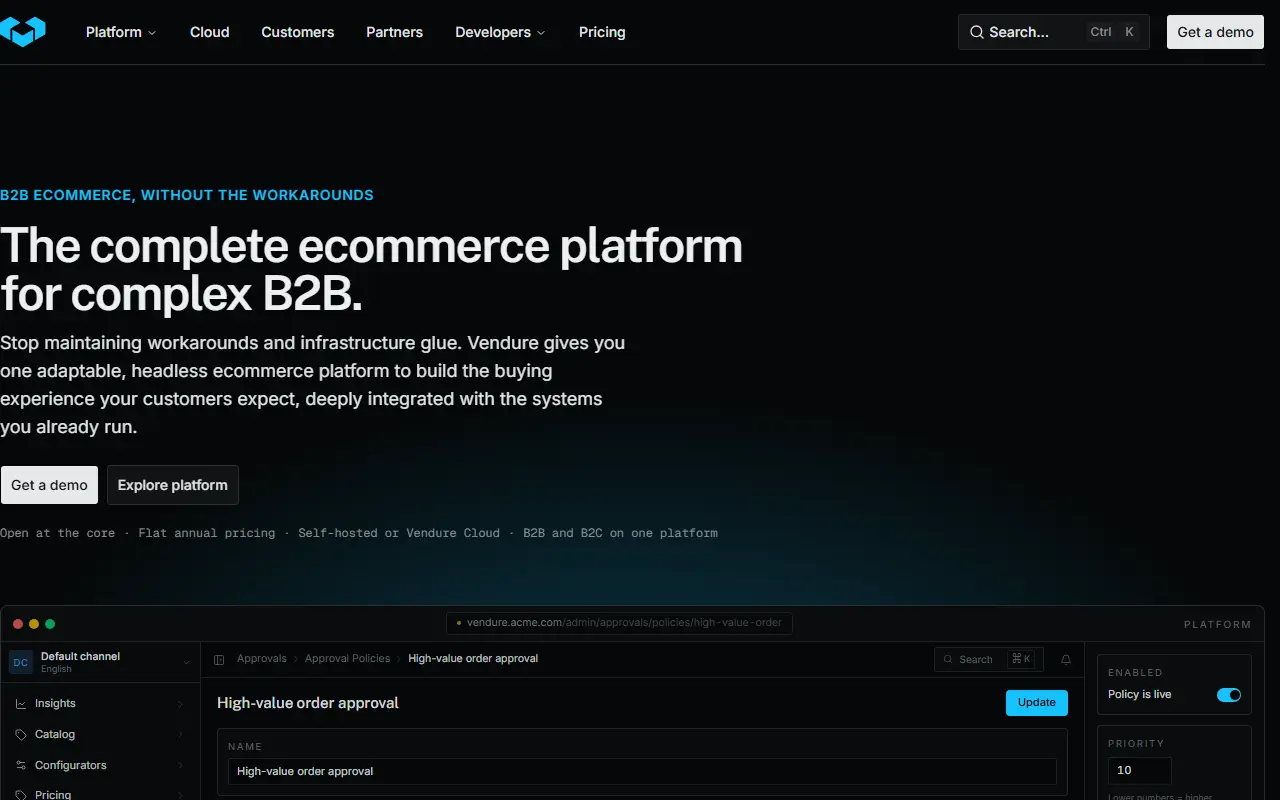
vendure.ioVendure homepage screenshot

Vendure is a headless commerce platform, released as open source and written in TypeScript. Its backend uses Node.js, NestJS and GraphQL, and its admin dashboard is built with React and TanStack, so a team works in one language across the stack. It is plugin-first, so most behavior can be changed without forking the core.

One backend models catalog, orders, pricing, promotions and customers, and serves any frontend through a GraphQL API for D2C, B2B, marketplace and omnichannel scenarios. Built-in building blocks cover the catalog, orders, customers, promotions, sales channels, tax, shipping, payments and stock levels. Stable plugin contracts and service overrides allow custom entities, pricing logic and workflows. The introspectable GraphQL schema is described as straightforward to connect to LLM tool-calling, MCP servers and agent frameworks.

New projects are scaffolded with a command that sets up the server, admin dashboard and GraphQL API, and they require a current Node.js release (20.19 or 22.12) plus a SQL database such as PostgreSQL, MySQL, MariaDB or SQLite. The repository lists the licence as Other, so check the licence terms before commercial use.

Key features

  • Headless commerce with GraphQL API
  • TypeScript, NestJS and Node.js backend
  • React admin dashboard
  • Plugin contracts and service overrides
  • Catalog, orders, tax, shipping and payments
  • Support for multiple sales channels
  • PostgreSQL, MySQL, MariaDB or SQLite

Pricing: The open-source Vendure Core framework is free under GPLv3. The commercial Platform is a flat annual subscription quoted for each project.

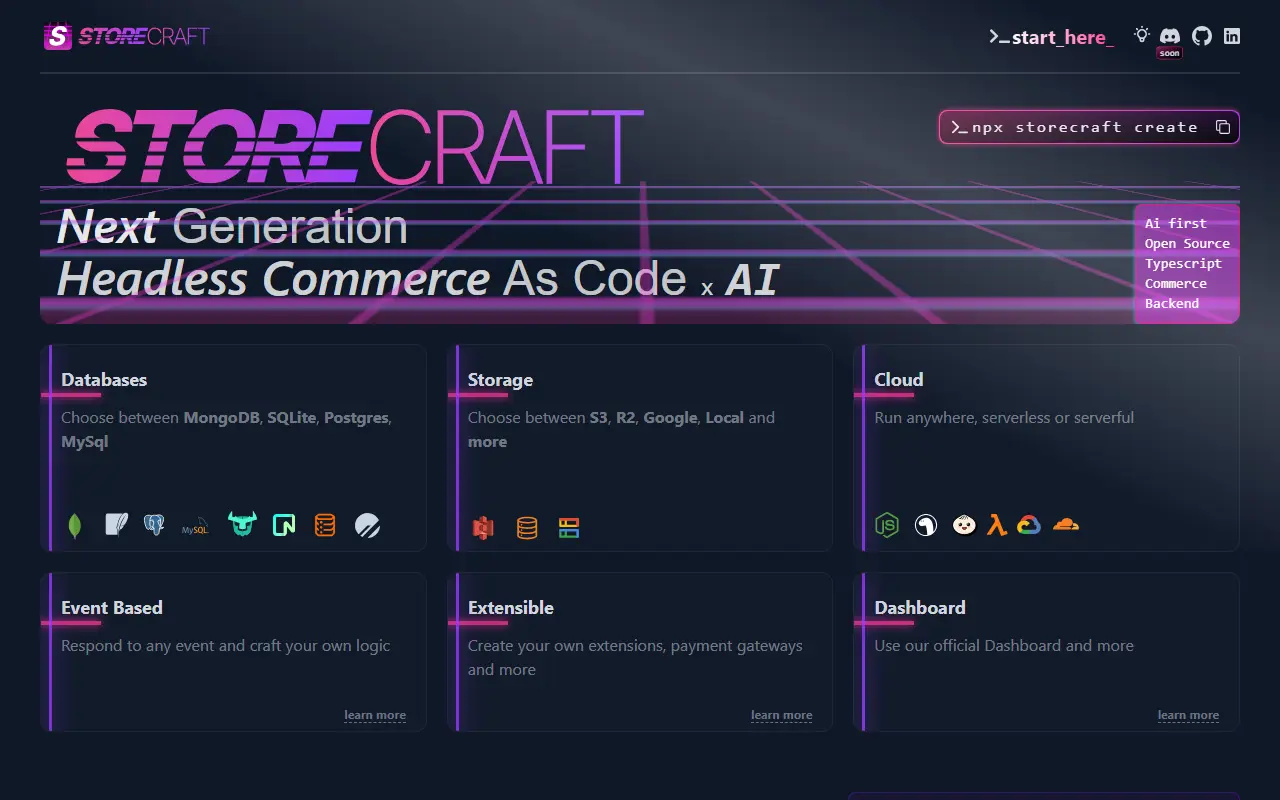
Storecraft

TypeScript headless e-commerce backend framework with a built-in AI shopping agent, REST API, dashboard and support for many databases and runtimes.

GitHub stars
860
Last commit
5 mo ago
Self-hosted
Yes
storecraft.appStorecraft homepage screenshot

Storecraft helps developers build headless e-commerce backends in TypeScript and JavaScript, with AI features built in. Its chat endpoint hosts an agent that can serve customers with carts and checkout, and similarity search works with popular large language models and vector stores. It is aimed at developers who want a programmable store back end they can run on serverless or conventional infrastructure.

The backend manages products, collections, orders, customers, authentication and emails through a programmable API, a REST API with generated reference documentation, and a query language called VQL for queries and similarity search. Payments are supported through PayPal, Stripe and Razorpay. It runs on Deno, Bun, Node, Cloudflare Workers, AWS Lambda and Google Cloud Functions, connects to databases such as MongoDB, libSQL, SQLite, PostgreSQL, MySQL, Neon, Turso, D1 and PlanetScale, and can store files locally or in R2, S3-compatible or Google storage.

A new app is created with a CLI command, and the generated server exposes a chat page, an official dashboard and an API reference. The architecture is modular, extensible and event based, and the repository is an npm workspace monorepo. The repository metadata lists the license as Other, so review the license file.

Key features

  • Built-in AI shopping agent chat endpoint
  • Similarity search with vector stores
  • REST API and VQL query language
  • PayPal, Stripe and Razorpay support
  • Runs on Node, Deno, Bun and edge runtimes
  • Many database and storage options
  • Official admin dashboard

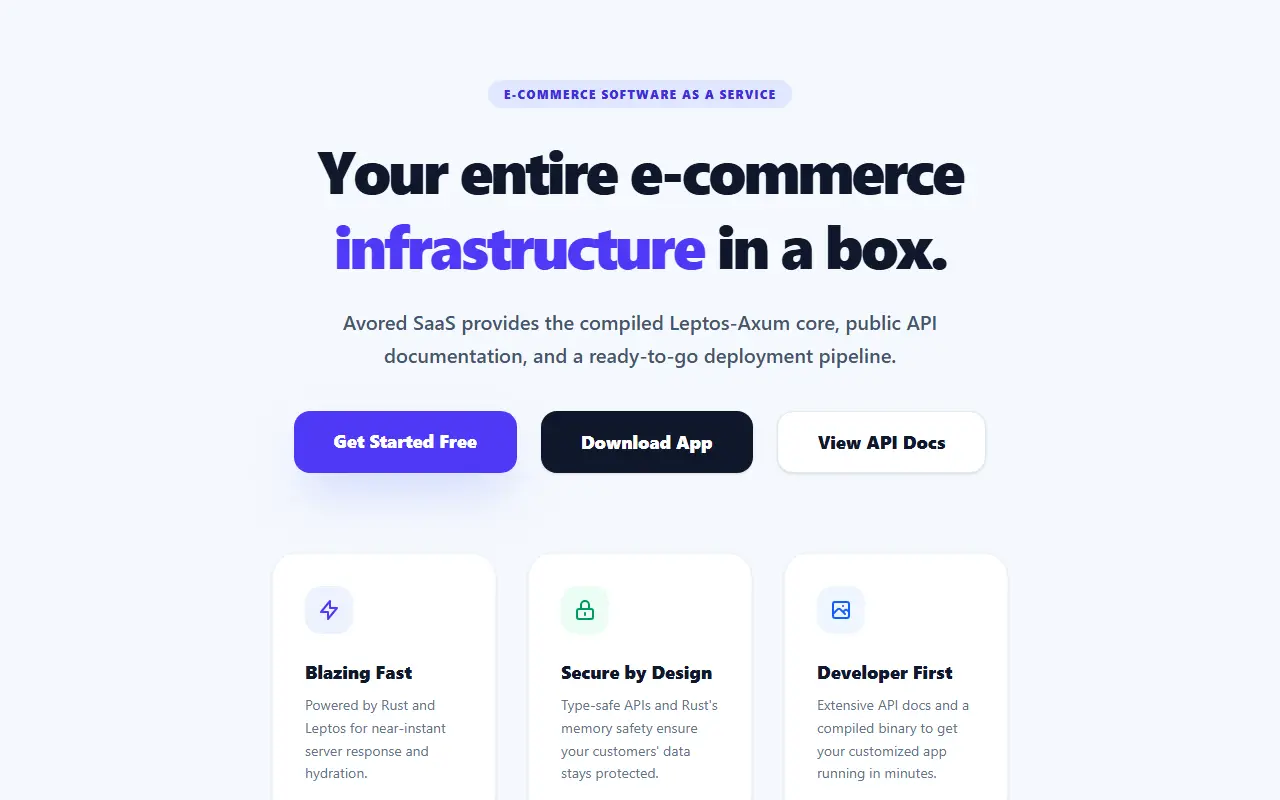
AvoRed

AvoRed is a free, open-source headless e-commerce platform built on Laravel with a GraphQL API, letting developers build custom storefronts on top of a PHP backend.

GitHub stars
1.5k
Last commit
2 yr ago
Latest release
3.34
Self-hosted
Yes
avored.comAvoRed homepage screenshot

AvoRed is a headless e-commerce system built as a Laravel package, exposing a GraphQL API rather than shipping a fixed storefront theme. It is aimed at PHP developers who want full control over the frontend presentation layer while relying on Laravel for the commerce backend logic.

Setting it up involves creating a new Laravel project and adding the AvoRed framework package along with optional add-ons for dummy data, cash-on-delivery payments and pickup options, then running the AvoRed installer and publishing its service provider, after which a GraphiQL interface becomes available for exploring the API. A separate frontend application, cloned from the same organization's repository, consumes this GraphQL API, and the whole stack can also be stood up through a documented Docker-based development setup.

AvoRed is written primarily in TypeScript for its frontend tooling alongside a Laravel and PHP backend. The repository metadata does not state a license, so check the repository before using it commercially.

Key features

  • Headless e-commerce via GraphQL
  • Laravel-based backend architecture
  • Order management and returns
  • Cash-on-delivery and pickup add-ons
  • Docker-based development setup

Pricing: Free to use; no license is stated in the repository metadata, so check the repository before commercial use.

Swell alternatives: questions

What is the best open-source alternative to Swell?
Medusa is the top-ranked open-source alternative to Swell on Enlisted: A TypeScript commerce platform with a customization framework and modular building blocks for B2B and direct-to-consumer stores, marketplaces and other commerce apps. Other strong options are Saleor, Spree Commerce, EverShop and Sylius.
Are these Swell alternatives free?
All 8 are open source, so the code is free to use under its licence, and 8 of them can be self-hosted on your own server. 2 also offer a paid or managed cloud version if you'd rather not host it yourself.
How is this list of Swell alternatives ranked?
By a score built from GitHub stars, star growth over the last 30 days and how recently the code changed. 6 of these projects shipped code in the last 30 days. Data is refreshed daily, and nobody can pay to move up.

People also look for alternatives to…

View all