10 open-source alternatives ranked by real activity

Open-source Snipcart alternatives

A curated, ranked list of the 10 best open-source alternatives to Snipcart.

The best open-source alternative to Snipcart is Medusa. If that doesn't suit you, other good options are Saleor, Magento Open Source, WooCommerce and Vendure.

Commercial alternatives to Snipcart include Swell, ThriveCart, Chargebee and Gumroad. See all 16.

Snipcart alternatives are mainly e-commerce tools. 10 of them shipped code in the last 30 days, 10 can be self-hosted, and 4 use a permissive licence.

Last updated November 13, 2026 · ranked by GitHub stars, growth and recent commits

Medusa

A TypeScript commerce platform with a customization framework and modular building blocks for B2B and direct-to-consumer stores, marketplaces and other commerce apps.

GitHub stars
37k
Last commit
today
Latest release
v2.22.6
Self-hosted
Yes
Hosted version
Available
medusajs.comMedusa homepage screenshot

Medusa is an open-source commerce platform that includes its own framework for customizing behavior. Rather than a fixed storefront product, it supplies foundational commerce building blocks, so developers can assemble custom commerce applications without reinventing core logic such as carts, orders and payments.

The framework and modules can power advanced B2B or direct-to-consumer stores, marketplaces, distributor platforms, point-of-sale systems and service businesses. Its core commerce modules are open source and published on npm, while Enterprise Edition features are marked separately in the repository. It is written in TypeScript on Node.js, and its topics mention AI coding tools alongside the standard e-commerce stack. Release notes and an integrations catalog help teams keep a project current and connected to payment, shipping and other services.

For hosting, Medusa Cloud is a managed environment tuned for Medusa apps with automated deployments, scaling and maintenance, and you can also run the code locally or on your own servers by following the documentation. The license is listed as 'Other', so review which components are covered by which terms.

Key features

  • Modular commerce building blocks
  • Framework for custom commerce logic
  • Support for B2B and direct-to-consumer stores
  • Core modules published on npm
  • Managed Medusa Cloud hosting
  • Integrations and release notes

Pricing: Medusa Cloud starts at $29 per month (Develop), then $99 (Launch) and $299 (Scale) per month; Enterprise is custom. The open-source software itself is free.

Saleor

An API-only, GraphQL-native headless commerce platform written in Python for composable, multichannel online stores.

GitHub stars
24k
Last commit
yesterday
Latest release
3.23.49
Licence
BSD-3-Clause
Self-hosted
Yes
Hosted version
Available
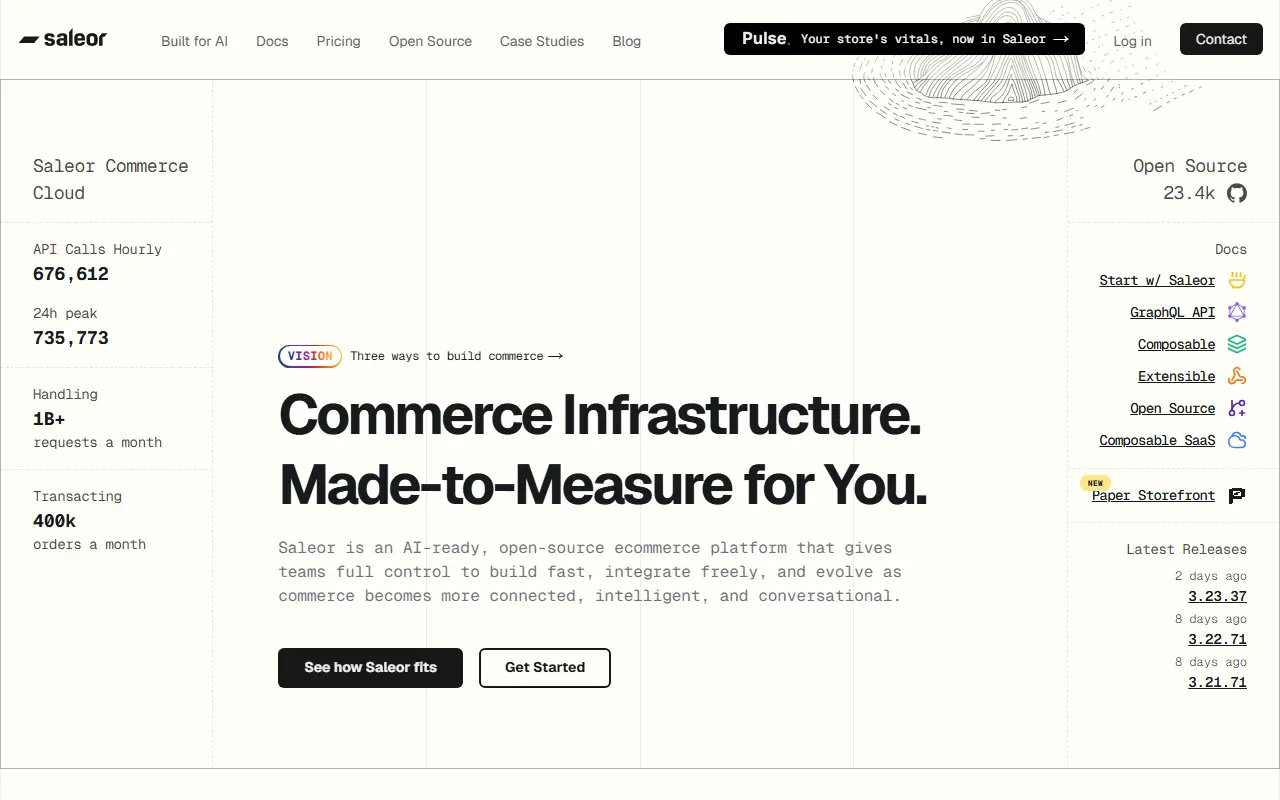
saleor.ioSaleor homepage screenshot

Saleor Core is an open-source headless commerce platform written in Python. It is API-only and GraphQL-native, so storefronts, dashboards and other clients talk to the backend exclusively through its API, which makes it a building block for composable commerce rather than a monolithic store application.

The project highlights several design choices: technology-agnostic, with no monolithic plugin system or lock-in; GraphQL only rather than a mix of API styles; open source with a single version and no feature fragmentation; cloud native; and native multichannel, with per-channel control over pricing, currencies, stock and products. Extension happens through webhooks and apps instead of modifying core code. Topics also mention product information management and order management.

Saleor is BSD-3-Clause licensed. The wider platform includes a separate dashboard and a storefront, and the README links documentation and community channels. You can self-host the core or use the vendor's cloud offering, and it suits engineering teams building custom shops, marketplaces and multi-country commerce experiences.

Key features

  • GraphQL-native, API-only architecture
  • Native multichannel pricing and stock control
  • Extensible through webhooks and apps
  • Product and order management
  • Technology-agnostic composable design
  • Separate dashboard and storefront projects

Pricing: Cloud Sandboxes are free for non-commercial use. Select is $1599 per month and Volume $3999 per month, each with a GMV allowance and a percentage fee above it; Enterprise is negotiated.

Magento Open Source

Magento Open Source is a PHP ecommerce platform for building online stores, with Adobe Commerce as its full-featured commercial counterpart.

GitHub stars
12k
Last commit
yesterday
Latest release
2.4.10-alpha1
Licence
OSL-3.0
Self-hosted
Yes

Magento Open Source is a PHP-based ecommerce platform used to build an online store from the ground up. The repository is magento/magento2, and the README presents it as software with the basic ecommerce capabilities, while directing merchants who need a more complete solution to Adobe Commerce.

Adobe Commerce adds an optimized cloud architecture with hosting, along with AI-powered merchandising and analytics, so the open-source edition is the self-managed starting point. The project has a large contributor community, with community maintainers who can review and merge pull requests, and the documentation covers system requirements, prerequisites and several installation options.

Magento is licensed under OSL-3.0, and contributors must sign the Adobe Contributor License Agreement. It runs on your own servers and fits developers, agencies and merchants who want control over the code of their store and are comfortable with the PHP ecosystem. Because it is a full platform, hosting, security updates and extensions are the store owner's responsibility.

Key features

  • Core ecommerce store functionality
  • PHP codebase for custom development
  • Quick-start and multiple installation options
  • Community maintainers reviewing contributions
  • Upgrade path to Adobe Commerce
  • Developer and end-user documentation

Pricing: Open source under OSL-3.0; the commercial Adobe Commerce edition adds cloud hosting and extra features.

WooCommerce

A customizable open-source ecommerce platform built as a plugin for WordPress; this repository is the monorepo for the core plugin and its extensions.

GitHub stars
11k
Last commit
today
Latest release
11.3.0
Self-hosted
Yes
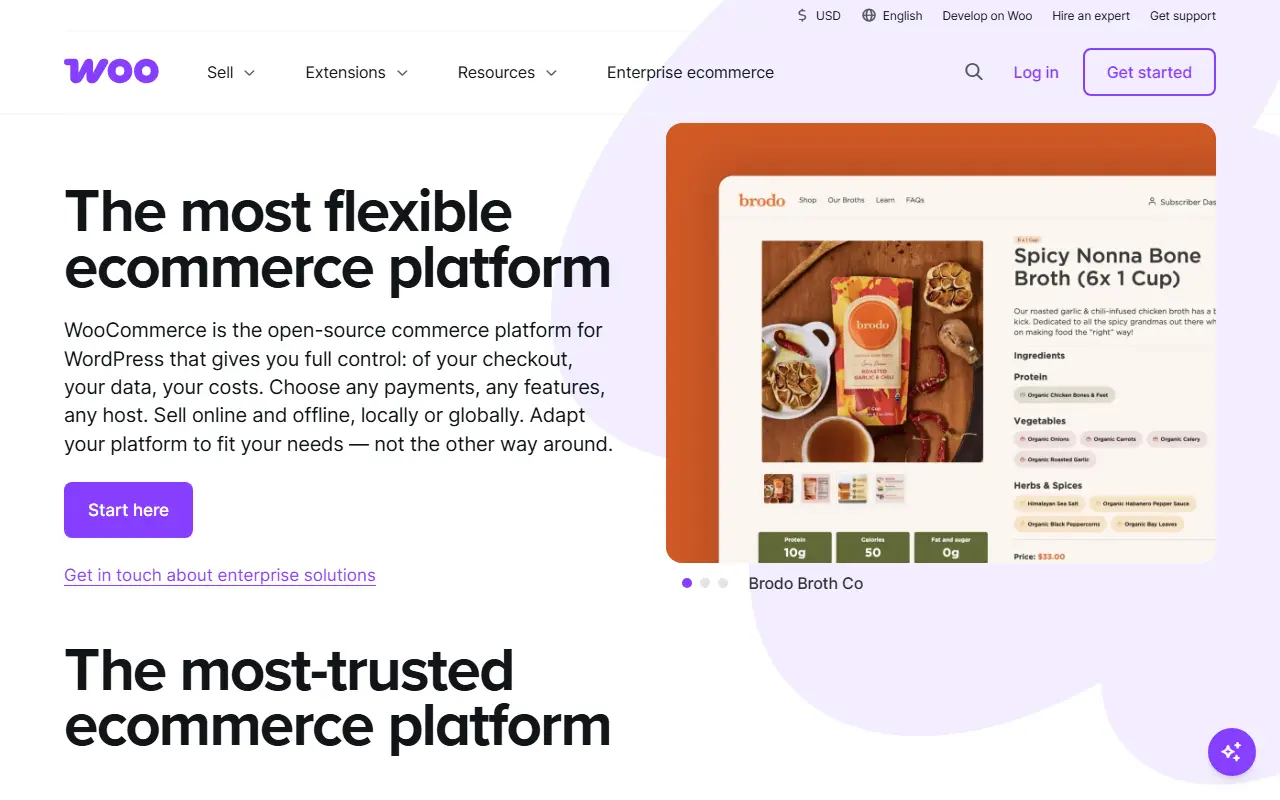
woocommerce.comWooCommerce homepage screenshot

WooCommerce is a customizable ecommerce platform that runs on WordPress, written mainly in PHP. The GitHub repository is a monorepo with the plugins, packages and tooling for developing the core WooCommerce plugin together with its extensions, so it is where the project's code, issues and development discussions live.

Developers working on it need Node.js, PNPM, PHP 7.4 or higher and Composer, and a POSIX-compliant operating system is assumed, with WSL recommended on Windows. The project maintains a development blog and a developer account on X for updates, and the topics reference React, since parts of its admin interface use it.

Because it is built on WordPress, merchants typically run WooCommerce on their own hosting, adding products, payments and shipping through extensions. The repository lists the license as Other, so check the licence terms in the repository. It suits small and mid-sized shops, agencies and developers who already work in the WordPress ecosystem.

Key features

  • Ecommerce functionality on WordPress
  • Extensions add features to the core
  • Monorepo of plugins and packages
  • PHP codebase with React-based admin parts
  • Developer blog and documentation
  • Large ecosystem of third-party extensions

Pricing: The core platform is free with no subscription or revenue share. You pay separately for hosting (about $25 to $350 a month) and optional extensions ($29 to $299 a year each).

Vendure

A headless commerce platform written in TypeScript on NestJS and GraphQL, with a React admin dashboard and a plugin-first architecture, released as open source.

GitHub stars
8.6k
Last commit
today
Latest release
v3.8.2
Self-hosted
Yes
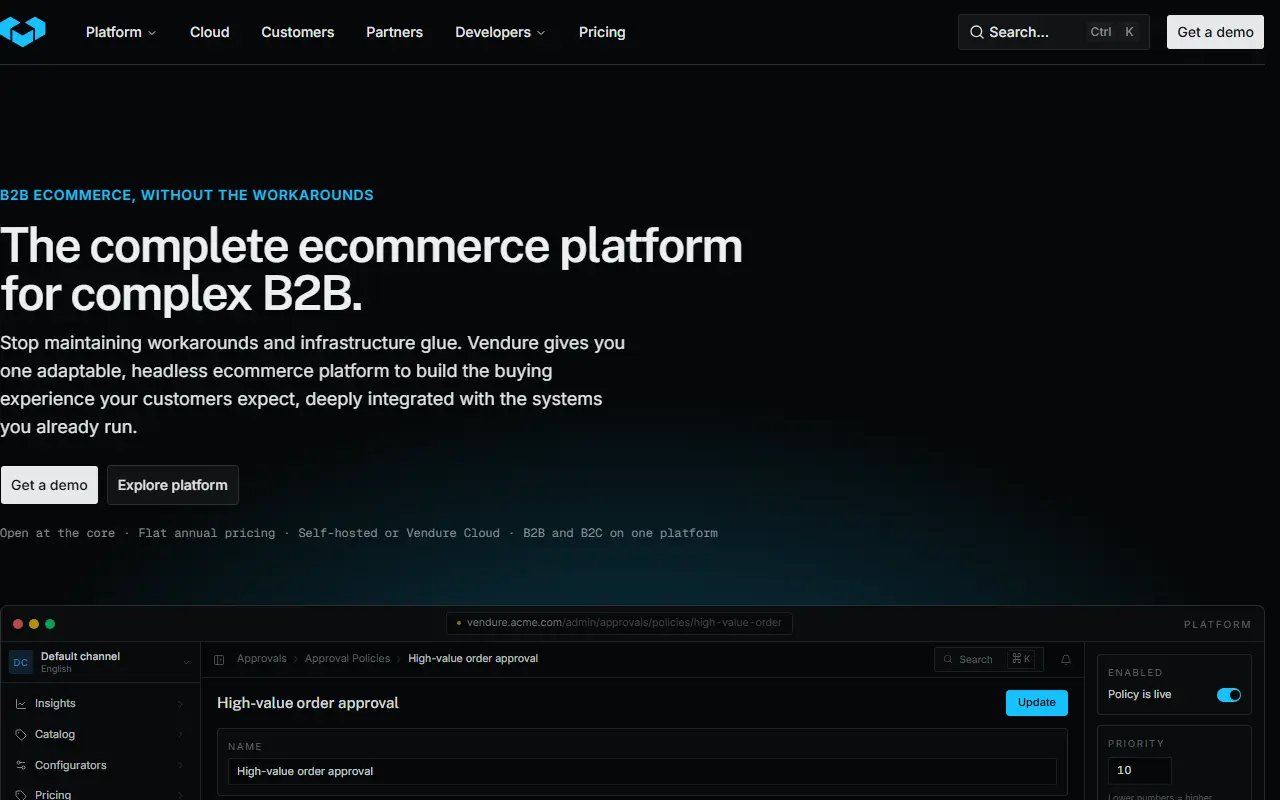
vendure.ioVendure homepage screenshot

Vendure is a headless commerce platform, released as open source and written in TypeScript. Its backend uses Node.js, NestJS and GraphQL, and its admin dashboard is built with React and TanStack, so a team works in one language across the stack. It is plugin-first, so most behavior can be changed without forking the core.

One backend models catalog, orders, pricing, promotions and customers, and serves any frontend through a GraphQL API for D2C, B2B, marketplace and omnichannel scenarios. Built-in building blocks cover the catalog, orders, customers, promotions, sales channels, tax, shipping, payments and stock levels. Stable plugin contracts and service overrides allow custom entities, pricing logic and workflows. The introspectable GraphQL schema is described as straightforward to connect to LLM tool-calling, MCP servers and agent frameworks.

New projects are scaffolded with a command that sets up the server, admin dashboard and GraphQL API, and they require a current Node.js release (20.19 or 22.12) plus a SQL database such as PostgreSQL, MySQL, MariaDB or SQLite. The repository lists the licence as Other, so check the licence terms before commercial use.

Key features

  • Headless commerce with GraphQL API
  • TypeScript, NestJS and Node.js backend
  • React admin dashboard
  • Plugin contracts and service overrides
  • Catalog, orders, tax, shipping and payments
  • Support for multiple sales channels
  • PostgreSQL, MySQL, MariaDB or SQLite

Pricing: The open-source Vendure Core framework is free under GPLv3. The commercial Platform is a flat annual subscription quoted for each project.

Aimeos for Laravel

Aimeos for Laravel is an open-source e-commerce package that adds a shop, admin backend and JSON and GraphQL APIs to a Laravel application.

GitHub stars
8.7k
Last commit
2 days ago
Licence
MIT
Self-hosted
Yes

Aimeos for Laravel is a Composer-based e-commerce package that installs into an existing Laravel application. The README says it can be added within 5 minutes and that parts of it can be adapted, extended or overwritten. It covers the shop itself, a full admin backend and an API layer, and is written in PHP under the MIT licence.

On the product side it handles bundles, vouchers, virtual, configurable, custom and event products, subscriptions with recurring payments, block and tier pricing, and a flexible basket rule system. Payments run through more than 100 gateways using the Omnipay PHP library. The maintainers claim response times down to 20ms and catalogs from one to over a billion items.

Aimeos supports multi-vendor, multi-channel and multi-warehouse setups, and the sites extension covers marketplaces and multi-tenant SaaS shops. A JSON REST API following jsonapi.org and a GraphQL admin API let teams build their own frontends or progressive web apps. A full shop distribution and a headless distribution are offered as alternatives to adding the package by hand.

Key features

  • Multi vendor, multi channel and multi warehouse
  • Many product types including bundles and vouchers
  • Recurring payments captured automatically
  • 100+ payment gateways via Omnipay
  • JSON REST API and GraphQL admin API
  • Discounts, vouchers and basket rules
  • Full admin backend with configurable product data
  • SEO support and translations into 30+ languages

Aimeos

Open-source PHP e-commerce platform on Laravel with a JSON REST API, GraphQL admin API, multi-vendor support and 100+ payment gateways.

GitHub stars
5.5k
Last commit
10 days ago
Licence
MIT
Self-hosted
Yes

Aimeos is an API-first, cloud-native e-commerce platform. This repository is the standalone Laravel shop distribution, installed with composer create-project aimeos/aimeos myshop and run locally with php artisan serve. The same project is offered as a Laravel package for adding a shop to an existing application, as a headless distribution for single page and progressive web apps, and as a TYPO3 extension.

The feature list covers multi-vendor, multi-channel and multi-warehouse setups, multi-tenant SaaS shops, bundles, vouchers, virtual, configurable and event products, subscriptions with recurring payments, block and tier pricing, discounts and a basket rule system. Payments go through the Omnipay PHP library, which the site says covers over 100 providers including Stripe, PayPal, Mollie and Adyen.

The admin backend is served at /admin, with a GraphQL API for administration. An MCP server lets AI agents such as Claude or ChatGPT search, create, update and delete products, categories, customers and orders, authenticated by a Laravel Sanctum token. Requirements include composer 2.2+, a web server such as Apache or Nginx, and MySQL, MariaDB, PostgreSQL or SQL Server.

Key features

  • JSON REST API and GraphQL admin API
  • Multi-vendor, multi-channel, multi-warehouse
  • Many product types
  • Subscriptions with recurring payments
  • Payment gateways through Omnipay
  • Pricing, discounts and basket rules
  • Headless distribution for SPA and PWA
  • MCP server for AI agents

Aimeos TYPO3

An e-commerce extension for TYPO3 that adds online shop, B2B and marketplace features to an existing TYPO3 website.

GitHub stars
1.6k
Last commit
8 days ago
Licence
GPL-3.0

Aimeos TYPO3 is the TYPO3 extension of the Aimeos e-commerce framework, written in PHP and published under GPL v3 on GitHub. Per the README, it can be installed into an existing TYPO3 site and customised, extended or overwritten as needed. The current stable release is 26.04 for TYPO3 13 and 14, with 25.10 as the LTS for TYPO3 12 and 13.

It can be installed with Composer, through the TER from the TYPO3 Extension Manager, or as a 1-click Aimeos distribution that includes demo data. Setup also covers importing an example page tree, adding site configuration and setting up SEO-friendly URLs. Payment redirects need the cookieSameSite option set to None.

The Aimeos project describes the framework as open source and free for commercial use. Its features include a JSON:API REST and GraphQL interface, multi-vendor and multi-warehouse support, many product types, subscriptions with recurring payments, and payment gateways through the Omnipay library. It is also presented as scalable to over a billion items with Elasticsearch.

Key features

  • Installs into an existing TYPO3 site
  • Install via Composer, TER or 1-click distribution
  • Example page tree import for shop setup
  • JSON REST API for custom frontends and mobile apps
  • Multi-tenancy for marketplaces and B2B
  • Subscriptions with automatic payment capture
  • Payment drivers through the Omnipay library

Aimeos Symfony

A Symfony bundle that adds the Aimeos e-commerce package to a Symfony application for online shops and B2B applications.

GitHub stars
1.6k
Last commit
26 days ago
Licence
MIT

Aimeos Symfony is the Symfony bundle of the Aimeos e-commerce package. The repository describes it as a Symfony bundle for online shops and complex B2B applications, with topics including JSON:API, marketplace and performance. It is released under the MIT licence, and the README targets Aimeos 2026.10 with Symfony 7.3 or later.

It is a Composer-based library added to an existing Symfony application. Setup involves configuring the FOSUserBundle, Aimeos routing and shop settings, and the database through Doctrine, with MySQL as the default and other servers documented separately. A PHP built-in server command is suggested for quick tests, and the catalog list page is served at the shop path.

The administration interface is protected by a Symfony firewall that restricts access to the admin URLs. The README says the security configuration is the most complex part of the setup. Production installs can skip demo data with the no-dev option, and an upgrade guide covers moves between major versions.

Key features

  • Symfony bundle for online shops and B2B applications
  • Composer-based installation
  • Admin interface secured by the Symfony firewall
  • Other database servers than MySQL supported
  • SMTP mail sending through MAILER_URL
  • Demo data can be left out of production installs

Easy Digital Downloads

Easy Digital Downloads is a WordPress plugin for selling digital products, focused on the essential e-commerce features for downloadable goods.

GitHub stars
894
Last commit
14 days ago
Latest release
3.7.3
Licence
GPL-2.0
Self-hosted
Yes
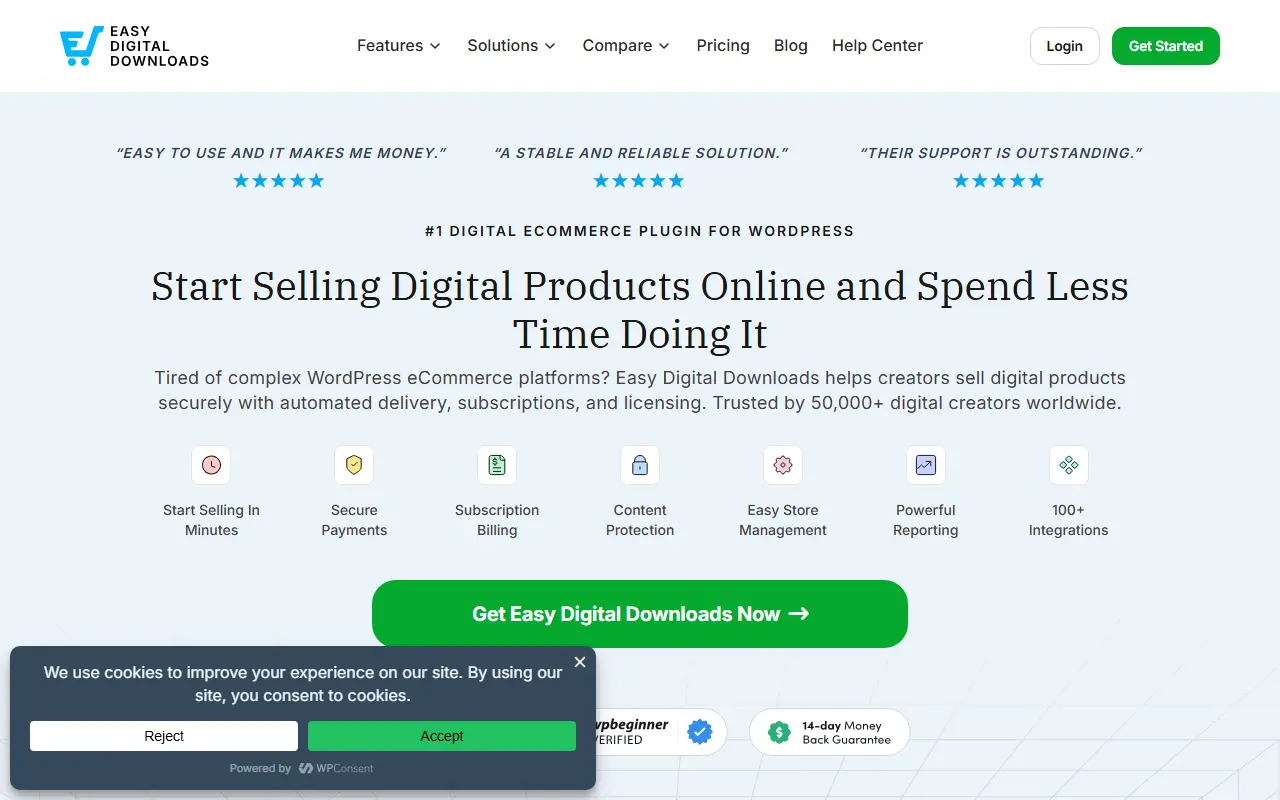
easydigitaldownloads.comEasy Digital Downloads homepage screenshot

Easy Digital Downloads (EDD) is a WordPress plugin for selling digital downloads. Its authors argue that the large WordPress e-commerce plugins have never handled digital goods well, so EDD concentrates on the features sellers actually need rather than every possible option, and aims to make selling downloads easy and complete.

Installed into an existing WordPress site, it adds a store for digital products with payment support, with Stripe among the topics listed by the repository. The codebase has build scripts that prepare installable packages, translations can be contributed in other languages, and the repository serves as a developer portal while customer support is handled through the vendor's support page.

EDD is written in PHP and released under the GPL-2.0 license. Because it runs inside WordPress, you host it with your own WordPress hosting. Documentation, extensions and support are provided on easydigitaldownloads.com, and contributors can raise issues or send pull requests on GitHub.

Key features

  • Digital download storefront inside WordPress
  • Focused feature set for digital goods
  • Stripe payment integration
  • Build scripts for installable packages
  • Translatable into other languages

Pricing: The Lite plugin is free. Yearly passes list at $199 (Personal), $399 (Extended), $599 (Professional) and $999 (All Access), with half-price introductory first-year offers shown.

Commercial Snipcart alternatives

Hosted, closed-source products that compete with Snipcart. Showing 12 of 16.

See every Snipcart alternative on its tool page

Snipcart alternatives: questions

What is the best open-source alternative to Snipcart?
Medusa is the top-ranked open-source alternative to Snipcart on Enlisted: A TypeScript commerce platform with a customization framework and modular building blocks for B2B and direct-to-consumer stores, marketplaces and other commerce apps. Other strong options are Saleor, Magento Open Source, WooCommerce and Vendure.
What are the best commercial alternatives to Snipcart?
Swell, ThriveCart, Chargebee, Gumroad and Stripe Billing are among the hosted, closed-source alternatives to Snipcart listed on Enlisted, which lists 16 in total. Compare their pricing and features on each tool page.
Are these Snipcart alternatives free?
All 10 are open source, so the code is free to use under its licence, and all of them can be self-hosted on your own server or computer. 2 also offer a paid or managed cloud version if you'd rather not host it yourself.
How is this list of Snipcart alternatives ranked?
By a score built from GitHub stars, star growth over the last 30 days and how recently the code changed. 10 of these projects shipped code in the last 30 days. Data is refreshed daily, and nobody can pay to move up.

People also look for alternatives to…

View all