7,363 open-source and SaaS tools, with GitHub stats refreshed every day.

6 alternatives ranked by real activity

Open-source Ecwid alternatives

A curated, ranked list of the 6 best open-source alternatives to Ecwid.

The best open-source alternative to Ecwid is Bagisto. If that doesn't suit you, other good options are WooCommerce, EC-CUBE, thirty bees and Module Shop.

Ecwid alternatives are mainly e-commerce tools. 4 of them shipped code in the last 30 days, 6 can be self-hosted, and 2 use a permissive licence.

Last updated October 2, 2026 · ranked by GitHub stars, growth and recent commits

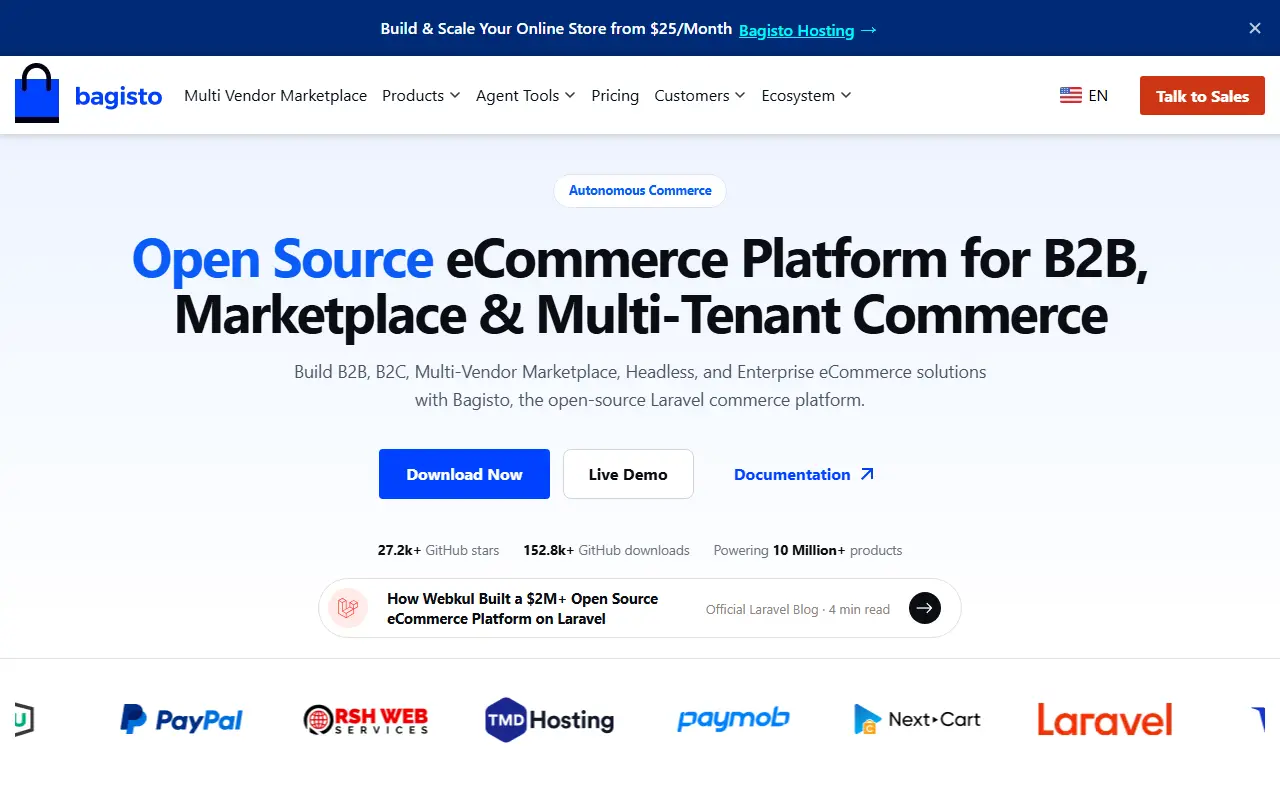
Bagisto

An open-source Laravel and Vue.js platform for building online stores, B2B commerce sites and multi-vendor marketplaces, with headless and multi-tenant options.

GitHub stars
28k
Last commit
yesterday
Latest release
v2.5.0-beta6
Licence
MIT
Self-hosted
Yes
bagisto.comBagisto homepage screenshot

Bagisto is an open-source eCommerce and multi-vendor marketplace platform built on Laravel and Vue.js. It provides a flexible, customizable foundation for launching online stores, B2B commerce portals and marketplaces, and aims to cut the time and cost of development while leaving room to customize and scale.

The project's description claims support for catalogs of ten million or more SKUs, and its topics mention headless commerce, multi-tenancy and use as a Laravel package or framework. It is written in PHP and suits agencies and in-house teams that already know Laravel. The repository links to documentation, an installation guide, a Docker installation path and community forums, and the 2.x line was in beta at the time of writing.

Bagisto is MIT licensed, so you can host it on your own servers and modify it freely. It is a fit for merchants who prefer an open codebase over a hosted store builder, and for developers building custom commerce experiences who want Laravel conventions rather than a proprietary platform.

Key features

  • Single-vendor and multi-vendor store support
  • B2B commerce capabilities
  • Built on Laravel and Vue.js
  • Headless commerce and multi-tenancy options
  • Docker installation guide
  • Customizable and extensible codebase

Pricing: Free and open source under the MIT license.

WooCommerce

A customizable open-source ecommerce platform built as a plugin for WordPress; this repository is the monorepo for the core plugin and its extensions.

GitHub stars
11k
Last commit
today
Latest release
11.1.2
Self-hosted
Yes
woocommerce.comWooCommerce homepage screenshot

WooCommerce is a customizable ecommerce platform that runs on WordPress, written mainly in PHP. The GitHub repository is a monorepo with the plugins, packages and tooling for developing the core WooCommerce plugin together with its extensions, so it is where the project's code, issues and development discussions live.

Developers working on it need Node.js, PNPM, PHP 7.4 or higher and Composer, and a POSIX-compliant operating system is assumed, with WSL recommended on Windows. The project maintains a development blog and a developer account on X for updates, and the topics reference React, since parts of its admin interface use it.

Because it is built on WordPress, merchants typically run WooCommerce on their own hosting, adding products, payments and shipping through extensions. The repository lists the license as Other, so check the licence terms in the repository. It suits small and mid-sized shops, agencies and developers who already work in the WordPress ecosystem.

Key features

  • Ecommerce functionality on WordPress
  • Extensions add features to the core
  • Monorepo of plugins and packages
  • PHP codebase with React-based admin parts
  • Developer blog and documentation
  • Large ecosystem of third-party extensions

Pricing: The core platform is free with no subscription or revenue share. You pay separately for hosting (about $25 to $350 a month) and optional extensions ($29 to $299 a year each).

EC-CUBE

EC-CUBE is an open-source e-commerce platform from Japan, built with PHP, Symfony and Doctrine for creating customizable online stores.

GitHub stars
789
Last commit
yesterday
Latest release
4.3.1-p1
Self-hosted
Yes
ec-cube.netEC-CUBE homepage screenshot

EC-CUBE is an open-source e-commerce platform developed in Japan and written in PHP on the Symfony framework with Doctrine ORM and Twig templates. The repository README, which is in Japanese, is aimed mainly at developers, while ready-to-install packages are distributed from the official EC-CUBE site.

The current development line is 4.4, with older 2.x and 3.x versions maintained in separate repositories. The documented environment is Apache 2.4 with mod_rewrite and mod_ssl, PHP 8.2 through 8.5, and PostgreSQL 13 through 18 or MySQL 8.4 LTS. Front-end styles are written in Sass and JavaScript is bundled with esbuild, and a Docker Compose setup is available for development.

Developer documentation lives at doc4.ec-cube.net and accepts pull requests, community discussion happens in a developer forum and Slack, and contributions follow a published guide with CI checks for code style, static analysis and tests. The license is listed as Other, so review the terms before commercial use.

Key features

  • Symfony, Doctrine and Twig foundation
  • Packages distributed from the official site
  • Sass and esbuild front-end build
  • Docker Compose development environment
  • Developer documentation for 4.x
  • Support for PostgreSQL and MySQL

thirty bees

thirty bees is an open-source PHP e-commerce platform that began as a fork of PrestaShop 1.6 and stays compatible with most PS 1.6 modules.

GitHub stars
767
Last commit
5 days ago
Latest release
1.7.0
Self-hosted
Yes
thirtybees.comthirty bees homepage screenshot

thirty bees is an e-commerce solution that started as a fork of PrestaShop 1.6.1.11 and remains compatible with almost all PrestaShop 1.6 modules. The project emphasizes stability, correctness and reliability of its feature set so that merchants can concentrate on growing their business rather than chasing breaking changes.

Its roadmap focuses on removing very old code such as PrestaShop 1.4 backward compatibility, dropping outdated or pointless back-office switches, managing JavaScript and CSS vendor packages, bringing the modules it ships up to the standard of the default ones, and moving the back office to Bootstrap 4. The installer checks requirements automatically, and the supported environment is PHP 7.4 to 8.3, Apache or nginx on Linux or macOS, and MySQL 5.5.3 or newer or MariaDB 10 or newer, plus several PHP extensions.

thirty bees describes itself as committed to being free and open source, funding itself through a backers program. It is written in PHP and you host it on your own server. The license is not stated in the repository metadata, so check the repository for the exact terms.

Key features

  • Fork of PrestaShop 1.6.1.11
  • Compatible with most PrestaShop 1.6 modules
  • PHP 7.4 to 8.3 support
  • Installer that checks requirements
  • Roadmap of back-office cleanup
  • Community backers program

Pricing: Described as free and open source; check the repository for the exact license terms.

Module Shop

Modular, cross-platform online store system built on .NET 8 with a REST API, admin back office and support for several databases.

GitHub stars
959
Last commit
8 mo ago
Licence
MIT
Self-hosted
Yes
demo.shopapi.circle.ac.cnModule Shop homepage screenshot

Module Shop is a simple, modular e-commerce system built on .NET 8 and documented in Chinese. It splits the application into self-contained modules, runs on Docker, Windows, Linux and macOS, and supports Microsoft SQL Server, PostgreSQL, MySQL and SQLite. It is free and open source, aimed at .NET developers who want a store back end they can extend.

The back-end service lives in the repository's server folder and exposes a documented REST API, with Swagger available for online calls and comments in Chinese. A mock API controller exists for development and demo sites, to simulate administrators and buyers and reset sample data. The README lists many API controllers, covering accounts, application settings, cache, countries, uploads, user addresses, carousel and HTML widgets, brands, categories, products and product attributes.

A demo of the admin site and the API documentation is available online. The project uses Entity Framework Core and is MIT licensed. The README also advertises other projects from the same author, but this entry is only about the store system, which you deploy and operate yourself.

Key features

  • Modular .NET 8 architecture
  • REST API with Swagger documentation
  • Admin back office
  • Support for SQL Server, PostgreSQL, MySQL and SQLite
  • Docker and cross-platform deployment
  • Product, brand and category management

Pricing: Free and open source under the MIT license.

SmartStore.NET

SmartStore.NET was an open-source, GPL-licensed ASP.NET MVC e-commerce shopping cart platform with built-in CMS and page-builder features; it is now deprecated in favor of Smartstore 5.

GitHub stars
2.7k
Last commit
3 yr ago
Latest release
4.2.0
Licence
GPL-3.0
Self-hosted
Yes

SmartStore.NET was an open-source e-commerce shopping cart solution built on ASP.NET MVC, aimed at businesses that wanted an enterprise-capable online store they could run and customize on Microsoft-centric infrastructure. It combined storefront, cart and checkout functionality with content-management and page-builder features in the same system.

The platform included its own CMS and page builder, Lucene-powered search, SASS-based theming with Bootstrap 4 styling, support for liquid templating, Entity Framework 6 data access, Autofac dependency injection and Azure deployment compatibility, reflecting a fairly complete, enterprise-oriented .NET e-commerce stack.

The README states this repository is outdated and no longer actively maintained, and directs users to Smartstore 5, its successor built on ASP.NET Core. It required IIS 7 or newer, ASP.NET 4.5 or newer, and SQL Server, and the Community Edition was released under the GPLv3 license.

Key features

  • ASP.NET MVC e-commerce storefront and checkout
  • Built-in CMS and page builder
  • Lucene-powered search
  • Bootstrap 4 and SASS theming
  • Entity Framework 6 data layer
  • Azure deployment support

Pricing: The Community Edition is free and open source under the GPLv3 license. This version is deprecated in favor of the ASP.NET Core-based Smartstore 5.

Ecwid alternatives: questions

What is the best open-source alternative to Ecwid?
Bagisto is the top-ranked open-source alternative to Ecwid on Enlisted: An open-source Laravel and Vue.js platform for building online stores, B2B commerce sites and multi-vendor marketplaces, with headless and multi-tenant options. Other strong options are WooCommerce, EC-CUBE, thirty bees and Module Shop.
Are these Ecwid alternatives free?
All 6 are open source, so the code is free to use under its licence, and all of them can be self-hosted on your own server or computer.
How is this list of Ecwid alternatives ranked?
By a score built from GitHub stars, star growth over the last 30 days and how recently the code changed. 4 of these projects shipped code in the last 30 days. Data is refreshed daily, and nobody can pay to move up.

People also look for alternatives to…

View all