 TrackMedia
 TrackRev

About Alokai
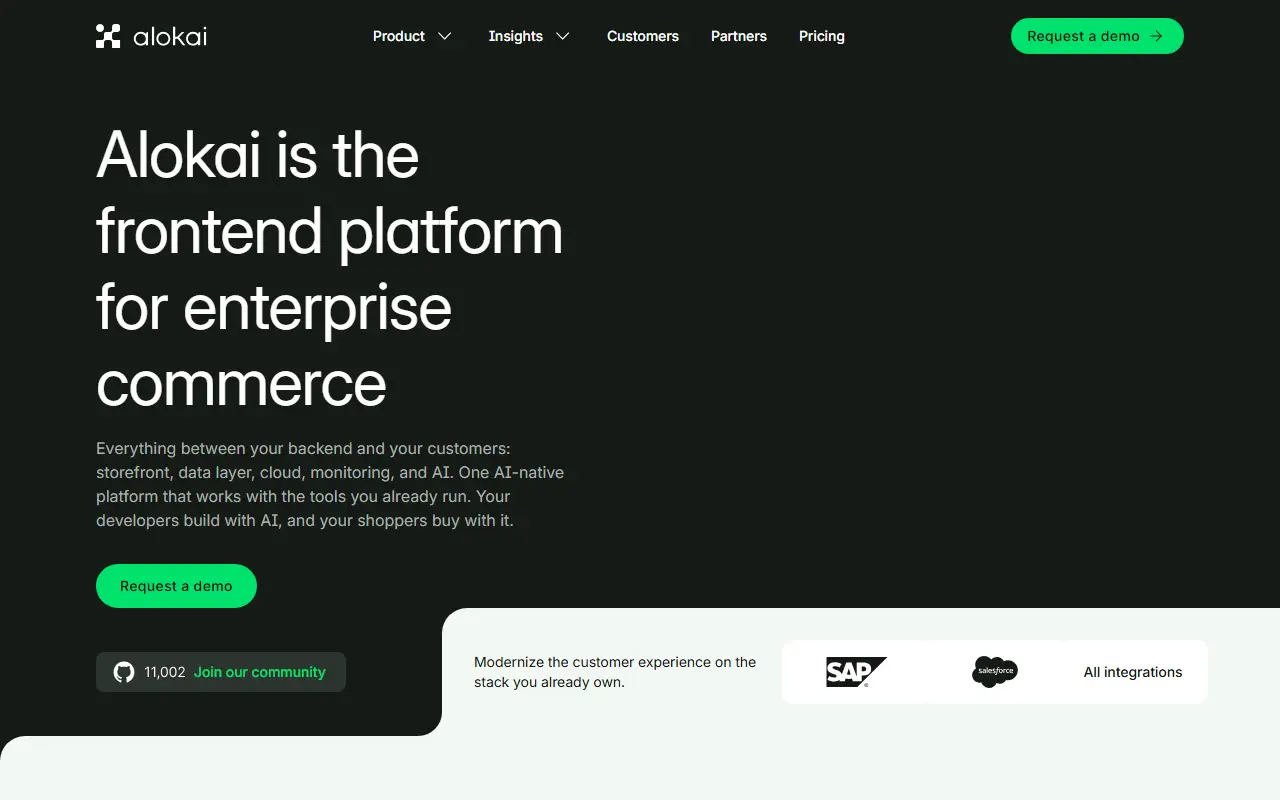
Vue Storefront, now branded Alokai, is a frontend-as-a-service approach to composable commerce. It gives teams a working e-commerce storefront and a layer of tooling that connects the frontend to whichever backend platform they use, instead of building the shopping interface and every integration from scratch.
The ecosystem includes starter applications for Nuxt and Next.js, a ready-made theme based on the Storefront UI component library, and a middleware server built on Express that links the frontend with commerce platforms and other integrations. It is described as backend-agnostic, working with any backend that has an API, with prebuilt integrations for platforms such as Magento, Shopware, Shopify and commercetools.
The code is developed in the open on GitHub, with TypeScript, GraphQL, Docker and Jest in its stack, and the repository does not state a licence in its metadata. Teams can customize the theme or build their own from scratch. The platform suits developers and merchants who want a headless storefront with fast delivery and the freedom to swap the commerce backend later.
Key features
- Prebuilt storefront for Nuxt or Next.js
- Integrations with many commerce backends
- Storefront UI component library
- Express-based middleware layer
- Customizable theme or build from scratch
- TypeScript codebase with Docker support
Good fit for
- Building a headless storefront on Magento or Shopify
- Replacing a slow legacy e-commerce frontend
- Switching commerce backends without redoing the UI
Alokai: questions and answers
- What is Alokai used for?
- Alokai, formerly Vue Storefront, is a frontend platform that connects any commerce backend to a customizable Nuxt or Next.js storefront. It is a good fit for building a headless storefront on Magento or Shopify, replacing a slow legacy e-commerce frontend and switching commerce backends without redoing the UI.
- Is Alokai open source?
- Yes. Alokai is open source. Its source code is on GitHub at vuestorefront/vue-storefront.
- Is Alokai free?
- Yes. Alokai is open source, so the software itself is free to use. A managed cloud version is also available.
- Can I self-host Alokai?
- Yes. Alokai can be self-hosted on your own server or infrastructure.
- What is Alokai an alternative to?
- Alokai is an open-source alternative to Ecwid and Shoplazza. Other open-source alternatives to Ecwid include Medusa, Bagisto and Saleor.
- Is Alokai actively maintained?
- The most recent commit to Alokai was on 9 June 2026. The project has 11k stars on GitHub, with 8 added in the last 30 days.
Open-source alternatives to Alokai
See all
Medusa
E-commerce
The world's most flexible commerce platform for agents and developers
OSSvs BigCommerce★ 37k
Bagisto
E-commerce
Open Source eCommerce & Multi-Vendor Marketplace Platform Built with Laravel for Enterpris
MITvs BigCommerce★ 28k
Saleor
E-commerce
Saleor Core: the high performance, composable, headless commerce API.
BSD-3-Clausevs commercetools★ 24k
Magento Open Source
E-commerce
Prior to making any Submission(s), you must sign an Adobe Contributor License Agreement, a
OSL-3.0vs BigCommerce★ 12k
WooCommerce
E-commerce
A customizable, open-source ecommerce platform built on WordPress. Build any commerce solu
OSSvs BigCommerce★ 11k
PrestaShop
E-commerce
PrestaShop is the universal open-source software platform to build your e-commerce solutio
OSSvs BigCommerce★ 9.3k
SaaS alternatives to Alokai
See all
Ecwid
E-commerce
Embeddable online store that adds a shop to an existing website
SaaS
Shoplazza
E-commerce
Hosted ecommerce platform and website builder for cross-border sellers
SaaS
Nuvemshop
E-commerce
Hosted store builder used by merchants in Latin America, also sold as Tiendanube
SaaS
Shift4Shop
E-commerce
Hosted ecommerce platform from Shift4, formerly known as 3dcart
SaaS
Adobe Commerce
E-commerce
Ecommerce platform formerly Magento Commerce, with B2B and headless options
SaaS
BigCommerce
E-commerce
Hosted ecommerce platform with built-in B2B features and headless options
SaaS