#1
PHP content management system with a drag-and-drop page builder, multi-site support and built-in e-commerce, usable as a traditional or headless CMS.
- GitHub stars
- 1.3k
- Last commit
- 15 days ago
- Latest release
- 1.0.9.0
- Licence
- AGPL-3.0
- Self-hosted
- Yes
vvveb.com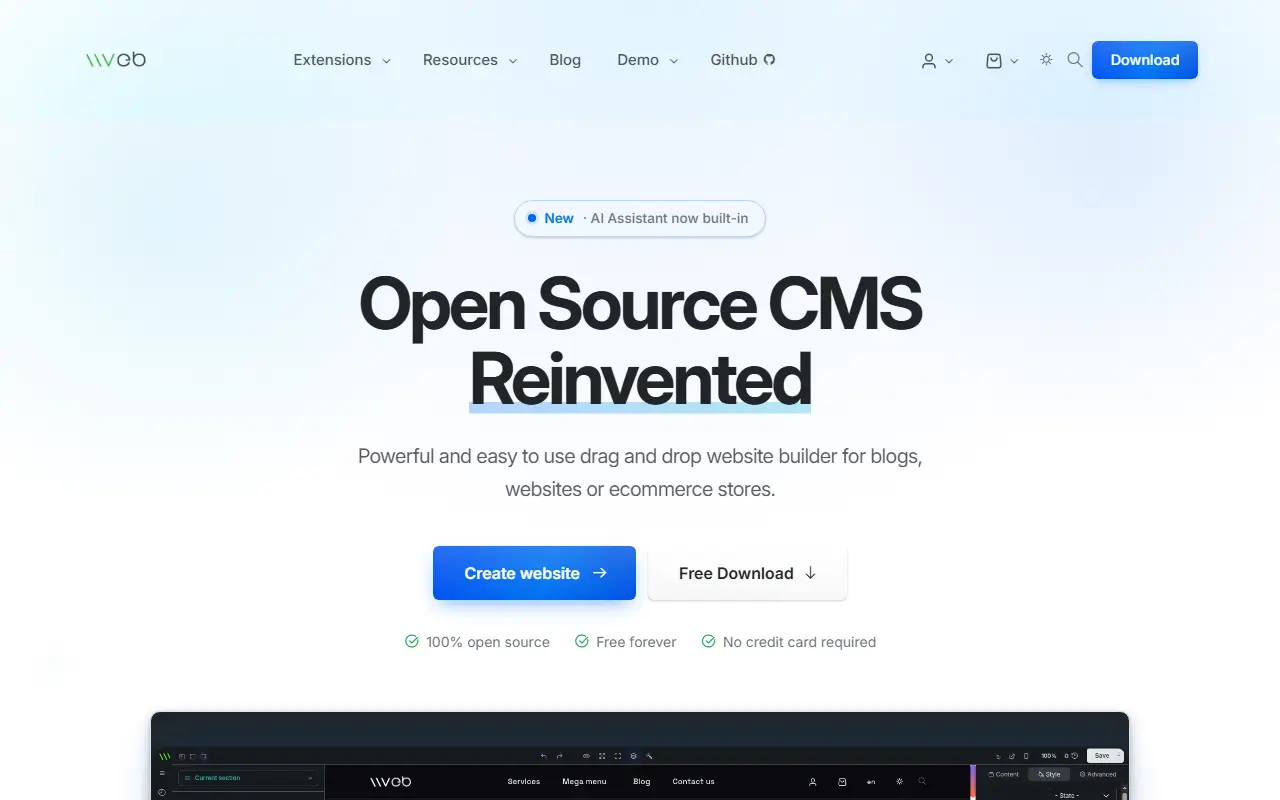
Vvveb is a self-hosted CMS for building websites, blogs and online stores. It combines a drag-and-drop page builder with publishing tools such as revisions, media management, multi-user access and role permissions, plus localization and multi-language support.
For selling online it adds one-page checkout, subscriptions, digital assets, vouchers and coupons, and product options, attributes, variants, reviews and questions. A marketplace allows themes and plugins to be installed from the admin dashboard, custom fields, posts and products are supported, and a plugin system with events enables extensions. It can also run as a hybrid headless CMS through GraphQL and REST APIs.
The project highlights a small resource footprint, caching that makes pages load like static files, a bundled SEO plugin, brute-force and SQL injection protection, a hidden admin login page and an install where only one PHP file is publicly exposed. It needs PHP 7.4 or later, with 8.3 recommended, and a MySQL, SQLite or PostgreSQL driver. It is licensed under AGPL-3.0.
Key features
- Drag-and-drop page builder
- Built-in e-commerce with one-page checkout
- Multi-site and multi-language support
- Headless mode with GraphQL and REST APIs
- Theme and plugin marketplace
- Bundled SEO plugin and security protections
- Backup and import/export for migration
Pricing: Free and open source under the AGPL-3.0 licence.
#2
An open-source website builder written in Java for blogs, knowledge bases, company sites and online stores, with a plugin and theme marketplace and Docker setup.
- GitHub stars
- 40k
- Last commit
- yesterday
- Latest release
- v2.27.2
- Licence
- GPL-3.0
- Self-hosted
- Yes
halo.run
Halo is an open-source website building tool written in Java. It targets a range of needs, from personal blogs and knowledge bases to corporate websites and online shops, and aims to cover them all in a single, easy-to-use system. Its documentation and project text are primarily in Chinese.
A quick-start Docker command launches a trial environment, and the maintainers recommend deploying with the 1Panel server management panel for reverse proxy, SSL certificates and upgrade and backup handling. An application market offers more than 100 free themes and plugins, and developers can publish their own. A public demo environment is available for exploring the admin interface.
Halo comes in three editions. The Community edition is free under GPL-3.0 and suits individual developers and open-source projects. The Professional edition adds features such as a mobile app, AI site generation, phone number login and a paid theme and plugin market. A Commerce edition adds an integrated online store with payment support for the Chinese market, including WeChat Pay and Alipay.
Key features
- Website builder for blogs and company sites
- Theme and plugin application market
- Docker quick start
- Knowledge base and documentation sites
- Optional online store in the Commerce edition
- Mobile app and AI site generation in Professional edition
Pricing: The Community edition is free and open source under GPL-3.0; Professional and Commerce editions add paid features.
#3
WordPress is an open-source publishing platform and CMS for building websites, blogs and online stores with themes, blocks and plugins.
- GitHub stars
- 22k
- Last commit
- yesterday
- Self-hosted
- Yes
- Hosted version
- Available
wordpress.org
WordPress is a content management system and publishing platform for building websites, blogs and apps. People write and organize content in a browser-based editor, choose how the site looks with themes, and publish without writing code. Its own site describes it as the platform behind millions of websites, from creators and small businesses to enterprises.
Design and editing are built around blocks, so pages can be assembled and rearranged visually with a live preview as content changes. Styling can be adjusted for different screen sizes and interactive states without writing CSS. Functionality is extended through a large library of plugins that add features such as stores, analytics, newsletters and social media integration.
The software is written in PHP and is open source; the GitHub repository is a read-only mirror of the project's Subversion repository, with development happening elsewhere. You can run it on your own hosting, and a managed service is also available through WordPress.com. It suits individual bloggers, small businesses and larger organizations alike.
Key features
- Block-based page and post editor
- Themes for site design
- Plugin library for extra functionality
- Site editor with responsive styling controls
- Media library with a built-in editor
- Runs on your own PHP hosting
Pricing: The software is free and open source; costs come from hosting and any paid themes or plugins you choose.
#4
An open-source visual website builder positioned as a Webflow alternative, connecting to any headless CMS and supporting all CSS properties, hosted by Webstudio or yourself.
- GitHub stars
- 9.2k
- Last commit
- today
- Latest release
- 0.312.0
- Licence
- AGPL-3.0
- Self-hosted
- Yes
- Hosted version
- Available
webstudio.is
Webstudio is a visual development platform, released as open source, for developers, designers and cross-functional teams, and is presented as an alternative to Webflow. It is a visual builder that connects to any headless CMS and supports all CSS properties, and you own the data, components and infrastructure.
You can choose the hosted version or deploy your own instance, and the topics mention Cloudflare Workers, React, Remix and accessibility via Radix UI. The project provides a blog, documentation, a roadmap and an issue tracker for the builder, and a community on Discord.
Licensing is split. The Webstudio core, meaning all functionality in the repository, is free and open source under AGPL-3.0-or-later, while the optional sdk-components-animation package is proprietary and requires accepting the Webstudio, Inc. EULA. It is written in TypeScript. It suits designers and developers who want Webflow-style visual building with the option to self-host.
Key features
- Visual builder for websites
- Support for all CSS properties
- Connects to any headless CMS
- Host on Webstudio or self-host
- React and Remix based codebase
- Optional proprietary animation package
Pricing: Core is open source under AGPL-3.0-or-later; an optional animation package is proprietary. A hosted version is offered.
#5
Magento Open Source is a PHP ecommerce platform for building online stores, with Adobe Commerce as its full-featured commercial counterpart.
- GitHub stars
- 12k
- Last commit
- yesterday
- Latest release
- 2.4.10-alpha1
- Licence
- OSL-3.0
- Self-hosted
- Yes
Magento Open Source is a PHP-based ecommerce platform used to build an online store from the ground up. The repository is magento/magento2, and the README presents it as software with the basic ecommerce capabilities, while directing merchants who need a more complete solution to Adobe Commerce.
Adobe Commerce adds an optimized cloud architecture with hosting, along with AI-powered merchandising and analytics, so the open-source edition is the self-managed starting point. The project has a large contributor community, with community maintainers who can review and merge pull requests, and the documentation covers system requirements, prerequisites and several installation options.
Magento is licensed under OSL-3.0, and contributors must sign the Adobe Contributor License Agreement. It runs on your own servers and fits developers, agencies and merchants who want control over the code of their store and are comfortable with the PHP ecosystem. Because it is a full platform, hosting, security updates and extensions are the store owner's responsibility.
Key features
- Core ecommerce store functionality
- PHP codebase for custom development
- Quick-start and multiple installation options
- Community maintainers reviewing contributions
- Upgrade path to Adobe Commerce
- Developer and end-user documentation
Pricing: Open source under OSL-3.0; the commercial Adobe Commerce edition adds cloud hosting and extra features.
#6
A customizable open-source ecommerce platform built as a plugin for WordPress; this repository is the monorepo for the core plugin and its extensions.
- GitHub stars
- 11k
- Last commit
- today
- Latest release
- 11.3.0
- Self-hosted
- Yes
woocommerce.com
WooCommerce is a customizable ecommerce platform that runs on WordPress, written mainly in PHP. The GitHub repository is a monorepo with the plugins, packages and tooling for developing the core WooCommerce plugin together with its extensions, so it is where the project's code, issues and development discussions live.
Developers working on it need Node.js, PNPM, PHP 7.4 or higher and Composer, and a POSIX-compliant operating system is assumed, with WSL recommended on Windows. The project maintains a development blog and a developer account on X for updates, and the topics reference React, since parts of its admin interface use it.
Because it is built on WordPress, merchants typically run WooCommerce on their own hosting, adding products, payments and shipping through extensions. The repository lists the license as Other, so check the licence terms in the repository. It suits small and mid-sized shops, agencies and developers who already work in the WordPress ecosystem.
Key features
- Ecommerce functionality on WordPress
- Extensions add features to the core
- Monorepo of plugins and packages
- PHP codebase with React-based admin parts
- Developer blog and documentation
- Large ecosystem of third-party extensions
Pricing: The core platform is free with no subscription or revenue share. You pay separately for hosting (about $25 to $350 a month) and optional extensions ($29 to $299 a year each).
#7
A PHP open-source e-commerce platform for building online stores, with payment integrations, translations, responsive front and back offices and a customizable architecture.
- GitHub stars
- 9.3k
- Last commit
- yesterday
- Latest release
- 9.2.1
- Self-hosted
- Yes
prestashop-project.org
PrestaShop is an e-commerce web application written in PHP and released as open source, built to give merchants and shoppers a solid shopping cart experience. It is described as highly customizable, supports the major payment services, is translated into many languages, is localized for many countries and has a responsive design for both the storefront and the back office.
The GitHub repository contains the source code for development and preview, while stable downloads come from the releases page. The stable line is PrestaShop 9.0, first released in June 2025, and the develop branch holds work in progress toward version 9.1. Installing it requires a web server with PHP 8.1 or newer and MySQL 5.6 or later, or a compatible fork such as MariaDB, plus a database tool such as phpMyAdmin. Apache or Nginx are recommended.
PrestaShop is a self-hosted platform, so merchants run it on their own hosting, and the repository lists the licence as Other. Its topics mention CMS and PHP framework use. It suits small and mid-sized merchants and agencies building custom shops with extensions and themes.
Key features
- Full e-commerce storefront and back office
- Support for major payment services
- Translations and country localization
- Responsive front and back office
- Highly customizable modules and themes
- PHP 8.1+ with MySQL or MariaDB
Pricing: Free open-source software; the repository lists the license as Other.
#8
Low-code visual website builder from Frappe for designing responsive pages and publishing them with one click, integrated with the Frappe ecosystem.
- GitHub stars
- 2.5k
- Last commit
- yesterday
- Latest release
- v1.38.0
- Licence
- MIT
- Self-hosted
- Yes
frappe.io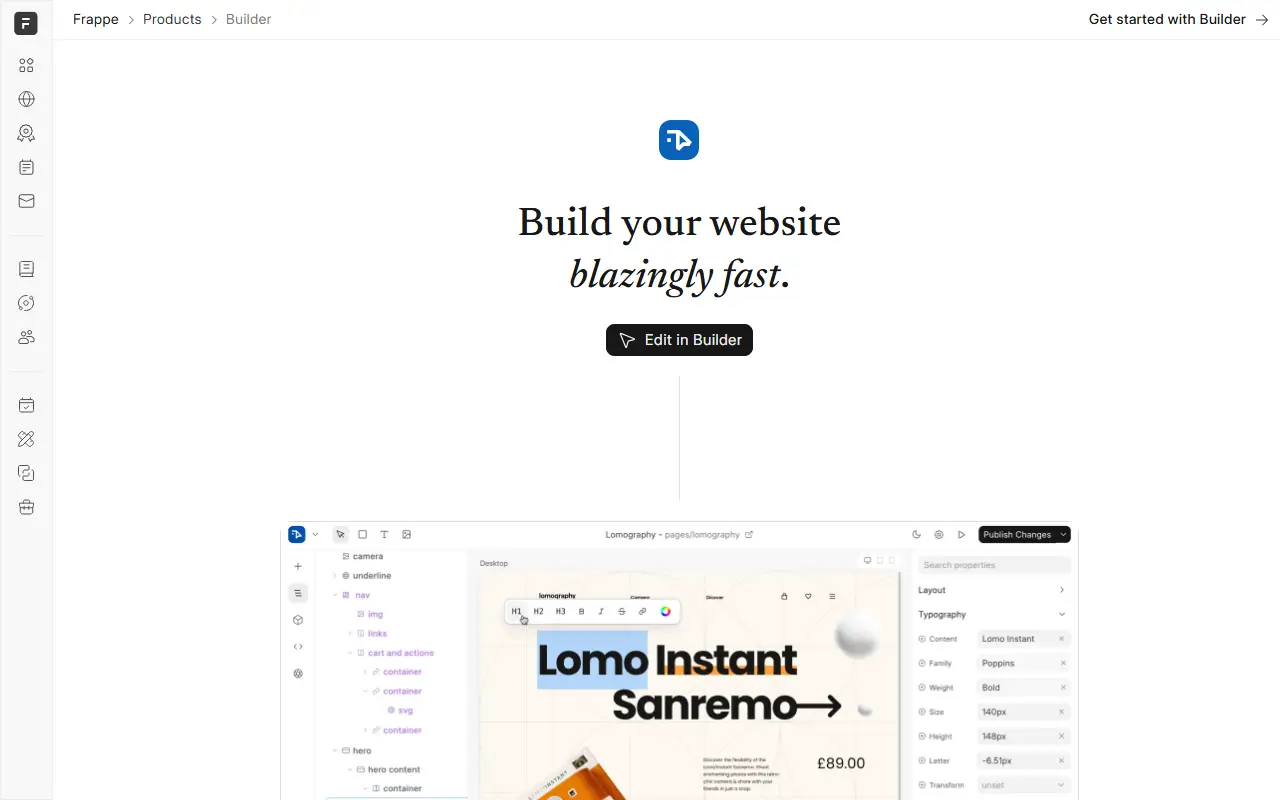
Frappe Builder is a low-code website builder designed for simplicity, speed, and flexibility. Designers can lay out pages visually, and developers can customize them. A click-to-publish option covers the end-to-end process of making a site live. It is part of the Frappe ecosystem, written with Python, Vue, and TypeScript, and released under the MIT license.
The author says existing tools were too complex, too restrictive, or hard to integrate with Frappe, and that pages made with them often carried unnecessary scripts and styles. Builder aims to produce lean pages. The topics mention responsive layouts, Figma, a CMS, ERPNext website integration, and an AI website builder.
It suits teams already running Frappe or ERPNext who want to design public pages such as landing pages and marketing sites without leaving the platform, and developers who want a visual tool that integrates with their Frappe data. Documentation and a project website are available.
Key features
- Visual drag-and-drop page builder
- Click-to-publish workflow
- Responsive page layouts
- Integration with the Frappe ecosystem
- Lean pages without extra scripts
- Customization for developers
Pricing: Free and open source under the MIT license.
#9
Joomla is a long-established open-source PHP content management system for building multilingual websites, with a large extension ecosystem.
- GitHub stars
- 5.2k
- Last commit
- today
- Latest release
- 6.2.0
- Licence
- GPL-2.0
- Self-hosted
- Yes
joomla.org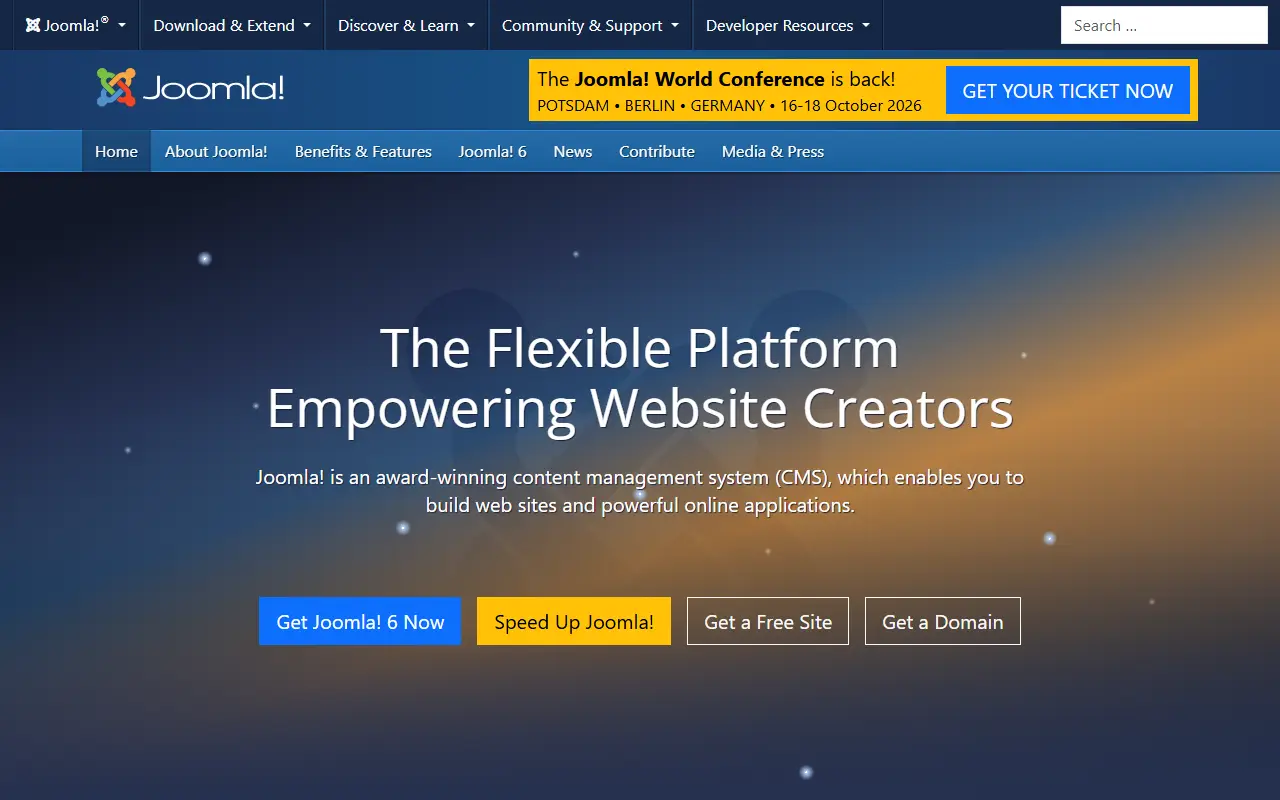
Joomla is a free, open-source content management system written in PHP. It lets site owners and developers build, organize and publish websites and web applications through an administrator interface, and it is tagged as both a CMS and a website builder with multilingual capabilities.
This repository contains the source of the current Joomla CMS, with version history and detailed changelogs published on the project site and continuous integration status shown for PHP and Node. Joomla relies on a large community of extension developers and translators to extend the core, and the project promotes contributions through Hacktoberfest.
Joomla is licensed under GPL-2.0 and installed on your own web hosting with a database. It suits small business sites, community portals, publishers and agencies that want a mature, extensible PHP CMS with built-in support for multiple languages.
Key features
- PHP content management system
- Multilingual website support
- Administrator back end for editors
- Extensions and templates ecosystem
- Published version history and changelogs
- Active community development
Pricing: Free and open source under GPL-2.0.
#10
Free, open-source visual website builder that exports clean static HTML and CSS, positioned as a libre alternative to Webflow.
- GitHub stars
- 3k
- Last commit
- today
- Latest release
- v3.10.0
- Licence
- AGPL-3.0
- Self-hosted
- Yes
- Hosted version
- Available
silex.me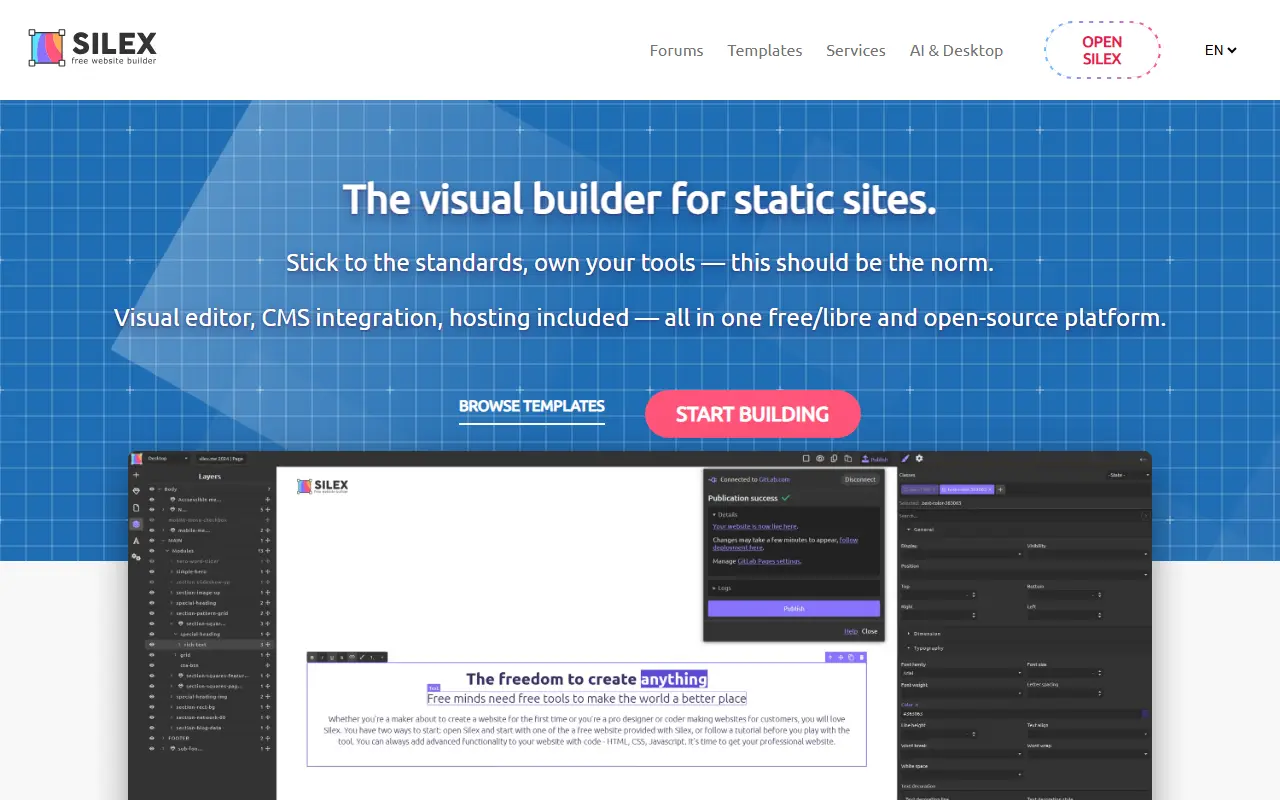
Silex is a visual builder for static websites that can also pull in dynamic data. You design pages visually and export standard HTML and CSS that can be hosted anywhere, so there is no proprietary format, forced hosting, or subscription. It is released under the AGPL-3.0 license and presented as an open alternative to Webflow.
It is maintained by Silex Labs, a non-profit organization, and describes itself as free forever with all features included and no premium tier. It follows JAMstack practices, uses the GrapesJS editor according to its topics, and can pull content from WordPress through GraphQL. An MCP server is also mentioned among the project topics, and a desktop app can be downloaded alongside the online version.
You can try Silex online or run it yourself with Node.js. It suits web agencies, WordPress developers, freelance designers, and no-code builders who want a visual workflow with output they fully own. Because the output is standard web files, learning it also builds transferable HTML, CSS, and JAMstack skills.
Key features
- Visual page design with clean HTML and CSS export
- Host the exported site anywhere
- Dynamic data for static sites
- WordPress content through GraphQL
- Desktop app and online editor
- Built on the GrapesJS editor
Pricing: Silex is free to use hosted through a free GitLab account, as a desktop app, or self-hosted. Training, development and managed hosting are optional services quoted separately.
2 more Weebly alternatives
Weebly alternatives: questions
- What is the best open-source alternative to Weebly?
- Vvveb is the top-ranked open-source alternative to Weebly on Enlisted: PHP content management system with a drag-and-drop page builder, multi-site support and built-in e-commerce, usable as a traditional or headless CMS. Other strong options are Halo, WordPress, Webstudio and Magento Open Source.
- What are the best commercial alternatives to Weebly?
- Squarespace, Wix, Pixpa, Hostinger Website Builder and Bluehost Website Builder are among the hosted, closed-source alternatives to Weebly listed on Enlisted, which lists 43 in total. Compare their pricing and features on each tool page.
- Are these Weebly alternatives free?
- All 12 are open source, so the code is free to use under its licence, and all of them can be self-hosted on your own server or computer. 3 also offer a paid or managed cloud version if you'd rather not host it yourself.
- How is this list of Weebly alternatives ranked?
- By a score built from GitHub stars, star growth over the last 30 days and how recently the code changed. 12 of these projects shipped code in the last 30 days. Data is refreshed daily, and nobody can pay to move up.
 TrackMedia
 TrackRev