7,380 open-source and SaaS tools, with GitHub stats refreshed every day.

4 alternatives ranked by real activity

Open-source SkuVault alternatives

A curated, ranked list of the 4 best open-source alternatives to SkuVault.

The best open-source alternative to SkuVault is Odoo. If that doesn't suit you, other good options are ERPNext, InvenTree and OMS ERP.

SkuVault alternatives are mainly ERP tools. 3 of them shipped code in the last 30 days, 4 can be self-hosted, and 2 use a permissive licence.

Last updated October 3, 2026 · ranked by GitHub stars, growth and recent commits

Odoo

Open-source business software that runs in the browser, with CRM, eCommerce, accounting, inventory and HR apps usable alone or together as an ERP.

GitHub stars
55k
Last commit
today
Self-hosted
Yes
Hosted version
Available

Odoo is a bundle of browser-based, open-source business applications. Apps cover sales (CRM and eCommerce), a website builder, inventory and manufacturing, projects, invoicing and accounting, point of sale, human resources and marketing. It is written in Python, and GitHub lists the license as 'Other', so check the repository for the exact terms.

Each app can be used as a stand-alone application, but they are designed to work together, so installing several apps gives you a full-featured ERP system. This lets a business start with a single function, such as sales or invoicing, and add modules as its needs grow without changing platforms.

The README points to setup instructions for a standard installation, an eLearning course and a business game called Scale-up for learning the software, and developer tutorials for extending it. Odoo can be run on your own infrastructure, and the vendor's website offers commercial services. It suits small and mid-sized companies looking for an integrated business suite.

Key features

  • CRM and sales applications
  • Website builder and eCommerce
  • Billing and accounting
  • Warehouse and manufacturing management
  • Project management and HR apps
  • Stand-alone or integrated ERP use

Pricing: One app is free for unlimited users. Standard costs US$11.20 and Custom US$20.90 per user per month on monthly billing, with lower yearly rates; a free trial is offered and Custom allows on-premise hosting.

ERPNext

ERPNext, a free open-source ERP built on the Frappe framework, covering accounting, inventory, orders, manufacturing, assets and projects in one system.

GitHub stars
40k
Last commit
yesterday
Latest release
v15.121.6
Licence
GPL-3.0
Self-hosted
Yes
Hosted version
Available
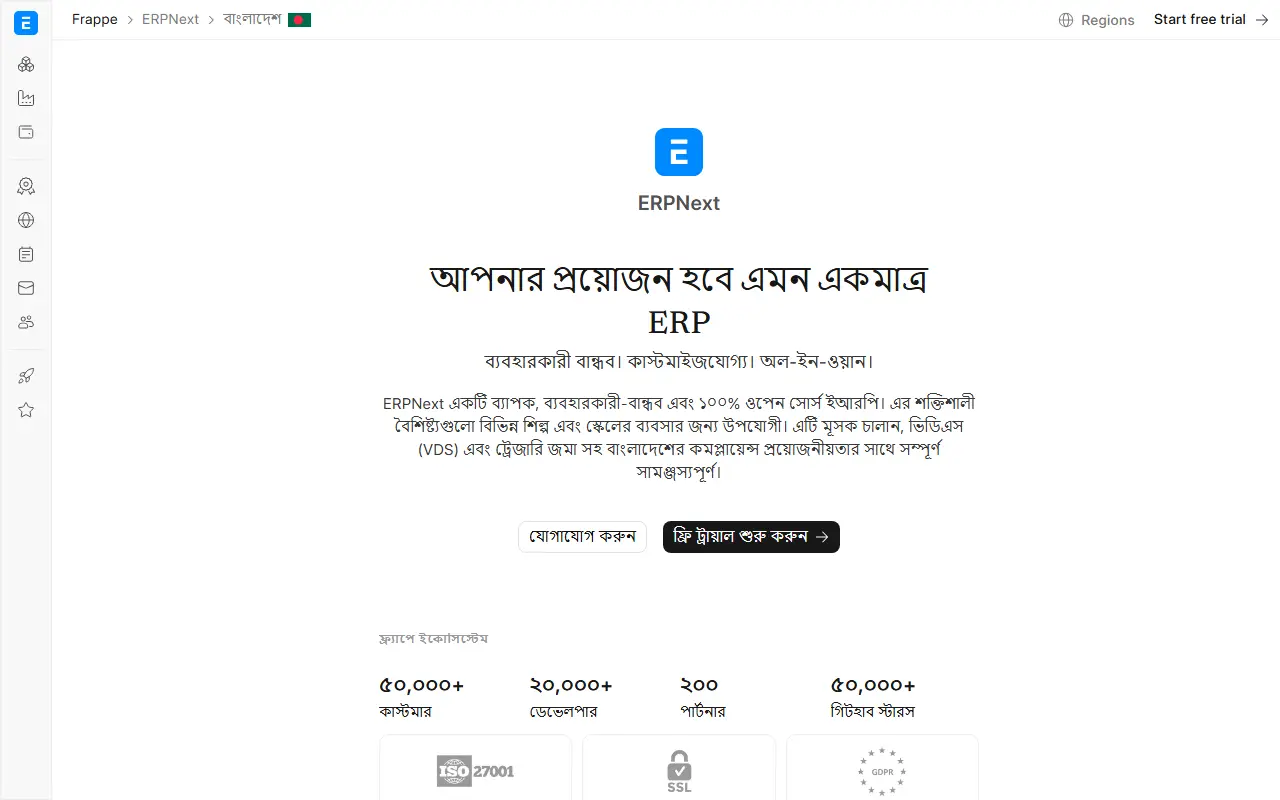
frappe.ioERPNext homepage screenshot

This entry points to ERPNext, the open-source enterprise resource planning system developed in the frappe/erpnext repository on top of the Frappe framework. It aims to replace the patchwork of separate programs a business often uses for invoices, stock, personnel and daily operations with a single integrated product.

Its modules include accounting for cash flow, transactions and financial reports; order management for inventory levels, replenishment, sales orders, customers, suppliers and shipments; manufacturing for production cycles, material consumption, capacity planning and subcontracting; asset management from purchase to disposal; and project delivery. Topics also list HR, CRM, procurement, retail, distribution, healthcare and support functions. It is written in Python, and a live demo is available.

ERPNext is GPL-3.0 licensed and can be self-hosted. The Frappe team also offers managed hosting, which suits companies that want the software without running servers. It is aimed at small and mid-size organizations that want an alternative to proprietary ERP suites.

Key features

  • Accounting and financial reporting
  • Inventory and order management
  • Manufacturing planning and subcontracting
  • Asset tracking across the organization
  • Project planning and delivery tracking
  • HR, CRM and procurement modules

Pricing: ERPNext software is free to self-host. Frappe Cloud hosting starts at $5 per month for a site and $20 per month for a server, not charged per user; a 14-day free trial is available.

InvenTree

InvenTree is an open-source inventory management system for stock control and part tracking, with a Django backend, REST API and plugin system.

GitHub stars
7.7k
Last commit
yesterday
Latest release
1.5.6
Licence
MIT
Self-hosted
Yes
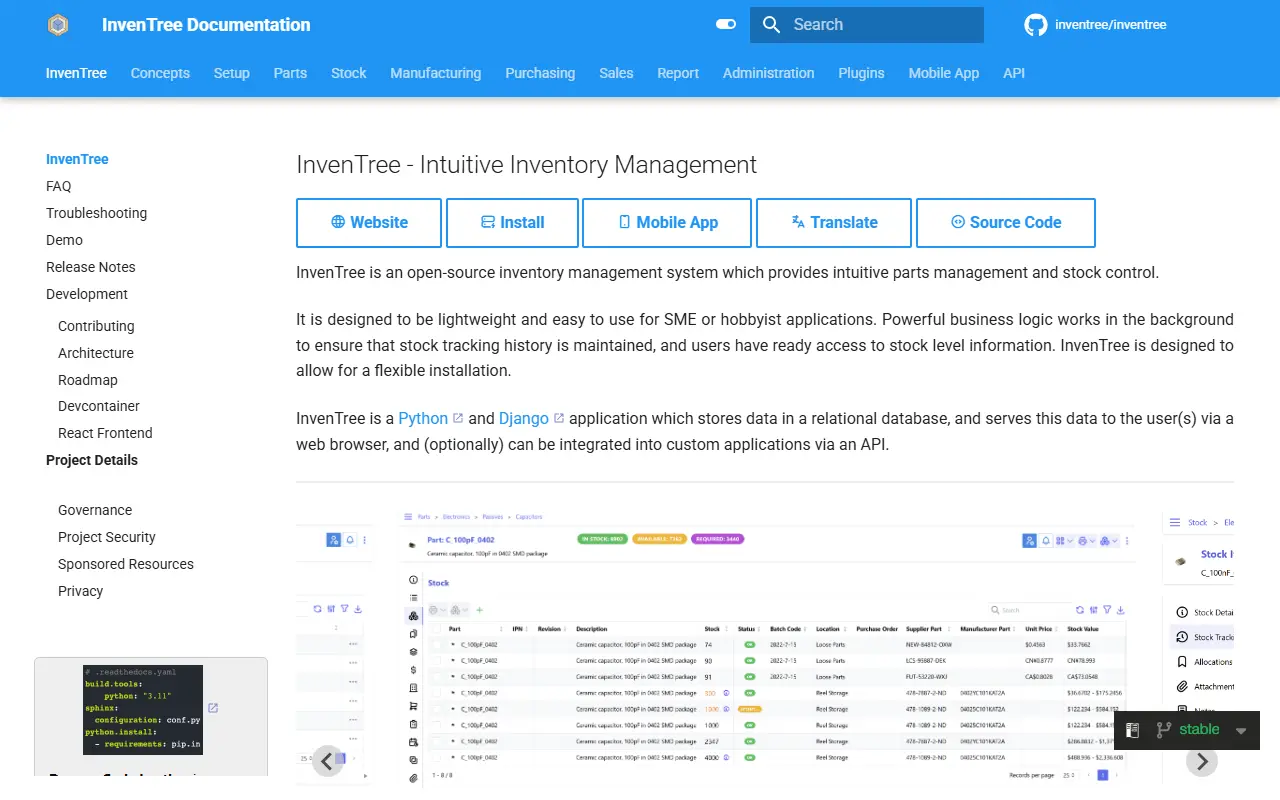
docs.inventree.orgInvenTree homepage screenshot

InvenTree is an open-source inventory management system that provides low-level stock control and part tracking. It targets organizations such as makers, electronics teams and small manufacturers that need to know which parts they have, where they are stored and how they are used.

The core is a Python and Django database backend that offers a web-based admin interface and a REST API for interaction with other applications. A plugin system supports custom applications and extensions, and integration options include the API, a Python module and third-party tools. The client is built with React, and the server supports PostgreSQL, MySQL, MariaDB and SQLite databases with Redis for caching.

InvenTree is licensed under MIT and deployed with Docker. A demo instance, documentation, a roadmap and issue tracker are linked from the repository, and translations are handled through Crowdin.

Key features

  • Low-level stock control
  • Part tracking
  • REST API for integrations
  • Plugin system for custom extensions
  • React web client
  • PostgreSQL, MySQL, MariaDB and SQLite support

Pricing: Free and open source under the MIT licence.

OMS ERP

Open-source Java business platform combining order management, inventory and finance for merchants selling across Chinese e-commerce channels.

GitHub stars
1.9k
Last commit
9 mo ago
Latest release
PRE
Licence
Apache-2.0
Self-hosted
Yes
k8s9.comOMS ERP homepage screenshot

OMS-ERP is an omni-channel business middle-platform from the Chinese vendor Feiji Technology (Xiamen), with documentation in Chinese. It pulls orders from marketplaces such as JD, Taobao, Tmall, Douyin and Pinduoduo, converts them into internal orders, and links the order, procurement, inventory and finance centers so that order, stock and financial data stay consistent. It targets retailers and brands that want to replace scattered e-commerce and ERP tools with a platform they own.

Technically it is a Spring Cloud microservice system designed for Kubernetes, with multi-tenant support, Zeebe and Activiti workflow engines and customizable reports. Common components such as Redis, MyBatis, saga-based distributed transactions, distributed locks and search are packaged as reusable services so teams can extend the platform themselves. The repository lists topics including OMS, WMS, TMS, CRM and ERP.

The code is published under the Apache-2.0 license, though the README's installation and usage sections are still empty. The vendor's website describes its business model as full source code delivery, local or private cloud deployment, documentation, customization and training, with a commercial license certificate offered as an added service. Contact the vendor for editions and pricing.

Key features

  • Aggregates orders from major Chinese e-commerce platforms
  • Order, procurement, inventory and finance centers
  • Spring Cloud microservice architecture
  • Multi-tenant support
  • Zeebe and Activiti workflow engines
  • Customizable reports

Pricing: Code is on GitHub under Apache-2.0. The vendor also sells a commercial license certificate with source delivery, deployment and training; prices are not published.

SkuVault alternatives: questions

What is the best open-source alternative to SkuVault?
Odoo is the top-ranked open-source alternative to SkuVault on Enlisted: Open-source business software that runs in the browser, with CRM, eCommerce, accounting, inventory and HR apps usable alone or together as an ERP. Other strong options are ERPNext, InvenTree and OMS ERP.
Are these SkuVault alternatives free?
All 4 are open source, so the code is free to use under its licence, and all of them can be self-hosted on your own server or computer. 2 also offer a paid or managed cloud version if you'd rather not host it yourself.
How is this list of SkuVault alternatives ranked?
By a score built from GitHub stars, star growth over the last 30 days and how recently the code changed. 3 of these projects shipped code in the last 30 days. Data is refreshed daily, and nobody can pay to move up.

People also look for alternatives to…

View all