 TrackMedia
 TrackRev

 IntelliJ IDEA
 Localize
 WorkFlowy
 MATLAB
 WebStorm
 PyCharm
 IBM SPSS Statistics
 Remember The Milk
 RustRover
 RubyMine
 GoLand
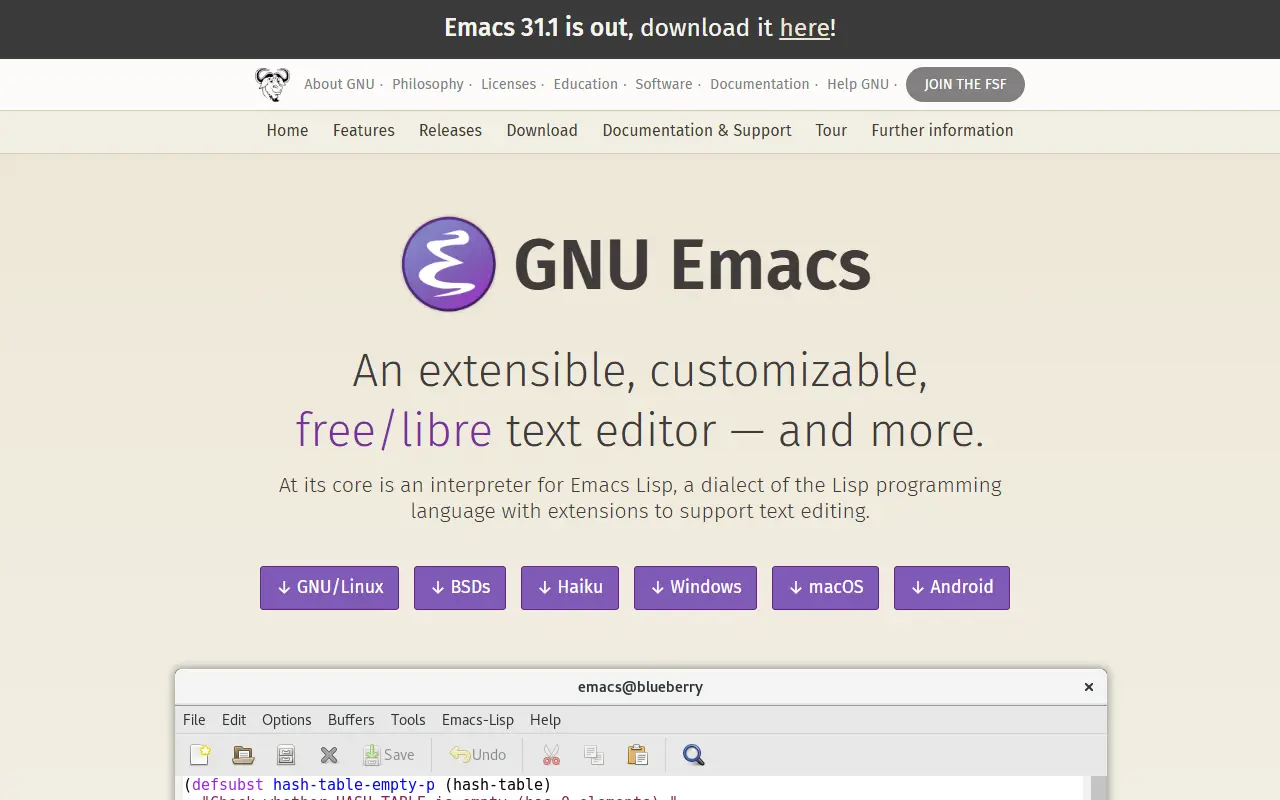
About GNU Emacs
GNU Emacs is an extensible, customizable, free text editor. The editor is built around an Emacs Lisp interpreter, a Lisp variant extended for editing text, and that same language is used to customize and extend it, which makes nearly every behavior of the editor programmable by its users.
Emacs offers content-aware editing modes with syntax coloring for many file types, built-in documentation with a tutorial for new users, and full Unicode support. It doubles as a calendar, an IRC client, a news and mail reader, a project planner and a front end for debuggers, and a packaging system downloads and installs extensions.
Emacs runs on GNU/Linux, the BSDs, Haiku, Windows, macOS and Android, and is licensed under GPL-3.0. Customization is done with Emacs Lisp code or a graphical interface. The GitHub repository is a mirror of the GNU project's source, and the official site offers downloads, a guided tour and documentation.
Key features
- Emacs Lisp scripting and customization
- Content-aware editing modes with syntax coloring
- Built-in documentation and tutorial
- Full Unicode support
- Package system for extensions
- Mail, news and IRC clients
- Debugger interface and calendar
Good fit for
- Programming with a customizable editor
- Writing and organizing notes and plans
- Reading mail and news inside the editor
GNU Emacs: questions and answers
- What is GNU Emacs used for?
- GNU Emacs, an extensible and customizable free text editor built around an Emacs Lisp interpreter, with features reaching well beyond editing. It is a good fit for programming with a customizable editor, writing and organizing notes and plans, and reading mail and news inside the editor.
- Is GNU Emacs open source?
- Yes. GNU Emacs is open source under the GPL-3.0 licence. Its source code is on GitHub at emacs-mirror/emacs and is written mainly in Emacs Lisp.
- Is GNU Emacs free?
- Yes. GNU Emacs is open source, so the software itself is free to use.
- What is GNU Emacs an alternative to?
- GNU Emacs is an open-source alternative to Sublime Text, BBEdit, Sitebulb and Spotify. Other open-source alternatives to Sublime Text include Visual Studio Code, VSCodium and Neovim.
- Is GNU Emacs actively maintained?
- Yes. The most recent commit to GNU Emacs was on 12 November 2026. The project has 5.2k stars on GitHub, with 29 added in the last 30 days.
Open-source alternatives to GNU Emacs
See all
Visual Studio Code
Developer Tools
Visual Studio Code
MITvs Sublime Text★ 195k
VSCodium
Developer Tools
binary releases of VS Code without MS branding/telemetry/licensing
MITvs Sublime Text★ 34k
Neovim
Developer Tools
Vim-fork focused on extensibility and usability
OSSvs Sublime Text★ 104k
Vim
Developer Tools
The official Vim repository
Vimvs Sublime Text★ 41k
Zed
Developer Tools
Code at the speed of thought – Zed is a high-performance, multiplayer code editor from the
OSSvs Sublime Text★ 95k
code-server
Developer Tools
VS Code in the browser
MITvs Replit★ 80k
SaaS alternatives to GNU Emacs
See all
Sublime Text
Developer Tools
Fast cross-platform text and code editor with multi-select and a Python plugin API
SaaS
BBEdit
Developer Tools
Text, code and markup editor for macOS
SaaS
Sitebulb
Marketing & SEO
Website crawler producing technical SEO audits and prioritized hints
SaaS
Spotify
Media & Streaming
Spotify is a digital music streaming service that gives access to millions of songs through a web player and mobile and desktop apps.
SaaS
Localazy
Localization
Developer-focused localization platform with a free tier
SaaS
Stoplight
API Tools
API design, documentation and governance platform now owned by SmartBear
SaaS