7,363 open-source and SaaS tools, with GitHub stats refreshed every day.

3 alternatives ranked by real activity

Open-source Stoplight alternatives

A curated, ranked list of the 3 best open-source alternatives to Stoplight.

The best open-source alternative to Stoplight is Scalar. If that doesn't suit you, other good options are Cortex Docs and Voiden.

Stoplight alternatives are mainly API tools. 3 of them shipped code in the last 30 days, 3 can be self-hosted, and 3 use a permissive licence.

Last updated October 2, 2026 · ranked by GitHub stars, growth and recent commits

Scalar

An open-source API platform that renders interactive OpenAPI and Swagger references and includes an offline-first API client with desktop apps.

GitHub stars
16k
Last commit
today
Latest release
release-2026-10-02-0962afc
Licence
MIT
Self-hosted
Yes
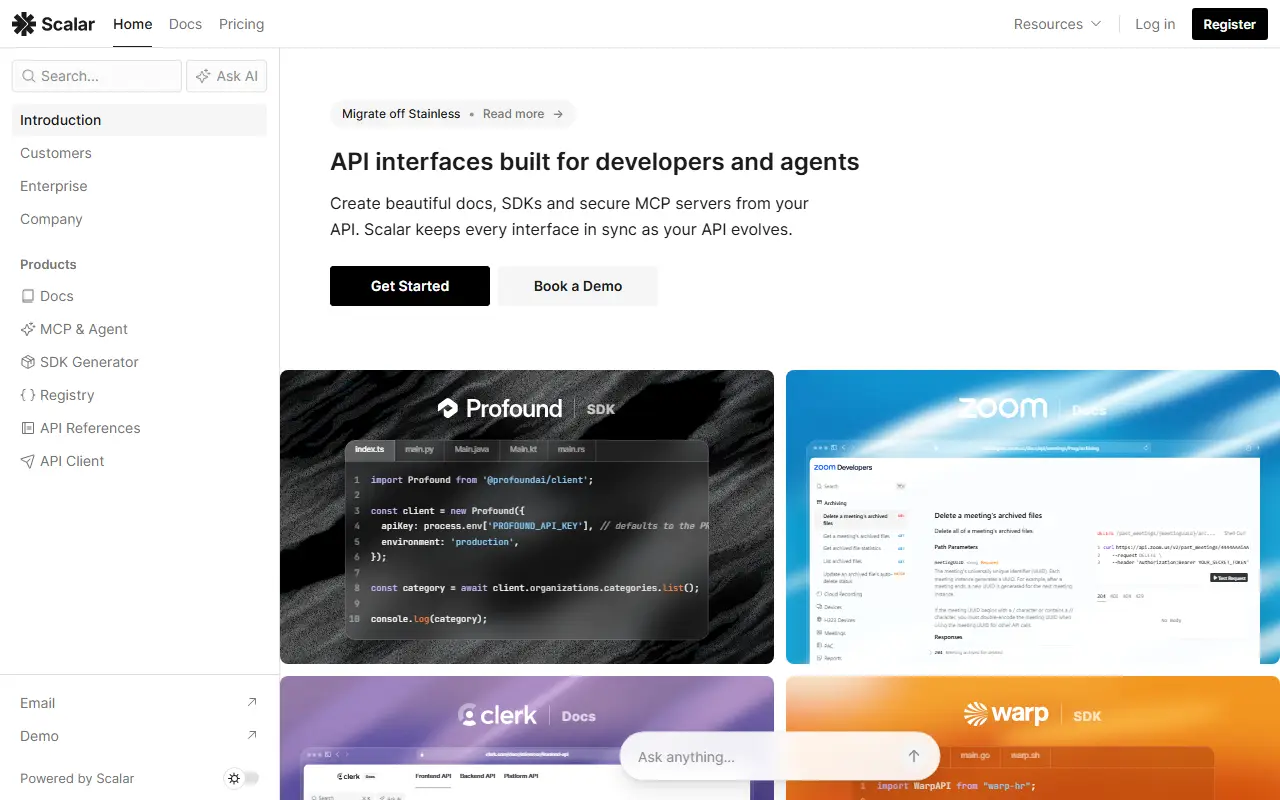
scalar.comScalar homepage screenshot

Scalar is an open-source API platform built around the OpenAPI standard. One part turns OpenAPI or Swagger documents into an interactive API reference with a built-in testing tool and generated code samples for many languages and frameworks, and it aims for a modern look rather than a dated one. Integrations exist for popular server frameworks, so docs can be mounted straight into an existing project.

The other part is an API client designed to work offline and built for OpenAPI. It is free and open source, treats OpenAPI and Swagger as first-class inputs, works with dozens of API frameworks such as Elysia, Hono and FastAPI, and can stay in sync with a running server through a watch mode. Environment variables, dynamic parameters and the other staples of a REST client are included. You can try it in the browser or download it for Windows, macOS or Linux.

The quickstart even offers a prompt you can hand to a coding agent to set up the reference in your project. Scalar is MIT licensed and written in TypeScript and Vue. It suits API teams that want better-looking documentation and a lighter alternative to Postman-style tools tied to their specs.

Key features

  • Interactive API reference from OpenAPI documents
  • Built-in request testing tool
  • Code samples in many languages
  • Offline-first API client for desktop
  • Watch mode that syncs with server frameworks
  • Integrations for Hono, FastAPI and Elysia

Pricing: Free plan for up to 3 APIs. Pro is $150 and Business $600 per month ($125 and $500 billed yearly); Enterprise is custom.

Cortex Docs

Generates interactive API documentation, typed SDKs, and MCP servers from OpenAPI, AsyncAPI, GraphQL, gRPC, OpenRPC, and Markdown sources.

GitHub stars
3.2k
Last commit
yesterday
Latest release
v0.1.36
Licence
MIT
Self-hosted
Yes
Hosted version
Available
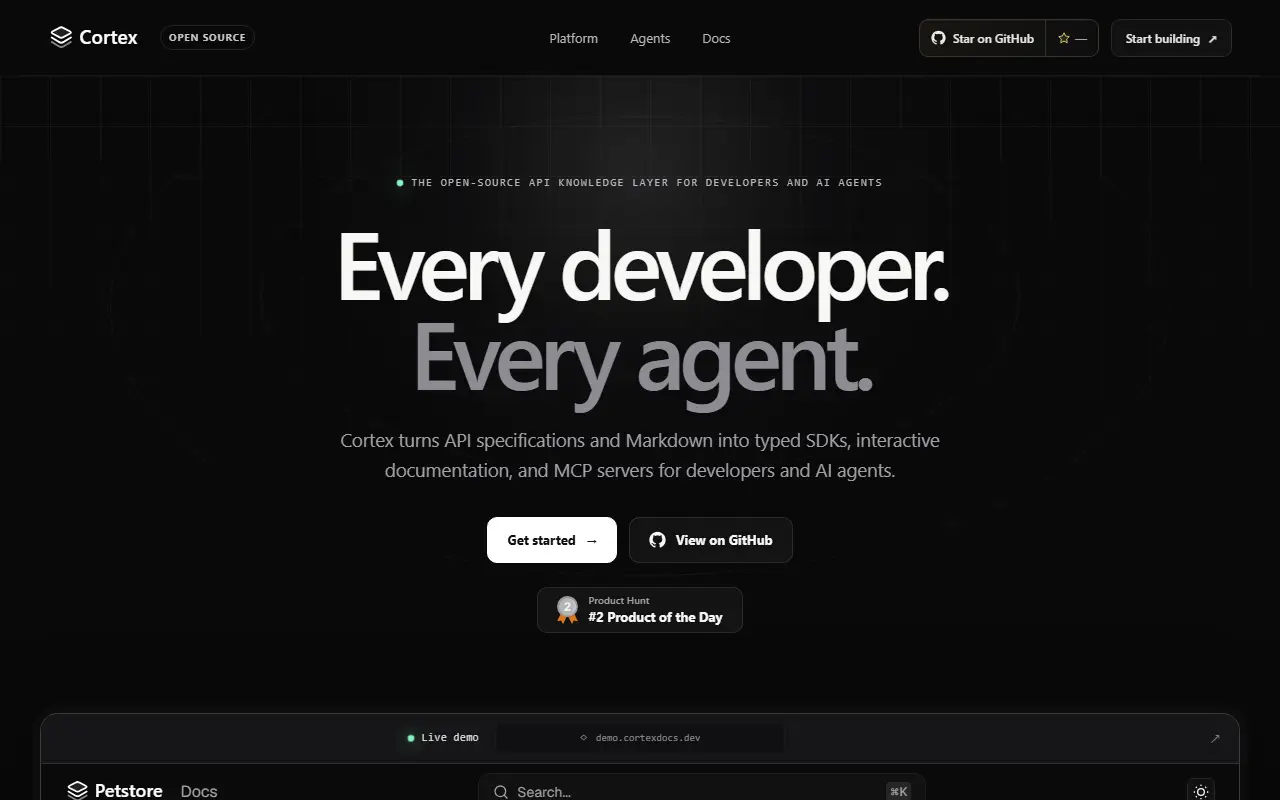
cortexdocs.devCortex Docs homepage screenshot

Cortex turns API specifications and Markdown files into developer-facing outputs from a single project configuration. It reads sources such as OpenAPI, AsyncAPI, GraphQL, Protocol Buffers, OpenRPC, and plain Markdown, and produces interactive documentation for people, typed SDKs for applications, and an MCP server so AI agents can work with the same project context. It is released under the MIT license.

Generated SDKs cover many languages, including TypeScript, Python, Go, Java, Kotlin, Ruby, PHP, Rust, and C++, and can combine several specification files into one client. The tool supports HTTP, WebSocket, GraphQL, gRPC, and JSON-RPC clients, and builds static HTML documentation with interactive API reference pages. The MCP server includes typed tools, embedded specifications, and SDK guides.

You can try a local demo in about a minute, keep documentation in Git, and publish a free site for a public GitHub repository through the project's hosting flow. It suits API providers and developer-experience teams who want one source of truth for docs, client libraries, and agent access.

Key features

  • Interactive API reference documentation
  • Typed SDK generation for many languages
  • MCP server generated from API specs
  • Supports OpenAPI, AsyncAPI, GraphQL, gRPC, and OpenRPC
  • Combines multiple spec files in one SDK
  • Static HTML documentation output
  • Markdown content kept in Git

Pricing: Free and open source under the MIT license; free hosted documentation sites are offered for public repositories.

Voiden

Offline, Git-native API workspace that designs, tests, and documents APIs in plain-text Markdown files with reusable blocks and an agent-friendly CLI.

GitHub stars
1.9k
Last commit
yesterday
Latest release
v2.3.1-b
Licence
Apache-2.0
Self-hosted
Yes
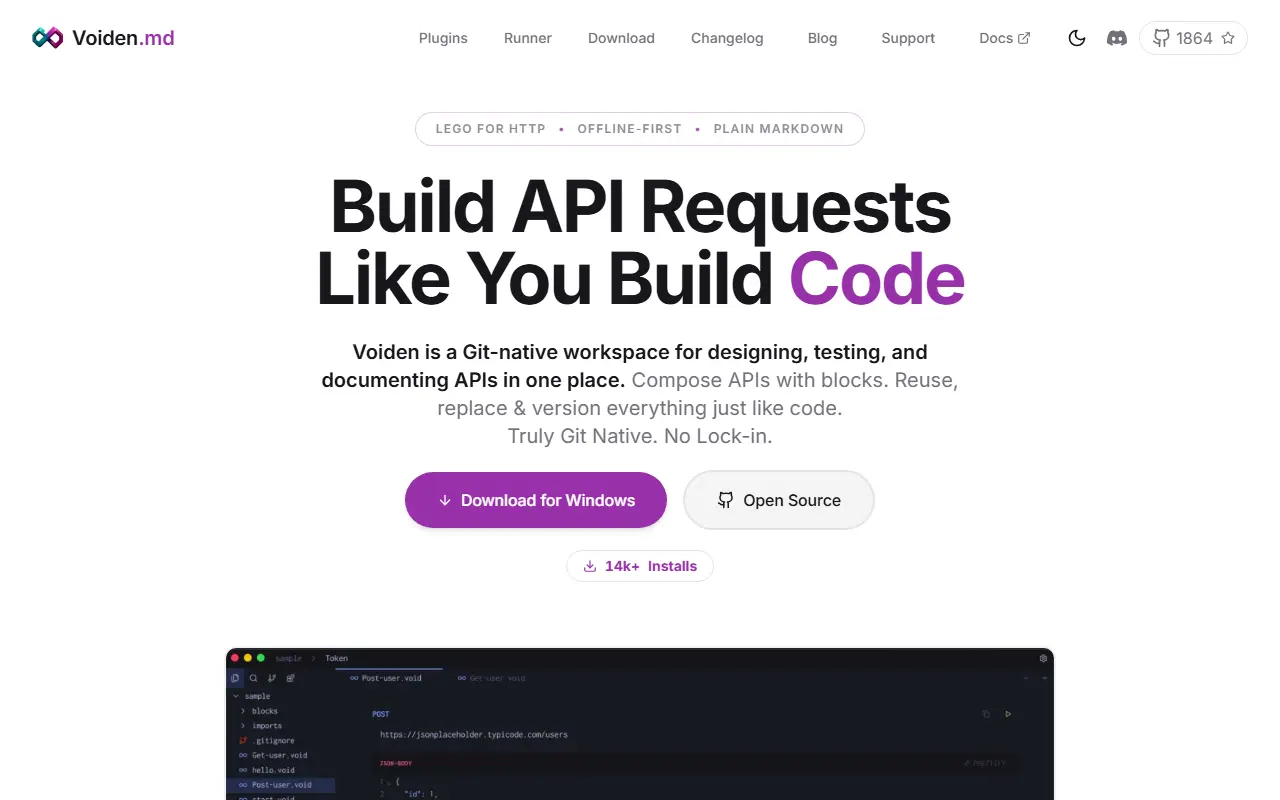
voiden.mdVoiden homepage screenshot

Voiden is an offline API client for developers, QA engineers, and technical writers to build, test, collaborate on, and document APIs in one place. APIs are described in plain-text .void files that you keep in Git, with no account and no required cloud sync. It is built with Electron and TypeScript and released under the Apache-2.0 license.

Requests are composed from reusable API blocks that can be replaced and versioned like code, with a slash-command interface and a command-line tool designed to work with AI agents. It supports REST, GraphQL, gRPC, and WebSocket protocols, imports OpenAPI, and topics mention an MCP client. The project says it has no telemetry, no venture funding, and no cloud lock-in.

Voiden is positioned as an alternative to Postman, Bruno, and Insomnia. It suits teams who want their API collections and documentation to live in the repository as files that can be reviewed and shared through normal Git workflows.

Key features

  • Plain-text .void files stored in Git
  • Reusable API blocks
  • REST, GraphQL, gRPC, and WebSocket support
  • Agent-friendly command-line interface
  • OpenAPI support
  • No account or telemetry

Pricing: Free and open source under the Apache-2.0 license, with no account required.

Stoplight alternatives: questions

What is the best open-source alternative to Stoplight?
Scalar is the top-ranked open-source alternative to Stoplight on Enlisted: An open-source API platform that renders interactive OpenAPI and Swagger references and includes an offline-first API client with desktop apps. Other strong options are Cortex Docs and Voiden.
Are these Stoplight alternatives free?
All 3 are open source, so the code is free to use under its licence, and all of them can be self-hosted on your own server or computer. 1 also offers a paid or managed cloud version if you'd rather not host it yourself.
How is this list of Stoplight alternatives ranked?
By a score built from GitHub stars, star growth over the last 30 days and how recently the code changed. 3 of these projects shipped code in the last 30 days. Data is refreshed daily, and nobody can pay to move up.

People also look for alternatives to…

View all