
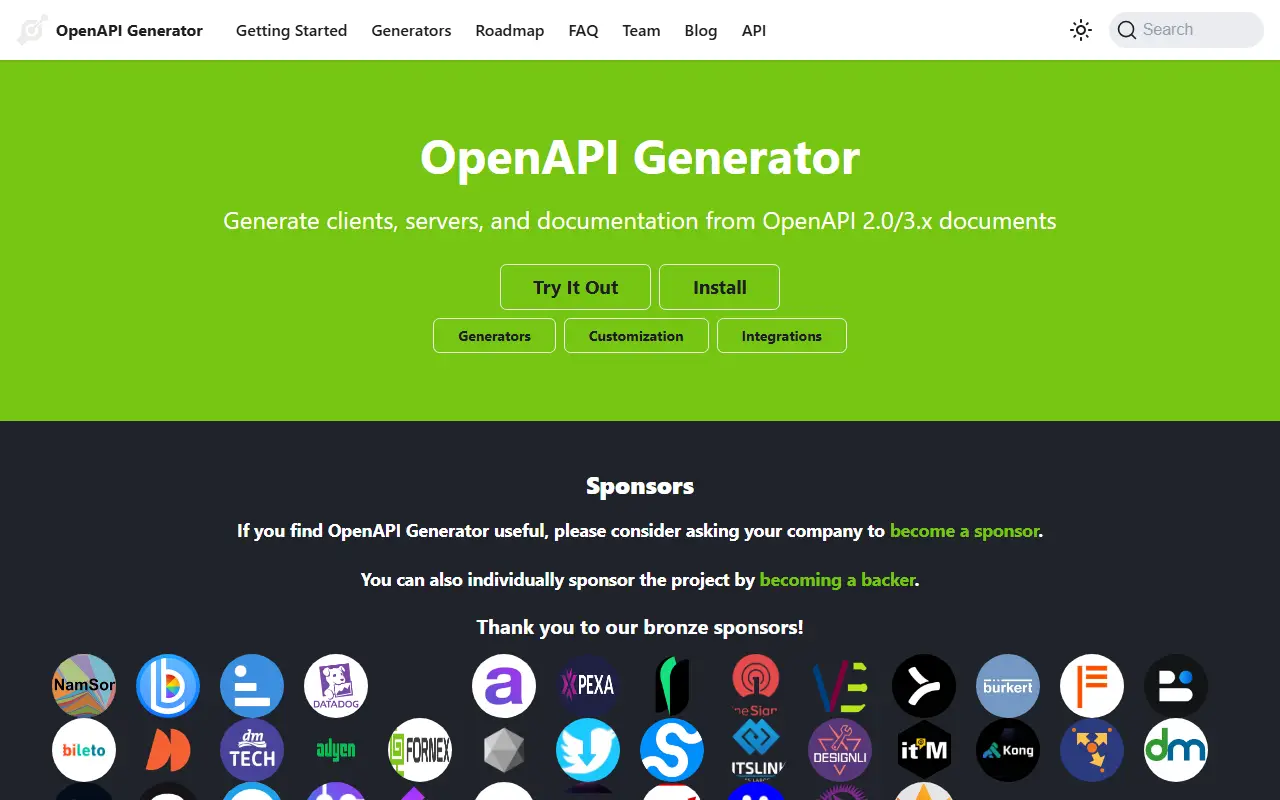
About OpenAPI Generator
OpenAPI Generator takes an OpenAPI specification, in version 2 or 3, and produces client SDKs, server stubs, documentation and configuration automatically. Instead of hand-writing the same API wrapper in every language, teams define the API once and generate code for many languages and frameworks.
The project, written in Java and maintained by the OpenAPI Tools organization, offers a migration guide for users coming from Swagger Codegen, a wiki and FAQ, and an eBook introducing code generation for REST APIs. It carries an explicit security warning: if the spec, templates or other inputs such as options and environment variables come from an untrusted source, review them first to avoid problems like code injection. Vulnerabilities should be reported to the maintainers by email.
OpenAPI Generator is Apache-2.0 licensed and runs locally or in CI as a command line tool, Maven or Gradle plugin, or Docker image, so there is no hosted service involved. It suits API providers shipping official SDKs and developers who want type-safe clients generated from a contract.
Key features
- Generates API client SDKs
- Generates server stubs
- Produces documentation and configuration
- Supports OpenAPI v2 and v3 specs
- Migration guide from Swagger Codegen
- Runs from CLI, build plugins or Docker
Good fit for
- →Shipping SDKs for a public API
- →Generating server skeletons from a spec
- →Keeping clients in sync with an API contract
- Built with
- Java
- Tags
- openapi
- code-generation
- sdk
- api-client
- swagger
- java
- rest-api
- api-tools
OpenAPI Generator: questions and answers
- What is OpenAPI Generator used for?
- OpenAPI Generator is a Java-based generator that creates API client libraries, server stubs, documentation and configuration automatically from an OpenAPI specification. It is a good fit for shipping SDKs for a public API, generating server skeletons from a spec and keeping clients in sync with an API contract.
- Is OpenAPI Generator open source?
- Yes. OpenAPI Generator is open source under the Apache-2.0 licence. Its source code is on GitHub at OpenAPITools/openapi-generator and is written mainly in Java.
- Is OpenAPI Generator free?
- Yes. OpenAPI Generator is open source, so the software itself is free to use.
- What is OpenAPI Generator an alternative to?
- OpenAPI Generator is an open-source alternative to Stainless, Speakeasy, APIMatic and SwaggerHub. Other open-source alternatives to Stainless include Cortex Docs.
- Is OpenAPI Generator actively maintained?
- Yes. The most recent commit to OpenAPI Generator was on 2 October 2026, and the latest release is v7.25.0, published on 24 August 2026. The project has 27k stars on GitHub.
Open-source alternatives to OpenAPI Generator
See all
Cortex Docs
API Tools
Cortex - Generates interactive API documentation, typed SDKs, and MCP servers from OpenAPI
MITvs Mintlify★ 3.2k
Scalar
API Tools
Scalar is an open-source API platform: 🌐 Modern RES
MITvs Postman★ 16k
Insomnia
API Tools
The open-source, cross-platform API client for GraphQL, REST, WebSockets, SSE and gRPC. Wi
Apache-2.0vs Postman★ 40k
Voiden
API Tools
Design, Test and Document APIs in plain Markdown. Compose Requests with API blocks. Reuse,
Apache-2.0vs Postman★ 1.9k
Mockoon
API Tools
Mockoon is the easiest and quickest way to run mock APIs locally. No remote deployment, no
MITvs Beeceptor★ 8.4k
Requestly
API Tools
Community hub for Requestly API Client — bugs, feature requests, and roadmap. The privacy-
OSSvs Postman★ 6.8k
SaaS alternatives to OpenAPI Generator
See all
Stainless
API Tools
Generates typed client SDKs and docs from OpenAPI specs
SaaS
Speakeasy
API Tools
Generates SDKs, Terraform providers and docs from OpenAPI specs
SaaS
APIMatic
API Tools
SDK generation, API docs and code samples produced from API specs
SaaS
SwaggerHub
API Tools
Collaborative platform for designing and documenting OpenAPI-based APIs
SaaS
0mcp
API Tools
Platform for launching and running production MCP servers so SaaS products work with AI agents
SaaS
AppForgeNow
API Tools
Converts REST APIs into ChatGPT apps by mapping responses to UI widgets and packaging a deployable bundle
SaaS