8 open-source alternatives ranked by real activity

Open-source Bump.sh alternatives

A curated, ranked list of the 8 best open-source alternatives to Bump.sh.

The best open-source alternative to Bump.sh is GitBook. If that doesn't suit you, other good options are OpenAPI Generator, Scalar, Sphinx and Readthedocs.org.

Commercial alternatives to Bump.sh include Theneo, Redocly, Mintlify and ReadMe. See all 13.

Bump.sh alternatives are mainly documentation & wiki tools, but some are also API tools and file storage & sharing tools. 6 of them shipped code in the last 30 days, 8 can be self-hosted, and 6 use a permissive licence.

Last updated November 13, 2026 · ranked by GitHub stars, growth and recent commits

GitBook

GitBook is a knowledge platform that connects docs, product and users, answers user questions, and identifies knowledge gaps.

GitHub stars
29k
Last commit
yesterday
Latest release
@gitbook/react-contentkit@0.7.7
Licence
GPL-3.0
Hosted version
Available
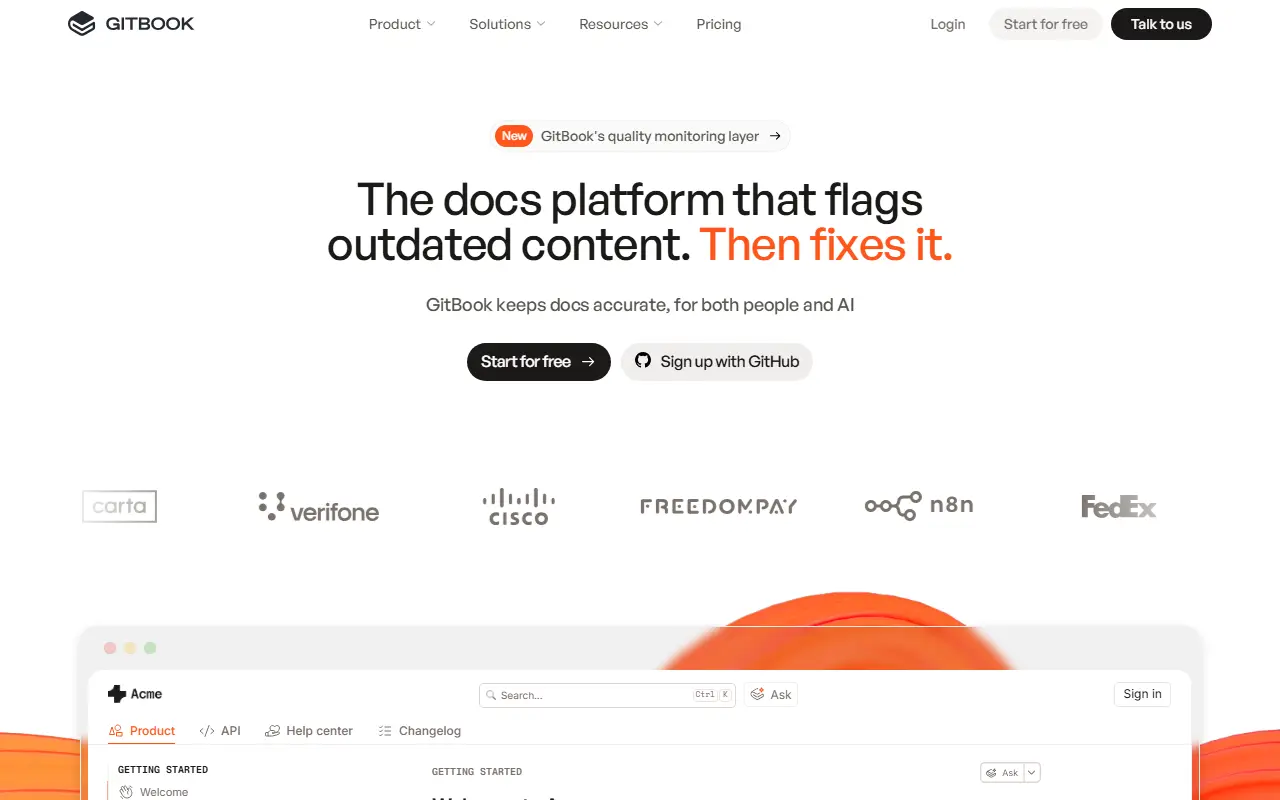
gitbook.comGitBook homepage screenshot

GitBook is a knowledge platform that connects your docs, product and users. It answers user questions and identifies knowledge gaps. The platform includes docs-as-code support and AI insights.

Key features

  • AI insights
  • Quality monitoring layer that flags outdated content
  • Proactive updates
  • Embed and connect
  • Ask your docs
  • Agent traffic tracker

OpenAPI Generator

A Java-based generator that creates API client libraries, server stubs, documentation and configuration automatically from an OpenAPI specification.

GitHub stars
27k
Last commit
2 days ago
Latest release
v7.27.0
Licence
Apache-2.0
Self-hosted
Yes
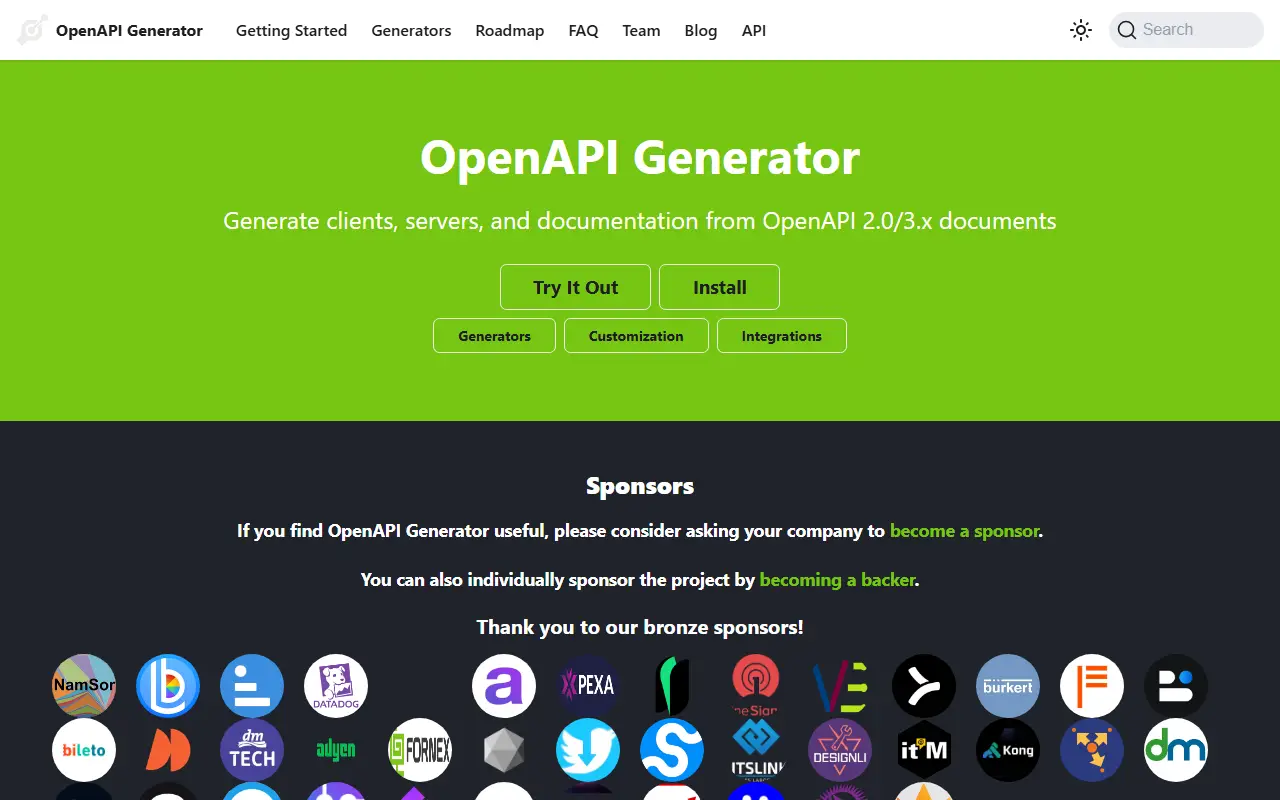
openapi-generator.techOpenAPI Generator homepage screenshot

OpenAPI Generator takes an OpenAPI specification, in version 2 or 3, and produces client SDKs, server stubs, documentation and configuration automatically. Instead of hand-writing the same API wrapper in every language, teams define the API once and generate code for many languages and frameworks.

The project, written in Java and maintained by the OpenAPI Tools organization, offers a migration guide for users coming from Swagger Codegen, a wiki and FAQ, and an eBook introducing code generation for REST APIs. It carries an explicit security warning: if the spec, templates or other inputs such as options and environment variables come from an untrusted source, review them first to avoid problems like code injection. Vulnerabilities should be reported to the maintainers by email.

OpenAPI Generator is Apache-2.0 licensed and runs locally or in CI as a command line tool, Maven or Gradle plugin, or Docker image, so there is no hosted service involved. It suits API providers shipping official SDKs and developers who want type-safe clients generated from a contract.

Key features

  • Generates API client SDKs
  • Generates server stubs
  • Produces documentation and configuration
  • Supports OpenAPI v2 and v3 specs
  • Migration guide from Swagger Codegen
  • Runs from CLI, build plugins or Docker

Pricing: Free and open source under the Apache-2.0 license.

Scalar

An open-source API platform that renders interactive OpenAPI and Swagger references and includes an offline-first API client with desktop apps.

GitHub stars
16k
Last commit
today
Latest release
release-2026-11-12-7e9d6bd
Licence
MIT
Self-hosted
Yes
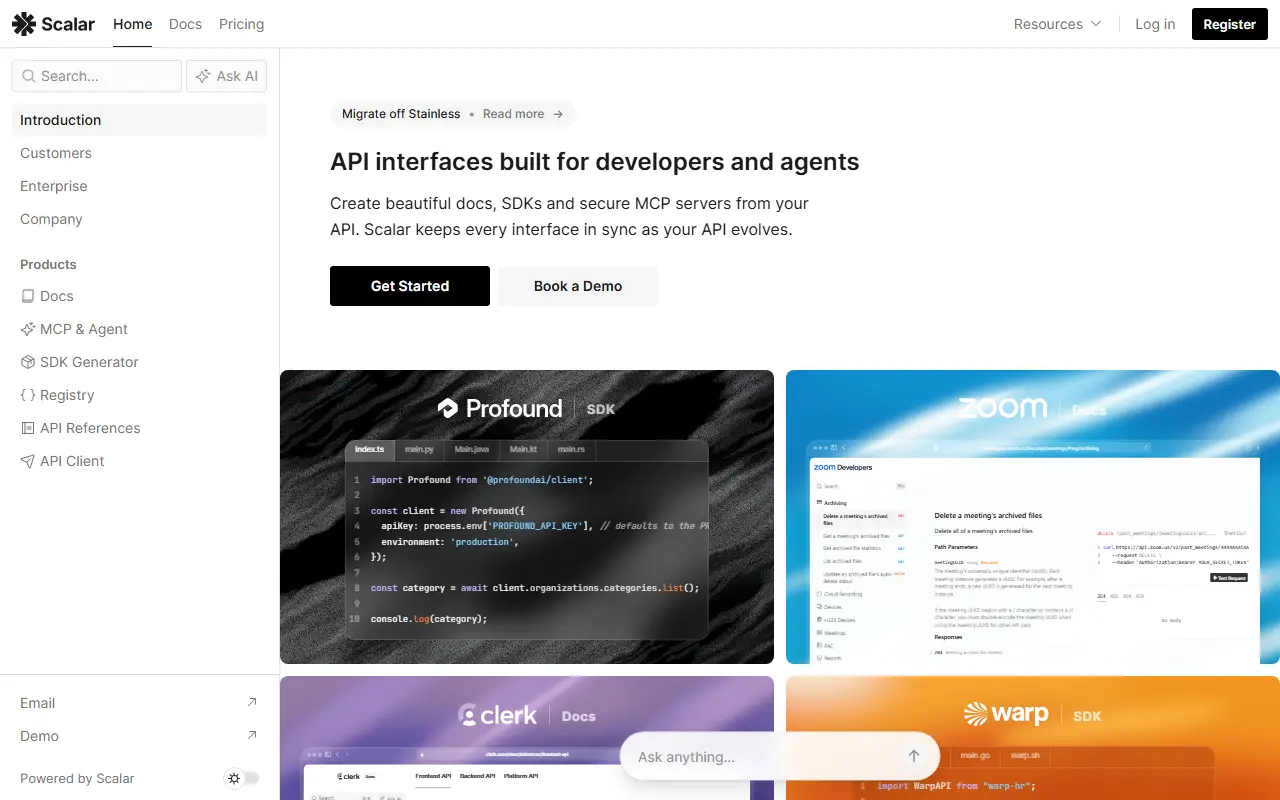
scalar.comScalar homepage screenshot

Scalar is an open-source API platform built around the OpenAPI standard. One part turns OpenAPI or Swagger documents into an interactive API reference with a built-in testing tool and generated code samples for many languages and frameworks, and it aims for a modern look rather than a dated one. Integrations exist for popular server frameworks, so docs can be mounted straight into an existing project.

The other part is an API client designed to work offline and built for OpenAPI. It is free and open source, treats OpenAPI and Swagger as first-class inputs, works with dozens of API frameworks such as Elysia, Hono and FastAPI, and can stay in sync with a running server through a watch mode. Environment variables, dynamic parameters and the other staples of a REST client are included. You can try it in the browser or download it for Windows, macOS or Linux.

The quickstart even offers a prompt you can hand to a coding agent to set up the reference in your project. Scalar is MIT licensed and written in TypeScript and Vue. It suits API teams that want better-looking documentation and a lighter alternative to Postman-style tools tied to their specs.

Key features

  • Interactive API reference from OpenAPI documents
  • Built-in request testing tool
  • Code samples in many languages
  • Offline-first API client for desktop
  • Watch mode that syncs with server frameworks
  • Integrations for Hono, FastAPI and Elysia

Pricing: Free plan for up to 3 APIs. Pro is $150 and Business $600 per month ($125 and $500 billed yearly); Enterprise is custom.

Sphinx

Sphinx is a documentation generator that supports reStructuredText and MyST Markdown, with features like cross-referencing, multiple output formats, themes, extensions, and internationalization.

GitHub stars
8.1k
Last commit
4 days ago
Latest release
v9.2.0
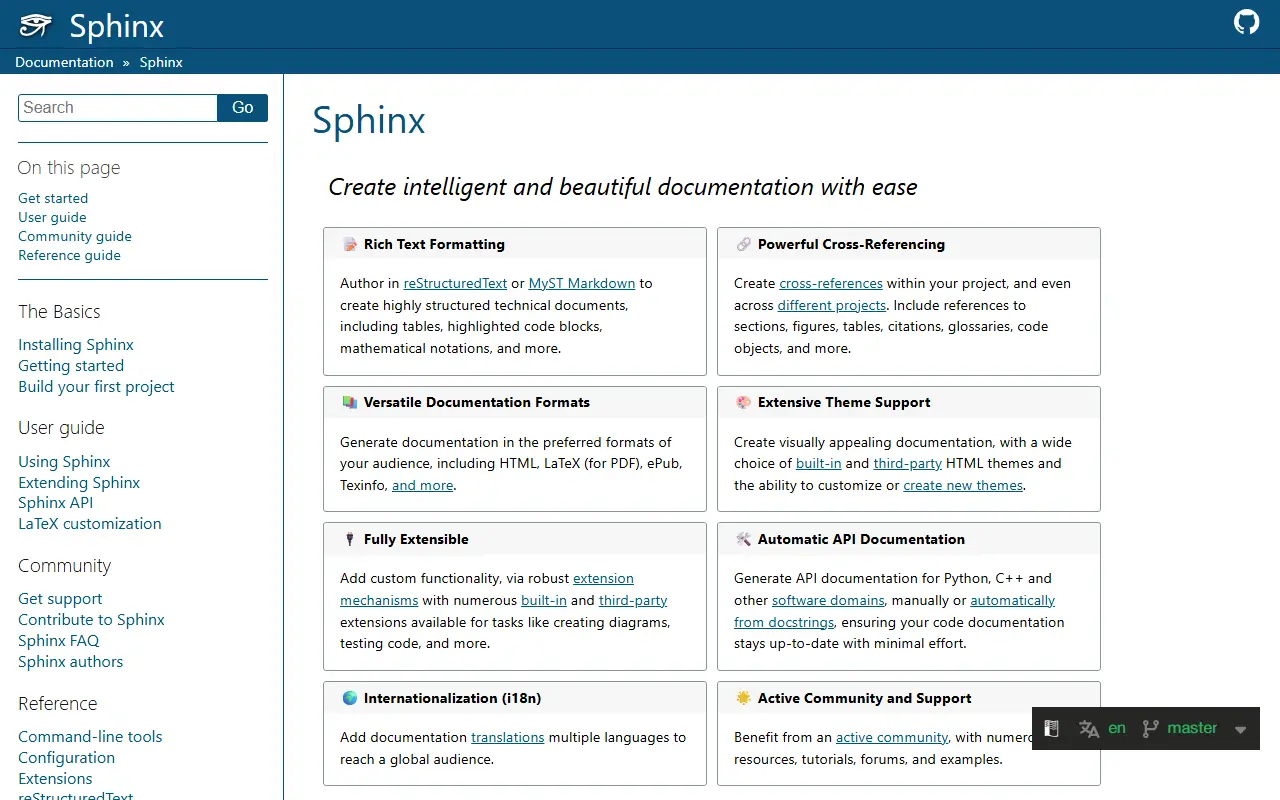
sphinx-doc.orgSphinx homepage screenshot

Sphinx is a documentation generator that allows authors to write in reStructuredText or MyST Markdown to create structured technical documents. It supports tables, highlighted code blocks, mathematical notations, and cross-references within and across projects.

The tool can generate documentation in formats such as HTML, LaTeX (for PDF), ePub, and Texinfo. It offers built-in and third-party HTML themes, extension mechanisms for custom functionality, and automatic API documentation for Python, C++, and other software domains.

Key features

  • Rich text formatting with reStructuredText or MyST Markdown
  • Cross-referencing within and across projects
  • Multiple output formats: HTML, LaTeX, ePub, Texinfo
  • Extensive theme support with built-in and third-party themes
  • Extensible via built-in and third-party extensions
  • Automatic API documentation for Python, C++, and other domains

Readthedocs.org

Read the Docs is a documentation building and hosting platform that connects to Git repositories and handles builds, previews, and access control.

GitHub stars
8.4k
Last commit
yesterday
Latest release
2026.11.10
Licence
MIT
Hosted version
Available
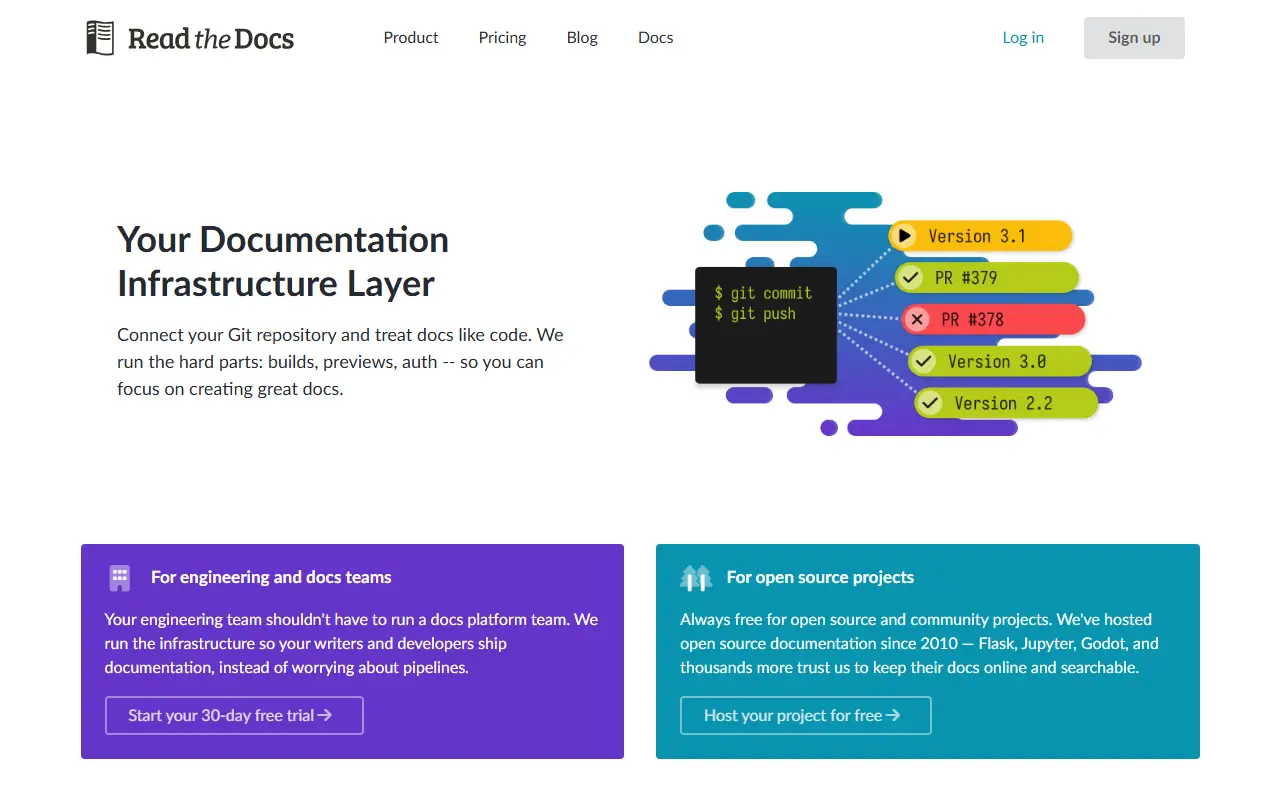
readthedocs.orgReadthedocs.org homepage screenshot

Read the Docs is a documentation building and hosting platform. It connects to Git repositories and handles builds, previews, and authentication so developers can focus on writing documentation. The platform supports Sphinx, MkDocs, Docusaurus, and other documentation tools.

It offers versioned documentation, integrated search, pull request previews, and access control with SSO via GitHub or GitLab. There is a free community edition for open-source projects and a paid business edition for commercial projects starting at $50 per month.

Key features

  • Connects to Git repositories and builds documentation from code
  • Supports Sphinx, MkDocs, Docusaurus, and other documentation tools
  • Versioned documentation that matches product release cycles
  • Pull request previews with visual diff against production
  • Access control with SSO via GitHub or GitLab
  • AI agent integration via llms.txt and Markdown content negotiation

Docfx

Docfx converts .NET assembly, XML code comment, REST API Swagger files and markdown into rendered HTML pages, JSON model or PDF files.

GitHub stars
4.5k
Last commit
4 days ago
Latest release
v2.81.0
Licence
MIT
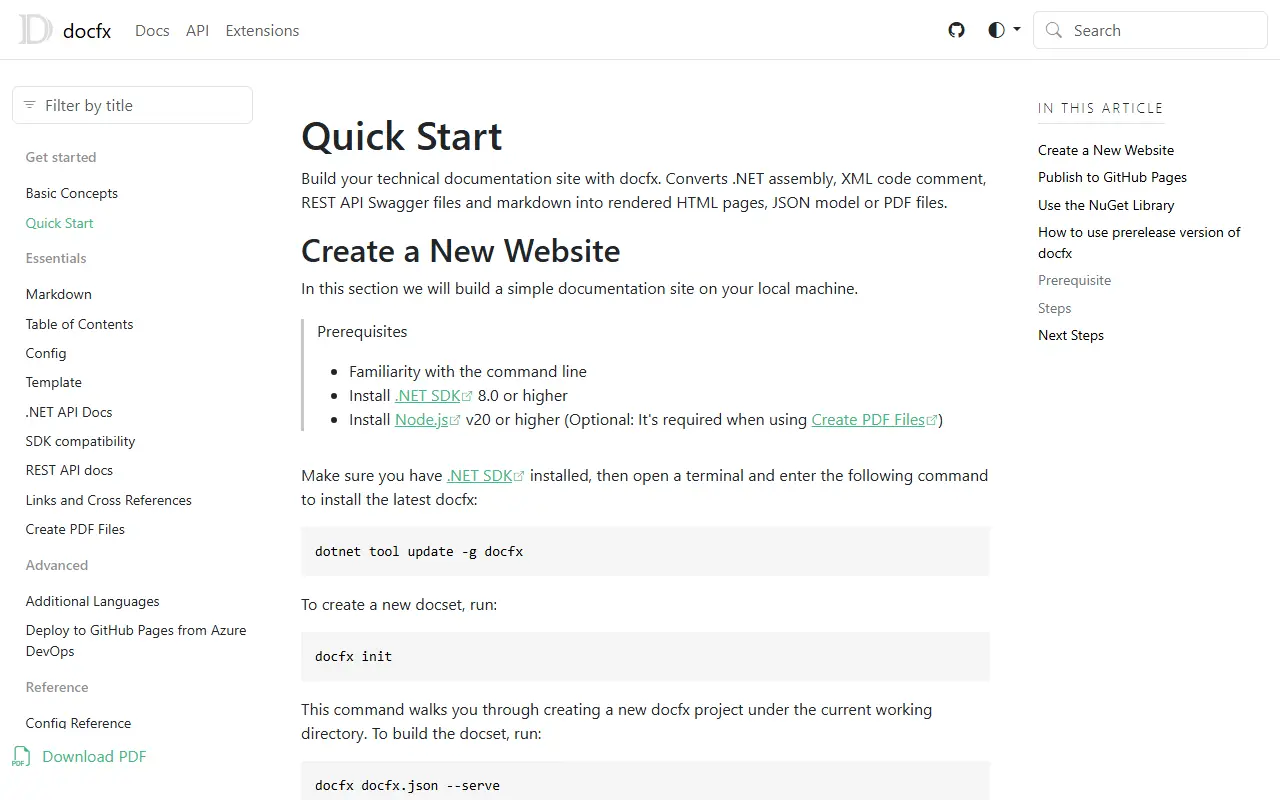
dotnet.github.ioDocfx homepage screenshot

Docfx is a static site generator that builds technical documentation sites. It converts .NET assembly, XML code comment, REST API Swagger files and markdown into rendered HTML pages, JSON model or PDF files.

It is designed for developers who need to generate documentation for .NET projects. The tool can be installed as a .NET tool and used from the command line to create and build documentation projects.

Key features

  • Converts .NET assembly, XML code comment, REST API Swagger files and markdown into rendered HTML pages, JSON model or PDF files.
  • Provides a command-line interface to initialize and build documentation projects.
  • Produces static HTML files under the _site folder for publishing to static site hosting servers.
  • Supports publishing to GitHub Pages via GitHub Actions.

Cortex Docs

Generates interactive API documentation, typed SDKs, and MCP servers from OpenAPI, AsyncAPI, GraphQL, gRPC, OpenRPC, and Markdown sources.

GitHub stars
3.3k
Last commit
1 mo ago
Latest release
v0.1.36
Licence
MIT
Self-hosted
Yes
Hosted version
Available
cortexdocs.devCortex Docs homepage screenshot

Cortex turns API specifications and Markdown files into developer-facing outputs from a single project configuration. It reads sources such as OpenAPI, AsyncAPI, GraphQL, Protocol Buffers, OpenRPC, and plain Markdown, and produces interactive documentation for people, typed SDKs for applications, and an MCP server so AI agents can work with the same project context. It is released under the MIT license.

Generated SDKs cover many languages, including TypeScript, Python, Go, Java, Kotlin, Ruby, PHP, Rust, and C++, and can combine several specification files into one client. The tool supports HTTP, WebSocket, GraphQL, gRPC, and JSON-RPC clients, and builds static HTML documentation with interactive API reference pages. The MCP server includes typed tools, embedded specifications, and SDK guides.

You can try a local demo in about a minute, keep documentation in Git, and publish a free site for a public GitHub repository through the project's hosting flow. It suits API providers and developer-experience teams who want one source of truth for docs, client libraries, and agent access.

Key features

  • Interactive API reference documentation
  • Typed SDK generation for many languages
  • MCP server generated from API specs
  • Supports OpenAPI, AsyncAPI, GraphQL, gRPC, and OpenRPC
  • Combines multiple spec files in one SDK
  • Static HTML documentation output
  • Markdown content kept in Git

Pricing: Free and open source under the MIT license; free hosted documentation sites are offered for public repositories.

Slate

Slate is an open source file storage app for collecting, organising and sharing files on the web, built on IPFS, Filecoin and Textile.

GitHub stars
520
Last commit
3 yr ago
Licence
MIT
Hosted version
Available

Slate is an open source storage system for data, meant to make it easy to collect, organise and share files anywhere on the web. The project describes itself as the first open source file storage application designed to encourage collaboration and research across a distributed network.

It is built on IPFS, Filecoin and Textile, with the aim of a data storage and transactions network that is open and usable for everyone. The stated primary objective is a strong experience for uploading, collecting and sharing media, with more file types to follow.

Users create an account on the hosted site to try it. Every account can use the Developer API to upload files with code and HTTP, and the documentation sits under the API tab after logging in. The code is MIT licensed, written in JavaScript with Next.js and React, and the GitHub description marks it as work in progress.

Key features

  • Collect, organise and share files on the web
  • Built on IPFS, Filecoin and Textile
  • Developer API for uploading files over HTTP
  • API available to every account
  • Public collections and user profiles

Commercial Bump.sh alternatives

Hosted, closed-source products that compete with Bump.sh. Showing 12 of 13.

See every Bump.sh alternative on its tool page

Bump.sh alternatives: questions

What is the best open-source alternative to Bump.sh?
GitBook is the top-ranked open-source alternative to Bump.sh on Enlisted: GitBook is a knowledge platform that connects docs, product and users, answers user questions, and identifies knowledge gaps. Other strong options are OpenAPI Generator, Scalar, Sphinx and Readthedocs.org.
What are the best commercial alternatives to Bump.sh?
Theneo, Redocly, Mintlify, ReadMe and Stoplight are among the hosted, closed-source alternatives to Bump.sh listed on Enlisted, which lists 13 in total. Compare their pricing and features on each tool page.
Are these Bump.sh alternatives free?
All 8 are open source, so the code is free to use under its licence, and all of them can be self-hosted on your own server or computer. 4 also offer a paid or managed cloud version if you'd rather not host it yourself.
How is this list of Bump.sh alternatives ranked?
By a score built from GitHub stars, star growth over the last 30 days and how recently the code changed. 6 of these projects shipped code in the last 30 days. Data is refreshed daily, and nobody can pay to move up.

People also look for alternatives to…

View all